Newsletter Parshat Lech Lecha

בס״ד
Moor Lane - Logo.JPG
ק׳ ק׳ שׁערי תפילה
Have a look at our website www.moorlane.info 
*****
image.png

*****

Bar Mitzvah Invitation

image.png

🎉🎉🎉🎉🎉🎉🎉🎉🎉🎉

PHOTO-2024-11-03-08-36-53.jpg

Moorlanenews 
would like to wish
Yacov נ״י
& all his family 
a massive mazal tov on celebrating his 
Bar Mitzvah 
שיזכה לגדל בתורה ומצות ומעשים טובים
image.png
Special Mazal Tov 
to our dear friends
 Alex & Sophie
on celebrating the 
bar mitzvah of their son
May Hashem bless them with good long and healthy life 
and may they always have much nachat 
from all their children

****************

image.png

Winter Season begins 

THIS WEEK

PHOTO-2024-11-04-19-08-30.jpg

****

image.png

Mazal Tov 
to
Avi & Racheli Levy
on celebrating the wedding 
of their son
Shoham 
to 
Talia Ronen

Wishing Chatan & Kala
a big Mazal Tov
with
בריאות, ברכה, מזל, הצלחה, שמחה, פרנסה ושלום בית 
שיזכו לבנות בית נאמן בישראל  

🎉  Moorlanenews 🎉
would like to use this opportunity
to wish 
Shoham & Talia
a heartfelt Mazal Tov
on their wedding
and wish them
בריאות, ברכה, מזל, הצלחה, שמחה, פרנסה ושלום בית 
שיזכו לבנות בית נאמן בישראל  


Mazel Tov 
to 
Avi & Racheli
on celebrating the wedding of their son

****

🗓️

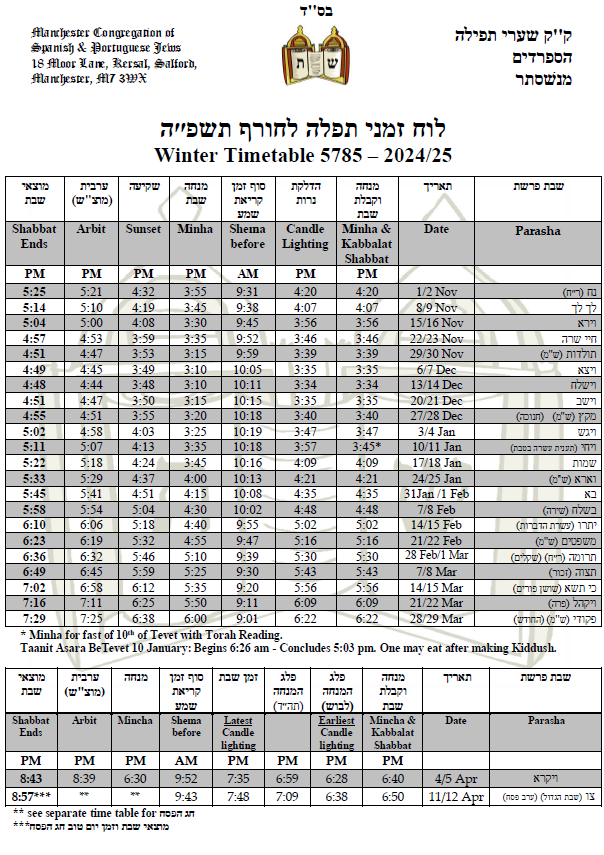
לוח זמני תפלה לחורף תשפ״ה

Winter Timetable 5785 – 2024/25

מוצאי שבת

ערבית
)
מוצש(

שקיעה

מנחה שבת

סוף זמן קריאת שמע

הדלקת נרות

מנחה וקבלת שבת

תאריך

שבת פרשת

Shabbat

Ends

Arbit

Sunset

Minha

Shema before

Candle Lighting

Minha & Kabbalat Shabbat

Date

Parasha

PM

PM

PM

PM

AM

PM

PM


5:14

5:10

4:19

3:45

9:38

4:07

4:07

8/9 Nov

לך לך


🕯️WINTER TIMES FOR SHABBAT MORNING🕯️

שבת

קרבנות

8:45 am
הודו

9:00 am

*******

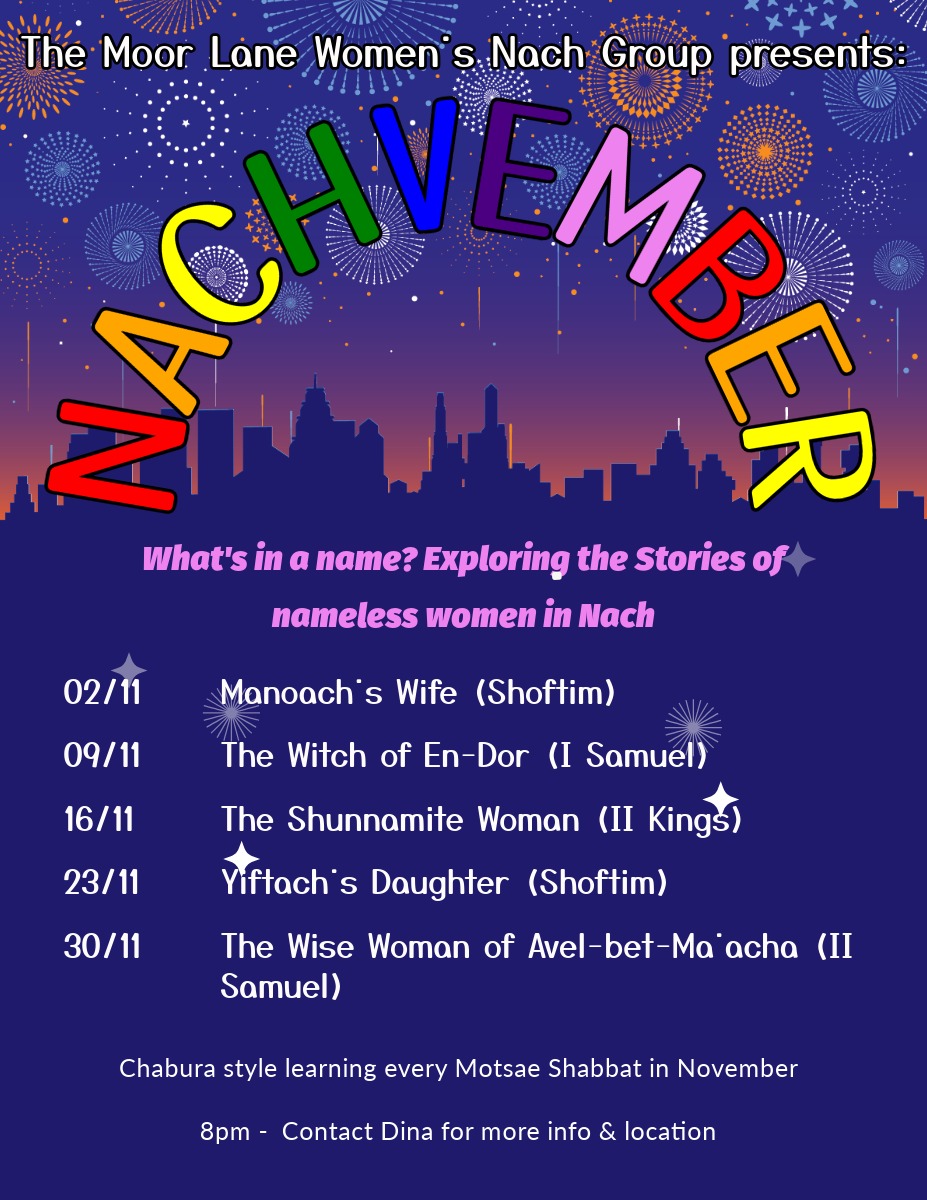
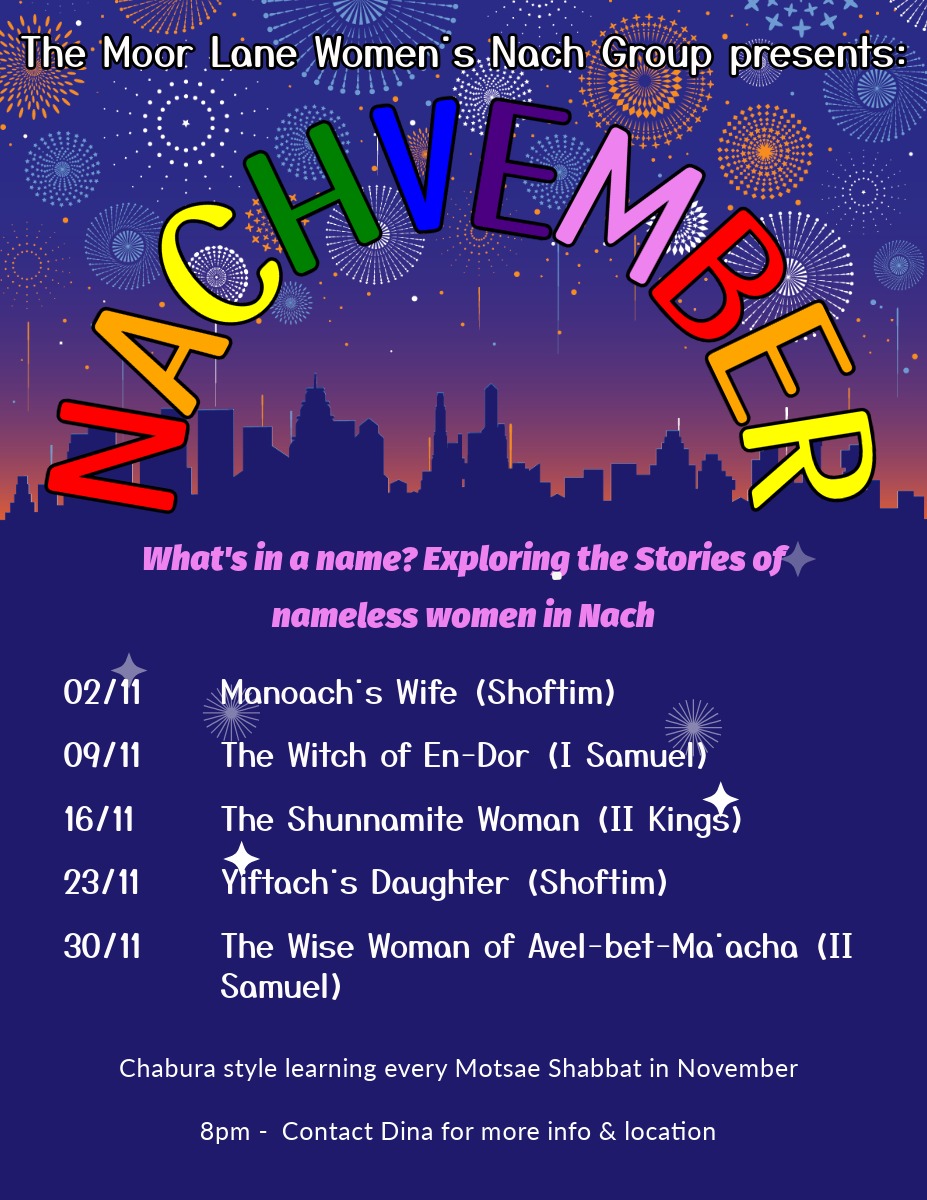
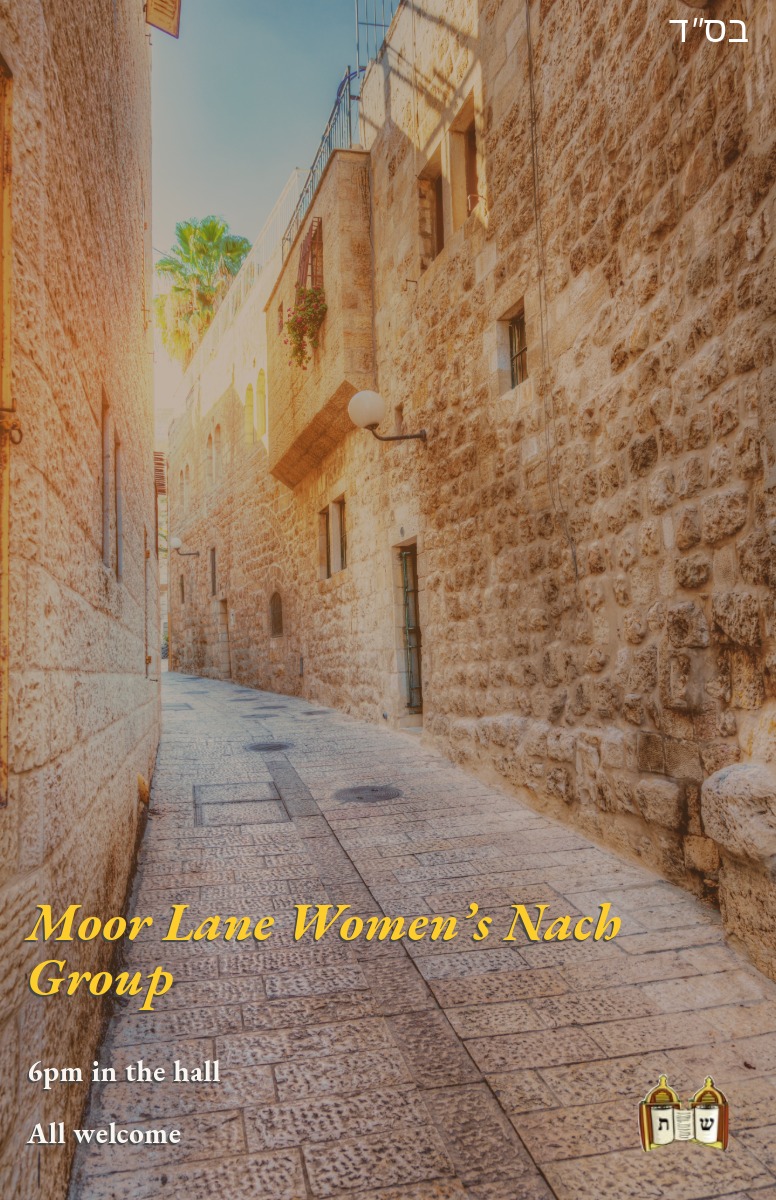
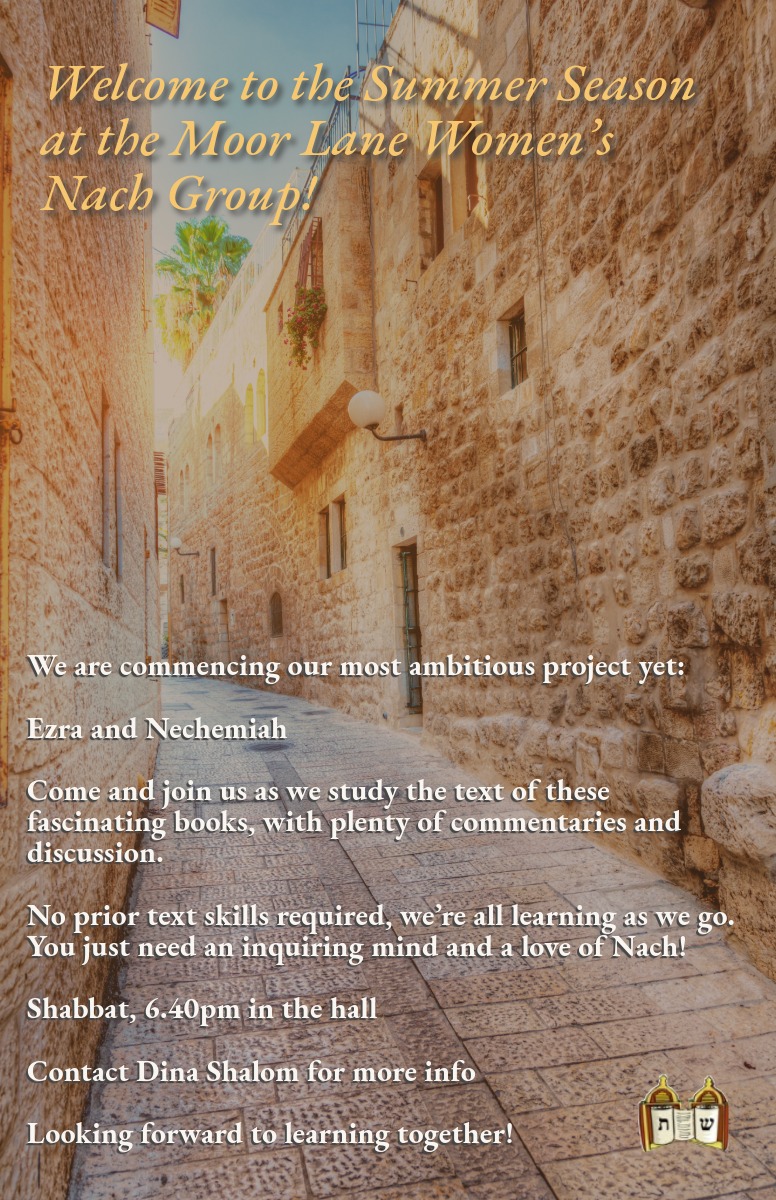
Moor Lane Women’s Nach Group
📚
PHOTO-2024-10-29-21-33-11.jpg
********
📜
Parasha Overview

Ten generations have passed since Noach. Man has descended spiritually. In the year 1948 from Creation, Avram is born. By observing the world, Avram comes to recognize G-d’s existence, and thus merits G-d appearing to him. At the beginning of this week’s Torah portion, G‑d tells Avram to leave his land, his relatives and his father's house and travel to an unknown land where G-d will make him into a great nation. Avram leaves, taking with him his wife Sarai, his nephew Lot, their servants, and those whom they converted to faith in G-d. When they reach the land of Canaan G-d appears to Avram and tells him that this is the land that He will give to his descendants.

A famine ensues and Avram is forced to relocate to Egypt to find food. Realizing that his wife’s beauty could cause his death at the hand of the Egyptians, Avram asks her to say that she is his sister. Sarai is taken to Pharaoh, but G‑d afflicts Pharaoh and his court with severe plagues and she is released unmolested. Avram returns to Eretz Yisrael (Canaan) with much wealth given to him by the Egyptians. During a quarrel over grazing rights between their shepherds, Avram decides to part ways with his nephew Lot. Lot chooses to live in the rich but corrupt city of Sodom in the fertile plain of the Jordan. A war breaks out between the kings of the region and Sodom is defeated. Lot is taken captive. Together with a handful of his converts, Avram rescues Lot, miraculously overpowering vastly superior forces, but Avram demurs at accepting any of the spoils of the battle.

In a prophetic covenant, G-d reveals to Avram that his offspring will be exiled to a strange land where they will be oppressed for 400 years, after which they willemerge with great wealth and return to Eretz Yisrael, their irrevocable inheritance. Sarai is barren and gives Hagar, her Egyptian hand-maiden, to Avram in the hope that she will provide them with a child. Hagar becomes arrogant when she discovers that she is pregnant. Sarai deals harshly with her, and Hagar flees. On the instruction of an angel, Hagar returns to Avram and gives birth to Yishmael. The weekly portion concludes with G-d commanding Avram to circumcise himself and his offspring throughout the generations as a Divine covenant. G-d changes Avram’s name to Avraham, and Sarai’s name to Sarah. Hashem promises Avraham a son, Yitzchak, despite Avraham being ninety-nine years old and Sarah ninety. On that day, Avraham circumcises himself, Yishmael and his entire household.

Ohr Somayach Institutions www.ohr.edu

*******
image.png

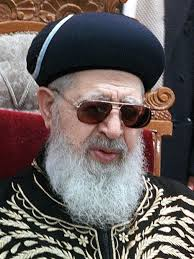
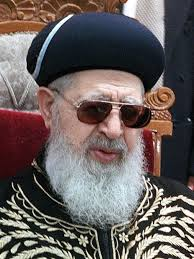
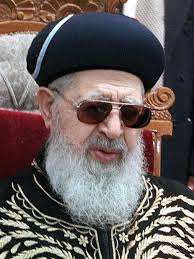
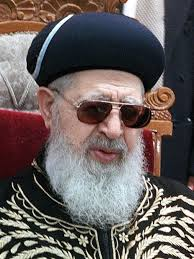
Halachot from Maran Rabbi Ovadia Yosef Ztz'l

דין הזכרת משיב הרוח

מתחילין לומר “משיב הרוח”

“משיב הרוח ומוריד הגשם”, הוא שבח להשם יתברך, שאנו אומרים אותו בימות החורף, בתפלת העמידה, בברכת “מחיה המתים”. וכפי שמופיע בכל הסידורים.

מתחילין לומר “משיב הרוח ומוריד הגשם” החל מתפילת מוסף של חג שמחת תורה, והזכרה זו, אינה שאלה ובקשה על הגשם, אלא היא שבח להשם יתברך, ולכן הזכרה זו נקראת “גבורות גשמים”, שמדברת מענין גבורותיו של השם יתברך בעולמו.

אבל שאלת “טל ומטר” שבברכת השנים, (כלומר, בברכת ברך עלינו, או ברכנו, שאומרים “ותן טל ומטר לברכה”), היא בקשה מהשם יתברך על הגשם. וישנם כמה הבדלים בהלכה, בין הזכרת גבורות גשמים שבברכת “אתה גבור”, לבין שאלת טל ומטר שבברכת השנים, והשינוי הראשון הוא, שמזכירין גבורות גשמים, כבר מתפילת מוסף של שמחת תורה, ואילו שאלת גשמים, אינה אלא מליל שבעה במרחשון.

מדוע מזכירים משיב הרוח בברכת מחיה המתים?

אמרו בגמרא (ברכות לג.), שמזכירין גבורות גשמים (“משיב הרוח”) בברכת “אתה גבור”, שהיא ברכת “מחיה המתים”, משום שהיא ברכה על תחיית המתים, ומתוך שירידת גשמים שקולה כנגד תחיית המתים, לפיכך קבעוה בתחיית המתים. ושאלת גשמים (“ותן טל ומטר לברכה”), קבעו בברכת השנים, משום שברכת השנים היא ברכה על פרנסה, וירידת גשמים גם היא ענין פרנסה לעולם.

מי ששכח להזכיר “משיב הרוח ומוריד הגשם”

מי ששכח להזכיר משיב הרוח ומוריד הגשם, ונזכר לאחר שסיים את ברכת “מחיה המתים”, יש לבאר, האם עליו לחזור לתחילת תפלת העמידה ולהתפלל שנית, או שהוא רשאי להמשיך בתפלתו. והנה הדין בזה הוא תלוי, שאם אמר “מוריד הטל” במקום “משיב הרוח ומוריד הגשם (כפי מנהג הספרדים בימות הקיץ), אינו חוזר לראש התפלה. כיון שאמר “מוריד הטל”.

אבל אם לא הזכיר כלל, לא “מוריד הטל”, ולא “משיב הרוח”, (כפי מנהג חלק מעדות האשכנזים בימות הקיץ), ונזכר בטעותו מיד לאחר שסיים את ברכת “מחיה המתים”, עליו לומר מיד “משיב הרוח ומוריד הגשם”, ואחר כך ימשיך בברכת “אתה קדוש”. ואם התחילה כבר בברכת “אתה קדוש”, ונזכר שלא אמר “משיב הרוח”, הרי אין לו תקנה, ועליו לחזור שוב לראש התפלה.

The Laws of Mentioning “Mashiv Ha’Ruach”

We Begin Reciting “Mashiv Ha’Ruach
Mashiv Ha’Ruach U’Morid Ha’Geshem” is a praise we recite to Hashem during the winter months within the “Mechayeh Ha’Metim” blessing of the Amidah as is printed in all Siddurim.

We begin reciting “Mashiv Ha’Ruach U’Morid Ha’Geshem” in the Mussaf prayer of Simchat Torah (outside of Israel from Shemini Atzeret). This recitation does not constitute a request or plea for rain; rather, it is merely meant as praise to Hashem and is therefore dubbed, “Powers of Rain.” The actual request for dew and rain can be found in the ninth blessing of the Amidah prayer referred to as the “Blessing of the Years” (Barech Aleinu). There are several halachic differences between mentioning the “Powers of Rain” in the second blessing of the Amidah prayer entitled, “Ata Gibor,” and the actual request for dew and rain in the ninth blessing. Firstly, whereas we begin mentioning the “Powers of Rain” from Mussaf of Shemini Atzeret, we do not actually request dew and rain until the night of the Seventh of Marcheshvan (outside of Israel from the night of the Fifth of December), as we shall discuss in following Halachot.

Why is “Mashiv Ha’Ruach” Mentioned in the “Mechayeh Ha’Metim” Blessing?
The Gemara (Berachot 33a) states that we mention the “Powers of Rain” in the “Ata Gibor” blessing for this blessing deals with the Resurrection of the Dead and since rainfall is tantamount to The Resurrection, our Sages thus established this sentence to be mentioned in the blessing dealing with The Resurrection. Our Sages established the actual request for rain in the “Blessing of the Years,” for this is a blessing regarding one’s livelihood and rainfall is a matter of sustenance for the entire world.

One Who Forgets to Mention “Mashiv Ha’Ruach
If one forgets to recite “Mashiv Ha’Ruach” and becomes aware of his mistake only after concluding the “Mechayeh Ha’Metim” blessing, we must analyze whether one must return to the beginning of the Amidah prayer and begin it again or may one continue his prayer as usual. This law indeed depends on one important factor: If one inserted “Morid Ha’Tal” instead of “Mashiv Ha’Ruach” (as is the Sephardic custom during the summer months), one would not return to the beginning of the Amidah prayer since one has said “Morid Ha’Tal.” 

However, if one mentioned neither “Mashiv Ha’Ruach” nor “Morid Ha’Tal” (which is indeed customary among several Ashkenazi communities during the summer months), if one has not yet begun the “Ata Kadosh” blessing, one should recite “Mashiv Ha’Ruach U’Morid Ha’Geshem” between the “Mechayeh Ha’Metim” and “Ata Kadosh” blessings and then just continue his prayer as usual. If, however, one has already begun the “Ata Kadosh” blessing and only then realizes his mistake, one must begin his Amida prayer anew.


Newsletter Parashat Noach

בס״ד
Moor Lane - Logo.JPG
ק׳ ק׳ שׁערי תפילה
Have a look at our website www.moorlane.info 
*****
image.png

*****

תזכו לשנים רבות

May the upcoming year bring the kahal 

good health, beracha and hatzlacha

****

image.png

is Thursday night Friday & Shabbat

This Shabbat is Shabbat Rosh Chodesh
(1) Say half Halel 
(2) 2 Sefarim 
i) Noach  
ii) Rosh Chodesh
(3) Haftara of Rosh Chodesh     

********

💳

💷 Pledge Reminder 💷

If you received an Aliya during the Yamim Noraim or over Succot

and pledged any money or would like to make a donation

the donation can be fulfilled in any of the following ways: 

 ·  By post addressed to

'The Treasurer, Manchester Congregation of Spanish and Portuguese Jews, 

18 Moor Lane, Salford, Manchester M7 3WX'.

· By hand to the treasurer or any member of the Mahamad.

·Anonymously in the donations box in the Synagogue.

·Direct Debit to the shul's account 

for account details please speak to the treasurer

·Cheque 

Cheques should be made payable to 

'Manchester Congregation of Spanish & Portuguese Jews'. 

Thank you all for your very generous donations

 & Tizke Lemitzvot

****

image.png

Winter Season begins 

NEXT WEEK

stayed tuned for details

****

🗓️

לוח זמני תפלה לחורף
תשפ״ה

Winter Timetable 5785 – 2024/25

מוצאי שבת

ערבית
)
מוצש(

שקיעה

מנחה שבת

סוף זמן קריאת שמע

הדלקת נרות

מנחה וקבלת שבת

תאריך

שבת פרשת

Shabbat

Ends

Arbit

Sunset

Minha

Shema before

Candle Lighting

Minha & Kabbalat Shabbat

Date

Parasha

PM

PM

PM

PM

AM

PM

PM


5:25

5:21

4:32

3:55

9:31

4:20

4:20

1/2 Nov

נח (ר״ח)  


🕯️NEW WINTER TIMES FOR SHABBAT🕯️

שבת

קרבנות

8:45 am
הודו

9:00 am

📎 Winter timetable attached to this email

*******

Moor Lane Women’s Nach Group
📚
PHOTO-2024-10-29-21-33-11.jpg
********
📜
Parasha Overview

It is now ten generations since the creation of the first man. Adam's descendants have corrupted the world with immorality, idolatry and robbery, and Hashem resolves to bring a flood which will destroy all the earth's inhabitants except for the righteous Noach, his family and sufficient animals to re-populate the world. Hashem instructs Noach to build an ark in which to escape the flood. After forty days and nights, the flood covers the entire earth, including the tops of the highest mountains. After 150 days the water begins to recede. On the 17th day of the 7th month, this ark comes to rest on Mount Ararat. Noach sends forth a raven and then a dove to ascertain if the waters have abated. The dove returns. A week later, Noach again sends the dove, which returns the same evening with an olive leaf in its beak. After seven more days, Noach once again sends forth the dove, which this time does not return. Hashem tells Noach and his family to leave the ark. Noach brings offerings to Hashem from the animals which were carried in the ark for this purpose. Hashem vows never again to flood the entire world and gives the rainbow as a sign of this covenant.

Noach and his descendants are now permitted to eat meat, unlike Adam. Hashem commands the Seven Universal Laws: The prohibitions against idolatry, adultery, theft, blasphemy, murder and eating the meat of a living animal, and the obligation to set up a legal system. The world's climate is established as we know it today.

Noach plants a vineyard and becomes intoxicated from its produce. Ham, one of Noach's sons, delights in seeing his father drunk and uncovered. Shem and Yefet, however, manage to cover their father without looking at his nakedness, by walking backwards. For this incident, Canaan is cursed to be a slave. The Torah lists the offspring of Noach's three sons from whom the seventy nations of the world are descended.

The Torah records the incident of the Tower of Bavel, which results in Hashem fragmenting communication into many languages and the dispersal of the nations throughout the world. The Torah portion concludes with the genealogy from Noach to Avram.

Ohr Somayach Institutions www.ohr.edu

*******
image.png

Halachot from Maran Rabbi Ovadia Yosef Ztz'l

הקדמה להלכות כבוד אב ואם

כבד את אביך ואת אמך

שנינו בברייתא במסכת קידושין (דף ל:) תנו רבנן, נאמר: “כבד את אביך ואת אמך” ונאמר “כבד את ה' מהונך”, השוה הכתוב כבוד אב ואם לכבוד המקום (המקום, היינו הקדוש ברוך הוא.) נאמר “איש אמו ואביו תיראו” ונאמר “את ה' אלוקיך תירא”, השוה הכתוב מוראת אב ואם למוראת המקום.

תנו רבנן (שנו חכמים): שלשה שותפין באדם, הקדוש ברוך הוא, ואביו ואמו, ופירוש הדברים, שביצירת האדם שותפים האב והאם, והקדוש ברוך הוא נופח בו נשמה. ועוד אמרו רבותינו, בזמן שאדם מכבד את אביו ואת אמו, אומר הקדוש ברוך הוא, מעלה אני עליכם כאילו דרתי ביניכם וכבדתם אותי.

כבוד האב וכבוד האם

תניא, רבי אומר, גלוי וידוע לפני מי שאמר והיה העולם שבן מכבד את אמו יותר מאביו, לפיכך הקדים הקדוש ברוך הוא כבוד אב לכבוד אם. וגלוי וידוע לפני מי שאמר והיה העולם שבן מתיירא מאביו יותר מאמו, לפיכך הקדים הקדוש ברוך הוא מורא אם למורא האב. (שנאמר “איש אמו ואביו תיראו”.)

עד היכן כיבוד הורים?

שאלו את רבי אליעזר, עד היכן כבוד אב ואם? אמר להם, צאו וראו מה עשה עובד כוכבים אחד באשקלון ודמא בן נתינה שמו, פעם אחת בקשו ממנו חכמים אבנים לאפוד בסכום של שש מאות אלף דינרי זהב, והיה מפתח של אותו מקום שבו האבנים נמצא תחת הכר שישן עליו אביו, ובכדי לא לצער את אביו, לא הקיצו משנתו, לשנה האחרת, נתן הקדוש ברוך הוא שכרו, שנולדה לו פרה אדומה בעדרו, ומכר אותה לחכמי ישראל בעד אותו סכום שהפסיד בשביל כבוד אביו.

ועוד סיפרו שם בגמרא על דמא בן נתינה, שפעם אחת היה לבוש בגדי זהב מאותם של נכבדי רומי, והיה יושב בין גדולי רומי, ובאה אמו וקרעה ממנו את אותו הבגד, וטפחה על ראשו וירקה בפניו, והוא לא הכלימה.

ועוד הביאו שם (דף לא:) מעשה ברבי טרפון, שבכל פעם שהייתה אמו יורדת ועולה למיטתה (שהייתה גבוהה מן הארץ) היה כורע כדי שתוכל אמו לרדת על גבו (דהיינו שהיה משמש לה כ”דרגש” לעלות ולרדת ממיטתה.) ועוד הובאו שם בגמרא כמה מעשים בגודל מצות כבוד אב ואם ועד היכן הדברים מגיעים. ומרן רבינו יוסף קארו, בשולחן ערוך (יו”ד ס”י רמ) פתח את הלכות כבוד אב ואם “צריך ליזהר מאד בכבוד אביו ואמו ובמוראם”, כי מצוה זו היא יקרה מאד, ובנקל יכול אדם להיכשל בה, ועל כן החובה מוטלת על כל אדם להיזהר הרבה במצוה זו לקיימה כהלכתה, ובימים הקרובים יובאו ברצות ה' עיקרי דיני כבוד אב ואם, ממה שביארנו לפני כמה שנים, ובסדר נכון בעזרת ה'


Introduction to the Laws of Honoring One’s Parents

Honor Your Father and Your Mother
The Baraita (Kiddushin 30b) states: “One verse states, ‘Honor your father and your mother,’ while another verse states, ‘Honor Hashem with your wealth.’ We see that that the Torah equates honoring one’s parents to honoring Hashem. One verse states, ‘Each man shall revere his mother and father,’ while another verse states, ‘You shall fear Hashem, your G-d.’ we see that the Torah equates revering one’s parents to revering Hashem.”

The Baraita further states that there are three partners in the formation of man: Hashem, one’s father, and one’s mother. The parents provide the physical body while Hashem infuses it with a soul. Furthermore, our Sages taught that when honors one’s parents, Hashem says, “I consider it as though I have dwelled among you, and you have honored Me.”

Honor of One’s Father vs. Honor of One’s Mother
The Baraita states: “Rabbi (Yehuda Ha’Nassi) said: It is revealed before the Master of the Universe that one honors one’s mother more than one’s father. It is for this reason that the Torah preempted the honor of one’s father before the honor of one’s mother. It is also revealed before the Master of the Universe that one reveres one’s father more than one’s mother. It is for this reason that the Torah preempted the reverence of one’s mother before one’s father.

The Extent to Which One Must Honor One’s Parents
The Sages asked Rabbi Eliezer how far one must go to honor one’s parents. He told them, “Go see how a gentile from Ashkelon named Dama ben Netina honored his father. Once, the Sages required a stone for the priestly apron whose value was six-hundred thousand gold coins and the key to the safe rested under the head of Dama’s sleeping father. In order not to inconvenience his father, Dama did not wake him. The next year, Hashem repaid Dama with a Red Heifer born in his flock which the Sages purchased from him for the same amount they originally wished to purchase the stone which he had forgone because of his father’s honor.”

The Gemara proceeds to recount that once, Dama ben Netina was dressed in golden robes designated for Roman nobility and his mother showed up, tore the garment, hit him on the head, and spat in his face and yet, Dama did not shame her.

The Gemara (ibid 31b) proceeds to quote an incident regarding Rabbi Tarfon’s mother that every time she needed to get in and out of her bed (which was quite high), Rabbi Tarfon would get down on all fours so that his mother could use his back a step-stool. The Gemara quotes several other incidents which teach us the extent to which one must honor one’s parents. Maran Ha’Shulchan Aruch (Yoreh De’ah, Chapter 240) introduces this topic, as follows: “One must be exceedingly careful with honoring and revering one’s parents.” This Mitzvah is extremely precious, and one can easily falter in it, and one must therefore take utmost care to observe this Mitzvah properly. Throughout the coming days, we shall, G-d-willing, discuss the primary laws of this Mitzvah based on what we have discussed in the past with some new insights as well.

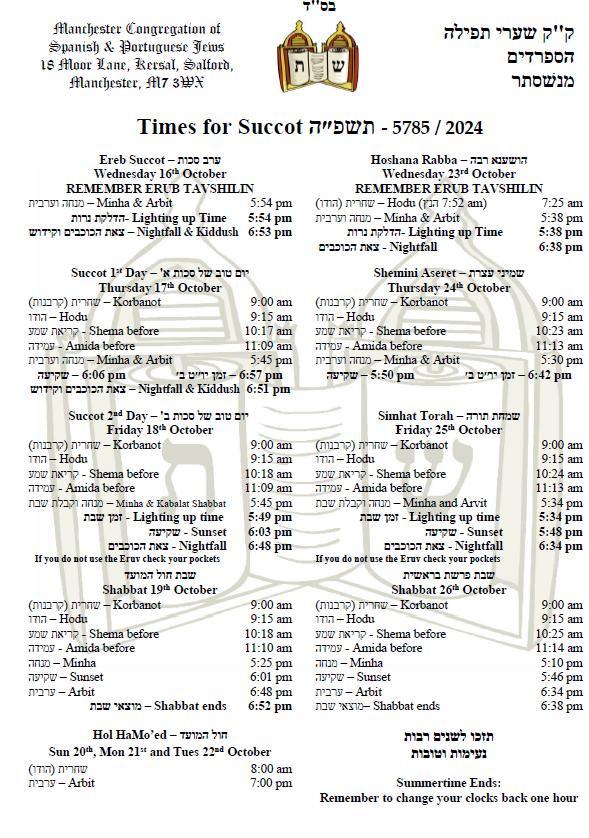
Newsletter Succot 5785 – 2024

בס״ד
Moor Lane - Logo.JPG
ק׳ ק׳ שׁערי תפילה
image.png
Have a look at our website www.moorlane.info 
*****
image.png
image.png
*****
Winter timetable 
3b913971-b21a-4488-b744-b340329f7759.png
attached to this email
****
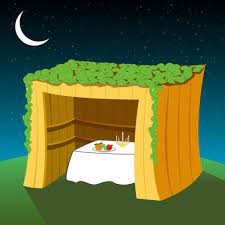
Succot
  1. According to the Torah, what three basic requirements define a material as valid for use as a succa roof?
    It must grow from the ground, no longer be connected to the ground, and not be receptive to tumah (ritual defilement).
  2. If the succa causes discomfort (e.g., it's too cold) to the extent that under similar conditions you would leave your very own house, you are exempt from the mitzvah. Why?
    Because the commandment of living in a succa is to dwell in the succa for seven days the same way you dwell in your house the rest of the year. (Mishna Berura 640:13)
  3. What two things are forbidden to do outside of the succa all seven days of the festival?
    Eat (an 'established' meal) or sleep. (Orach Chaim 639:2)
  4. What is the absolute minimum number of meals a person is required to eat in the succa during the seven day holiday?
    One. Eating a meal in the succa the first night of Succos is a requirement. The rest of the festival, a person can eat 'snacks' which are not required to be eaten in a succa. (Outside Israel, one must eat a meal the second night of Succos as well. However, there is no requirement to live outside Israel!) (Orach Chaim 639:3)
  5. Besides referring to the tree and its fruit, what does the word “esrog” mean literally?
    Beauty. (Ramban Vayikra 23:40)
  6. What is the minimum length of a lulav?
    Its spine must be at least 4 tefachim (halachic handbreadths).
  7. What is the maximum percentage a person is required to add to the purchase price of his esrog in order to obtain an esrog of greater beauty?
    33.3% (Orach Chaim 656:1)
  8. On the Shabbos that occurs during Succos, we read the Book of Koheles, in which King Solomon refers to himself as “Koheles.” Why is King Solomon called Koheles?
    Because he gathered (kihale) vast wisdom, and because he, as king, gathered the nation on Succos after the Sabbatical year. (Rashi, Koheles 1:1)
  9. What prohibition could a person transgress simply by sitting in the succa on the eighth day of Succos?
    Bal Tosif – “Do not add to the mitzvos.” The commandment to live in the succa applies for only seven days. To sit in the succa on the eighth day with intent to fulfill the mitzvah transgresses “bal tosif.” (Orach Chaim 666:1)
  10. We hold a tallis over the heads of the people who read the end of the Torah and the beginning of the Torah. Why?
    It represents the wedding canopy, symbolizing that through the Torah we wed ourselves to Hashem.
*****
image.png

Halachot from Maran Rabbi Ovadia Yosef Ztz'l

גשמים בסוכה

ישנם מקומות, כמו במדינת ניו יורק וסביבותיה, שרגילים לרדת שם גשמים בימי חג הסוכות. וגם בארץ ישראל אירע כמה פעמים שירדו גשמים בחג הסוכות.

ובארץ ישראל, הגשמים בחג הסוכות אינם סימן ברכה, כמו שאמרו רבותינו, למה זה דומה? לעבד שמוזג כוס לרבו, ושפך לו רבו את הכוס על פניו. כלומר, שאינו חפץ במעשיו של העבד. אף כאן, כשיורדים גשמים בחג, כולם יוצאים מן הסוכה ונראה שאין הקדוש ברוך הוא חפץ שישבו בסוכה.  

ומכל מקום עלינו לדון, כיצד יש לנהוג כאשר יורדים גשמים בסוכה?

אדם שהיה אוכל בסוכה, ולפתע התחילו לרדת גשמים רבים (באופן, שאילו היה תבשיל עדין מונח על השולחן בסוכה, היה התבשיל מתקלקל מחמת הגשמים. רש”י סוכה כט.), עליו לצאת מן הסוכה ולהכנס לביתו. ושם ימשיך את סעודתו. ואף על פי שאין בפועל תבשיל שמתקלקל על השולחן, ולמשל, אדם האוכל עוגות בסוכה, ואין שם דבר שיתקלקל מחמת הגשמים שאינם חזקים כל כך, גם כן אינו צריך להשאר בסוכה במצב כזה, ועליו להכנס לביתו. (שלחן ערוך סימן תרלט סעיף ה).

ואם תוך כדי הסעודה, בשעה שיושב בביתו, פסקו הגשמים, אין חובה לחזור ולאכול את המשך הסעודה בסוכה, ורק בתורת חומרא, אם ירצה לחזור ולהשלים את הסעודה בסוכה, תבוא עליו ברכה. (יביע אומר ח”ט סימן סג). וכל זה בשאר ימי החג, אבל בליל יום טוב הראשון של החג, יש חובה לחזור ברגע שיפסקו הגשמים, ולאכול בסוכה כזית פת.

וכן הדין לגבי אדם שראה שיורדים גשמים, ולכן התחיל לאכול בביתו, ופסקו הגשמים. שאין עליו חובה לעבור לסוכה ולהשלים שם את הסעודה, אלא גומר את כל הסעודה בביתו. ודין זה אינו שייך דוקא לגבי ירידת גשמים, אלא גם אם היה יושב בסוכה, ולפתע החלה לנשוב רוח עזה שמחמתה החלו נושרים קסמים מהסכך לתוך הסוכה, וקשה לו לסבול את הדבר, הרי הוא רשאי להכנס ולאכול בביתו. (סוכה דף כט.).

מקום שיורדים שם גשמים, אבל בסוכה יש סכך עבה, עד כדי כך שלא יורדים בתוכה גשמים, צריך לאכול בסוכה, ורשאים גם כן לברך “לישב בסוכה” בשעה שאוכלים שם. (חזון עובדיה סוכות עמוד קפה, בשם בכורי יעקב).

הפטור מן הסוכה מחמת ירידת הגשמים, ובכל זאת מחמיר על עצמו ואוכל בסוכה, אינו אלא הדיוט, ואינו מקבל שכר על כך, (הרמ”א סימן תרלט). ואם בירך על האכילה “לישב בסוכה”, ברכתו היא ברכה לבטלה.

היוצא מן הסוכה מפני הגשמים, לא יבעט ויצא, כלומר, לא ינוס בכעס ויצא, אלא יצא בהכנעה, כמו עבד שבא למזוג כוס לרבו, ורבו שפך את המים על פניו, שעל העבד להתנהג בהכנעה ולא בכעס וכדומה.

Rain in the Sukkah

There are certain places, such as New York, where it commonly rains during the holiday of Sukkot. Even in Israel it has happened in the past that rain has fallen during Sukkot.

In the Land of Israel, rain during the Sukkot holiday is an ominous sign, as our Sages taught that this is comparable to a servant who pours a beverage for his master and the master throws the cup in the servant’s face. So too, when it rains on Sukkot and everyone leaves the Sukkah, it is a sign that Hashem does not want us to be sitting in the Sukkah.

Nevertheless, we must discuss how one should behave when it rains in the Sukkah. If one was sitting and eating in the Sukkah and it suddenly begins to rain strongly (to the extent that if a plate of food was before him, the food would get ruined, see Rashi’s commentary on Sukkah 29a), one should exit the Sukkah and return home and continue one’s meal there. Although there might not be an actual plate of food on the table getting ruined, for instance, if one is eating cake and they do not get ruined from such rain, nevertheless, one still need not remain in the Sukkah in this case and one should return home (See Shulchan Aruch Chapter 639, Section 5).

If during one’s meal at home, the rain stops, there is no obligation to continue one’s meal in the Sukkah and doing so is merely a stringency (see Yabia Omer Volume 9, Chapter 63). The above applies on any other day of the Sukkot holiday. However, on the first night of Sukkot, one is obligated to return to the Sukkah and eat a Kezayit of bread there as soon as the rain stops.

Similarly, if one begins to eat at home because he sees that it is raining and then he realizes that the rain has stopped, he need not go out to the Sukkah in order to finish his meal; rather, one may conclude one’s meal at home. This law does not only apply to rain, rather, if one was sitting in the Sukkah and strong winds start gusting suddenly and pieces of the Sechach start falling into the Sukkah and it makes it difficult to remain in the Sukkah, one may finish one’s meal at home (see Sukkah 29a).

If it is raining outside but the Sechach on one’s Sukkah is so thick that the rain does not penetrate the Sukkah, one must eat in the Sukkah and even recite the blessing of “Leeshev Ba’Sukkah.” (Chazon Ovadia- Sukkot, page 185 quoting the Bikurei Yaakov)

If one is exempt from the Mitzvah of Sukkah because of rain and the like and nevertheless acts stringently and eats in the Sukkah anyway is considered a fool and does not receive reward for this (see Rama in Chapter 639). If one recites the “Leeshev Ba’Sukkah” blessing in such a case, this blessing will have been in vain.

If one must leave the Sukkah as a result of rain and the like, one should not kick it on one’s way out; rather, one should leave in a subjugated manner similar to a servant that had a beverage thrown in his face by his master in that he must act in a subjugated manner and not with anger and the like.

בין כיפור לסוכות – דפנות הסוכה

הימים הללו, שבין יום הכפורים לסוכות, הם ימים מקודשים, ואנו עוסקים בהם במצות הסוכה, ללכת מחיל אל חיל. ואמרו רבותינו, כי ארבע הימים שבין יום הכפורים לחג הסוכות, נזכרים ונעשים כימים המקודשים, והם כימי חול המועד, ובהם עוסקים כל ישראל במצוות, סוכה ולולב, ומעשים הללו מעוררים בלב ישראל לאהוב את ה' יתברך, ולשמוח במצותיו, לשמוח שמחה רוחנית אמיתית, לעבוד את ה' בטוב לבב. ובכל הימים הללו אין אומרים “נפילת אפיים” בתפלה, כי הם כמו יום טוב.

אמרו רבותינו, שהסוכה צריכה להיעשות משלוש דפנות וסכך. הדפנות שהם הכתלים (המחיצות, הקירות) של הסוכה, מותר לעשותם מכל דבר שירצה, ובתנאי שתהיינה הדפנות חזקות ויציבות דיין בכדי שתעמודנה היטב בפני הרוח המצויה, לפי שכל שאין הדפנות יציבות בפני הרוח, הרי אינן כשירות למצות סוכה.

ולפיכך פסק מרן רבינו עובדיה יוסף זצוק”ל, שאין לעשות דפנות לסוכה מסדינים ויריעות וכדומה, לפי שהם הולכים ובאים עם הרוח, ואפילו בנדנוד קל, ולכן אינם נחשבים כדפנות שעומדות ברוח מצויה. ואפילו אם מותח את הסדינים היטב, וקשרם בחזקה לעמודי הסוכה כדי שלא ינועו עם הרוח, אין להתיר, מפני שלפעמים מתרופפים הקשרים על ידי הרוח ומתנודדים הסדינים ונמצאת הסוכה פסולה, והיושב בתוכה אינו יושב בסוכה, ואם בירך “לישב בסוכה” הרי ברכתו ברכה לבטלה.

ואף שיש מהאחרונים שכתבו, שכל שהסדינים אינם מתנודדים הרבה עם הרוח (כשלושה טפחים מצד לצד) עדיין הדפנות כשירות, מכל מקום מדברי הראשונים נראה שאפילו בנדנוד מועט כבר נפסלת הסוכה. וכן היא הסכמת רוב פוסקי זמנינו, ומהם הגאון רבי שלמה זלמן אוירבך זצ”ל והגאון רבי יוסף חיים זוננפלד זצ”ל. גם הגאון רבי משה פיינשטיין זצ”ל כתב, שאין להקל לבנות סוכות כאלו עם יריעות בד או פלסטיק, והוסיף שמה שאנו רואים בארצות הברית (מקום מושבו של הגר”מ פיינשטיין) שמוכרים סוכות שדפנותיהן עשויות מיריעות, פשוט שלא היה זה על פי הוראת חכם, כי אין להשתמש בסוכות אלו.

דבר המקבל טומאה
מה שכתבנו, שדפנות הסוכה מותר לעשותם מכל דבר שירצה, הכוונה היא, אפילו לעשות דפנות מכלים, כגון ארון, ארגז וכיוצא בזה. ואף על פי שארגז הוא “כלי”, ומכיון שהוא כלי, הרי הוא ראוי לקבל טומאה, (כלומר, אם נגע בכלי אדם טמא, גם הכלי יכול לקבל טומאה). וכל דבר שראוי לקבל טומאה אסור לסכך בו את הסוכה. מכל מקום, את דפנות הסוכה מותר לעשות גם מדבר המקבל טומאה.

כלומר, את הסכך של הסוכה, יש לעשות רק מדבר שאינו מקבל טומאה. אבל את דפנות הסוכה, מותר לעשות גם מכלי, או דבר אחר, שמקבלים טומאה.

מעמיד – אזיקונים
ומכל מקום אותו חלק בדפנות הסוכה שהסכך מונח עליו, (כלומר, החלק העליון של הדופן), הרי הוא נקרא, “מעמיד הסכך”. שהסכך עומד עליו. ואת “מעמיד הסכך” יש לעשות לכתחילה מדבר שאינו מקבל טומאה. (מפני שחששו רבותינו שמא יבוא לסכך בדבר שמעמיד את הסכך). ולכן אם עשה דופן לסוכה מדבר המקבל טומאה, כגון ארגז עץ או צינורות של ברזל (שגם הם מקבלים טומאה), טוב לתת נסר של עץ על גבי הדופן או הצינורות, מארבע צידי הסוכה, באופן שהסכך ינתן על גבי נסר העץ, ולא על גבי דבר המקבל טומאה.

ומטעם זה, נכון להזהר לכתחילה, שכל דבר שמעמיד או מחזיק את הסכך, לא יהיה מדבר שמקבל טומאה. ולכן נכון להזהר שלא לקשור את הסכך לסוכה באמצעות “אזיקונים”, כדי שהסכך לא יעוף מהסוכה ברוח מצויה. אולם אם שם את האזיקונים רק כדי שאם תגיע רוח סערה שאינה מצויה הסכך לא יעוף, יש להקל.

The Walls of the Sukkah

The days between Yom Kippur and the Sukkot holiday are indeed holy ones during which we are involved with the building of the Sukkah in order to go from strength to strength. Our Sages teach us that the four days between Yom Kippur and Sukkot are treated as sanctified days and are similar to the days of Chol Ha’Moed. During these days the entire Jewish nation is involved in the Mitzvot of Sukkah and Lulav and these actions arouse the Jewish nation’s love for their Father in Heaven and to rejoice in His commandments thus bringing about service of Hashem with a gladdened heart. During these days, Tachanun (supplication) prayers are omitted from all prayer services, for these days are tantamount to Yom Tov.

A Sukkah must consist of three walls and Sechach (roof of the Sukkah made from objects which grow from the ground). The walls of the Sukkah may be made from any material one wishes as long as they are strong and sturdy enough to withstand an ordinary wind (breeze); if the walls are not sturdy enough to withstand such a wind, they are not valid for the Mitzvah of Sukkah.

Therefore, Maran Rabbeinu Ovadia Yosef zt”l rules that one should not use sheets, fabrics, and the like for the walls of the Sukkah, for they flap back and forth in the wind; even a small movement renders them unfit to withstand an ordinary wind. Even if one stretches these sheets until they are taut and then ties them very well to the poles of the Sukkah so that they do not move in the wind, this is still unacceptable, for sometimes, the knots come loose as a result of the wind and the sheets begin to sway and this renders the Sukkah invalid, in which case anyone who sits in it is in essence not sitting in a Sukkah and any “Leeshev Ba’Sukkah” blessings recited upon it are blessings in vain. Although there are those who maintain that as long as the sheets do not sway very much in the wind (approximately three Tefachim or twenty-four centimeters from side to side) these walls are still valid, nevertheless, it appears from the words of the Rishonim that even a slight movement invalidates the Sukkah. This is indeed the consensus among most modern-day Poskim including Hagaon Harav Yosef Chaim Zonnenfeld zt”l and Hagaon Harav Shlomo Zalman Auerbach zt”l. Similarly, Hagaon Harav Moshe Feinstein zt”l writes that one may not be lenient and build his Sukkah out of sheets of fabric or tarp and he adds that the fact that such Sukkot are sold in the United States (place of Harav Feinstein’s residence) must not have been done in accordance with the ruling of a Halachic authority, for such Sukkot may not be used.

Material Which is Capable of Becoming Impure

We have written that one may make the walls out of any material one wishes, including vessels, such as closets, chests, and the like. Although these items are vessels and thus are capable of becoming impure (meaning that if an impure person touches the vessel it will consequently become impure as well) and such things may not be used for the Sechach of the Sukkah, the walls of the Sukkah may nevertheless be made of things which are capable of becoming impure.

This means that the Sechach of the Sukkah must be made only from material incapable of becoming impure but the walls of the Sukkah may be made from vessels of any other item which is capable of becoming impure.

Supports- Plastic Zip Ties

Nonetheless, the part of the wall of the Sukkah where the Sechach rests is considered “the Sechach’s support” and should preferably be made of materials which are not capable of becoming impure due to an edict of our Sages who were concerned that perhaps one will come to use such materials as Sechach. Thus, if the walls of the Sukkah are made of materials that are capable of becoming impure, such as closets, metal poles, and the like, it is preferable to place a wooded beam on top of the walls or poles around all four sides of the Sukkah in such a way that the Sechach will rest on the wooden beams as opposed to the material which is capable of becoming impure.

For the above reason, it is preferable that anything that supports or holds the Sechach in place not be made of materials capable of becoming impure. Thus, one should preferably not tie down the Sechach with plastic zip ties so that it does not fly away. However, if the Sechach is sturdy enough as is and one is merely tying it down in order to prevent it from flying away in extremely strong winds, there is room for leniency in this regard.

דין הסכך בסוכה והקישוטים הנתלים בסכך

מצוה ליַפּוֹת את הסוכה
מצוה גדולה ליַפּוֹת את הסוכה ולנאותה כמה שאפשר, להכניס לתוכה כלים נאים, ולהאירה באור יקרות. וכתבו המקובלים, שעל ידי כיבוד הסוכה באור יקרות, יזכה האדם שנפשו תשב במנוחה בגן עדן, וכפי ערך מה שיקיים את המצוה בכוונה טובה באופן הנאות, כך יעשה לו שָם סוכה לנשמתו. ׁכמו שמבואר בזהר הקדוש פרשת פנחסׂ. ובהציע הכלים הנאים שיש לו' והמצעות הנאות בסוכה, יקשור לו האל יתברך כמה חופות בגן עדן העליון. ובכל זאת, יש לדעת, שלעתים מתוך הכוונה הטובה לקשט את הסוכה, הסוכה נפסלת. לכן יש להיות בקי בדינים המובאים כאן, לנהוג על פי ההלכה.

התנאים שיהיה הסכך כשר
נאמר בתורה (דברים טז.) “חג הסוכות תעשה לך באספך מגרנך ומיקבך”. ולמדו מכאן רבותינו (במסכת סוכה דף יב.), שיש לסכך את הסוכה, בדברים הנאספים מן הגורן ומן היקב, כלומר פסולת הגורן והיקב, שהם קש ותבן וזמורות ואשכולות ריקים מן הענבים, וכיוצא בהן.

וכן נאמר בספר נחמיה (פרק ח), שאמרו ראשי העם אל בני ישראל, “צאו ההר, והביאו עלי זית ועלי עץ שמן ועלי הדס ועלי תמרים ועלי עץ עבות, לעשות סוכות ככתוב”. ומכאן למדו רבותינו שצריך שיהיו לסכך שמסככים בו שלשה תנאים.

א. צריך שיהיה גידולו מן הארץבצריך שיהיה תלוש ולא מחובר לקרקעג.  צריך שיהיה דבר שאינו ראוי לקבל טומאה. כמו פסולת הגורן והיקב, שבאה מן הארץ, והיא תלושה ואינה מחוברת לקרקע, וכן אינה ראויה לקבל טומאה, שכל דבר שאינו “אוכל” או “כלי”, אינו ראוי לקבל טומאה. ולמשל, אם גופו של מת, נגע בענף של דקל, אין הענף מקבל טומאה, אבל אם נגע גופו בכלי עץ, הרי הכלי מקבל טומאה. ולכן אין לסכך בכלי. (ואפילו אם נשבר הכלי, אין לסכך בשבריו).

ולפיכך אסור לסכך את הסוכה בכל מיני מתכות, שהרי אין גידולם מן הארץ. וכן אין מסככים בענפי אילן המחובר לקרקע, שאין לסכך אלא בדבר התלוש מן הקרקע. וכן אין מסככים בכל מיני אוכלים, כגון פירות, מפני שהם ראויים לקבל טומאה, וכן אין מסככים בכלים, אף על פי שהם עשויים עץ, מפני שהם ראויים לקבל טומאה, ואפילו אם סיכך בסכך כשר, אלא ששם עליו סכך פסול, הסוכה פסולה. ולכן אם בנה סוכה כשירה, אבל היא נמצאת תחת מרפסת של שכן וכדומה, ודאי שסוכה זו היא פסולה.

דין קשוטי נייר
הנייר אין מסככים בו, ואפילו הוא עשוי מעץ, מפני שנשתנתה צורתו לגמרי, ואינו נחשב לדבר שגידולו מן הארץ. ולכן, הקישוטים שנוהגים לתלות תחת סכך הסוכה, בכדי ליפות את הסוכה, הרי הם עלולים לפסול את הסוכה מפני שהם אינם סכך כשר.

לכן כתב מרן רבינו עובדיה יוסף זצ”ל, שצריך להקפיד לתלות את קישוטי הסוכה שתחת הסכך, באופן שיהיו צמודים לסכך, ותלויים בתוך ארבעה טפחים לסכך, (שהם כשלושים ושניים סנטימטר), שאם הם יורדים למטה, ליותר ממרחק של שלושים ושנים סנטימטר מהסכך, יש חשש פן יפסלו את הסוכה כאמור, אבל כשהם בתוך ארבעה טפחים, בטלים הם לגבי הסכך, ואין כל חשש שיפסלו את הסוכה, אפילו אם הם גדולים מאד.

ולסיכום: יש לסכך את הסוכה, בדבר שגידולו מן הארץ, ושהוא תלוש, ושאינו מקבל טומאה. ואם רוצים לקשט את הסוכה בקישוטי נייר, רשאים לעשות כן, אך יש לתלות את הקישוטים באופן שיהיו צמודים לסכך, ולא יהיו גדולים ויורדים מן הסכך יותר משלושים ושניים סנטימטר, שאז, הם עלולים לפסול את הסוכה

Laws of the Sechach (Roof) of the Sukkah and Decorations Hung from the Sechach

The Mitzvah to Beautify the Sukkah

It is a great Mitzvah to beautify the Sukkah and decorate it as much as possible by adorning it with beautiful vessels and illuminating it with fine lights. The Mekubalim write that by honoring the Sukkah with fine lighting, one’s soul will merit resting peacefully in Gan Eden; one’s performance of this Mitzvah with pure intention and in a beautiful manner will directly impact the kind of Sukkah that will be made for one’s soul in Gan Eden, as the holy Zohar (Parashat Pinchas) states. When one places his fine vessels and linens in the Sukkah in order to adorn it, Hashem shall prepare the individual several canopies in the celestial Gan Eden. Nevertheless, we must point out that sometimes as a result of one’s good intention to decorate the Sukkah, one may inadvertently invalidate the Sukkah. One must therefore be fluent in the laws discussed in this segment in order to know how to observe this Mitzvah according to Halacha.

Conditions for Valid Sechach 

The Torah states (Devarim 16): “You shall make for yourself a holiday of Sukkot when you gather [the produce] from your granaries and wineries.” Our Sages learned from here (Sukkah 12a) that one should make the Sechach out of things gathered from granaries and wineries, i.e. the waste from granaries and wineries, such as straw, hay, twigs, or empty clusters of grapes and the like.

Similarly, the book of Nechemia (Chapter 8) states that the leaders of the nation told the Jewish people: “Go out to the mountain and bring olive branches, branches of an oily tree, myrtle branches, palm branches, and branches of a thick tree in order to make Sukkot as it is written.” Our Sages learned from here that in order to be valid, the Sechach must meet three requirements:

It must grow from the ground, it must be detached from the ground, and it must be something that is incapable of becoming impure (as we have already discussed), similar to the waste of granaries and wineries which grows from the ground, is detached from the ground, and is not capable of becoming impure, for anything which is neither a vessel or a food is incapable of becoming impure. If, for instance, a corpse would come in contact with a palm branch, the palm branch would not become impure. However, if it would come in contact with a wooden vessel, it would become impure, and it is thus invalid for use as Sechach (even if the vessel has broken, one may still not use the broken pieces as Sechach).

Thus, one may not use any type of metal as Sechach, as metal does not grow from the ground. Similarly, one may not use tree branches that are attached to the ground, for only things that are detached from the ground may be used as Sechach. Additionally, one may not use foods or vessels (even if they are made from wood) as Sechach, for these things are capable of becoming impure. Even if one covers his Sukkah with valid Sechach and only places invalid Sechach on top of that, the Sukkah is invalid. Therefore, if one builds a valid Sukkah but it is under a neighbor’s balcony, the Sukkah is most certainly invalid.

Paper Decorations

Paper may not be used as Sechach although it is a derivative of wood, since its appearance has changed completely and it is no longer considered something that grew from the ground. Thus, decorations hung from the Sechach in order to beautify the Sukkah can very well invalidate the Sukkah, for they are invalid for use as Sechach.

Therefore, Maran Rabbeinu Ovadia Yosef zt”l writes that one should take care to hang such decoration within four Tefachim (approximately thirty-two centimeters) of the Sechach, for in this way, they are considered part of the Sechach and they in no way invalidate the Sukkah, even if they are quite large. However, if the decorations droop below four Tefachim of the Sechach, there is concern for the invalidation of the Sukkah, as we have explained.

Summary: For the Sechach (roof) of the Sukkah, one must use a material which grows from the ground, is no longer attached to the ground, and which is incapable of becoming impure. If one wishes to adorn one’s Sukkah with paper decorations (or any other material for that matter), one may do so but one must make sure that they are hung in close proximity to the Sechach and do not droop down more than thirty-two centimeters (12.6 inches) from the Sechach, for this invalidates the Sukkah.

Newsletter Yom Kippur 5785 – 2024

בס״ד
Moor Lane - Logo.JPG
ק׳ ק׳ שׁערי תפילה
Have a look at our website www.moorlane.info 
image.png
*****

כתיבה וחתימה טובה  

תזכו לשנים רבות נעימות וטובות
שנה טובה ומתוקה 

Moorlanenews
takes this opportunity to 
ask mechila to all readers for any mistakes 
or if we upset anyone in the past year
******
image.png
📱Coming Soon📱
Moorlanenews will be on 
WhatsApp
for members & friends of the
Bet Hakeneset
******
image.png
*****
image.png
AUCTION FOR PETICHAT HAHECHAL
Bids are invited for Petichat HaHechal for 
image.png
DEADLINE IS TOMORROW 
THURSDAY 10th OCTOBER 9 pm 
As of 10:45 pm the 
CURRENT TOP BIDS
Arvit – Tefilah (Kal Nidre)  £5
Arvit – Tefilat Parnasah      £72 
Shacharit – Tefilah               £26 
Shacharit – Sefer                  £36 
Musaf – Tefilah                    £26 
Mincha – Tefilah                 £36 
Maftir Yonah                      £125
Ne’ilah – Tefilah                 £72 
Please PM Benjamin Hassan
 
*****
Reminder for ladies on Yom Kippur 
Ladies who intend to light at home before Yom Kippur begins 
but still want to drive to the Bet Hakeneset for Arbit should:
(1) 
Light, but have in mind NOT to accept Yom Kippur until 
(a) they get to the Bet Hakeneset or 
(b) no longer need to do any melacha 
or touch something muktze
(2)
The Beracha of Shehecheyanu should be said 
(a) in the Bet Hakeneset or
 (b) with the chazzan at the beginning of Arvit
which is said straight after Kal Nidre
 
Other Important Announcements
(3)
image.png
As there will be more people in attendance 
over the Yamim Noraim & Yamim Tovim 
people should expect that the windows will be open 
at times throughout the services. 
If you feel you will be cold 
when the windows are open 
please bring extra layers & appropriate clothing.
****
Medical Advice for Yom Kippur
Yom Kippur Medical Exemptions 
 PLEASE BE SURE TO CONSULT WITH YOUR DOCTOR IN GOOD TIME!
People with a medical condition that could deteriorate and endanger them as a result of fasting
 are exempt from fasting on Yom Kippur. 
They should get advice from a specialist and the rabbi in a timely manner. 
If it is necessary to eat, one should try to adhere to the following quantities and timings. 
 
The measures for Yom Hakippurim
Solid food: up to 30 c.c. (approximately 30 grams in weight) of solid food in any ten minutes. 
Liquids: up to 40 millilitres (1½ fluid ounces) in 10 minutes. 
One may eat the 30 c.c. measure and drink 40 ml. in the same ten minutes. 
 
If one has to consume large quantities (for instance a patient with a kidney condition) 
one may reduce the time interval to five minutes or even two minutes. 
For patients with a heart condition, a total of half a litre of liquid during the day may be sufficient. 
(Naturally, this should be confirmed with the doctor.) 
This would involve drinking the 40 ml. measure fourteen or fifteen times in the course of the day. 
When drinking, all liquids are equal. One may therefore prefer to drink milk or fruit juice. 
One might be advised to add glucose, vitamins or some nourishment to the drink. 
Tizku Leshanim Rabbot
******
image.png
חזק וברוך
&
Thank you 
to everyone who helped ensure 
we had a minyan for selichot 
throughout the whole month of Elul
& the Aseret Yeme Teshuva
*****
image.png
🕯️🕯️Reminder Yom Kippur Nachalot List🕯️🕯️

A few weeks ago we sent each member a private email with the list of the names of deceased loved ones for the Hashkavot on Yom Kippur. We also asked you to reply to that email to either (1) inform us of any changes to the list or (2) to let us know that the list is correct. 

To date, we have not received a reply to many of the emails, and failure to do so will mean that we may not say the השכבה/hashkava individually for your relative(s) and instead just add the name(s) together with a list of other names, so please, if you have not yet replied to the email, recheck your emails and avoid a disappointment.

The deadline for replies will be tomorrow Thursday 10th October

Alternatively, return the list by hand to a member of the Mahamad.

Donations can be made by

1) Handing it to a member of the executive or Mahamad.

2) Online Banking:

Bank

Branch Title (not address)

Sorting Code Number

Natwest Bank plc


463 Bury New Road, Prestwich, Manchester M25 1AB

01-07-20


Beneficiary’s Name

Account Number

MANCHESTER CONGREGATION OF SPANISH AND PORTUGUESE JEWS

01012525

 Thank you

Arichut Yamim Tizku Leshanim Rabot

The Gabbaim

****
Yom Kippur Q&A
  1. Passover commemorates the going out of Egypt. Shavuos commemorates the giving of the Torah. What historical event can Yom Kippur be said to commemorate?
    Moshe came down from Mount Sinai on the tenth of Tishrei with the second set of Tablets, signifying forgiveness for the sin of the golden calf. Yom Kippur can be said to commemorate this event, the first national day of forgiveness for the Jewish People.
  2. For what kinds of sins does Yom Kippur not atone?
    Sins committed against other people, including hurting someone’s feelings. Yom Kippur does not atone for these sins until the perpetrator gains forgiveness from the victim himself. (Orach Chaim 606:1)
  3. What should someone do if the person he wronged does not forgive him the first time?
    He should try at least two more times to gain forgiveness.(Orach Chaim 606:1)
  4. Why is the vidui confession included during the mincha prayer the afternoon before Yom Kippur?
    Lest one choke while eating the pre-Yom Kippur meal and die without atonement, or lest one become intoxicated and unable to concentrate on the prayers at night.(Mishna Berura 607:1)
  5. On Yom Kippur we refrain from: Working, eating, drinking, washing, anointing, family relations and wearing leather shoes. Which three of these prohibitions are more severe than the others?
    Eating, drinking, working. (Mishna Kritut 1:1)
  6. In what two ways does the prohibition against eating food on Yom Kippur differ from the prohibition against eating pork the entire year?
    a. Although any amount is forbidden, eating on Yom Kippur is not punishable by a Sanhedrin until one has eaten food equal in volume to the size of a date. Eating pork, on the other hand, is punishable for eating even an olive-sized piece, which is smaller than a date. (Mishna Berura 612:1)
    b. Eating on Yom Kippur incurs the punishment of karet – spiritual excision, whereas eating pork does not.
  7. Who wrote the prayer “Unesaneh Tokef” said during the chazan’s repetition of musaf?
    “Unesaneh Tokef” was written by Rabbi Amnon of Mainz, Germany about 1000 years ago.
  8. Why do we read the book of Yona on Yom Kippur?
    The repentance of the people of Ninveh serves as an inspiration to us to repent, and shows us that repentance can overturn a Divine decree. (Shelah Hakadosh)
  9. In what two ways does havdalah after Yom Kippur differ from havdalah after Shabbos?
    After Yom Kippur, the blessing over spices is omitted from havdalah. Also, the source of the flame used for havdalah after Yom Kippur must be a fire kindled before Yom Kippur. (Orach Chaim 624:3,4)
  10. Ideally, what mitzvah should one begin immediately after Yom Kippur?
    Building the succa. (Rema, Orach Chaim 624:5)
*****
image.png
attached to this email
****

image.png

Halachot from Maran Rabbi Ovadia Yosef Ztz’l

אכילה ורחיצה ביום הכפורים


בענין פדיון הכפרות, כבר ביארנו בשנים קודמות שניתן לעשות כפרות על ידי מעות (כסף), ונוהגים שלוקחים שטר (כמו שטר של עשרים או של חמישים שקלים) מעל ראש המתכפר או המתכפרת, ואומרים “זו חליפתך זו תמורתך זו כפרתך, אלו המעות ילכו לצדקה ותכנס (ותכנסי) אתה (את) לחיים טובים ולשלום”. (כמו שמודפס במחזורים ליום הכיפורים). וכן עושים לכל אחד ואחת מבני הבית. ולשאלת רבים אנו מפרסמים מקום של תורה שידוע לנו שאפשר להעביר לשם את דמי הכפרות (אף על פי שעושים בכסף, לאחר מכן ניתן להעביר את אותו הסכום שעשו איתו כפרות בהעברה בנקאית וכדומה), והוא המוסד “תפארת רשב”י”, שמנוהל על ידי אנשים יראי שמים בתכלית, הולכי תמים ופועלי צדק. להפקדת תרומות, מספר החשבון הוא: 169250, סניף 167, בנק דיסקונט. תזכו למצוות.   


————————


מדיני יום הכפורים 


הכל חייבים להתענות ביום הכפורים, ובכלל החיוב גם נשים מעוברות ומניקות שחייבות להתענות בו. וכל אשה שיש חשש לבריאותה מחמת התענית, תעשה שאלת חכם הבקיא בדינים אלו, שיורה לה אם תתענה. ואסור לשום אדם להחמיר על עצמו, ולהתענות כאשר מצב בריאותו אינו מאפשר זאת. שהרי התורה הקדושה אמרה, “וחי בהם”, ולא שימות בהם. ואסור לאדם להמית עצמו או אפילו להכניס עצמו לספק סכנה בשביל תענית יום הכפורים. וכאשר מרן רבינו הגדול זצוק”ל היה רבה הראשי של תל אביב, וכן בשנים שאחר כך, היה מטריח עצמו ונוסע בכל ערב יום כפור, בשעות יקרות אלו, לבית החולים, בכדי לדבר על לבם של החולים שהתענית מסוכנת להם, לבל יתענו, והיה מזכיר את דברי הרדב”ז, שמי שאינו שומע לרופאים מפני שאומר שהוא בוטח בה’, הרי זה חסיד שוטה, שהרי התורה אמרה שניתנה רשות לרופא לרפאות, וממילא אדם חייב להתנהג בכל דבר על פי כללי הרפואה, לאחר התייעצות עם מורה הוראה.


חולה שעצם החולי אינו מביאו לסכנה 


ויש לציין, שגם חולה שעצם החולי שלו אינו סכנה ממש, מכל מקום לפעמים מחמת תרופות שהוא נוטל, הרי הוא חייב לשתות. ואם לא ישתה עלול הוא להכנס בחשש סכנה. וגם באופן כזה יש להתייעץ עם רופא ומורה הוראה בכדי לדעת כיצד לנהוג. ומצוי מצב זה בחולים הנוטלים תרופות פסיכיאטריות, ואצלם לעתים גם עצם החולי מוגדר חולי שיש בו סכנה.


מי שהוצרך לאכול ביום הכפורים 


ומי שהוצרך לאכול ביום הכפורים מחמת מחלה, אם הוא מוכרח לאכול ולשתות כדרכו ממש, הרי שהוא רשאי לעשות כן. שאין לך דבר העומד בפני פיקוח נפש. אולם בדרך כלל, אין הדבר כן, אלא הוא יכול להסתפק באכילה ושתיה באופן שאינו אוכל או שותה בבת אחת כמות גדולה, אלא יעשה הפסקות בין אכילה לאכילה, ובכל פעם לא יאכל יותר משיעור של כשלשים גרם מאכל, או ארבעים גרם משקה. ולאחר כעשר דקות יאכל או ישתה שוב כמות זהה. ולפני יום הכפורים יכין לעצמו מאכלים מסודרים ושקולים בשיעור של כשלשים גרם. ויכין לעצמו כלי המכיל כארבעים גרם משקה, ובכל פעם ימלא אותו וישתה ממנו (כמו בקבוק של תינוקות וכדומה).


רחיצה וטבילה ביום הכפורים 


אסור לרחוץ במים ביום הכפורים, ואפילו להושיט אצבעו במים אסור, ולא אסרו אלא רחיצה של תענוג, אבל אם היו ידיו או שאר גופו מלוכלכים בטיט וכדומה, מותר לרחצם, כיון שאינה רחיצה של תענוג . וטבילה במקוה טהרה, אסורה גם היא ביום הכפורים.


ביום הכפורים שחרית יטול ידיו עד סוף קשרי אצבעותיו בלבד, ויטול שלוש פעמים לסירוגין כדרכו בכל ימות השנה, ומברך על נטילת ידיים.

לא ירחוץ פניו במים ביום הכפורים בבוקר, ואם היו פניו מלוכלכות, כגון שיש לו לכלוך ליד עיניו, מותר לרחוץ המקום המלוכלך. ומי שהוא מפונק, ואין דעתו מיושבת עליו כשאינו רוחץ פניו בשחרית, מותר לו לרחוץ פניו בשחרית. והאשכנזים מחמירים בזה שלא לרחוץ הפנים ביום הכפורים אפילו מי שהוא איסטניס, אלא אם כן להעביר הלכלוך סביב עיניו וכיוצא בזה.

אסור לצחצח שיניים ביום הכפורים. ואפילו מי שמיקל בדבר בזהירות ביום תשעה באב, לא יעשה כן ביום הכפורים.


Eating and Washing Oneself on Yom Kippur


Regarding the custom of Kapparot, we have discussed in the past that this custom may be fulfilled through money. A bill is taken ($10, $20, etc.) and circled around the head of the atoned party three times, and the following text is recited: “This money is in your stead, your substitute, and your atonement. This money shall be donated to Tzedakah, and you should enter into good life and peace.” This text is printed in all Yom Kippur Machzorim. This process is repeated for every member of the family.

Some Laws of Yom Kippur
All are obligated to fast on Yom Kippur, including pregnant and nursing women. Any woman whose health is at risk due to the fast should consult a prominent Torah scholar who is well-versed in these laws, and he should render his ruling whether or not she must fast. One whose medical condition does not allow him to fast may not be stringent and fast, for our holy Torah writes, “That he shall live by them,” and not that he should die by them. One may not cause himself to die or even place himself in a possibly dangerous situation because of the fast of Yom Kippur. When Maran zt”l served as Chief Rabbi of Tel Aviv and for several years after this as well, he would spend the precious hours of every Erev Yom Kippur by travelling to the hospital in order to convince patients whom the fast of Yom Kippur posed a danger to not fast. He would quote the words of the Radbaz who writes that one who does not listen to doctors claiming that he places his complete trust in Hashem is a pious fool, for the Torah gives doctors permission to heal and by default, one must follow the rules of medicine after consulting with a prominent halachic authority.

One Suffering from an Illness which does not Pose any Danger
We should point out that even if one suffers from an ailment which is not necessarily life-threatening, nevertheless, sometimes the medications one takes make it necessary for one to drink, and if one does not, this may pose a danger to him. In such a situation, the patient should consult his doctor and a prominent halachic authority to discern the proper course of action. This situation is common in patients taking medications for mental illnesses; indeed, sometimes, some of these illnesses can be considered life-threatening in and of themselves.

One who Must Eat on Yom Kippur
If one must eat on Yom Kippur due to an illness, if he must eat and drink in a regular manner, he may do so, as the is nothing that stands in the way of a life-threatening situation. Nevertheless, usually this is not the case and one can make do with eating or drinking in a way that he does not consume large amounts of food or beverage in one shot. Rather, one should take breaks between eating and every time he eats or drinks, he should consume no more than thirty grams of food or forty grams of beverage. After approximately ten minutes have elapsed, he should eat or drink a similar amount. One should prepare organized and measured portions of food of approximately thirty grams before Yom Kippur. One should prepare himself a utensil that holds approximately forty grams of liquid (such as a baby bottle, shot glass, and the like) and every time one needs to, one should fill it up and drink from it.

Washing and Immersing Oneself on Yom Kippur
One may not wash himself with water on Yom Kippur. Even placing one’s finger into water is prohibited. Nevertheless, only pleasurable washing is prohibited; however, if one’s hands or any other body part were soiled from mortar and the like, one may wash them, as this does not constitute a pleasurable washing. Immersing oneself in a Mikveh is also forbidden on Yom Kippur.

On the morning of Yom Kippur, one should wash his hands only until his knuckles. One should wash each hand three times while switching off hands and recite the “Al Netilat Yadayim” blessing, as he would any other day of the year.

One should not wash one’s face on the morning of Yom Kippur; if one’s face is dirty due to eye residue and the like, one may wash the dirty place. If one is finicky and cannot relax until he has washed his face in the morning, he may do so on the morning of Yom Kippur. Ashkenazim are stringent regarding this matter and rule that even one who is finicky cannot wash his face; rather, one may only wash off the dirt around one’s eyes and the like.

One may not brush one’s teeth on Yom Kippur. Even one who acts leniently and brushes one’s teeth carefully on Tisha Be’av may not do so on Yom Kippur at all.


****

AUCTION FOR PETICHAT HAHECHAL

image.png
AUCTION FOR PETICHAT HAHECHAL
Bids are invited for Petichat HaHechal for 
Rosh Hashanah and Yom Kippur, 
and will operate as follows:

image.png 
Rosh Hashanah: 
A single bid for the Petichot over Rosh Hashanah, 
to be submitted by no later than
9pm, Tuesday 1st October. 

*******

image.png
Yom Kippur: 
Individual bids for each Tefilla, 
to be submitted by 
9pm Thursday 10th October. 

There will be daily updates showing highest bids for that day, 
starting after Rosh Hashanah (beli neder!). 
Bids to be submitted to either 
Mord Maman or Benjamin Hassan.

Rosh Hashana 5785 -2024

בס״ד
Moor Lane - Logo.JPG
ק׳ ק׳ שׁערי תפילה
Have a look at our website www.moorlane.info 
****
image.png

Wishing Members & Friends

of 

ק׳ ק׳ שערי תפילה

Moor Lane Bet Hakeneset

a

כתיבה וחתימה טובה  

תזכו לשנים רבות נעימות וטובות
שנה טובה ומתוקה 

שנה עם בריאות ברכה מזל הצלחה פרנסה טובה 

רפואה שלמה והצלה לכל עם ישראל

image.png
*******
Silver Polishing
PHOTO-2023-09-10-10-40-02.jpg
A very big 
THANK YOU
to all those who so beautifully polished 
the silver in our 
Bet Hakeneset 
תזכו לשנים רבות נעימות וטובות
********
מנהגים
Spanish & Portuguese Minhagim on Rosh Hashana
a) Piyutim are said in the middle of the tefila
b) NO shofar blowing in the silent amida 
******
2 Important Notices 
concerning Rosh Hashana
(1)
image.png
We would kindly ask the kahal that over 
Rosh Hashana 
NO nuts or nut based snacks (e.g. bamba) 
are to be brought into our Bet Hakeneset
*****
(2)
image.png
As there will be more people in attendance 
over the Yamim Noraim & Yamim Tovim 
people should expect that the windows will be open 
at times throughout the services. 
If you feel you will be cold 
when the windows are open 
please bring extra layers & appropriate clothing.
*****
Reading Material for Rosh Hashana
attached to this email
1)

image.png

2)

image.png

3)

image.png

4)

image.png

5)

image.png

6)

image.png

********

Pledge Reminder

There is a big segula to pay any debts before Rosh Hashana,

so we'd like to send a reminder that if you have made 

a donation to the Bet Hakeneset 

after receiving an Aliya in the last few weeks,

the donation can be fulfilled in any of the following ways: 

 ·  By post addressed to

'The Treasurer, Manchester Congregation of Spanish and Portuguese Jews, 

18 Moor Lane, Salford, Manchester M7 3WX'.

· By hand to the treasurer or any member of the Mahamad.

·Anonymously in the donations box in the Synagogue.

·Direct Debit to the shul's account 

for account details please speak to the treasurer

·Cheque 

 Cheques should be made payable to 

'Manchester Congregation of Spanish & Portuguese Jews'. 


Thank you & Tizke Lemitzvot

*******
Rosh Hashana
  1. Why do we blow the shofar during the month of Elul?
    After the sin of the golden calf, Moshe went up to Mount Sinai to receive the second set of Tablets on Rosh Chodesh Elul. On that day, the Jewish People sounded the shofar to remind themselves to stray no more after idol worship. Also, the sound of the shofar strikes awe into our hearts and inspires us to return to the ways of Torah. (Mishna Berura and Aruch Hashulchan Orach Chaim 581)
  2. Where in the written Torah text does it tell us explicitly that the first day of Tisrei is Rosh Hashanah?
    Nowhere. The Torah calls it “a day of shofar blowing.” (This is one of many examples showing how our observance depends on the continuous oral tradition dating back to Mount Sinai). (Bamidbar 29:1)
  3. We eat apples dipped in honey to symbolize a sweet year. Why do we choose apples above other sweet fruits?
    Isaac blessed Jacob with the words: “The fragrance of my son is like the fragrance of a field which Hashem has blessed…” (Bereishis 27:27). The Talmud identifies this “field” as an apple orchard. (Ta'anis 29b, Biyur Hagra)
  4. What two blessings do we say before sounding the shofar?
    “Blessed are You… who has commanded us to hear the sound of the shofar,” and the shehechiyanu blessing. (Orach Chaim 581:2)
  5. Which Book of Tanach does the beginning of the Tashlich prayer come from?
    The Book of Micha (7:18-20).
  6. What three barren women were “remembered” by Hashem on Rosh Hashanah?
    Sara, Rachel and Chana. On Rosh Hashanah it was decreed that these barren women would bear children. (Tractate Rosh Hashanah 10b)
  7. A person's yearly allowance is fixed on Rosh Hashanah, except for three types of expenses. What are they?
    Expenses for Shabbos, Yom Tov, and the cost of one's children's Torah education. (Ba'er Hetaiv Orach Chaim 242:1)
  8. We refer to the binding of Isaac in our prayers when we say: “Answer us as You answered Abraham our father on Mount Moriah…” What was Abraham's prayer on Mount Moriah?
    He prayed that Mount Moriah should remain a place of prayer for all future generations (Onkelos 22:14). Also, he prayed that his sacrifice of the ram should be considered as though he had actually sacrificed Isaac. (Rashi 22:13)
  9. Why, even in Israel, are there two days of Rosh Hashanah, whereas other festivals in Israel are celebrated for only one day?
    Before our current exile, we did not have a fixed calendar as we do today. Rather, the Supreme Torah Court in Jerusalem determined our calendar on a month to month basis. They did this on the first day of every month, based on witnesses testifying that they had seen the new moon. Therefore, the people outside Israel had insufficient time to find out the exact date in time for the festivals. The “two-day festival” arose to correct this situation. In Israel, however, the people lived close enough to Jerusalem to find out the exact date of all the festivals except Rosh Hashanah. Since Rosh Hashanah occurs on the first day of the month, even those living in Jerusalem sometimes needed to observe it for two days, if the witnesses failed to arrive.
  10. What halacha applies to the shehechiyanu blessing on the second night of Rosh Hashanah which does not apply on the second night of any other holiday?
    On the second night of Rosh Hashanah it is customary to wear a new garment or to have a new fruit on the table when saying the shehechiyanu blessing. Thus, the shehechiyanu blessing applies not only to the holiday, but to the new garment or new fruit as well. (This is done in order to accommodate the minority of halachic authorities who rule that no shehechiyanu blessing be said on the second night of Rosh Hashanah.) (Taz 600:2)
*******
image.png

Halachot from Maran Rabbi Ovadia Yosef Ztz'l

תקיעת שופר

מצות עשה מן התורה לשמוע תרועת השופר ביום ראש השנה, שנאמר “יום תרועה יהיה לכם”. ואסור לדבר בין התקיעות, וכל שכן בזמן התקיעות עצמם, ומשעה שבירך “לשמוע קול שופר” (או שיצא ידי חובת הברכה מפי השליח ציבור), לא יוציא הגה מפיו עד שישמע את התקיעות.

כמה תקיעות יש לשמוע?

וכמה תקיעות חייב אדם לשמוע בראש השנה? מן התורה, די לשמוע תשע תקיעות. ונסביר את הדברים:

נאמר בתורה שלוש פעמים “יום תרועה יהיה לכם”, “זכרון תרועה מקרא קודש”, “והעברת שופר תרועה”. וקיבלו רבותינו “הלכה למשה מסיני”, שכל התקיעות הללו אמורות לגבי ראש השנה, שיש לתקוע בו שלוש פעמים.

וכל תרועה שצריך לתקוע, מורכבת משלוש תקיעות. תקיעה, תרועה ותקיעה. כי כל תרועה, צריך שיהיו לפניה ולאחריה קולות של תקיעה פשוטה. שכך למדו רבותינו מן הפסוקים. נמצאנו למדים, שעלינו לתקוע שלוש תרועות, ולפני ולאחרי כל אחת מהן, יש לתקוע תקיעה פשוטה. ובסך הכל: תקיעה תרועה תקיעה, תקיעה תרועה תקיעה, תקיעה תרועה תקיעה. שהן תשעה קולות של שופר.

מדוע אנו תוקעים הרבה תקיעות ולא תשע?

אם כן לכאורה היה עלינו לשמוע אך ורק תקיעה, תרועה, תקיעה, שלוש פעמים. אולם אין אנו עושים כן. וכפי שנסביר:

התקיעה שנאמרה בתורה, היא קול תקיעה חלקה, ישרה ורצופה. אולם לגבי התרועה שנאמרה בתורה, יש בידינו ספק מה היא. מפני שחלפו הרבה שנים, ונתפזרו עם ישראל בגלות, ותקיעת שופר היא דבר שמתרחש רק פעם אחת בשנה, ולכן אין אנו יודעים איך התרועה נשמעת, האם היא היללה שמיללות הנשים בשעה שמייבבות, והן קולות קצרים ביותר ורצופים (מה שאנו קוראים בזמן הזה “תרועה”), או שהתרועה היא האנחה כדרך שנאנח אדם פעם אחר פעם כאשר דואג לבו מדבר גדול (כלומר, שלוש פעמים תו תו תו, מה שאנו קוראים “שברים”). או אולי, התרועה שנאמרה בתורה היא שניהם יחד, גם קול היללה וגם קול השברים.

ומחמת הספק, אנו עושים הכל. נמצא שסדר התקיעות כך הוא: התוקע מברך, ומיד תוקע “תקיעה” ולאחריה שלושה “שברים” ואחריהם “תרועה” ואחריה “תקיעה”. וחוזר על סדר זה שלוש פעמים. ותוקע “תקיעה”, ואחריה שלושה “שברים” ואחריהם “תקיעה”, וחוזר על סדר זה שלוש פעמים. ותוקע “תקיעה” ואחריה “תרועה” ואחריה “תקיעה”, וחוזר על סדר זה שלוש פעמים. נמצא מנין התקיעות שלושים, כדי להסתלק מן הספק. (ראש השנה לד. והרמב”ם פ”ג ה”א ומרן בש”ע סימן תקצ).

והוא מה שאנו רואים במחזורים: תשר”ת תשר”ת תשר”ת, כלומר תקיעה שברים תרועה תקיעה – שלוש פעמים. ואחר כך, תש”ת תש”ת תש”ת, כלומר תקיעה שברים תקיעה – שלוש פעמים. ואחר כך תר”ת תר”ת תר”ת, והוא תקיעה תרועה תקיעה – שלוש פעמים.

ורמז לדבר “יום תרועה יהיה לכם”, “יהיה” בגימטריא שלושים.

ואלו התקיעות הן חובה מעיקר הדין. ומלבד זה תוקעים עוד שלושים תקיעות בחזרת השליח ציבור של מוסף. ולאחר מכן בסיום התפלה.


Shofar Blowing

There is a positive Torah commandment to hear the Shofar blasts on Rosh Hashanah, as the Torah states, “A day of blasts shall it be for you.” It is forbidden to speak between the various sets of Shofar blasts and this is certainly the case during the time the Shofar is actually being sounded. As soon as one recites the blessing of “Lishmo’a Kol Shofar” (or has fulfilled one’s obligation by hearing the Shofar blower recite it), one should not utter anything until one hears the Shofar blasts.

How Many Blasts Must One Hear?
According to the Torah, it is sufficient to hear nine Shofar blasts on Rosh Hashanah. Let us now discuss this further:

The Torah states “blasts” in three different contexts: “A days of blasts shall it be for you”, “A memorial of blasts, a convocation of holiness”, and “And you shall make a proclamation with the Shofar blasts”. Our Sages had an oral tradition from Moshe Rabbeinu that all of these blasts apply to Rosh Hashanah and one must sound three blasts on that day.

Every sounding of Shofar blasts on Rosh Hashanah must be comprised of three separate blasts: Teki’ahTeru’ahTeki’ah. This is because or Sages derived from various verses in the Torah that every Teru’ah sound must be preceded and followed by a Teki’ah sound. Thus, we must blow three Teru’ah blasts, each of them preceded and followed by a Teki’ah blast, amounting to three sets of Teki’ahTeru’ahTeki’ah, i.e. nine blasts.

Why Do We Blow Many More than Nine Shofar Blasts?
Based on the above, one should only be required to hear three sets of Teki’ahTeru’ahTeki’ah on Rosh Hashanah. However, this is not what is practiced, as we shall now explain:

The Teki’ah described by the Torah refers to a flat, straight, continuous Shofar blast. Nevertheless, a doubt exists regarding what the Torah describes as a “Teru’ah” because many years have passed and the Jewish nation has been scattered in the diaspora as a result of several long exiles. Thus, we are unsure whether Teru’ah refers to a wailing sound that women make when crying, i.e. very short, continuous sounds blown one after another (what we refer to as “Teru’ah” nowadays) or a longer sighing sound one would make again and again when worried about something important (three times, what we would call “Shevarim” nowadays). It is likewise possible that the Torah-prescribed “Teru’ah” actually refers to a combination of both sounds, sighing and wailing.

Because of this is vested in doubt, we blow all of these. Thus, the proper order of blowing the Shofar is, as follows: After reciting the blessing, the Shofar-blower blows a Teki’ah, followed by a Shevarim, immediately followed by a Teru’ah, followed by a Teki’ah. This order is repeated three times. After a brief pause, the blower then blows a Teki’ah, followed by a Shevarim, followed by a Teki’ah. This order is likewise repeated three times. After another short pause, the blower resumes by blowing a Teki’ah, followed by a Teru’ah, followed by a Teki’ah. This order is likewise repeated three times. The final order of Shofar blasts necessary in order to remove all doubt is therefore thirty. (See Rosh Hashanah 34a, Rambam Hilchot Shofar, Chapter 3, Halachot 1-3, and Shulchan Aruch, Chapter 590, Sections 1-2.)

These Shofar blasts are obligatory according to the letter of the law. Besides for these, thirty more blasts are blown during the silent Mussaf Amida prayer, another thirty during the Chazzan’s repetition of Mussaf, and a final ten within the Kaddish following Mussaf.

Newsletter Parashat Nitzavim Vayelech

בס״ד
Moor Lane - Logo.JPG
ק׳ ק׳ שׁערי תפילה
Have a look at our website www.moorlane.info 
*****
image.png

*****

PHOTO-2024-08-29-21-34-12.jpg

*****

image.png

Yamim Noraim & Succot Time Table attached

*****

Silver Polishing
PHOTO-2023-09-10-10-40-02.jpg
If you have any time spare 
please come to the  
BET HAKENESET
@ 2pm
THIS SUNDAY
to fulfill the Mitzvah of 
זה קלי ואנו־הו
and help polish the silver in our 
Bet Hakeneset
May Hashem repay you with 
loads of beautiful things in your life 
תזכו לשנים רבות נעימות וטובות

****

image.png
Mazal Tov
to
Benji & Danielle Sasoon
on the safe arrival of a new baby boy

Sheyizke Laberit Bizmana Latorah Lachupa Ulemaasim Tovim

Mazal Tov to 
Grandparents & all the family
********

Pledge Reminder

There is a big segula to pay any outstanding debts before Rosh Hashana,

so we'd like to send a reminder that if you have made 

a donation to the Bet Hakeneset 

after receiving an Aliya in the last few weeks,

the donation can be fulfilled in any of the following ways: 

 ·  By post addressed to

'The Treasurer, Manchester Congregation of Spanish and Portuguese Jews, 

18 Moor Lane, Salford, Manchester M7 3WX'.

· By hand to the treasurer or any member of the Mahamad.

·Anonymously in the donations box in the Synagogue.

·Direct Debit to the shul's account 

for account details please speak to the treasurer

·Cheque 

 Cheques should be made payable to 

'Manchester Congregation of Spanish & Portuguese Jews'. 


Thank you & Tizke Lemitzvot

**********

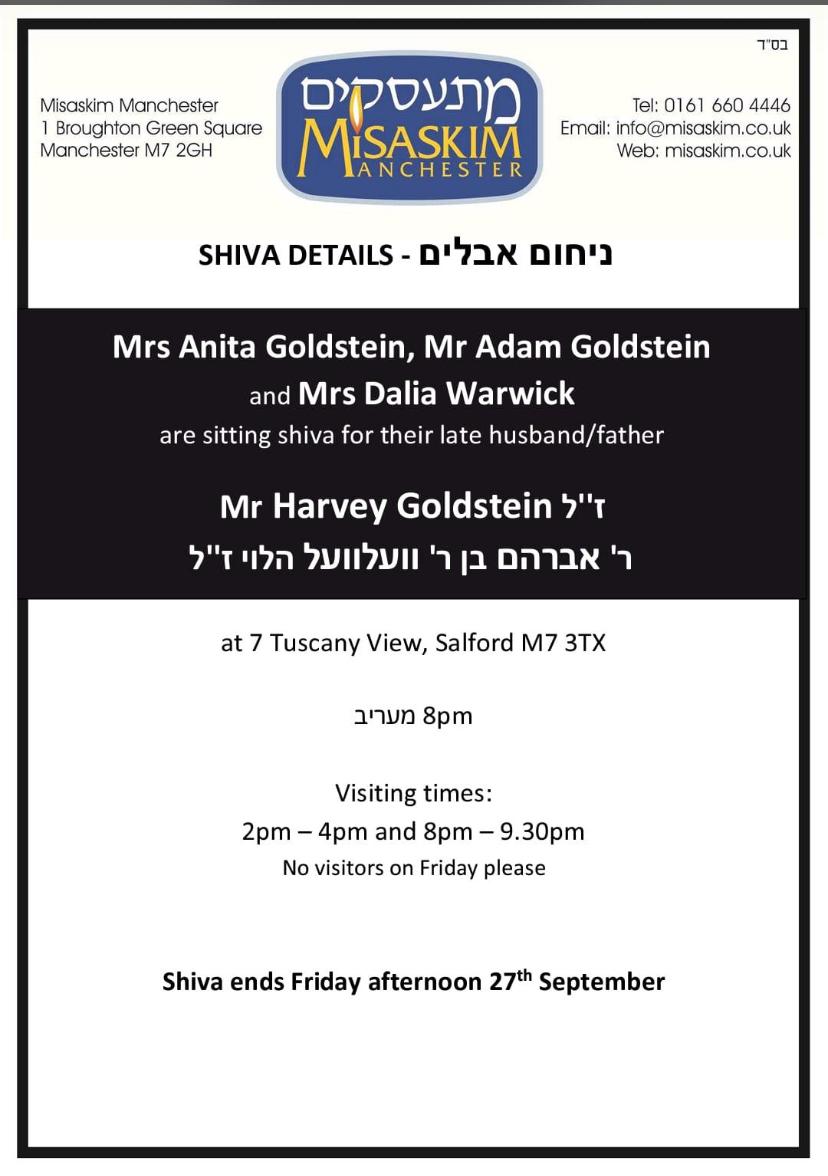
ברוך דיין האמת

image.png
It is with great regret & sadness

that we inform the Kahal

of the Petira – the passing of 


Mr. Harvey Goldstein  ע״ה


father of  

Mrs. Dalia Warwick (jnr) שתח״י


מן השמים תנחמו

אריכות ימים


Moorlanenews 

would like to use this opportunity

to send their heartfelt condolences

to  

Mrs. Dalia Warwick שתח״י 

and 

wish her, her mother & brother 

and Family Goldstein 

מן השמים תנחמו

  אריכות ימים  

PHOTO-2024-09-22-18-48-09.jpg

*****

ברוך דיין האמת

image.png
It is with great regret & sadness

that we inform the Kahal

of the Petira – the passing of 


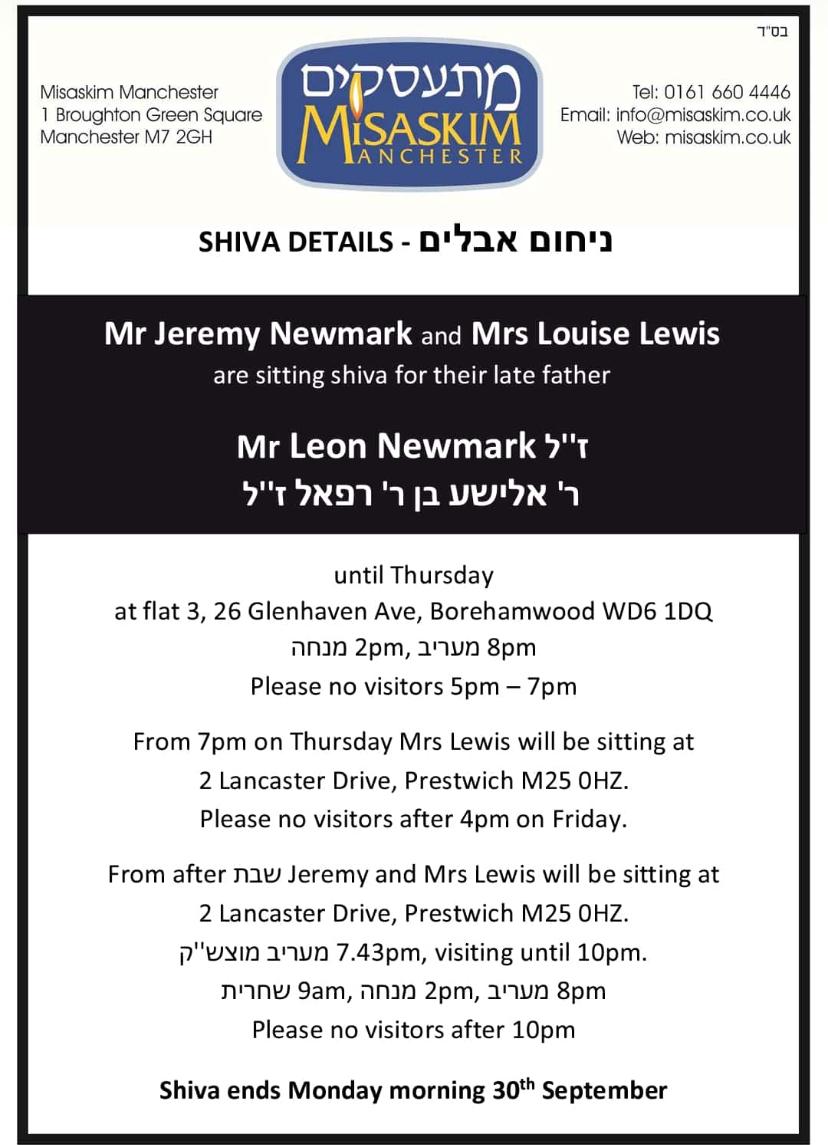
Mr. Leon Newmark  ע״ה


father of  

Mrs. Louise Lewis שתח״י


מן השמים תנחמו

אריכות ימים


Moorlanenews 

would like to use this opportunity

to send their heartfelt condolences

to  

Mrs. Louise Lewis שתח״י 

and all her family 

מן השמים תנחמו

  אריכות ימים  

PHOTO-2024-09-24-23-05-19.jpg

******

Machazorim

image.pngimage.png image.png

Do you have any Machazorim that belong to Moor Lane?

We are missing several Machazorim 

and need them returned in time for the Yamim Noraim. 

if you have any Machazorim 

please return them as soon as possible

Thanking you in advance

The Gabbaim

*****

לוח זמני תפלה לקיץ תשפ״ד

Summer Timetable 5784 – 2024


מוצאי שבת

ערבית

)מוצ”ש(

שקיעה

סוף זמן קראת שמע

זמן שבת

פלג מנחה (תה״ד)

פלג מנחה (לבוש)

מנחה וקבלת שבת

תאריך

שבת פרשת

Shabbat

Ends

Arbit

Sunset

Shema to be read before

Candles to be
lit by


Earliest Candle lighting

Minha & Kabbalat Shabbat*

Date

Parasha

PM

PM

PM

AM

PM

PM

PM

PM


7:41

7:37

6:50

10:02

6:39

6:11

5:41

6:40

27/28 Sep

נצבים־וילך


For those not in the Bet Hakeneset, but wishing to bring in Shabbat with the Kahal, candles should be lit about 30 minutes after the time listed for Minha and Kabbalat Shabbat, unless the time listed in the ‘latest candle lighting’ column is earlier, when candles MUST be lit by that time, in all cases

שבת

קרבנות

9:00 am
הודו

9:15 am

מנחה

NEW TIME

6:00 pm

Moor Lane Women’s Nach Group
PHOTO-2024-09-25-11-34-58.jpg
NEW TIME
6:00 pm
in the Shul Library
Subject: Sefer Ezra & Yom Tov related learning

********

Parasha Overview

Nitzavim

On the last day of his life, Moshe gathers together all the people, young and old, lowly and exalted, men and women in a final initiation. The covenant includes not only those who are present, but even those generations not yet born. Moshe admonishes the people again to be extremely vigilant against idol worship, because in spite of having witnessed the abominations of Egypt, there will always be the temptation to experiment with foreign philosophies as a pretext for immorality.

Moshe describes the desolation of the Land of Israel which will be a result of the failure to heed Hashem’s mitzvahs. Both their descendants and foreigners alike will remark on the singular desolation of the Land and its apparent inability to be sown or to produce crops. The conclusion will be apparent to all — the Jewish People have forsaken the One who protects them, in favor of idols which can do nothing. Moshe promises, however, that the people will eventually repent after both the blessings and the curses have been fulfilled. However assimilated they will have become among the nations, eventually G-d will bring them back to Eretz Yisrael.

Moshe tells the people to remember that the Torah is not a remote impossibility. Rather, its fulfillment is within the grasp of every Jew. The Torah portion dramatically concludes with Moshe's comparing the Jewish People's choice to follow the Torah to a choice between life and death. Moshe exhorts the people to choose life.

Vayelech

On this, the last day of his life, Moshe goes from tent to tent throughout the camp, bidding farewell to his beloved people, encouraging them to keep the faith. Moshe tells them that whether he is among them or not, Hashem is with them, and will vanquish their enemies. Then he summons Yehoshua, and in front of all the people, exhorts him to be strong and courageous as the leader of the Jewish People. In this manner, he strengthens Yehoshua's status as the new leader.

Moshe teaches them the mitzvah of Hakhel. E very seven years, on the first day of the intermediate days of Succot, the entire nation, including small children, is to gather together at the Temple to hear the King read from the Book of Devarim. The sections that he reads deal with faithfulness to G-d, the Covenant, and reward and punishment. G-d tells Moshe that his end is near, and he should therefore summon Yehoshua to stand with him in the Mishkan, where G-d will teach Yehoshua. G-d then tells Moshe and Yehoshua that after entering the Land, the people will be unfaithful to Him, and begin to worship other gods. G-d will then completely hide his face, so that it will seem that the Jewish People are at the mercy of fate, and that they will be hunted by all. G-d instructs Moshe and Yehoshua to write down a song — Ha'azinu — which will serve as a witness against the Jewish People when they sin. Moshe records the song in writing and teaches it to Bnei Yisrael. Moshe completes his transcription of the Torah, and instructs the Levi'im to place it to the side of the Aron (Holy Ark), so that no one will ever write a new Torah scroll that is different from the original — for there will always be a reference copy.

Ohr Somayach Institutions www.ohr.edu

*******
image.png

Halachot from Maran Rabbi Ovadia Yosef Ztz'l

עירוב תבשילין שיש לעשות בשנה זו (ראש השנה התשפ”ה), ודין מקלחת ביום
ראש השנה

בהלכה הקודמת ביארנו את דין הדלקת הנרות בימי ראש השנהוהזכרנו שביום טוב שחל בערב שבת, יש להניח “עירוב
תבשילין”, וכמו שנבאר
.

עירוב תבשילין, מהו?
בשנה זו (התשפ”ה) יחול יום
טוב שני של ראש השנה ביום שישי הקרוב. ואסרו חכמים לבשל ביום טוב לצורך השבת אלא
על ידי “עירוב תבשילין”. וכיצד עושים עירוב תבשילין?  יש להניח
“פת ותבשיל” מערב יום טוב, (כלומר, מיום רביעי
), לצורך השבת
(כלומר, לצורך אכילתו בשבת), כדי שיהיה ניכר, שאינו מתחיל בבישול ובאפיה ביום טוב
לצורך השבת, אלא רק מסיים מלאכתו
.

ביאור הדברים
וביאור הדברים, כי מפני כבוד יום
טוב, אסרו חכמים לבשל ביום טוב לצורך השבת, (שלא יראה כאילו היום טוב, הוא כיום
חול בפני השבת). אבל אם התחילו לבשל לכבוד שבת כבר מערב יום טוב (כלומר, לפני
שנכנס החג), וביום טוב עצמו רק מסיימים את המלאכה, אין בכך פגיעה בכבוד יום טוב.
ולכן מניחים תבשיל ופת מערב יום טוב לצורך השבת, כדי להראות שכבר התחילו עוד קודם
יום טוב בהכנת המאכלים לצורך השבת, וביום טוב עצמו אינם אלא כמסיימים את המלאכה).
ואם לא עשה עירוב תבשילין, אינו יכול לבשל ביום טוב לצורך השבת
.

אופן הכנת העירוב
הפת והתבשיל שצריך להשאיר, יש בהם
כמה פרטי דינים. והנהוג הוא להניח פת
,
דהיינו לחם, (במשקל של כ-30 גרם)
וביצה קשה. וכשלוקח את הפת והתבשיל בערב יום טוב (לפני כניסת החג) מברך
ברוך אתה ה' אלוקינו מלך העולם אשר קדשנו
במצוותיו וצונו על מצות עירוב
.( ויברך בשם ומלכות,  ואחר
כך יאמר: בדין עירובא, יהא שרי לנא לאפויי ולבישולי ולאדלוקי שרגא ולמעבד כל צרכנא
מיום טוב לשבת. (פירוש הדברים: בעירוב זה, יהיה מותר לנו לאפות ולבשל ולהדליק הנר
ולעשות כל צרכינו מיום טוב לשבת). ואחר כך שומר את הפת והתבשיל , ואוכלם (לכתחילה)
בליל שבת
.

עירוב כללי
ברוב המקומות נוהגים רבני העיר
לעשות עירוב תבשילין, באופן מיוחד שמועיל לאותם ששכחו לעשות עירוב תבשילין, ולכן
אם שכח לעשות עירוב תבשילין והרב הנמצא במקומו עשה עירוב באופן כזה, יכול לסמוך על
עירובו של הרב, ומותר לבשל ביום טוב לצורך השבת, ומכל מקום לכתחילה חייב כל אדם
לעשות עירוב תבשילין בביתו
.

לסיים את המלאכות מוקדם
אף על פי שעשה עירוב תבשילין,
לכתחילה יש לסיים את כל המלאכות שעושים ביום טוב לצורך השבת, בעוד היום גדול,
כלומר בשעה מוקדמת, ולא להמשיך במלאכות עד סמוך לכניסת השבת. ומכל מקום אם נתעכב
מחמת איזו סיבה, רשאי להמשיך לבשל ביום טוב עד סמוך לשקיעת החמה
.

הדלקת הנרות בשנה זו
הדלקת נרות שבת ביום טוב השני של
ראש השנה, צריכה להיות כעשרים דקות קודם שקיעת החמה, מפני שלאחר מכן כבר מתקדש
היום בקדושת השבת, ואסורה הדלקת הנר
.
ומותר להכין את נרות השבת ביום טוב
עצמו
.

דין מקלחת ביום ראש השנה
לשאלת רבים, בענין מקלחת בימי ראש השנה הבאים עלינו לטובה, (שהם
יומיים הסמוכים ליום שבת קודש), כבר ביארנו את פרטי הדין בזה
בהלכה מיוחדת. ובדבר השאלה המתעוררת מידי שנה בארצות הברית, לגבי דודי
מים הגדולים המצויים שם, שהם מלאים מים רותחים תמיד, ותחת הדוד דולקת אש קטנה,
שלפעמים
(כשמתרבים המים הקרים, ואז על ידי הפעלת טרמוסטט)
האש מתגברת ומרתיחה שוב את המים. הנה דנו בזה כמה מגדולי דורינו. והרה”ג רבי
גבריאל אלבז שליט”א
(עורך ההלכה יומית בשפה האנגלית), האריך בדין זה
בתשובה, והציגה בפני מורינו הראשון לציון הגאון רבי יצחק יוסף שליט”א, והלה
השיבו בתשובה מיום כ”א אלול התשע”ג, שהוא מצטרף להקל בזה, שמותר להתקלח
ממים היוצאים מדוד זה
,
כאשר היו כבר מים רותחים בדוד עוד
לפני יום טוב, והביא כמה טעמים להקל בדבר, מפי סופרים וספרים
.


The Eruv Tavshilin
One Should Make this Year 

(Rosh Hashanah-5785) 

and the Laws of Showering on Yom
Tov

In the previous Halacha, we have explained the laws of
candle-lighting on both days of Rosh Hashanah. We have mentioned that when Yom
Tov coincides with Erev Shabbat (Friday), one should place an Eruv
Tavshilin
, as we shall now explain.

What is an Eruv Tavshilin?

This year (5785), the second day of Rosh Hashanah will fall out on Friday, Erev
Shabbat. Our Sages prohibited cooking on Yom Tov for Shabbat without placing an
Eruv Tavshilin,” which is placing (designating) bread and a cooked
food on Erev Yom Tov (Wednesday) for Shabbat (i.e. to be eaten on Shabbat) in
order for it to be recognizable that one is not beginning to cook or bake on
Yom Tov for Shabbat; rather, one is merely concluding this work.

Explanation of the Above

In honor of Yom Tov, our Sages prohibited cooking on Yom Tov for Shabbat (in
order for Yom Tov not to appear like a regular weekday with regards to
Shabbat). However, if one begins cooking for Shabbat on Erev Yom Tov (i.e.
before the onset of the holiday) and merely concludes on Yom Tov, this does not
constitute a lack of respect for Yom Tov. We therefore leave bread and a cooked
food on Erev Yom Tov to be eaten on Shabbat in order to show that one has
already begun preparing foods for Shabbat before the onset of Yom Tov and that
on Yom Tov itself, one is merely finishing off what one has already started. If
one did not place an
Eruv Tavshilin, one may not cook on Yom Tov for
Shabbat.

The Proper Way to Prepare
the Eruv

There are several laws regarding the bread and cooked food one must leave for
the
Eruv Tavshilin. It is customary to leave bread (amounting to a
weight of approximately fifty-four grams) and a hard-boiled egg. When one takes
the bread and hard-boiled egg on Erev Yom Tov (Wednesday), one recites: “
Baruch
Ata Hashem Elokeinu Melech Ha’Olam Asher Kideshanu Be’mitzvotav Ve’tzivanu Al
Mitzvat Eruv
.” One must include Hashem’s name while reciting this
blessing. After reciting the blessing, one should say: “With this Eruv, we
shall be permitted to bake, cook, light candles, and do anything necessary on
Yom Tov for Shabbat.” One then saves the bread and cooked food and (preferably)
eats them on Shabbat night or any other time on Shabbat.

A Public Eruv

In most places, the rabbis of the city customarily make an Eruv Tavshilin
in a special way that will benefit those who have forgotten to make one. Thus,
if one forgets to make an
Eruv Tavshilin but the local rabbi has made
an
Eruv in this way, one may rely on the Eruv of the rabbi
and one may cook on Yom Tov for Shabbat. Nevertheless, it is preferable for
each individual to make an
Eruv Tavshilin in his own home.

Concluding Shabbat
Preparations as Early as Possible

Although one has made an Eruv Tavshilin, it is preferable to finish
all works one is performing on Yom Tov for Shabbat as early on in the day as
possible and not to carry on until close to the onset of Shabbat. Nevertheless,
if one was delayed for whatever reason, one may continue to prepare
until a
several minutes before sunset.

Candle-Lighting for
Shabbat this Year

On the second day of Rosh Hashanah, candles should be lit approximately twenty
minutes before sunset, for after this time, the day already takes on the
sanctity of Shabbat and lighting candles is forbidden. One may prepare the
Shabbat candles during Yom Tov itself.  

Showering on Yom Tov 

By Popular Demand: As a response to the many questions we have
received regarding the issue of showering during the upcoming holiday of Rosh
Hashanah (especially since it will be a three-day holiday since Rosh Hashanah
falls out on Thursday and Friday leading directly into Shabbat), we have
already discussed some details pertaining to this law in a
special Halacha. Regarding the question which arises every year in the
United States regarding boiler systems which consist of large tanks always
filled with boiling water under which there is always a small flame ignited by
means of a pilot when sometimes, (when an abundance of cold water enters the
tank via the cold water valve and causes the thermostat to turn on and sense
the difference in water temperature) the pilot ignites a larger flame and
reboils the water, indeed, several great
halachic
authorities of our generation have discussed this issue. Last year, however,
our
Rabbi Meir Gavriel Elbaz Shlit”a (author
of the English version of the
Halacha Yomit) wrote a halachic thesis on
this topic and presented it to the great Rishon
Le’Tzion and Sephardic Chief
Rabbi of Israel, Hagaon Harav Yitzchak Yosef
Shlit”a, whereby the
latter responded in a letter dated 21 Elul, 5773, that he too agrees that there
is room to rule leniently on this matter
and it is thus permissible to
take a shower using water coming out of this kind of boiler when the tank was
already filled with boiling water before the onset of Yom Tov
. This
ruling is
comprised of several sources for leniency with regards to this matter
based on the words of great Poskim and
halachic works.
This lenient ruling applies to the upcoming holidays of Sukkot and Shemini
Atzeret as well which likewise fall out on Thursday and Friday and lead
directly into Shabbat. In addition, this ruling applies to any other holidays,
even if they are not three-day holidays. Nevertheless, there is absolutely no
room for leniency to do so on Shabbat and obviously, the above applies only to
Yom Tov. Likewise, this leniency applies specifically to the issue of showering
on Yom Tov and does not address the prohibitions of squeezing or plucking out
hair which are absolutely forbidden on Yom Tov.
On must therefore be certain to
use only liquid soap, preferably no shampoo, and to dry one’s self very gently
after the shower.


Ladies’ Seating Plan for the Yamim Noraim – High Holy Days FOR PAYING MEMBERS ONLY

Ladies’ Seating Plan for the Yamim Noraim – High Holy Days

FOR PAYING MEMBERS ONLY 


Dear Lady Members of our kehila,


Baruch Hashem, like in other years, we are willing to reserve a seat for lady members of our community.


We will attempt, to the best of our ability, to allocate the seats according to where ladies sit throughout the year, but we cannot guarantee how the seats will be allocated. We will also consider accommodating places for unmarried girls over Bat Mitzva to sit next to or close to their mothers.


Please tick for which day(s):

1)     Only Rosh Hashana 1st Day                                                    _______

2)     Only Rosh Hashana 2nd day                                                    _______

3)     ONLY Yom Kippur                                                                   _______

4)     BOTH (Boths days of Rosh Hashana and Yom Kippur)          _______


Please let us know below who the seat is for:

1)     Name  _______________________________

2)     Name  _______________________________

3)     Name  _______________________________

4)     Name  _______________________________

Please note, we will gladly reserve and allocate you a seat, however, if for example, you are allocated a seat for Yom Kippur but can only come for Ne’ilah please understand that your seat cannot be kept vacant all day, when others could use the seat until you arrive.


Therefore, we endeavour to do the following:


·       A clear sign will be posted asking ladies to respect the allocated seating plan by not sitting in someone’s allocated place and to vacate the seat as soon as the lady comes.


·       If someone is sitting in your allocated seat when you arrive, you have the right to politely ask that person to move.


·       We request that you ask the lady to move in the most polite, discreet and nicest way possible so as not to cause embarrassment, offence or any discomfort whatsoever.


 All requests should be sent by email to

THIS EMAIL 

moorlanenews@gmail.com

 no later than 

Sunday 29th September 9 pm


If your wife or any other lady you know 

does not receive the 

moorlenenews email 

please forward this email to her.


Please fill in 

Name:


Please tick for which day(s):

1)     Only Rosh Hashana 1st Day                            _______

2)     Only Rosh Hashana 2nd day                           _______

3)     ONLY Yom Kippur                                         _______

4)     BOTH (Rosh Hashana and Yom Kippur)       _______


Please let us know below who the seat is for:

1)     Name  _______________________________

2)     Name  _______________________________

3)     Name  _______________________________

4)     Name________________________________


Thanking you in advance.


Tizku leshanim rabot


The Gabbaim


PS – Whilst there is no charge for allocating you a seat, any donations made will be gratefully appreciated.


FOR NON-MEMBERS

If you would like us to reserve you a place or Rosh Hashana & Yom Kippur, then there will be a charge of £25 per seat per day for non-members or alternatively, become a country member as a family – this is £220 (Full membership is £360 pa) for the year and this gets you seats for Rosh Hashana & Yom Kippur, and discounted hall fees throughout the year. 

We will NEVER turn anyone away if you have any financial issues, so please speak to a member of the mahamad and arrangements can be made.


Tizku leshanim rabot


The Gabbaim


Newsletter Parashat Ki Tavo

בס״ד
Moor Lane - Logo.JPG
ק׳ ק׳ שׁערי תפילה
Have a look at our website www.moorlane.info 
*****
image.png

******

PHOTO-2024-08-29-21-34-12.jpg

*****

Machazorim

image.pngimage.png image.png

Do you have any Machazorim that belong to Moor Lane?

We are missing several Machazorim 

and need them returned in time for the Yamim Noraim. 

if you have any Machazorim 

please return them as soon as possible

Thanking you in advance

The Gabbaim

********

Pledge Reminder

There is a big segula to pay any outstanding debts before Rosh Hashana,

so we'd like to send a reminder that if you have made 

a donation to the Bet Hakeneset 

after receiving an Aliya in the last few weeks,

the donation can be fulfilled in any of the following ways: 

 ·  By post addressed to

'The Treasurer, Manchester Congregation of Spanish and Portuguese Jews, 

18 Moor Lane, Salford, Manchester M7 3WX'.

· By hand to the treasurer or any member of the Mahamad.

·Anonymously in the donations box in the Synagogue.

·Direct Debit to the shul's account 

for account details please speak to the treasurer

·Cheque 

 Cheques should be made payable to 

'Manchester Congregation of Spanish & Portuguese Jews'. 


Thank you & Tizke Lemitzvot

*******

לוח זמני תפלה לקיץ תשפ״ד

Summer Timetable 5784 – 2024

מוצאי שבת

ערבית

)מוצ”ש(

שקיעה

סוף זמן קראת שמע

זמן שבת

פלג מנחה (תה״ד)

פלג מנחה (לבוש)

מנחה וקבלת שבת

תאריך

שבת פרשת

Shabbat

Ends

Arbit

Sunset

Shema to be read before

Candles to be
lit by


Earliest Candle lighting

Minha & Kabbalat Shabbat*

Date

Parasha

PM

PM

PM

AM

PM

PM

PM

PM


7:58

7:54

7:08

9:57

6:56

6:25

5:55

6:40

20/21 Sep

כי תבא

For those not in the Bet Hakeneset, but wishing to bring in Shabbat with the Kahal, candles should be lit about 30 minutes after the time listed for Minha and Kabbalat Shabbat, unless the time listed in the ‘latest candle lighting’ column is earlier, when candles MUST be lit by that time, in all cases


שבת

קרבנות

9:00 am
הודו

9:15 am

מנחה

NEW TIME 

6:00 pm

Moor Lane Women’s Nach Group
NEW TIME
6:00 pm
in the Shul Library

*************

Parasha Overview

When the Jewish People dwell in the Land of Israel, its first fruits are to be taken to the Temple and given to the kohen. This is done in a ceremony that expresses recognition that it is G-d who guides the history of the Jewish People throughout all ages. This passage forms one of the central parts of the Pesach Haggadah that we read at the Seder.

On the last day of Pesach of the fourth and seventh years of the seven-year shemitta cycle, a person must recite a disclosure stating that he has indeed distributed the tithes to the appropriate people in the prescribed manner. With this mitzvah Moshe concludes the commandments that Hashem has told him to give to the Jewish People. Moshe exhorts them to walk in Hashem’s ways because they are set aside as a treasured people to Him.

When the Jewish People cross the Jordan River they are to make a new commitment to the Torah. Huge stones are to be erected and the Torah is to be written on them in the world's seventy primary languages, after which they are to be covered over with a thin layer of plaster. Half the tribes are to stand on Mount Gerizim, and half on Mount Eval, and the levi'im will stand in a valley between the two mountains. The levi'im will recite twelve commandments, and all the people will answer “amen” to the blessings and the curses. Moshe then details the blessings that will be bestowed upon the Jewish People, blessings that are both physical and spiritual. However, if the Jewish People do not keep the Torah, Moshe details a chilling picture of destruction, resulting in exile and wandering among the nations.

Ohr Somayach Institutions www.ohr.edu

*******
image.png

Halachot from Maran Rabbi Ovadia Yosef Ztz'l

ביטול מצוות עשה וברכה לבטלה

שאלה: לפני כמה ימים מסרתי את התפילין שלי לבדיקה, ולחרדתי גילה הבודק שבתפילין של ראש היתה חסרה מילה אחת, שהוא פסול ברור, וכמובן החליף מיד את הפרשיות כהלכה, אך לבי מר לי על העבר, מהו התיקון שעלי לעשות לכפר על עווני?

תשובה: בשאלה זו נשאל מרן רבינו עובדיה יוסף זצ”ל (בספרו עמוד כו), והשיב, שעלינו לדון כאן בשני ענינים נפרדים.

האחד, מצד מה שהשואל לא הניח תפילין של ראש במשך כמה שנים, והענין השני, מצד מה, שהיה מברך בכל יום ברכה לבטלה על התפילין. כי האדם ששאל על כך את מרן זצ”ל, היה אשכנזי, והאשכנזים נוהגים לברך על תפילין של ראש ברכה נפרדת, נמצא, שאם התפילין פסולות, בודאי שאין לברך על הנחתן, ואם בירך, הרי היא ברכה לבטלה, שהוא איסור מן התורה לדעת הרמב”ם כמו שביארנו כבר.

והנה ראשית כל נבאר, שזה החוטא העומד לפנינו, דינו הוא כדין “שוגג”, כלומר, ישנם שלש מדרגות בכל מעשה, ישנו “מזיד”, שהוא העושה איזה מעשה בכוונה תחילה, כגון מי שנוסע בשבת, ויודע שאסור ליסוע בשבת. וישנו “שוגג”, שהוא העושה מעשה בלא כוונה, כגון מי שנסע בשבת ולא ידע שאותו היום הוא שבת וכיוצא בזה. ויש “אנוס”, והוא מי שעושה מעשה מחמת אונס, כגון מי שלקחו אותו אנשים אחרים והכריחו אותו ליסוע בשבת בעל כורחו. והנה ה”אנוס”, הוא פטור לגמרי, שאינו אחראי למעשיו. וה”מזיד”, הוא אחראי במלוא כובד האחריות על מעשיו. אולם השוגג, אין דינו חמור כדין המזיד, שהרי לא התכון למה שעשה, ומאידך גיסא, אינו יכול לפטור עצמו לחלוטין מן הדין כמו מי שהיה אנוס, שהרי אילו היה נזהר, לא היה נופל באותו מכשול שנפל בו.

ועתה לגבי השאלה, הנה מצד מה שלא הניח תפילין, נראה שאינו צריך לעשות תיקון מיוחד, הואיל ועל ביטול מצות עשה (הנחת תפילין היא מצות עשה, ואם אינו מניחן, נחשב למבטל מצות עשה) אמרו במסכת יומא (דף פו.) “עבר על מצות עשה ושב בתשובה, לא זז משם עד שנמחל לו”. וכן פסק הרמב”ם. והואיל והשואל שלפנינו מצטער על חטאו, ומודה בו, ומקבל על עצמו להזהר להבא שלא להכשל, הרי שנתכפר חטאו.

ולא נותר לדון אלא מצד העון של הברכות לבטלה שהיה מברך בכל יום על תפילין פסולות. והנה אם נאמר שדינו הוא ממש כדין מי שעבר על מצות לא תעשה, שהרי נשא שם שמים לשוא ועבר על “לא תשא את שם ה' אלהיך לשוא”, הרי דינו הוא כמבואר במסכת יומא (פו.) שהתשובה אינה מכפרת לגמרי, ורק על ידי יום הכפורים יתכפר חטאו. ולכן עליו להתאמץ יותר בתפלותיו שיקבל ה' את תשובתו בזכות היום הקדוש.

אולם מרן רבינו עובדיה יוסף זצ”ל, כתב בזה, שבהיות ולדעת הרבה ראשונים, איסור ברכה לבטלה אינו מן התורה, אלא מדרבנן, בלאו הכי יש לומר שאינו זקוק לתיקון מיוחד על חטאו, ודי לו בתשובה רגילה בלבד. (אף שלמעשה אנו נזהרים בדין ברכה לבטלה כדעת הרמב”ם, שהוא איסור מן התורה). ועוד הוסיף, שמכיון שעבר על הזכרת שם השם בשוגג, יש אומרים שאפילו במצות לא תעשה, אם עבר עליה בשוגג אינו זקוק לכפרה מיוחדת, ורק במזיד צריך רחמים מרובים שביום הכפורים יכופר חטאו.

ולכן פסק שדי לאותו אברך שבא לפניו בשאלה, שיחזור בתשובה, וה' הטוב יכפר בעדו.

ומכאן נלמד כמה יש להזהר באיסורי ברכות לבטלה באופן הבא ברשלנות, שהרי זה כמו מי שמזכיר שם השם במזיד, ותשובתו קשה. ויש להתחזק בענין זה, לשים לב על כל ברכה וברכה לפני הוצאתה מן הפה, וה' הטוב יראה בענינו ויקבל ברחמים וברצון את תפלתינו.

Rectifying the Transgression of a Positive Commandment and a Blessing in Vain

Question: If one has one’s Tefillin checked and the inspection reveals that unfortunately, a word was missing from the head Tefillin (which constitutes an absolute invalidation of the Tefillin) and after obviously switching Tefillin immediately, the individual’s heart is still bitter about the past and he would like to know: What rectification process can he perform to atone for this sin?

Answer: Maran Rabbeinu Ovadia Yosef zt”l was asked this question in his work (Chazon Ovadia-Yamim Nora’im, page 26) and writes that there are two issues which must be addressed: Firstly, is the fact that this person did not don the head Tefillin for several years. Secondly is the fact that he would recite a daily blessing in vain on the Tefillin (for the inquiring individual was Ashkenazi and Ashkenazim customarily recite a separate blessing before donning the head Tefillin), for one may not recite a blessing on invalid Tefillin and one who does so recites a blessing in vain, which is a Torah prohibition according to the Rambam.

We must first establish that the person asking this question is halachically classified as “unintentional,” i.e. there are three categories regarding any action: “Intentional,” one who performs a premeditated action, for instance, one who drives a car on Shabbat and knows that it is forbidden to do so, “unintentional,” one who performs an action unintentionally, for instance, one who drives a car on Shabbat and does not know that that day is Shabbat and the like, and “forced,” one who performs an action by force, for instance, one who drives a car on Shabbat while being forced to do so by others. Regarding one who is forced, such an individual is completely exempt, for he is not held responsible for his actions. One who performs an action intentionally bears complete responsibility for his actions. However, one who performs an action unintentionally cannot be considered as severe as one who did so intentionally, for he did not intend to do what he did. On the other hand, he cannot exempt himself completely as if he was forced, for if he would have been more careful, he would not have transgressed what he did.

Returning to our question, regarding the fact that the inquirer has not donned Tefillin, he seemingly would not have to undergo any special rectification process, for regarding transgressing a positive commandment (donning Tefillin is a positive Torah commandment and failing to don them constitutes a negation of a positive commandment), the Gemara (Yoma 86a) tells us, “If one transgresses a positive commandment and repents, he is immediately forgiven.” The Rambam rules likewise. Since this inquirer feels remorse for his sin, admits it, and accepts upon himself to take care not to transgress it again in the future, his sin is atoned for.

The only thing left to address is all the blessings in vain he would recite every day upon donning these invalid Tefillin. If we were to consider it as though he has transgressed an actual negative Torah prohibition, for he has uttered the name of Hashem in vain and transgressed the verse, “Do not bear the name of Hashem, your G-d, in vain,” the Gemara (Yoma 86a) tells us that repentance does not atone for such things completely; rather, only through Yom Kippur can his sin be completely forgiven. Thus, he must pray fervently that Hashem accept his repentance in the merit of the holiest of days.

Nevertheless, Maran zt”l writes that since according to many Rishonim the prohibition of reciting a blessing in vain is not a Torah prohibition, rather, it is only Rabbinic in nature, in any case there is no special requirement for his rectification process and a regular repentance will suffice (although in practice we are careful regarding blessings in vain in accordance with the view of the Rambam who writes that it is indeed a Torah prohibition).  Maran zt”l adds that since he has transgressed uttering Hashem’s name in vain unintentionally, there are those that say that even if one transgresses a negative Torah commandment unintentionally that he needs no special atonement and only when performing such a sin intentionally will one need great mercy to be forgiven through Yom Kippur.

Thus, Maran zt”l ruled that a regular repentance was sufficient for this young Torah scholar and Hashem would forgive him for his iniquity.

We see clearly how much one should be careful not to recite blessings in vain in a negligent manner, for this is considered uttering Hashem’s name in vain intentionally and repentance for this is difficult. One should strengthen his observance of this matter by paying close attention before reciting any blessing out of one’s mouth. May Hashem see our suffering and accept our prayers mercifully and willingly.


Newsletter Parashat Ki Tese

בס״ד
Moor Lane - Logo.JPG
ק׳ ק׳ שׁערי תפילה
Have a look at our website www.moorlane.info 
*****
image.png

******

PHOTO-2024-08-29-21-34-12.jpg

*****

Machazorim

image.pngimage.png image.png

Do you have any Machazorim that belong to Moor Lane?

We are missing several Machazorim 

and need them returned in time for the Yamim Noraim. 

if you have any Machazorim 

please return them as soon as possible

Thanking you in advance

The Gabaim

****

Call to Action: Please *each* share the below message and image with *10* contacts on Whatsapp

𝐑𝐞𝐠𝐢𝐬𝐭𝐞𝐫 𝐍𝐎𝐖 (𝐥𝐢𝐧𝐤 ⬇️) & 𝐒𝐀𝐕𝐄 𝐓𝐇𝐄 𝐃𝐀𝐓𝐄 – 𝐎𝐂𝐓 𝟔 (if you have already done so pls share with family/friends)

As Hamas continues to refuse to release the hostages & Israel remains under constant attack by Hezbollah 𝐌𝐚𝐧𝐜𝐡𝐞𝐬𝐭𝐞𝐫 𝐌𝐔𝐒𝐓 𝐬𝐭𝐚𝐧𝐝 𝐭𝐨𝐠𝐞𝐭𝐡𝐞𝐫 𝐚𝐬 𝐚 𝐜𝐨𝐦𝐦𝐮𝐧𝐢𝐭𝐲 𝐩𝐮𝐛𝐥𝐢𝐜𝐥𝐲 & 𝐩𝐫𝐨𝐮𝐝𝐥𝐲!

🇮🇱 On Sunday, October 6, 2024, we are calling on the Jewish community of Manchester and the North West, together with our dear non-Jewish friends and supporters, to gather together to march through – and rally in – Manchester city centre to show our loud and proud support for the State of Israel and the IDF, to call for the release of all the hostages immediately, to remember and mourn the thousands of people brutally murdered on October 7 and to say loudly – NEVER AGAIN IS NOW.

🇮🇱 Zionists are being blamed for everything in the UK & Israel is under attack from all sides

⬇️REGISTER NOW & SHARE WITH FAMILY/FRIENDS!⬇️
Please register for more information on location, speakers and other event details here – https://www.eventbrite.co.uk/e/manchester-stands-with-israel-march-and-rally-tickets-972071611357

******

Parasha Questions attached

image.png

*****

לוח זמני תפלה לקיץ תשפ״ד

Summer Timetable 5784 – 2024

מוצאי שבת

ערבית

)מוצ”ש(

שקיעה

סוף זמן קראת שמע

זמן שבת

פלג מנחה (תה״ד)

פלג מנחה (לבוש)

מנחה וקבלת שבת

תאריך

שבת פרשת

Shabbat

Ends

Arbit

Sunset

Shema to be read before

Candles to be
lit by


Earliest Candle lighting

Minha & Kabbalat Shabbat*

Date

Parasha

PM

PM

PM

AM

PM

PM

PM

PM


8:16

8:12

7:25

9:52

7:13

6:39

6:09

6:40

13/14 Sep

כי תצא

For those not in the Bet Hakeneset, but wishing to bring in Shabbat with the Kahal, candles should be lit about 30 minutes after the time listed for Minha and Kabbalat Shabbat, unless the time listed in the ‘latest candle lighting’ column is earlier, when candles MUST be lit by that time, in all cases


שבת

קרבנות

9:00 am
הודו

9:15 am

מנחה

6:30 pm


6:40 pm

Moor Lane Women’s Nach Group

PHOTO-2024-06-18-08-44-27.jpg

*************

Parasha Overview

The Torah describes the only permissible way a woman captured in battle may be married. If a man marries two wives, and the less-favored wife bears a firstborn son, this son's right to inherit a double portion is protected against the father's desire to favor the child of the favored wife. The penalty for a rebellious son, who will inevitably degenerate into a monstrous criminal, is stoning. A body must not be left on the gallows overnight, because it had housed a holy soul. Lost property must be returned. Men are forbidden from wearing women's clothing and vice versa. A mother bird may not be taken together with her eggs. A fence must be built around the roof of a house. It is forbidden to plant a mixture of seeds, to plow with an ox and a donkey together, or to combine wool and linen in a garment. A four-cornered garment must have twisted threads tzitzit on its corners. Laws regarding illicit relationships are detailed. When Israel goes to war, the camp must be governed by rules of spiritual purity. An escaped slave must not be returned to his master.

Taking interest for lending to a Jew is forbidden. The Jewish People are not to make vows. A worker may eat of the fruit he is harvesting. Divorce and marriage are legislated. For the first year of marriage, a husband is exempt from the army and stays home to rejoice with his wife. Tools of labor may not be impounded, as this prevents the debtor from earning a living. The penalty for kidnapping for profit is death. Removal of the signs of the disease tzara'at is forbidden. Even for an overdue loan, the creditor must return the collateral daily if the debtor needs it. Workers' pay must not be delayed. The guilty may not be subjugated by punishing an innocent relative. Because of their vulnerability, converts and orphans have special rights of protection. The poor are to have a portion of the harvest. A court may impose lashes. An ox must not be muzzled while threshing. It is a mitzvah for a man to marry his brother's widow if the deceased left no offspring. Weights and measures must be accurate and used honestly. The Torah portion concludes with the mitzvah to erase the name of Amalek, for, in spite of knowing about the Exodus, they ambushed the Jewish People.

Ohr Somayach Institutions www.ohr.edu

*******
image.png

Halachot from Maran Rabbi Ovadia Yosef Ztz'l

הלכות תשובה

חודש אלול הוא חודש הרחמים והסליחות, ועל כן חובה קדושה על כל אדם מישראל, איש ואשה, לפשפש במעשיו כפי כוחו בימים אלו, ולשוב בתשובה לפני ה'. וכאשר נבוא לדין לפני ה' יתברך ביום ראש השנה, יתמלא עלינו ברחמיו, ויחדש עלינו שנה טובה. ולא ראוי לאדם בן דעת, לאחר את התשובה ולדחותה, וכמו שכתב בספר מסילת ישרים, כי לא ימצא איחור התשובה אלא בעמי הארץ. וכתב מרן רבינו עובדיה יוסף זצ”ל בשם רבינו האר”י ז”ל, שראוי לכוין היטב בימים אלו בברכת השיבינו שבתפילת שמונה עשרה, ולהתפלל על אלה שנטו מתורת ה', וביחוד אם הם קרוביו, כי ימים אלו הם עת רצון ומסוגלים לכך, כי ימינו של ה' יתברך פשוטה לקבל שבים.

מצות הוידוי

כתב הרמב”ם (בתחילת הלכות תשובה), כל מצות שבתורה, אם עבר אדם על אחת מהן, בין בזדון בין בשגגה, כשיעשה תשובה וישוב מחטאו, חייב להתודות (כלומר להתודות בפיו ולומר חטאתי לפניך ה' וכיוצא בזה) לפני ה' ברוך הוא. שנאמר (במדבר פרק ה'), איש או אשה כי יעשו מכל חטאות האדם וכו', “והתודו את חטאתם אשר עשו”, זה וידוי דברים. כלומר וידוי בדיבור בפיו ממש. ומכאן שוידוי זה הוא מצות עשה מן התורה. כיצד מתודין?, אומר, אנא ה', חטאתי עויתי פשעתי לפניך, ועשיתי כך וכך, והרי נחמתי (התחרטתי) ובושתי במעשי, ולעולם איני חוזר לדבר זה. (כלומר שמקבל על עצמו שלא לחזור שוב על חטאו). וזהו עיקרו של וידוי. וכל המרבה להתודות ומאריך בענין זה הרי זה משובח.

וכן היו נוהגים בזמן שבית המקדש היה קיים, והיו החוטאים מביאים קרבן חטאת או אשם לכפר על חטאתם, היו מתודין על חטאתם. שכל מי שאינו עושה תשובה, לא מתכפרין לו עוונותיו אפילו יקריב אלף קרבנות לשם ה'. והוידוי הוא מעיקרי (מתנאי) התשובה, נמצא  מי שלא התודה על עוונו, לא קיים מצוות התשובה.

ובזמנינו שחרב בית המקדש, ואין לנו מזבח להקריב עליו קרבנות, אין לנו אלא תשובה בלבד, וכל מי שעשה תשובה שלימה, אין מזכירין לו (ביום שיתן דין וחשבון על מעשיו) שום דבר מעוונותיו.

קבלה לעתיד

עוד תנאי יש במצות התשובה, שיקבל על עצמו השב בתשובה שלא יחזור עוד לחטאו, שאם עבר על מצות לא תעשה, כגון אדם שהיה מחלל שבת, או שהיה אוכל ממאכלים הצריכים בדיקה מן התולעים, או אשה שלא היתה נזהרת בלבושה שיהיה צנוע וכיוצא באלו, צריך שיקבלו על עצמם בכל לב שלא יחזרו עוד על מעשיהם הרעים. וכן אם ביטל מצות עשה, כגון אדם שלא היה עושה קידוש ביום השבת, או שלא היה מכבד את אביו ואת אמו וכיוצא באלו, צריך שיקבל על עצמו להזהר מכאן ולהבא במצוות אלו שלא לבטלן. אבל האומר אחטא ואשוב אחטא ואשוב, אין מספיקין בידו לעשות תשובה.

החרטה

גם צריך שיתחרט האדם על חטאיו, בידעו כמה הגדיל לעשות רעה בחטאו, והכעיס את בוראו המטיב לו. אבל אם לא התחרט על מעשיו, אפילו אם עזב את החטא ואינו שב לרשעו, ואפילו התודה על עוונו, לא קיים מצות התשובה, ולא נסלח עוונו.

נמצינו למדים שיש שלשה עיקרים במצות התשובה, שיתודה השב על חטאו בפיו. ושיקבל על עצמו שלא לחזור על חטאיו עוד. ושיתחרט על חטאו בלבו. וכל העושה כן, קיים מצות התשובה, והרי הוא אהוב לפני בוראו, ועליו אמר רבי עקיבא (ביומא פה:), אשריכם ישראל, לפני מי אתם מטהרין ומי מטהר אתכם?, אביכם שבשמים, שנאמר “מקוה ישראל ה'”, מה מקוה מטהר את הטמאים, אף הקדוש ברוך הוא מטהר את ישראל.

The Mitzvah of Teshuva (Repentance)

The Mitzvah of Confession
The Rambam writes (in the beginning of his Hilchot Teshuva) that if one transgresses any of the Torah’s commandments either knowingly or unknowingly, when one repents, one must confess one’s sin before Hashem, as the verse states, “If a man or woman shall perform any sin etc., they shall confess the sin which they have committed” which refers to actually confessing one’s sin verbally. This confession is actually a positive Torah commandment. How should one confess? One must say, “Please Hashem, I have sinned, transgressed, and have committed iniquities before you and I now regret and am ashamed of my actions and I shall never again do this (meaning that one must accept upon himself never to commit this sin again).” This is the primary aspect of the confession. The more one confesses and speaks lengthily in this manner, the more praiseworthy one is.

This was indeed the practice when the Bet Hamikdash stood when a sinner would bring a “Chatat” or “Asham” offering to atone for his sin, he would confess his sin upon the offering, for if one does not repent for one’s sin, one will not achieve atonement even if one brings one-thousand offerings to Hashem. Confession is an integral part of the Teshuva process and one who has not confessed his sin has not fulfilled the Mitzvah of Teshuva.

Nowadays when the Bet Hamikdash unfortunately lies in ruins and we have no Mizbe’ach (altar) to offer our sacrifices on, all we have left is Teshuva. Indeed, one who repents fully shall not be reminded at all of one’s sins on the Day of Reckoning.

Commitment for the Future
Another provision of the Mitzvah of Teshuva is that the repentant individual must accept upon himself never to return to his sin again, for instance, if one transgresses a negative Torah commandment, such as Shabbat desecration or if one ate foods requiring checking for worms without checking or if a woman was lax about the modesty of her clothing and the like, one must whole-heartedly accept upon one’s self never to repeat the sin. Similarly, if one has transgressed a positive Torah commandment, such as one who has not recited Kiddush on Shabbat or if one did not adequately honor one’s parents and the like, one must accept upon one’s to perform these Mitzvot properly from now on. However, if one says, “I shall sin and I shall repent, I shall sin again and repent again,” he will never be afforded the opportunity to repent.

Remorse
One must likewise feel remorse for the sins one has committed by realizing the wickedness of one’s actions and how much one has angered his Creator Who bestows so much good upon him. However, if one does not regret one’s deeds, even if one forsakes the sin completely and never performs it again and even if one has confessed one’s sin, one has not fulfilled the Mitzvah of Teshuva and one will remain unforgiven for his sin.

Based on the above, there are three primary aspects of Teshuva: Verbally confessing one’s sin, accepting upon oneself never again to commit these sins, and truly feeling remorse for the sin in one’s heart. If one does all of these things, one has fulfilled the Mitzvah of Teshuva and is beloved by his Creator. About such a person did Rabbi Akiva exclaim: “Fortunate are you, Israel! Before Whom are you becoming purified and Who is purifying you? Your Father in Heaven! As the verse states, ‘The Mikveh (hope) of Israel is Hashem’- just as a Mikveh purifies the impure, so does Hashem purify the Jewish nation.”