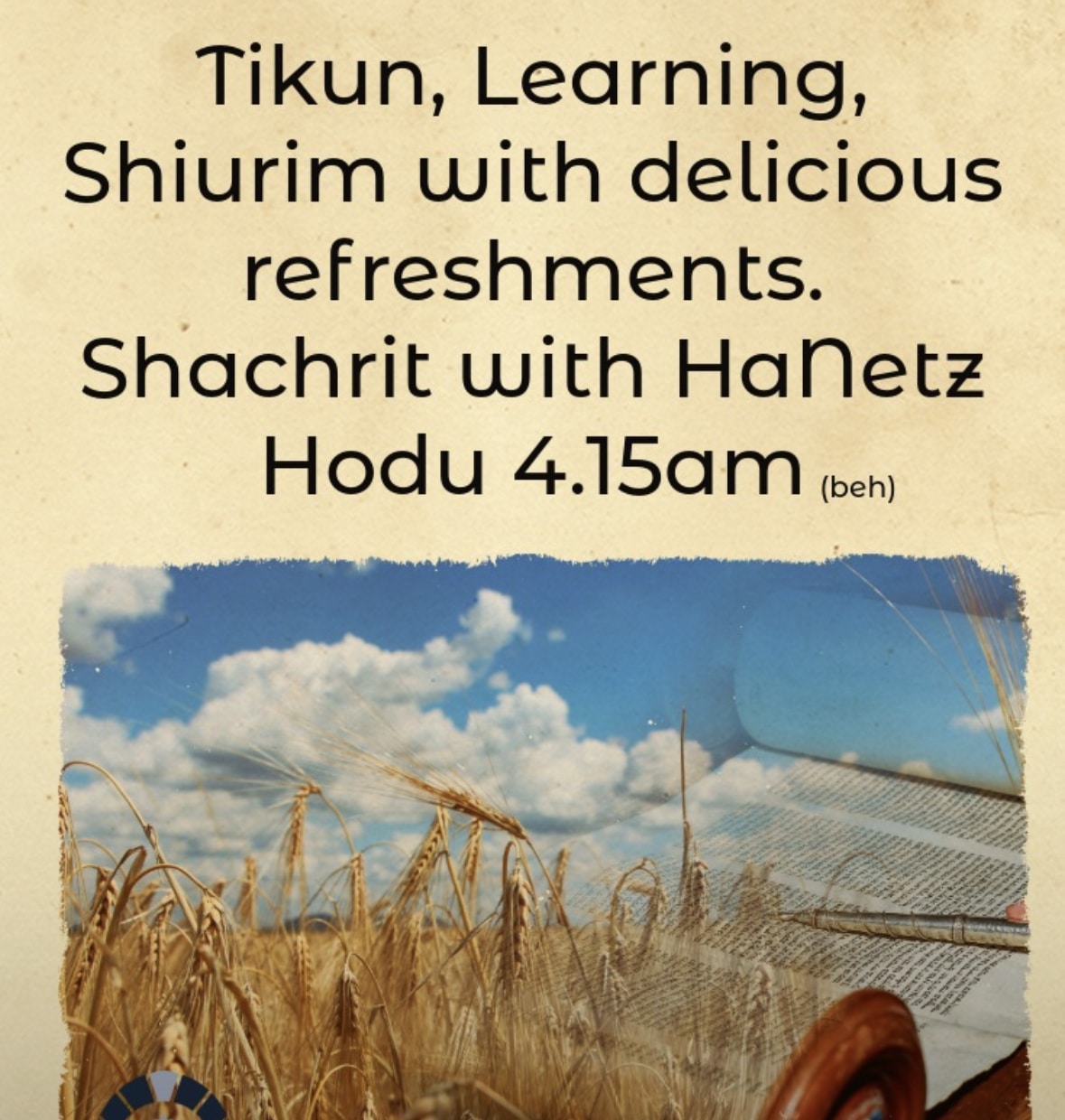


Newsletter Parashat Naso

בס״ד
Moor Lane - Logo.JPG

image.png
ק׳ ק׳ שׁערי תפילה
Have a look at our website 
*****
image.png
Please pray for the 
refua shelema of
יצחק בן יוכבד 
Yitzchak ben Yocheved
(

Follow this link to join the refua shelema WhatsApp group: https://chat.whatsapp.com/Fehwbolv3jn9lGrD125eis  )

ובתוך כל חולי ישראל בכל מקום שהם
****
image.png
****
For the next couple of weeks, 
the Torah reading in Israel 
and outside Israel will be different 
Below is an interesting article 
(from a few years ago)
explaining this phenomenon

Why Israel and Chutz La’Aretz Read Different Parshas 
(And Why We Don’t Re-Align Sooner)
Rabbi Jack Abramowitz
 
Why Do We Read Different Parshas?
This year, we have a situation that arises every so often – certainly not infrequently! In America, Europe, Australia, South Africa – basically, most of the world – the eighth and final day of Pesach falls on a Shabbos. But in Israel, where Pesach is only seven days long, the last day of the holiday is Friday. The next day is a regular, non-yom tov Shabbos (or “Shabbat,” as most people there would say). This creates the following discrepancy: in Israel, they read parshas Acharei Mos on the Shabbos that to them is the day after Pesach. In the rest of the world, where Shabbos is still observed as Pesach, we read the special portion for yom tov.
This means that the following week, Kedoshim is read in Israel and Acharei Mos is read in the rest of the world. The week after that, Emor is read in Israel and Kedoshim is read elsewhere. This goes on for fifteen weeks until the parshiyos eventually realign. This occurs when Israel reads parshas Masei and the rest of the world reads both Matos and Masei.
Fifteen weeks! Three and a half months!
Because this is a leap year (i.e., a year with an extra month of Adar), we may be looking at the maximum number of weeks possible for a discrepancy between Israel and elsewhere but in other years, the difference may be even more pronounced. If the sedras of Acharei Mos-Kedoshim, Behar-Bechukosai and Chukas-Balak were joined, as they are in most years, we might have three fewer weeks of discrepancy but an even bigger question arises: Why wait so long to re-synchronize the calendar when all we need to do is for Israel to split a double parsha?
The question is largely based on the assumption that having everybody read the same Torah portion at the same time should be the overriding concern. Before we address that assumption, let’s look at why we read the Torah the way we do.
The Rules of the Torah-Reading Schedule
Historically, the Torah was not always divided the way we read it today. Our current system was designed by the Geonim in Bavel (Babylonia) but for centuries, the triennial (three-year) cycle was popular in Israel. It is therefore not unheard of for different communities to not all be reading the same Torah portion at the same time. (It appears that things started to coalesce in the 14th century.) Nevertheless, there were always certain principles, such as that the portions of the curses in sefer Vayikra (meaning parshas Bechukosai) and in sefer Devarim (meaning parshas Ki Savo) should be read before Shavuos and Rosh Hashana, respectively; this practice is attributed to the Biblical Ezra (Megillah 31b – Tosfos there adds that parshas Bemidbar should also be read before Shavuos so that the curses in Bechukosai aren’t too close to Shavuos).
The Shulchan Aruch (OC 428:4) lays out four rules, which serve as the basis for why certain sedras may or may not be joined:
(1) The Shabbos before Pesach must be parshas Tzav in a regular year or parshas Metzora in a leap year, unless Rosh Hashana was on a Thursday, in which case it’s parshas Acharei Mos. This necessitates joining Vayakhel-Pekudei into a single parsha in most years;
(2) The Shabbos before Shavuos is parshas Bemidbar, as we have discussed. (In a leap year in which Rosh Hashana was on Thursday, it is parshas Naso.) Because of this, three sets of parshiyos in sefer Vayikra are combined in a regular (non-leap) year: Tazria-Metzora, Acharei Mos-Kedoshim and Behar-Bechukosai. (In regular years when Pesach starts on Shabbos, Behar and Bechukosai are read separately in Israel because 22 Nisan is a regular Shabbos there);
(3) Parshas Vaeschanan is read on the Shabbos after Tisha b’Av. Because of this, the parshiyos of Matos and Masei need to be combined except in leap years in which Rosh Hashana fell on Thursday or in Israel in leap years when Pesach starts on Shabbos (as is the case this year – 5779). Outside of Israel, when Shavuos falls on Friday (so that Shabbos is the second day), Chukas and Balak must also be read together;
(4) Parshas Nitzavim is read on the Shabbos before Rosh Hashana, as we have discussed. Because of this, if Rosh Hashana falls on a Monday, there will be two non-yom tov Shabboses in between Rosh Hashana and Succos. In such a case, the parshiyos of Nitzavim and Vayeilech must be split, reading Vayeilech between Rosh Hashana and Yom Kippur, so that Haazinu is read before Succos. (This is because V’Zos HaBracha needs to be read on Simchas Torah.) However, if Rosh Hashana falls on a Thursday, there is only one non-yom tov Shabbos between Rosh Hashana and Succos (the other being Yom Kippur) so Nitzavim-Vayeilech must be read as a single parsha in order the accomplish the same result.
We go into things with these four basic ground rules in place, but there are other factors to consider.
Why Don’t We Adjust Sooner?
As noted, the simple solution in most years would be for Israel to spilt a double parsha, which would cause them to realign with the rest of the world. The reason we don’t do this is explained by Rav Yissachar ben Mordechai ibn Sussan (15th century). In Tikkun Yissachar, he writes that Israel is following the predominant custom, which is presumably based on the Torah’s ideal that Pesach should be observed for seven days. It would be unseemly for the residents of Israel to tweak their practice to align with the rest of the world, whose Torah-reading schedule is “off” out of necessity, thanks to the addition of an eighth day of Pesach. And so, in Israel, they wait until the last possible juncture to combine sedras. (We’ll explain why in a moment.)
Because this year (5782) is a leap year, there are no double parshas for Israel to split, but the question still arises: why don’t the rest of us “double up” two sedras earlier, in order to catch up with Israel?
There are a number of factors. For one thing, in a leap year, combining Matos-Masei is the normal thing to do. If we combined an earlier sedra, we’d have to separate Matos and Masei, which goes against our “standard operating procedure.” (See Maharit.) But why are we so keen – both in Israel and elsewhere, to delay combining parshas to the last possible opportunity?
It seems that the appropriate course of action when doubling-up two sedras is to wait for the latest opportunity to do so. This could either be because people historically waited to combine parshas until they saw that they were going to have a problem meeting one of the four “checkpoints” described above, or simply in order to make it evident that they were “doubling up” Torah readings in order to meet one of these checkpoints.
While people might acknowledge the necessity inherent in the former hypothesis, I question its historicity, since we’ve been working with standardized calendars for far longer than we’ve had a standardized Torah-reading schedule; I therefore tend to favor the latter hypothesis. People may find it a less compelling reason but I think the logic underlying it makes perfect sense. Consider: We add an extra month of Adar to our calendar every so often in order to ensure that the following month – Nisan, in which Pesach occurs – falls in the spring. Doing it this way was a necessity in Sanhedrin times, when the calendar was set month by month, based on the testimony of witnesses. Nowadays, however, we have a calendar that will last us to eternity. We could just as easily accomplish our goal by inserting an extra Kislev or an extra Shevat. Nevertheless, we only insert an extra Adar since the additional month is only declared for the sake of the month that follows it. Similarly, I can see the logic of doubling up two Torah readings at the juncture closest to the point that actually necessitates such a change.

The Modern-Day Traveler’s Dilemma
It’s apparent that this issue has presented a halachic quandary for more than a millennium but it has really only become a point of contention for some people in the few decades, based on increasingly-common transit between Israel and diaspora communities. Being in a country reading the “wrong” parsha for one’s own schedule creates the inconvenience of trying to find a minyan reading the sedra of one’s homeland (probably easier for an American, European or Australian in Israel than vice versa) or trying somehow to “fix” things upon one’s return home.
Obviously, if one is in a place with a lot of one’s own countrymen, such as an English-speaking yeshiva in Israel or some kind of vacation resort, by all means one may read the sedra that the visiting congregation is up to even if it’s not the one being read throughout the country they’re visiting. It must be noted, however that one is not obligated to find such a minyan. Reading the Torah is a communal obligation, not an individual obligation. An individual fulfills his personal obligation through the communal reading even if it’s not the one he would have heard at home. (Yom Tov Sheini Kehilchaso 9:13-17 cites Rav Moshe Feinstein, Rav Shlomo Zalman Auerbach, Rav Shach and Rav Elyashiv on this matter.)
Nevertheless, some people seem to feel quite strongly that the ubiquity of travel between Israel and elsewhere warrants a change. I, personally, believe that such a demand may be missing the point of the enactment. The Geonim and Rishonim appear to have put a lot of thought into the matter of our Torah readings but the number of travelers between Israel and elsewhere does not appear to have been a major factor in the decision-making process. There have always been travelers between Israel and the diaspora. Even today, the number of travelers affected by this discrepancy represents a tiny minority of world Jewry. It just happens to be a somewhat larger tiny minority than in previous generations.
But What About Unity?
As far as the concept of “Jewish unity” – the idea that we should inherently all be reading the same parsha as much as possible – that’s a nice ideal but it’s not the driving force in this matter. Yes, Jewish unity is an important concept. This is stressed throughout our literature, from the idea that we camped at Sinai k’ish echad b’lev echad (like a single person with a unified purpose – Rashi on Exodus 19:2, citing the Mechilta d’Rabbi Yishmael) to the principle that kol Yisroel areivim zeh bazeh (all Jews are interconnected – Talmud Shevuos 39a. And no, that wasn’t a typo – “zeh bazeh” has a different nuance in meaning than the more familiar “zeh lazeh,” which occurs elsewhere). Jewish unity is important but it’s not the sole driving force in halacha.
Consider if you will the holiday of Purim, which occurred close to the end of the Biblical period. The Sages instituted that Purim be observed on 14 Adar. Unless one is in a city that was walled since the time of Joshua – in that case, one observes Purim on 15 Adar. And it doesn’t stop there! Take a look at the first two mishnayos in tractate Megillah: there were small villages where residents would only assemble in shuls on Mondays and Thursdays. In such villages, if 14 Adar didn’t fall on one of those days, they would observe Purim on the closest preceding Monday or Thursday. Accordingly, some people might read the megillah on 11, 12 or 13 Adar, while others read it on 14 Adar and still others read it on 15 Adar! Didn’t Chazal understand the importance of Jewish unity?
Of course they did. But they also understood that unity doesn’t mean being in lockstep. We all celebrate Purim in mid-Adar but the needs of different communities may affect exactly when that is. It may be inconvenient for a person if he’s in Jerusalem on 14 Adar and in Tel Aviv on 15 Adar – neither of which is observed as Purim – but we’re not about to change the practice because of such commuters.
The same is true of our Torah-reading schedule. All of Jewry now observes the one-year cycle, and we are sure to re-align at four points in the year, as detailed above. In between those points, however, there’s “wiggle room” that enables different communities to meet different halachic needs. Yes, there are some world travelers who may be inconvenienced by the differences between Israel and elsewhere but, as with those who commute in and out of Jerusalem in Adar, the onus is on the individual to adjust to the community, not vice versa.
The fact that we may sometimes read different sedras for weeks – or even for months – is a celebration of our individuality. The fact that we always make sure to re-align is a sign of our unity.
*****
🕯️שבת🕯️

לוח זמני  תפילה לקיץ תשפ״ו

Summer Timetable 5786 – 2026

מוצאי שבת

ערבית

)מוצ”ש(

סוף זמן קריאת שמע

זמן שבת

מנחה וקבלת שבת

תאריך

שבת פרשת

Shabbat

Ends

Arbit

Shema to be read before

Candles to be
lit by

Minha & Kabbalat Shabbat

Date

Parasha

PM

PM

AM

PM

PM


10:38

10:34

8:57

9:09

7:30

29/30
May

נשא


For those not in the Bet Hakeneset, but wishing to bring in Shabbat with the Kahal, candles should be lit about 30 minutes after the time listed for Minha and Kabbalat Shabbat. Unless the time listed in the ‘latest candle lighting’ column is earlier, when candles should be lit by that time, in all cases.

*****

🕯️SUMMER TIMES FOR SHABBAT 🕯️

שבת

מנחה וקבלת שבת

7:30 pm

קרבנות

9:00 am
הודו

9:15 am

מנחה של שבת

6:30 pm

********

image.png
Avot Ubanim Summer Season 
Every Shabbat Afternoon
@ 5:30 pm

******

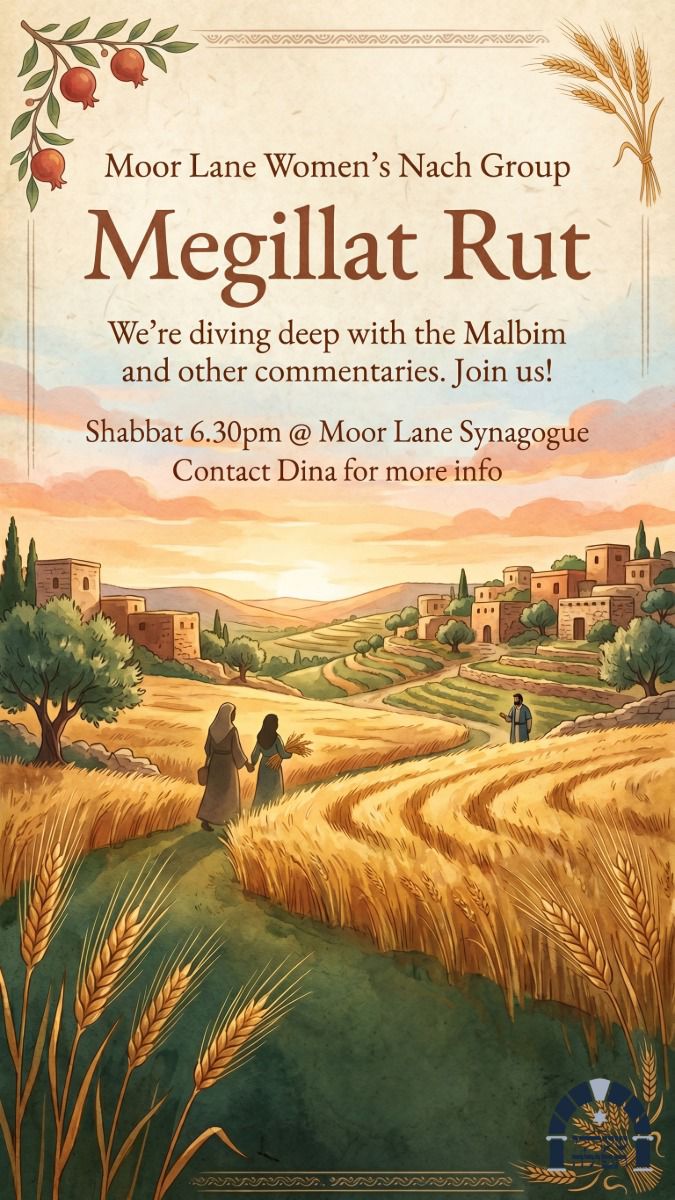
🪉Moor Lane Women’s Nach Group🪉

BACK NEXT WEEK

STAY TUNED

*******

📜
Parasha Overview

The Torah assigns the exact Mishkan-related tasks to be performed by the families of Gershon, Kehat, and Merari, the sons of Levi. A census reveals that over 8,000 men are ready for such service. All those ritually impure are to be sent out of the encampments.

If a person, after having sworn in court to the contrary, confesses that he wrongfully retained his neighbor’s property, he has to pay an additional fifth of the base-price of the object and bring a guilt offering as atonement. If the claimant has already passed away without heirs, the payments are made to a kohen.

In certain circumstances, a husband who suspects that his wife had been unfaithful brings her to the Temple. A kohen prepares a drink of water mixed with dust from the Temple floor and a special ink that was used for inscribing G-d's Name on a piece of parchment. If she is innocent, the potion does not harm her, but, rather, it brings her a blessing of children. If she is guilty, she suffers a supernatural death.

Nazir is one who vows to dedicate himself to G-d for a specific period of time. He must abstain from all grape products, grow his hair and avoid contact with corpses. At the end of this period he shaves his head and brings special offerings. The kohanim are commanded to bless the people. The Mishkan is completed and dedicated on the first day of Nissan in the second year after the Exodus. The prince of each tribe makes a communal gift to help transport the Mishkan, as well as donating identical individual gifts of gold, silver, animal and meal offerings.

*******
image.png  

Halachot from Maran Rabbi Ovadia Yosef Ztz'l

שאלה: האם חובה להמתין שש שעות בין אכילת מאכלי בשר לאכילת מאכלי חלב?

היום
הוא יום עשירי בטבת, והדינים השייכים אליו נתבררו
בהלכה מיוחדת

תשובה
:
בגמרא
במסכת חולין (דף קה.) אמר מר עוקבא (שם חכם), אבא שלי, כשהיה אוכל בשר, לא היה
אוכל גבינה אלא למחרת, ואילו אני, באותה סעודה איני אוכל בשר ואחר כך גבינה, אבל
לסעודה אחרת אני אוכל גבינה. וכתב הרי”ף, שמכאן אנו למדים, שאין לאכול גבינה
אחר בשר, אלא אם ישהה שיעור שבין סעודה לסעודה
. (ועל סגנון דברי
הגמרא, נדון בהלכה הבאה
).

כמה
יש להמתין בין אכילת בשר לאכילת חלב

נחלקו
רבותינו הראשונים כמה זמן יש להמתין, שדעת רבינו תם, שמותר לאכול גבינה מיד אחרי
אכילת בשר, ובלבד שינקה את פיו ואת ידיו. ולשיטתו צריך לפרש, שמר עוקבא שהיה ממתין
מסעודה לסעודה, מחמיר על עצמו היה, ואמר על עצמו שאינו מחמיר כל כך כמו אביו. אבל
אין בהמתנה זו חיוב מן הדין. אולם רוב הראשונים חלקו על דברי רבינו תם, ובהם:
הרי”ף, והרמב”ם ועוד. ופירשו שמה שהיה מר עוקבא ממתין שיעור זמן “שבין
סעודה לסעודה”, מן הדין היה עושה כן, ואמר שאינו נוהג חומרא כמו אביו שהיה
ממתין עשרים וארבע שעות. וכן פסק מרן השולחן ערוך, שמן הדין יש להמתין שיעור זמן
שבין סעודה לסעודה
.

וכמה
הוא שיעור הזמן שבין סעודה לסעודה שיש להמתין? דעת התוספות, שאין קצבה לשיעור זה,
אלא כל שסיים את סעודתו, כגון שכבר פינו את השולחן, רשאי לאכול מאכלי חלב אחרי
מאכלי בשר
.

אולם
דעת רוב הראשונים, שיש להמתין שש שעות בין אכילת בשר לאכילת גבינה, שזהו ההפרש בין
סעודה לסעודה שאמר מר עוקבא. וכן דעת הרמב”ם, שיש להמתין שש שעות, וכן פסק
מרן השלחן ערוך, וגם הרמ”א כתב שכך נכון לעשות, אף על פי שיש חולקים. ואף שיש
מן האשכנזים שמיקלים בפחות משש שעות, כתב מרן החיד”א, שבגלילותינו המנהג פשוט
לכל אדם להמתין שש שעות. וכתב המהרש”ל (רבי שלמה לוריא מגדולי פוסקי אשכנז
סמוך לזמן מרן) שאף למנהג האשכנזים, כל מי שיש בו ריח תורה ראוי לו להחמיר להמתין
שש שעות. ובספר ערוך השולחן (להגאון רבי יחיאל מיכל אפשטיין לפני למעלה ממאה שנים)
כתב שכיום אף מנהג רוב האשכנזים להחמיר בזה, וחלילה לשנות
.

מדוע
יש להמתין בין אכילת בשר לגבינה

וטעם
הדבר שלא לאכול גבינה אחרי בשר הוא משום בשר שנכנס בין השינים, ויש לחוש שכאשר
יאכל גבינה, יצא הבשר מבין שיניו ונמצא אוכל בשר וגבינה ביחד, וכך היא דעת
הרמב”ם. אולם לשיטת רש”י והרא”ש הטעם הוא מפני שהבשר מוציא טעם בפה
זמן ארוך. ולהלכה אנו נוקטים כשני הטעמים, ולכל הדעות אחרי שש שעות יכול לאכול
גבינה, ואף לשיטת הרמב”ם שסובר שיש לחוש לבשר שבין השינים, מכל מקום אחרי שש
שעות הבשר נחשב כבר מעוכל ואין לחוש לו. ומכל מקום אם יודע בפירוש שיש בשר בין
שיניו, צריך להסירו אף לאחר שש שעות
.

ולהלן
יבואר הדין אחר אכילת בשר עוף, ויבוארו עוד פרטי דינים בזה

Question: Is one obligated to wait six hours after eating
meat foods before eating dairy foods?

Answer: The Gemara in Masechet Chullin
(105a) states: “Mor Ukva said: When my father would eat meat, he would not
eat cheese until the next day. Regarding myself, however, within the same meal
I do not eat meat and then cheese, but I would eat cheese during the next
meal.” The Rif writes that we learn from here that one may eat cheese
after meat only after having waited the amount of time that is between one meal
and the next. (We shall deal with the Gemara's wording in the next Halacha,
G-d-willing.)

How Much One Must Wait Between Eating Meat and Dairy
The Rishonim disagree regarding exactly how much time one must wait. Rabbeinu
Tam is of the opinion that one may eat cheese immediately after eating meat as
long as one has washed out his mouth and cleaned his hands. Based on this, Mor
Ukva who would wait from one meal to the next was acting stringently about
which he exclaimed that he did not act as stringently as his father.
Nevertheless, this wait is not a halachic requirement. However, most Rishonim,
including the Rif, Rambam, and others, disagree with Rabbeinu Tam's opinion.
They understand that when Mor Ukva waited the amount of time “between one
meal and the next,” this was indeed a halachic requirement to which he
exclaimed that he did not act as stringently as his father who would wait
twenty-four hours. Indeed, Maran HaShulchan Aruch rules likewise that
halachically speaking, one must wait the amount of time that is “between
one meal and the next.”

What is the amount of time “between one meal and the next” that one
must wait? The Tosafot write that there is no actual time limit and as long as
one has concluded his meal, such as by clearing the table, one may eat dairy
foods after meat.

Nevertheless, most Rishonim agree that one must wait six hours between eating
meat and dairy foods, for this is the amount of time “between one meal and
the next” that Mor Ukva was speaking about. This is indeed the opinion of
the Rambam and Maran HaShulchan Aruch that one must wait six hours. The Rama
writes that this is indeed the correct opinion to follow although there are
dissenting views. Although there are certain Ashkenazi communities who act
leniently and wait less than six hours, Maran Ha'Chida writes that in our
communities, the established custom is for everyone to wait six hours. The
Maharshal (Hagaon Rabbeinu Shlomo Luria, one of the greatest Ashkenazi Poskim
close to the generation of Maran) writes that even according to the Ashkenazi
custom, anyone who has a “scent of Torah” within him should wait six
hours. The Sefer Aruch HaShulchan (authored by Hagaon Harav Yechiel Michel
Epstein zt”l who lived over one-hundred years ago) writes that
nowadays, the prevalent custom among most Ashkenazim as well is to wait six
hours and one should not change this, G-d-forbid.

The Reason to Wait between Eating Meat and Dairy Foods
The reason why eating cheese after meat is prohibited is because meat gets
stuck in between the teeth and we are concerned that when one eats cheese, the
meat caught in between one's teeth will become dislodged thereby causing one to
be eating meat and cheese together. This is indeed the Rambam's opinion. On the
other hand, Rashi and the Rosh explain that the reason is because meat gives
off a taste in one's mouth for a long time. Halachically speaking, we follow
both opinions and after six hours, one may eat cheese. Even according to the
opinion of the Rambam who is concerned for meat get stuck in one's teeth, after
six hours, the meat is considered digested and poses no concern anymore.
Nevertheless, if one is aware of a piece of meat stuck in his teeth, one must
remove it even after six hours have passed.

We shall discuss some related laws as well as the laws of eating dairy foods
after chicken or poultry in a following Halacha


 

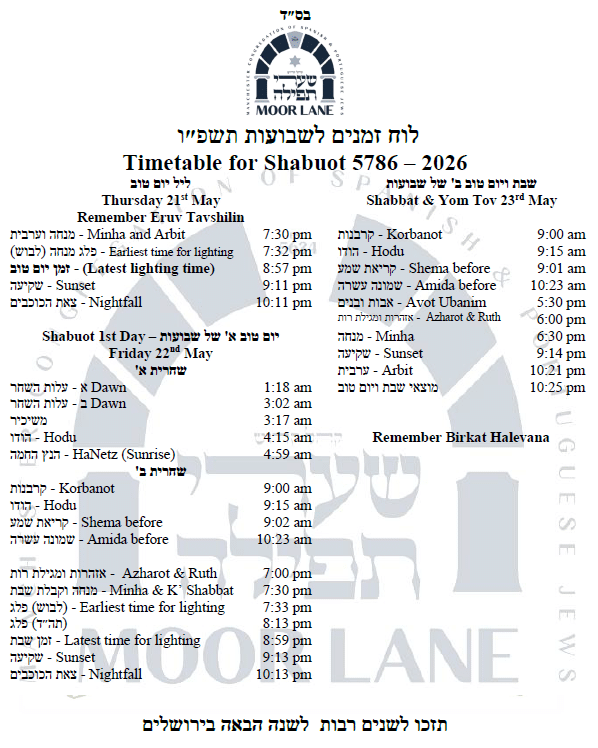
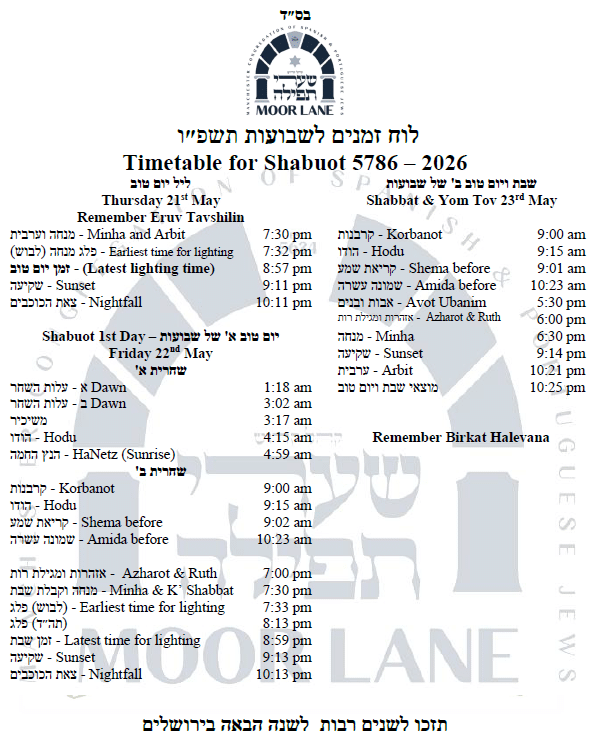
Newsletter Shavuot 5786 – Eruv Tavshilin

בס״ד
Moor Lane - Logo.JPG

image.png
ק׳ ק׳ שׁערי תפילה
Have a look at our website 
*****
image.png
Wishing all members & friends
חג שמח ומועדים לשמחה

🌺🌺⛰️🌺🌺 

*****
image.png
****
image.png
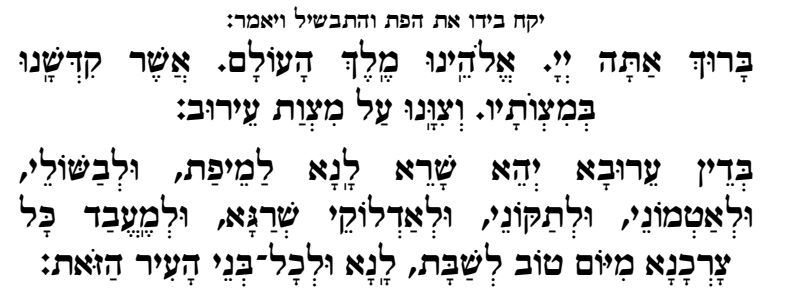
Remember Eruv Tavshilin
Eruv Tabshilin.jpg
*****
תיקון ליל שבועות
40304.jpg
*****
PHOTO-2026-05-18-14-28-02.jpg
*****
Minhagim

‘Aseret HaDiberot – The Ten Commandments

It is the minhag of all Jews from North Africa, as well as our brothers, the Ashkenazim, to stand up during the reading of the ‘Aseret HaDiberot (the Ten Commandments) on Shabu’ot, Shabat Yitro, and Shabat VaEthanan, to commemorate the time when Yisrael stood at Har Sinai as if we are once again welcoming the face of the Shekhina (Divine Presence) and accepting the Tora.[1]

However, Rambam[2] writes not to stand for the ‘aseret hadiberot because the heretics will claim, “we only attribute importance to these ten misvot as they are the only ones that are true; the rest of the Tora is not true,” has veshalom. The reason we continue to follow this minhag, is because the heretics at the time of Rambam were much different then the heretics of today as heretics of today do not make such claims.[3] Ribi Shalom Messas[4] is also of this opinion and explains further that whether we were to remain seated or we stood during the ‘aseret hadiberot it would not change the perception of the heretics; either way they would find ways to deny the Tora. Also, it is clear that since we continue to read the remainder of the parasha – and not solely the ‘aseret hadiberot – there is no reason to worry about such claims.[5] Ribi Yehuda ‘Ayash of Algeria is also of this opinion and writes that the claims of the heretics could only persuade an ignoramus of nowadays using such logic.[6] Furthermore, Maran HaHida[7] explains that since we make berakhot before and after each ‘aliya latora – and not just the ‘aliya of the ‘aseret hadiberot – we have no worry that heretics will make a claim that the rest of the Tora is untrue.

Maran HaHida[8] cautions us, however, to stand from the beginning of the ‘aliya in order to show that we stand for other pesuqim as well. He also adds that it is very important that if the majority of the congregation is standing, one is NOT allowed to sit, as this illustrates a belittlement of the ‘Aseret HaDiberot, G-d forbid. Nonetheless, the majority of Moroccan posqim write that the common minhag is to stand only upon reaching the ‘Aseret HaDiberot for we are not concerned about the claims of the heretics at all.[9]

It was the tradition to gather women together and read them these Ten Commandments, in Arabic “ ‘Asr Klmat,” along with its explanation according to Hazal.[10]

Certain parts of the parasha are read in a special tune, among them the ‘Aseret HaDiberot and the Shirat HaYam in order to ascribe special importance to these sections of the Tora as they speak about the high spiritual level of Bené Yisrael and not, has veshalom, to say that they are more important than the rest of the Tora.[11]


 The minhag of 

Spanish & Portuguese 
Synagogues & Communities 
is to STAND during 
the reading of the Aseret Hadiberot
Mekorot


[1] As the Tora says “they were standing at a distance.” This minhag is cited by Dibré Shalom VeEmet (Heleq 2, p.72). Sefer Mamlekhet Kohanim records that this was also the minhag in Djerba and mainland Tunisia, Noheg BeHokhma p.143, QS”A Toledano (Siman 442:9), Yehavé Da’at Hazan (Heleq 3, O”H, Siman 13), Maté Yehuda ‘Ayash (Siman 1:6), Dabar Shemuel by Ribi Shemuel Abuhab (Siman 276), Kapé Aharon (Siman 39), and Sedé Hemed (Kelalé HaPosqim, Siman 5:14). In Shemesh Umaghen (Heleq 1, O”H, Siman 57, p.130) Ribi Shalom Messas solidifies our custom to stand based on the fact that today we do not have the same type of heretics that they had in the times of Hazal and because of whom this minhag was spoken out fiercely against. Maran HaHida (LeDavid Emet Siman 7:5) further says that one should stand in order to stir feelings of fear and trepidation as were felt at Har Sinai.

 [2]In his handwritten responsa that was compiled along with approximately 367 other responses in 1934. (Siman 46).

 [3] Ribi Moshé Feinstein’s response, Igerot Moshé (Heleq 4, O”H Siman 22).

 [4] Shemesh Umaghen (Heleq 1, O”H Siman 57 p.130-1) and (Heleq 3, O”H Siman 55:3).

 [5] Maghen Abot (Siman 1, p.53-4): Diné Hashqamat HaBoqer.

 [6] Maté Yehuda (Siman 1:6).

 [7] LeDavid Emet (Siman 7:5).

 [8] Toub ‘Ayin (Siman 11).

 [9] Ribi Yehuda ‘Ayash of Algeria (Maté Yehuda Siman 1:6), Ribi Yishaq Hazan (Yehavé Da’atHeleq 3, Siman 13), Ribi Yosef Messas in Osar HaMikhtabim (Heleq 3, §1859), and HaMalakh Refael Berdugo as quoted by the QS”A of Ribi Refael Barukh Toledano (p.174), all say that the common minhag is to stand only once we reach the ‘Aseret HaDiberot. This is also the minhag of Tunisia (Mamlekhet Kohanim) and Libya (Netibot HaMa’arab, Shabu’ot §12).

 [10] This is to make the Tora more pleasant to them, and with this they should be more helpful to their husbands in facilitating their Tora learning. See Nahagu Ha’Am (Shabu’ot §5, p.57) as the source and for the lyrics in Arabic.

 [11] See Noheg BeHokhma (p.145 §13).
*****

🍸

Explanation of the היתיר – leniency, 

to make קידוש early on ליל שבועות

יש אומרים שבליל חג השבועות אין לקדש על הכוס עד שיהיה ודאי לילה, [שהוא כרבע שעה לאחר שקיעת החמה]. שאם יקדש מבעוד יום הרי הוא כמחסר קצת מיום מ''ט לספירה, וכתוב: ''שבע שבתות ''תמימות'' תהיינה''.

 ויש חולקים ואומרים שאין לחוש לכך, ושכן פשט המנהג לקדש אף מבעוד יום, ולכן לכתחילה נכון להמתין מלקדש עד לאחר שעברו עשרים דקות מהשקיעה, ובפרט במקומות אלו שאפשר לחשוש לדברי האחרונים ולהמתין עד הלילה, שנכון לעשות כן.

 ומכל מקום בשעת הצורך הרוצה לסמוך על המקילים, ולקדש על הכוס מבעוד יום ולהוסיף מחול על הקודש יש לו על מה שיסמוך. שכן הוא מעיקר הדין, וגם המנהג כן. 

ובפרט בארצות אירופה וכדומה, שהשקיעה מתאחרת מאד בימי הקיץ, ובני הבית מצטערים לשבת ולהמתין עד הלילה, וגם זה גורם הפרעה לסדר לימוד הלילה בספר קריאי מועד, כפי שנוהגים על פי הזוהר והאר''י ז''ל, שיש להקל להם לקדש ולסעוד מבעוד יום. ואם אפשר טוב שימתינו עד תחילת השקיעה, באופן שהשמש מתכסית מעינינו, ואז יקדשו ויסעדו. וטוב שיאכלו כזית לחם בצאת הכוכבים, ועליהם תבוא ברכת טוב. [יחוה דעת חלק ו' סימן ל. חזון עובדיה חלק א' סימן א. יביע אומר חלק ה' סימן ו' סק''ה. הליכות עולם חלק ב' עמוד ג'].

*******

Here are seven reasons why we read the Megillah of Ruth on Shavuot:

  1. The events occurred during the harvest season. Shavuos is the harvest festival.
  2. Ruth was a convert to Judaism. Conversion is an individual Kabbalas HaTorah.
  3. Ruth the Moabite was permitted to marry Boaz, based on a drasha (a teaching of the Oral Law) of the verse, “A Moabite may not marry into the Congregation of Hashem” (Devarim 23:4). This hints at the unity between the Written Torah and the Oral Torah.
  4. David Hamelech was born on Shavuos. The Megillah of Ruth concludes with David's lineage.
  5. To teach the greatness of gemillus chassadim – acts of loving-kindness.
  6. To teach that the Torah is acquired only through affliction and poverty.
  7. The name “Ruth” has the numerical value of 606. At Har Sinai the Jewish People accepted 606 mitzvos, in addition to the 7 Noachide Laws which were incumbent upon them already.
*****
Q & A on Megilat Rut
Questions
  1. Who wrote the Book of Ruth?
  2. During which historical period did the events of the Megillah of Ruth occur?
  3. Who was Naomi's husband?
  4. After she returned from Moav, by what name did Naomi ask to be called?
  5. How was Boaz related to Naomi?
  6. Into what did Boaz tell Ruth to dip her bread?
  7. Why is Elimelech's brother referred to as Ploni Almoni and not by his real name?
  8. With what object did Boaz redeem Elimelech's property?
  9. The people and the elders blessed Ruth that she should be like whom?
  10. What was Ruth's relationship to King David?
Answers
  1. The Prophet Samuel (Bava Batra 14b).
  2. During the era of the Shoftim, the Judges. Boaz was the shofet at the time (1:1).
  3. Elimelech. (1:2).
  4. Mara (1:20).
  5. He was her husband's brother's son. (2:1, Rashi).
  6. Vinegar (2:14).
  7. Since he didn't want to redeem his brother's property and thereby discharge his family duty (Rashi 4:1).
  8. With a shoe (according to the Targum, a glove) (4:8).
  9. Like Rachel and Leah (4:11).
  10. She was his great-grandmother: Ruth, Oved, Yishai, David (4:22).
**
****

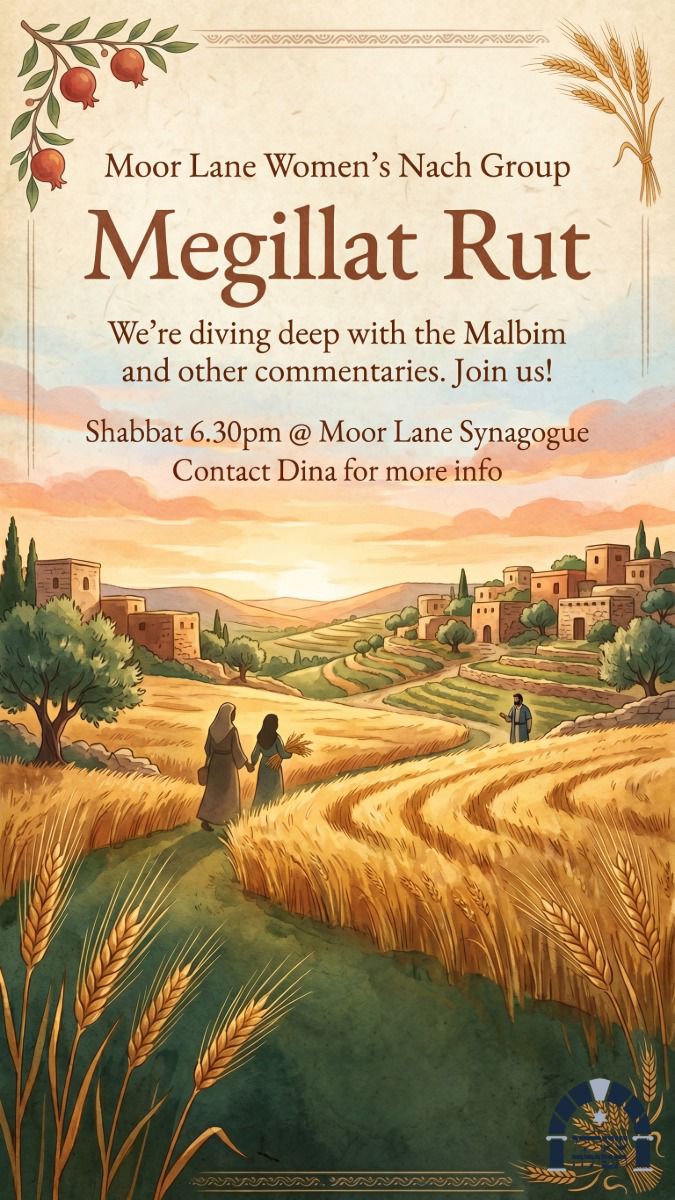
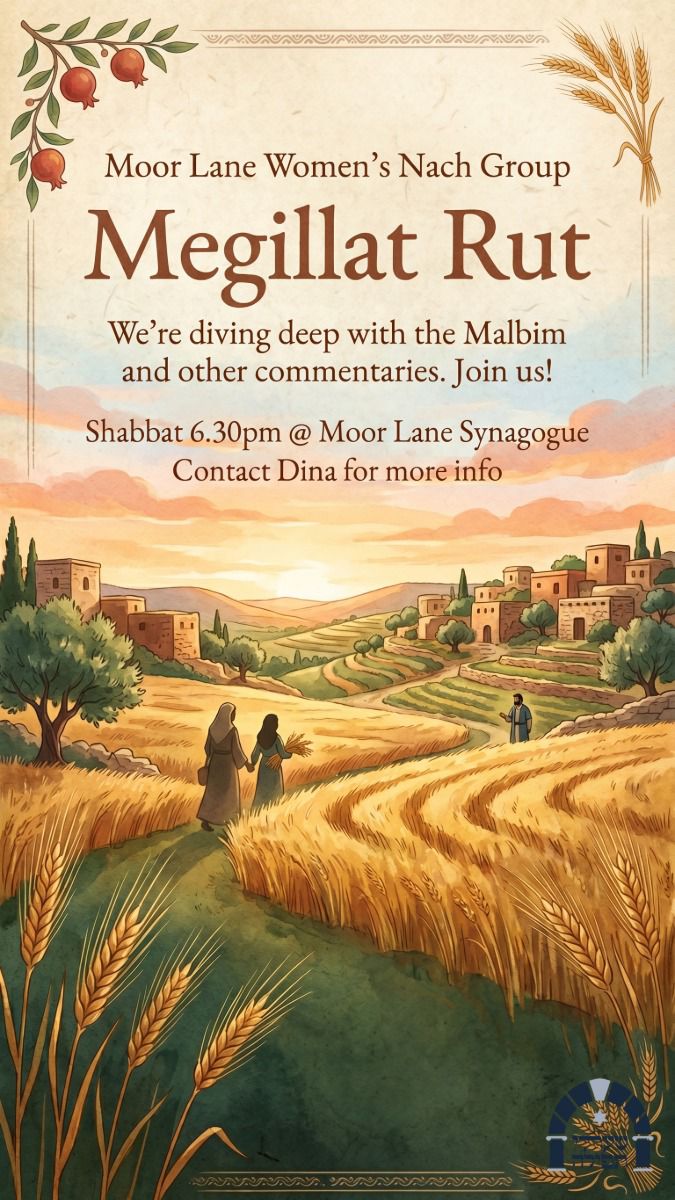
🪉Moor Lane Women’s Nach Group🪉

🪻🌷🌹🌺🌼🪷🌹🌷🪻

PHOTO-2026-04-22-09-42-40.jpg

🌹🌺 SHABBAT – 2nd day of Shavuot 🌺🌹
PHOTO-2026-05-13-19-32-37.jpg

*******

📜
Parasha Overview

*******
image.png  

Halachot from Maran Rabbi Ovadia Yosef Ztz'l

מקלחת ביו”ט

שאלה: האם מותר להתקלח במים חמים ביום טוב, (פסח, שבועות וסוכות)?

תשובה: ביארנו כבר, שאף על פי שדין יום טוב שוה לדין השבת באיסור עשיית מלאכה, מכל מקום יש כמה מלאכות שמותר לעשותן ביום טוב. ובתנאי שתהיינה המלאכות שוות לכל נפש. ולכן מותר ביום טוב לבשל לצורך יום טוב עצמו, בתנאי שלא יבעיר אש חדשה ביום טוב, אלא יעביר אש מאש אחרת הדלוקה כבר.

לפיכך, מותר לעשות ביום טוב מדורה בכדי להתחמם כנגדה בימי הקור, שהרי היא הנאה השווה לכל נפש, שכל בני האדם זקוקים לחימום. (ובתנאי שלא יבעיר אש חדשה, אלא יעביר אש מאש הדלוקה כבר).

ומטעם זה מותר גם כן לחמם מים ביום טוב (באמצעות בוילר חשמלי שהופעל מערב יום טוב, לפני שקיעת החמה), בכדי לרחוץ בהם את פניו ידיו ורגליו, שהיא הנאה “השוה” לכל נפש. אבל אסור לחמם מים בכדי לרחוץ את כל גופו, שאין זו הנאה השווה לכל נפש, לרחוץ את כל גופו בכל יום ויום.

ומכל מקום, הואיל ואין איסור עצמי לרחוץ את כל גופו ביום טוב במים חמים, רק האיסור הוא מצד צורת חימום המים ביום טוב, לכן, מים שהוחמו מערב יום טוב (כלומר לפני שקיעת החמה בערב יום טוב), מותר לרחוץ בהם כל גופו ביום טוב, שלא גזרו בזה רבותינו איסור אלא בשבת, כמו שביארנו כבר בהלכות שבת. וכמו כן מים שהוחמו על ידי דוד שמש ביום טוב עצמו, מותר לרחוץ בהם כל גופו ביום טוב. (וכל זה דוקא באמבטיה פרטית בביתו של כל אדם, אבל בבית המרחץ ציבורי, כגון בפנימיה שיש שם כמה מקלחות, אין להקל לרחוץ במים חמים ביום טוב אפילו רק פניו ידיו ורגליו, הואיל וגזרו בזה רבותינו איסור בזה, מפני שהבלנים האחראים על בתי המרחץ היו מזלזלים ומחממים מים באיסור(.

ולסיכום: מותר לרחוץ כל גופו ביום טוב במים חמים שהוחמו על ידי בוילר מערב יום טוב, או במים שהוחמו על ידי דוד שמש אפילו ביום טוב עצמו. ודין זה הוא דוקא באמבטיה פרטית שבביתו של כל אדם. אבל מים שהוחמו ביום טוב עצמו על ידי בוילר חשמלי שהודלק מערב יום טוב וממשיך את פעולתו ביום טוב עצמו, אסור להשתמש בהם ביום טוב לרחיצת כל גופו, אבל מותר לרחוץ במים הללו, את פניו ידיו ורגליו.

ולשאלת רבים, בדבר מים שהוחמו מערב יום טוב על ידי בוילר חשמלי. והבוילר ממשיך לפעול ביום טוב עצמו, ועל ידי כך נשמרת חמימות המים, האם מותר להשתמש במים אלה ביום טוב?

שאלנו על כך את מרן רבינו עובדיה יוסף זצ”ל, והשיב, שאם המים התחממו היטב מערב יום טוב, ופעולת הבוילר ביום טוב אינה אלא בכדי לשמור את חמימות המים, אבל לא בכדי לחממם מחדש, מותר לרחוץ בהם כל גופו ביום טוב.

ומכל מקום נראה שצריך להזהר, שלא יכנסו מים חדשים לדוד המים הרותחים, שעל ידי כך הוא מבשל את המים החדשים שנכנסים לדוד המים החשמלי. ועל כן עיקר ההיתר בדבר, הוא דוקא באופן שסוגר את ברז המים המזרים מים לדוד, בכדי שלא יכנסו שוב מים צוננים לדוד החשמלי. אבל אם אינו סוגר את ברז המים, לכאורה אין להקל בדבר. ועוד חזון למועד.


Showering on Yom Tov

Question: Is it permissible to take a hot shower on Yom Tov (i.e. Pesach, Shavuot, and Sukkot)?

Answer: We have previously established that although Yom Tov is equal to Shabbat regarding the prohibition of work, nevertheless, there are some forms of work which may be performed on Yom Tov, provided that they are works are enjoyable by all. Thus, one may cook something on Yom Tov to be eaten on Yom Tov itself, as long as he does not create a new fire on Yom Tov, rather, he should use a flame from a pre-existing fire.

Additionally, one may light a bonfire on Yom Tov in order to use it for warmth during the cold season, since this is considered an “enjoyment equal to all” (meaning everyone enjoys such a thing), as all indeed require warmth (once again, provided that one does not create a new fire, rather, only transfers a flame from a pre-existing fire.)

For the same reason, one may heat water on Yom Tov (using an electric/gas boiler that was already turned on from before sunset on Erev Yom Tov) in order to wash his face, hands, and feet, for this too is considered an “enjoyment equal to all.” However, one may not heat water on Yom Tov in order to wash his entire body, for washing one’s entire body daily is not considered an “enjoyment equal to all.”

Nevertheless, since the only prohibition involved here is regarding the way the water is heated on Yom Tov whereas the actual act of washing one’s entire body with hot water is not forbidden, one may indeed wash his whole body on Yom Tov with water that was heated before Yom Tov (i.e. before sunset on Erev Yom Tov), as our Sages did not ban this on Yom Tov as they did on Shabbat. Similarly, water that was heated through a solar heating tank (a.k.a. “Dud Shemesh,” common in Israel) on Yom Tov itself may be used to wash one’s entire body on Yom Tov. (All this applies only in one’s private shower at home, however, regarding a public shower room, such as in a dormitory where there are several shower stalls, one may not use the hot water from these showers even to wash his face, hands, and feet, for our Sages forbade washing with hot water in public places since the public bathhouse attendants would act derisively and heat up the water in forbidden ways.)

Summary: One may wash his entire body on Yom Tov either with water that was heated through an electric/gas boiler before the onset of Yom Tov or with water heated in a solar heating tank even on Yom Tov. This only applies, however, to one’s private shower at home. Nevertheless, water that was heated on Yom Tov itself through an electric/gas boiler that was turned on before the onset of Yom Tov yet continues to operate on Yom Tov may not be used to wash one’s entire body; however, one may use this water to wash his face, hands, and feet.

By popular request: Regarding water that was heated in an electric/gas boiler before the start of Yom Tov and the boiler continues to work on Yom Tov, causing the water to retain its heat, is it permissible to use this water on Yom Tov?

We had posed this question to Maran Rabbeinu Ovadia Yosef zt”l and his response was that if the water was heated well before the onset of Yom Tov and the boiler’s operation on Yom Tov serves only to retain the water’s heat but not to reheat it, one may use this water to wash his entire body on Yom Tov.

Nevertheless, one must take care that no new water enter the hot-water tank, for if so, by showering one is causing the new water entering the tank to be cooked. Thus, the only way it will be permissible to shower on Yom Tov (using water from an electric/gas boiler) is only if the cold-water valve, through which new water enters the hot-water tank, is shut. However, if one does not shut the cold-water valve, it seems there is no room for leniency in this matter.

Newsletter Parashat Bamidbar – Shabbat Mevarechim

בס״ד
Moor Lane - Logo.JPG

image.png
ק׳ ק׳ שׁערי תפילה
Have a look at our website 
***

image.png
שבת מברכים

THIS SHABBAT 

is  

שבת מברכים

Reminder
there will be NO derasha this week
instead we will have the 
kahal recitation of Sefer Tehilim
*******

image.png

THIS SHABBAT

we will be reading the Haftara of 

Machar Chodesh

********

ראש חודש
image.png
Rosh Chodesh Sivan
Motzae Shabbat / Sunday 17th May
****
Shabuot Timetable attached to this email
image.png
****
🕯️שבת🕯️

לוח זמני  תפילה לקיץ תשפ״ו

Summer Timetable 5786 – 2026

מוצאי שבת

ערבית

)מוצ”ש(

סוף זמן קריאת שמע

זמן שבת

מנחה וקבלת שבת

תאריך

שבת פרשת

Shabbat

Ends

Arbit

Shema to be read before

Candles to be
lit by

Minha & Kabbalat Shabbat

Date

Parasha

PM

PM

AM

PM

PM


10:10

10:06

9:06

8:48

7:30

15/16
May

במדבר 

(ש''מ)(מחר חודש)


For those not in the Bet Hakeneset, but wishing to bring in Shabbat with the Kahal, candles should be lit about 30 minutes after the time listed for Minha and Kabbalat Shabbat. Unless the time listed in the ‘latest candle lighting’ column is earlier, when candles should be lit by that time, in all cases.

*****

🕯️SUMMER TIMES FOR SHABBAT 🕯️

שבת

מנחה וקבלת שבת

7:30 pm

קרבנות

9:00 am
הודו

9:15 am

מנחה של שבת

6:30 pm

********

image.png
Avot Ubanim Summer Season 
Every Shabbat Afternoon
@ 5:30 pm

******

🪉Moor Lane Women’s Nach Group🪉

🪻🌷🌹🌺🌼🪷🌹🌷🪻

PHOTO-2026-04-22-09-42-40.jpg

🌹🌺 Save the Date 🌺🌹
PHOTO-2026-05-13-19-32-37.jpg

*******

📜
Parasha Overview

The Book of Bamidbar — “In the desert” — begins with Hashem commanding Moshe to take a census of all men over age twenty — old enough for service. The count reveals just over 600,000. The levi'im are counted separately later on because their service will be unique. They will be responsible for transporting the Mishkan and its furnishings, and assembling them when the nation encamps. The 12 Tribes of Israel, each with its banner, are arranged around the Mishkan in four sections: east, south, west and north. Since Levi is singled out, the tribe of Yosef is split into two tribes, Efraim and Menashe, so there will be four groups of three. When the nation travels, they march in a formation similar to the way they camp.

A formal transfer is made between the first-born and the levi'im, whereby the levi'im take over the role the first-born would have had serving in the Mishkan if not for the sin of the golden calf. The transfer is made using all the 22,000 surveyed levi'im from one month old and up. Only levi'im between 30 and 50 will work in the Mishkan. The remaining first-born sons are redeemed with silver, similar to the way we redeem our first-born today. The sons of Levi are divided into the three main families of Gershon, Kehat and Merari (besides the kohanim — the special division from Kehat's family). The family of Kehat carried the Menorah, the Table, the Altar and the Holy Ark. Because of their utmost sanctity, the Ark and the Altar are covered only by Aharon and his sons, before the levi'im prepare them for travel.

*******
image.png  

Halachot from Maran Rabbi Ovadia Yosef Ztz'l

רישיון נהיגה – לשון הרע

שאלה: אדם שמבקש לקבל רשיון נהיגה, וידוע לי שהוא אינו מסוגל מבחינה בריאותית לנהוג, האם עלי להודיע למשרד הרישוי על בעיה זו?

תשובה: כתב הרמב”ם (בפרק א מהלכות רוצח), וזו לשונו: כל היכול להציל את חברו ואינו מצילו, עובר על “לא תעמוד על דם רעך”, לפיכך הרואה את חברו טובע בים, או שלסטים באים עליו, ויכול להצילו, או ששמע שאנשים חושבים עליו רעה וטומנים לו פח, ולא גילה את אוזן חבירו להודיעו, הרי זה עובר על מה שנאמר בתורה “לא תעמוד על דם רעך”.

והנה אמנם מבואר בדברי הרמב”ם (פ”ז מה' עדות), שהמספר בגנות חברו, אף על פי שאומר אמת, הוא בכלל עוון “לשון הרע”, שעליו נאמר “יכרת ה' כל שפתי חלקות לשון מדברת גדולות”. מכל מקום, בודאי שכל איסור לשון הרע, שייך דוקא באופן שמתכוין רק להשמיץ את חברו ולבזותו, אבל אם מתכוין לתועלת, ולהרחקת הנזק, הדבר מותר. וכמו שמדוקדק בדברי הרמב”ם שהבאנו, שכתב שאם שמע אדם שאנשים חושבים לעשות רעה לחברו, ולא גילה את אוזן חבירו להודיעו, הרי זה עובר על מה שנאמר בתורה “לא תעמוד על דם רעך”. וכן פסקו הטור ומרן השלחן ערוך (סימן תכו).

וכן הגאון רבי ישראל איסר, מגדולי רבני וילנא, בספרו פתחי תשובה (סימן קנו) כתב כך:

“הנה המגן אברהם וכן בספרי המוסר האריכו בחומר איסור לשון הרע, וראיתי לנכון להעיר לאידך גיסא (לצד השני), שיש עון גדול יותר מזה, וגם הוא מצוי ביותר, וזהו מי שמונע עצמו מלגלות אוזן חבירו במקום שיש צורך להציל עשוק מיד עושקו, מפני שחושש לאיסור לשון הרע, כגון הרואה מי שאורב לחבירו להרגו או להזיקו בערמה, ומונע את עצמו מלהודיע לחבירו, מפני שחושב שהוא בכלל איסור לשון הרע, ובאמת שהנוהג כן גדול עונו מנשוא, ועובר על “לא תעמוד על דם רעך”.

וכן בעניני שידוכין שהבחור איש רע ובליעל ונוכל, ומבקש להתחתן, הרי זה בכלל מצות השבת אבידה. והדברים מסורים ללב, אם כוונת המספר לחבירו רעה, הרי זה בכלל איסור לשון הרע, אבל אם כוונתו לטובה להזהיר את חבירו ולהצילו מפח יקוש, מצוה רבה היא ותבוא עליו ברכה”.

וכן פסק כיוצא בזה הגאון בעל חפץ חיים (בהלכות איסורי רכילות כלל ט), שהרואה את חבירו שרוצה להשתתף באיזה מסחר עם חבירו, ויודע בודאי שעל ידי כך יגרם לו הפסד, חייב להודיע, וכן בעניני שידוכים וכו', ובלבד שלא יגזים בסיפורו יותר ממה שידוע לו, ושיכוין רק לתועלת הענין ולסילוק הנזק מחבירו בלבד, ולא יתכוין להשמיץ את חבירו מתוך קנאה ושנאה שבלבו עליו.

ומרן רבינו עובדיה יוסף זצ”ל בספרו שו”ת יחוה דעת (ח”ד סימן ס) הוסיף, שכאשר יש צורך בדבר, על שלטונות הצבא להמציא כל המסמכים הרפואיים שברשותם שהם חסויים, לבית הדין, בדבר מצב בריאותו של הבעל, כדי לדון ולפסוק בתביעת הגירושין של האשה נגד בעלה.

ולפיכך בנידון שלנו, פסק מרן רבינו זצ”ל, שהיודע שהאיש המבקש את רשיון הנהיגה, הוא חולה במחלה כל שהיא, או שמחמת זקנה אינו יכול לנהוג, ודבר זה אינו ניתן להבחנה בבדיקה שגרתית, עליו להודיע מיד למשרד הרישוי את אשר ידוע לו, כדי למנוע אסונות בנפש וברכושושומר ישראל ישמור שארית ישראל.

A Driver’s License-“Lashon Hara”

Question: If an individual wishes to obtain a driver’s license and I am aware of a medical problem that will impair him from driving, may I relay this information to the Department of Motor Vehicles?

Answer: The Rambam (Chapter 1 of Hilchot Rotze’ach) writes: “Anyone who has the ability to save one’s friend and does not transgresses the prohibition of ‘Do not stand idly by the blood of your friend.’ Thus, if one sees one’s friend drowning in the sea or being attacked by bandits and can save him or if one hears people planning evil and setting a trap for one’s friend and does not notify the individual, one has transgressed the negative commandment of “Do not stand idly by the blood of your friend.’”

Although the Rambam rules (Chapter 7 of Hilchot Edut) that one who speaks ill of one’s friend has transgressed the prohibition of speaking “Lashon Hara,” even if the information is true about whom the verse states, “May Hashem sever all flattering lips, the tongue that speaks proud things,” nevertheless, this prohibition of “Lashon Hara” certainly applies only in situations where one wishes to insult and mock one’s friend; however, if one’s intention is to merely bring about benefit by preventing harm, this is indeed permissible. This can likewise be inferred from the first Rambam we have quoted where he writes that if one hears people planning evil for one’s friend and one does not notify the individual, one transgresses the prohibition of “Do not stand idly by the blood of your friend.” The Tur and Maran Ha’Shulchan Aruch (Chapter 426) rules likewise.

Similarly, Hagaon Harav Yisrael Isser, one of the greatest scholars of Vilna, writes in his Sefer Pitchei Teshuva (Chapter 156), as follows:

“The Magen Avraham and great Mussar works speak lengthily about the prohibition of ‘Lashon Hara.’ I feel the need to point out the other side of the coin, i.e. the even greater sin of abstaining from revealing important information which will save the oppressed from his oppressor because one is concerned with the sin of ‘Lashon Hara,’ for instance, if one sees someone who wishes to kill or injure his friend secretly and does not reveal this to the friend because one believes this is ‘Lashon Hara.’ Clearly, the sin of one who behaves this way is too great to bear and this individual transgresses the prohibition of ‘Do not stand idly on your friend’s blood.’ Similarly, regarding Shidduchim (marriage matches), if one knows that the perspective groom is an evil and swindling man and he wishes to get married, this is included in the Mitzvah of returning a lost object to its owner. These issues are revealed only to one’s own heart, for if one intends to speak ill of his friend, this is ‘Lashon Hara’; however, if one intends to warn one’s friend in order to save him from a trap, this is a great Mitzvah and one will be rewarded for this.”

Similarly, the Chafetz Chaim (Chapter 9 of Hilchot Issurei Rechilut) rules that if one sees an individual who wishes to enter into a business venture with another person and knows that this will certainly cause the individual financial harm, one must notify him of this; the same applies to Shidduchim. This is on the condition that one does not exaggerate the matter to bigger proportions than one is aware of. One must likewise intend to benefit the individual and to help him avoid harm as opposed to humiliating the other party because of jealousy and hatred one has for him.

Maran Rabbeinu Ovadia Yosef zt”l adds in his Responsa Yechave Da’at (Volume 4, Chapter 60) that in situations where it is necessary, officers in the IDF should disclose confidential medical records pertaining to a husband’s health to the Bet Din in order to be able to judge a woman’s divorce claim against her husband.

Thus, regarding our scenario, Maran zt”l rules that if one knows that the applicant for a driver’s license has an illness that impairs his ability to drive or cannot drive safely because of his advanced age or any other reason which cannot be detected through a standard examination, one must immediately inform the Department of Motor Vehicles about this in order to prevent bodily and property damage as well as death, G-d-forbid.

Newsletter Parashat Behar Bechukotai

בס״ד
Moor Lane - Logo.JPG

image.png
ק׳ ק׳ שׁערי תפילה
Have a look at our website 
******
🕯️שבת🕯️

לוח זמני  תפילה לקיץ תשפ״ו

Summer Timetable 5786 – 2026

מוצאי שבת

ערבית

)מוצ”ש(

סוף זמן קריאת שמע

זמן שבת

מנחה וקבלת שבת

תאריך

שבת פרשת

Shabbat

Ends

Arbit

Shema to be read before

Candles to be
lit by

Minha & Kabbalat Shabbat

Date

Parasha

PM

PM

AM

PM

PM


9:55

9:51

9:12

8:36

7:30

8/9
May

בהר־בחקותי

For those not in the Bet Hakeneset, but wishing to bring in Shabbat with the Kahal, candles should be lit about 30 minutes after the time listed for Minha and Kabbalat Shabbat. Unless the time listed in the ‘latest candle lighting’ column is earlier, when candles should be lit by that time, in all cases.

*****

🕯️SUMMER TIMES FOR SHABBAT 🕯️

שבת

מנחה וקבלת שבת

7:30 pm

קרבנות

9:00 am
הודו

9:15 am

מנחה של שבת

6:30 pm

********

image.png
Avot Ubanim Summer Season 
Every Shabbat Afternoon
@ 5:30 pm

******

🪉Moor Lane Women’s Nach Group🪉

🪻🌷🌹🌺🌼🪷🌹🌷🪻

PHOTO-2026-04-22-09-42-40.jpg

*******

📜
Parasha Overview

Behar

The Torah prohibits normal farming of the Land of Israel every seven years. This “Shabbat for the land” is called “Shemitta.” After every seventh Shemitta, the fiftieth year, Yovel (“Jubilee”) is announced with the sound of the shofar on Yom Kippur. This was also a year for the land to lie fallow. G-d promises to provide a bumper crop prior to the Shemitta and Yovel years.

During Yovel, all land is returned to its original division from the time of Joshua, and all Jewish indentured servants are freed, even if they have not completed their six years of work. A Jewish indentured servant may not be given any demeaning, unnecessary or excessively difficult work, and may not be sold in the public market. The price of his labor must be calculated according to the amount oftime remaining until he will automatically become free. The price of land is similarly calculated.

Should anyone sell his ancestral land, he has the right to redeem it after two years. If a house in a walled city is sold, the right of redemption is limited to the first year after the sale. The Levites' cities belong to them forever. The Jewish People are forbidden to take advantage of one another by lending or borrowing with interest. Family members should redeem any relative who was sold as an indentured servant as a result of impoverishment.

Bechukotai

The Torah promises prosperity for the Jewish People if they follow G-d's commandments. However, if they fail to live up to the responsibility of this calling, then chilling punishments will result. The Torah details the harsh historical process that will fall upon them when Divine protection is removed.

These punishments, whose purpose is to bring the Jewish People to repent, will be in seven stages, each more severe than the last. Sefer Vayikra, the Book of Leviticus, concludes with the details of erachin — the process by which someone vows to give the Beit Hamikdash the equivalent monetary value of a person, an animal or a property.

*******
image.png  

Halachot from Maran Rabbi Ovadia Yosef Ztz'l

שאלה: האם מותר להדביק פלסטר על גבי מכה בשבת?

שאלה: האם מותר להדביק פלסטר על גבי מכה בשבת?

תשובה: בנדון הדבקת פלסטר בשבת, עלינו לדון מצד שלושה ענינים שונים:

האחד, מצד איסור רפואה בשבת. שכבר ביארנו לפני כמה חודשים, שאסרו רבותינו לעשות כל דבר של רפואה בשבת, (אלא אם מדובר באדם חולה ממש כמו שביארנו). והפלסטר הרי מיועד לרפאות את המכה.

הענין השני שעלינו לדון בו, הוא מצד איסור תפירה בשבת. כי הדבקת הפלסטר דומה לתפירה האסורה בשבת מן התורה.

והענין השלישי, מצד איסור קורע בשבת. כי לפני שמדביקים את הפלסטר, מפרידים ממנו את הניירות שמכסות את הדבק, ולכאורה יש בזה איסור משום קורע.

אם שייך איסור רפואה בפלסטר

והנה מצד איסור רפואה בשבת, אין איסור כלל בהדבקת פלסטר, כי הדבקת הפלסטר אינה נחשבת כדבר שבא לרפאות את הפצע, שכן עיקר תפקידו של הפלסטר, הוא לשמור על המכה שלא תשרט ושלא יפגעו בה זיהומים. וכמו שכתב מרן הבית יוסף (סימן שכח) בשם הירושלמי, שמותר להניח רטייה על גבי מכה (שנתרפאה), “שאינו אלא כמשמרה”, כלומר, הרטייה, התחבושת, אינה מיועדת לרפאות את המכה, אלא לשמור עליה מפני דברים חיצוניים.

ולא נותר לנו לדון אלא מצד איסור תפירה וקריעה בשבת.

תפירה וקריעה בפלסטר

והנה מרן השלחן ערוך (סימן שמ סי”ד) כתב כך: המדביק ניירות הרי זה בכלל מלאכת תופר, וחייב משום חילול שבת. וכן המפרק ניירות דבוקים, הרי זה בכלל מלאכת קורע וחייב משום חילול שבת. (ומדובר באופן שקורע את הניירות לצורך כל שהוא, ולא על מנת לקלקל את האריזה).

ומעתה לגבי פלסטר, גם כן נראה לכאורה שיש בהפרדת הניירות שעליו איסור קורע, ובהדבקתו על הגוף יש איסור משום תופר.

אולם מרן רבינו עובדיה יוסף זכר צדיק לברכה כתב שאין בזה איסור, לא משום תופר ולא משום קורע. וטעמו, משום שהנייר שהיה דבוק על הפלסטר, לא נועד להשאר דבוק על הפלסטר, שהרי כל מהותו היא כדי שיפרידוהו ויוכלו להדביק את הפלסטר. ולא אסרו מרן השלחן ערוך והפוסקים להפריד ניירות דבוקים, אלא כשנדבקו על דעת להשאר דבוקים תמיד, אבל כל שהודבקו על דעת שיפרידום, מותר. כיון שלא נעשה כן לקיום.

וכן לענין הדבקת הפלסטר, אין בזה איסור משום תופר, משום שאין דין תפירה בגוף האדם, וגם משום שאין איסור תפירה כשעושה כן לזמן מועט. ורק כשמדביק את הפלסטר על מנת שישאר שם תמיד יש בדבר איסור. והביא עוד טעמים וראיות להקל בזה.

לכן למעשה, אדם שנפצע בשבת, רשאי להדביק פלסטר על גבי המכה. ורשאי גם להפריד את הניירות הדבוקים לפלסטר לפני ההדבקה. (חזון עובדיה חלק ג עמוד תג).


Bandages on Shabbat

Question: May one stick an adhesive bandage onto a wound on Shabbat?

Answer: Regarding using adhesive bandages on Shabbat, there are three issues we must discuss:

The first issue is healing on Shabbat, for as we have already explained in previous Halachot, our Sages have forbidden performing any sort of healing on Shabbat (unless one is truly ill as we have discussed) and a bandage is meant to heal a wound.

The second issue is the prohibition of sewing on Shabbat. Sticking a bandage on a wound is similar to the Torah prohibition of sewing.

The third issue is the prohibition of tearing on Shabbat. Before removing the bandage, one must separate the two pieces of paper stuck to the bandage which cover the sticky part and it would seem that this should constitute the prohibition of tearing.

If Sticking On a Bandage Can Be Considered “Healing”
In terms of healing on Shabbat, there is no prohibition to stick a bandage onto a wound, for this is not considered something which heals the wound and the primary purpose of the bandage is to protect the wound from being aggravated further and from becoming infected. Indeed, Maran Ha’Bet Yosef (Chapter 328) quotes the Yerushalmi which states that it is permissible to place a bandage on a wound (which has already healed), for the dressing is not meant to heal the wound and is only meant to protect it from external threats.

All that is left then is to discuss whether or not the prohibitions of sewing and tearing on Shabbat apply here.

Sewing and Tearing Regarding a Bandage
As we have written, separating the paper covering the sticky part of the bandage seems to constitute the prohibition of tearing and sticking it onto a wound seems to constitute the prohibition of sewing on Shabbat.

Nevertheless, Maran Rabbeinu Ovadia Yosef zt”l writes that in actuality, none of the above prohibitions apply here. The reason for this is because the papers stuck to the bandage are not meant to remain that way since they are intended to be removed in order to be able to stick on the bandage. Maran Ha’Shulchan Aruch and the Poskim forbid separating papers which are stuck together only when they were meant to remain together when they were stuck together; however, if they were stuck together with the intention of later separating them, it is permissible to remove them.

Furthermore, with regards to sticking the bandage onto the wound, this does not constitute the prohibition of sewing, for sewing does not apply to the human body in addition to the fact that the prohibition of sewing does not apply when one is doing so for a temporary purpose. Applying a bandage is only forbidden when one sticks it on with the intention of it remaining always. He proceeds to support this with sources and reasons for this lenient ruling.

Thus, halachically speaking, if one is injured on Shabbat, one may stick a bandage onto the wound. One may likewise remove the papers stuck to the bandage before applying it (Chazon Ovadia-Shabbat, Volume 3, page 403).