

Parashat Ki Tavo – Bar Mitzva Invitation

בס״ד
Moor Lane - Logo.JPG

image.png
ק׳ ק׳ שׁערי תפילה
Have a look at our website 
******

✡️Bar Mitzvah Invitation✡️

PHOTO-2026-08-23-13-14-39.jpg

🎉🎉🎉🎉🎉🎉🎉🎉🎉🎉

Moorlanenews 
would like to wish
Refaeli Sefi נ״י 
a massive mazal tov on celebrating his 
Bar Mitzvah 
שיזכה לגדל בתורה ומצות ומעשים טובים
image.png
Mazal Tov 
to our dear members
 Serjio & Jennifer Lalouche
on celebrating the 
bar mitzvah of their son.
May Hashem bless them with 
 long and healthy life 
and may they always have much nachat 
from Refali Sefi & all their children.

******

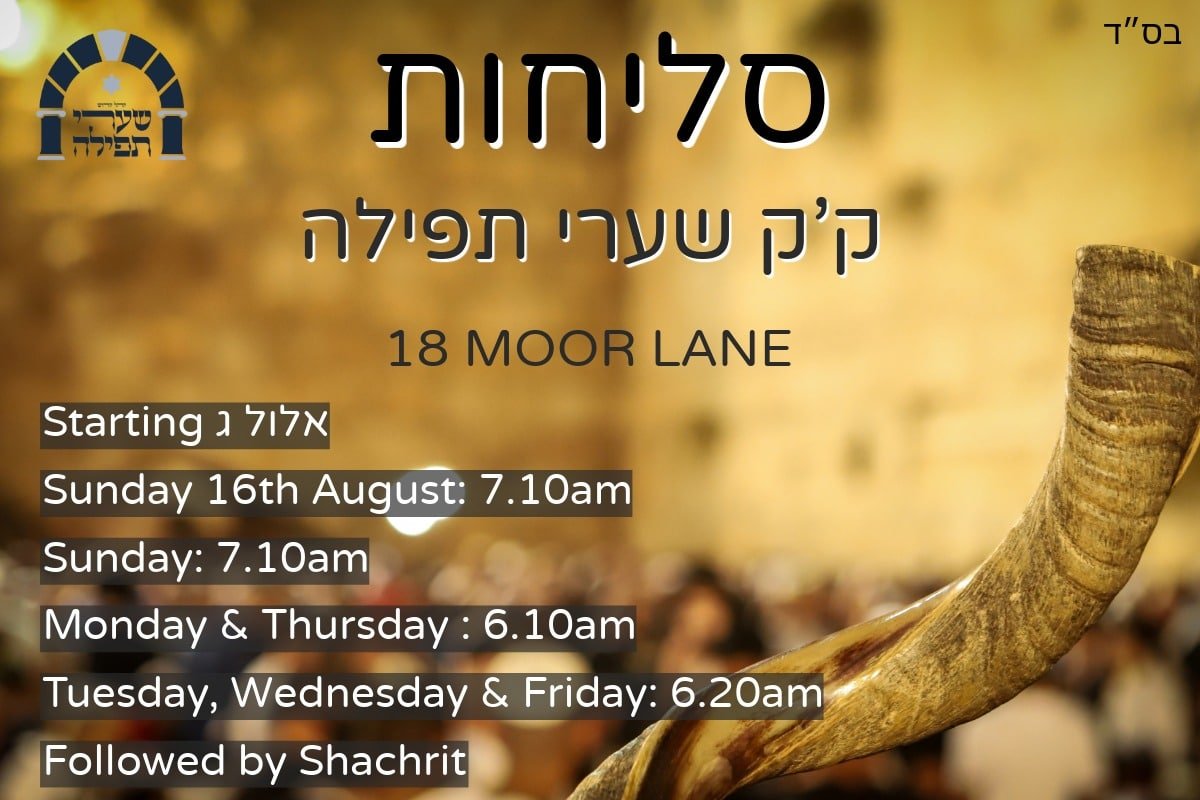
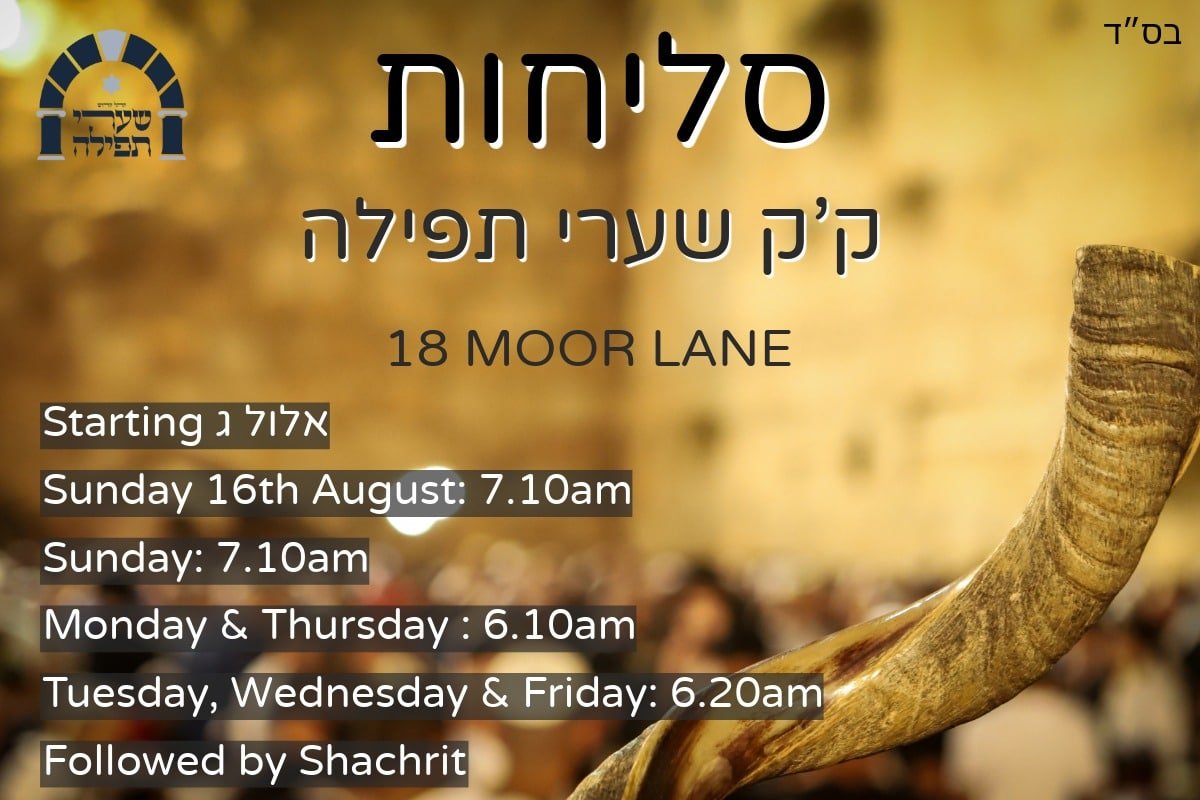
סליחות – Selichot
PHOTO-2026-08-01-23-38-48.jpg
*******
🕯️שבת🕯️

לוח זמני  תפילה לקיץ תשפ״ו

Summer Timetable 5786 – 2026

מוצאי שבת

ערבית

)מוצ”ש(

סוף זמן קריאת שמע

זמן שבת

מנחה וקבלת שבת

תאריך

שבת פרשת

Shabbat

Ends

Arbit

Shema to be read before

Candles to be
lit by

Minha & Kabbalat Shabbat

Date

Parasha

PM

PM

AM

PM

PM


8:58

8:54

9:41

7:53

7:00

28/29
Aug

כי תבא


Please note the change for Minha & Kabbalat Shabbat THIS WEEK ONLY at 7:00 pm


For those not in the Bet Hakeneset, but wishing to bring in Shabbat with the Kahal, candles should be lit about 30 minutes after the time listed for Minha and Kabbalat Shabbat. Unless the time listed in the ‘latest candle lighting’ column is earlier, when candles should be lit by that time, in all cases.

*****

🕯️SUMMER TIMES FOR SHABBAT 🕯️

שבת

מנחה וקבלת שבת

7:00 pm

קרבנות

9:00 am
הודו

9:15 am

מנחה של שבת

6:30 pm

********

image.png
Avot Ubanim Summer Season 
Every Shabbat Afternoon
@ 5:30 pm

******

📜
Parasha Overview

When the Jewish People dwell in the Land of Israel, the first fruits are to be taken to the Temple and given to the kohen. This is done in a ceremony that expresses recognition that it is Hashem who guides the history of the Jewish People throughout the ages. This passage forms one of the central parts of the Pesach Haggadah that we read at the Seder.

On the last day of Pesach of the fourth and seventh years of the seven-year shemitta cycle, a person must recite a disclosure stating that he has indeed distributed the tithes to the appropriate people and in the prescribed manner. With this mitzvah, Moshe concludes the commandments that Hashem has told him to give to the Jewish People. Moshe exhorts them to walk in Hashem’s ways, because they are set aside as a treasured people to Him.

When the Jewish People cross the Jordan River, they are to make a new commitment to the Torah. Huge stones are to be erected, and the Torah is to be written on them in the world’s seventy primary languages. Afterwards, the stones are to be covered over with a thin layer of plaster. Half of the tribes are to stand on Mount Gerizim, and half on Mount Eval, and the Levi'im will stand in a valley between the two mountains. The Levi'im will recite twelve commandments, and all the people will answer “amen” to both the blessings and the curses. Moshe then details the blessings that will be bestowed upon the Jewish People, blessings that are both physical and spiritual. If, however, the Jewish People do not keep the Torah, Moshe details a chilling picture of destruction, exile and wandering among the nations.

*******
image.png  

Halachot from Maran Rabbi Ovadia Yosef Ztz'l

דמעות בתפילה

לקראת סיום סדר הסליחות, נהגו הספרדים לומר פיוט “אליך ה' נשאתי עיני”, ובפיוט זה אנו אומרים “הַעֲבֵר חַטָּאתִי אֱלֹקֵי יְשׁוּעָתִי, וְגַם אֶת דִּמְעָתִי שִׂימָה בְּנֹאדֶךָ”. כלומר, מבקשים אנו מה' יתברך, שישמור את דמעותינו ושיהיו נראות לפניו, כדי לקבל את תשובתינו ואת תפילותינו.

ואצל האשכנזים נוהגים בדומה לזה, לומר פיוט “אזכרה אלוקים”, ושם אומרים: “יְהִי רָצוֹן מִלְּפָנֶיךָ שׁוֹמֵעַ קוֹל בְּכִיוֹת, שֶׁתָּשִׂים דִּמְעוֹתֵינוּ בְּנֹאדְךָ לִהְיוֹת, וְתַצִּילֵנוּ מִכָּל גְּזֵרוֹת אַכְזָרִיּוֹת, כִּי לְךָ לְבַד עֵינֵינוּ תְלוּיוֹת”.

ומקור הבקשה מאת ה', שישמור דמעותינו בתוך “נאד”, הוא בספר תהלים, שנאמר: “שִׂימָה דִמְעָתִי בְנֹאדֶךָ”, אשר על פסוק זה דרשו רבותינו במסכת שבת (דף קה:), שכל המוריד דמעות על אדם כשר, הקדוש ברוך הוא סופרן ומניחן בבית גנזיו. ורש”י בתהלים (פרק נו) פירש, שאנו מבקשים מהקדוש ברוך הוא, שיראה את דמעותינו, ויהיו נחשבות בעיניו כמו צרותינו. ובודאי, על ידי זה נזכה לקבלת התפילות.

ורבינו חיים ויטאל כתב בשם רבינו האר”י, שכל מי שלא מתעורר לבכיה בתפלות הימים הנוראים, ראש השנה ויום הכיפורים, זהו סימן שאין נשמתו הגונה ושלימה.

ומרן זצ”ל היה דורש, שאף בשעה שאדם לא מתעורר בבכיה, מכל מקום יתפלל בקול בכי, בתחנונים, כמו שנאמר: “כִּי שָׁמַע ה' קוֹל בִּכְיִי”.

אולם העירו בזה כמה אחרונים, ובכללם הרב בעל “אהלי יעקב” (בדיני הסליחות אות יא), שאם אדם מסויים יודע בעצמו שאינו בוכה, איך יוכל לומר כן? והלא נמצא שהוא דובר שקרים. ובספר טהרת המים הוסיף עוד, שאם לא בוכה באותו מעמד של הסליחות, לא יכול לומר נוסח כזה, שנמצא שהוא מדבר דבר שקר.

אולם מרן רבינו עובדיה יוסף זצוק”ל כתב (בחזון עובדיה עמוד יט), שאם אותו אדם, בוכה ביום הכיפורים, למשל בשעת הוידוי, ובפרט בוידוי של רבינו נסים ראש ישיבת בבל, יכול לכוין באומרו “וגם את דמעתי” על הדמעות שהוא מוריד בשעה שהוא באמת מוריד דמעות. ואין הכרח שתהיה בכייתו דוקא באותה שעה של הסליחות.

וכיוצא בזה בפיוט “לך אלי תשוקתי”, שאנו אומרים “אנסך את דמעי לך”, אם מכוין על דמעתו שבשעת הוידוי, די בזה. אף על פי שנכון מאד שכל אדם בעל לב יתעורר לבכיה דוקא בשעת אמירת הפיוט הזה, שהוא מלא רשפי אש שלהבת יה, ברגש טהור.

ויתירה מזו כתב הגאון רבי שלמה זלמן אוירבך (שלמי מועד עמוד כג), שמי שלא בוכה, יכול לכוין על הדמעות של כלל ישראל ששופכים דמעותיהם כמים בימים הללו, אף על פי שלא בכה בעצמו. והביא דבריו מרן זצ”ל.

ולסיכום: גם מי שלא בוכה בשעת אמירת הסליחות, רשאי להזכיר פיוטי סליחות שמוזכר בהם ענין הבכי והדמעות. ויכוין על הדמעות שמוריד בשעה שבאמת מוריד דמעות. וכמובן שתפילה בדמעה לא שבה ריקם, וחשוב מאד בפרט בתפילות הימים הנוראים, שיתפלל אדם מתוך בכיה, באהבת ה' וצער על שנתרחקנו מאתו בעוונותינו.


Tears During Prayer

Towards the end of the Selichot, the Sephardic custom is to recite the poem entitled “Elecha Hashem Nasati Enai.” In the fifth stanza of this stirring poem, we recite, “Remove my sin, G-d of my salvation; and also, my tear, place in your flask.” This means that we are requesting that Hashem collect our tears and save them so that they appear before Him so that He may accept our repentance and prayers.

Among Ashkenazi communities, it is customary to recite the “Ezkera Elokim” poem, which states: “May it be Your will, the One who hears crying voices, that you place our tears in your flask and that you save us from all cruel decrees, for our eyes are fixated only upon You.”

The source for this request to have our tears saved in Hashem’s flask is based on a verse in Tehillim, which states, “Place my tear in your flask,” about which the Gemara (Shabbat 105b) expounds that when one sheds tears for a worthy person, these tears are collected by Hashem and placed in His inner sanctum. Rashi (Tehillim 56) comments that we are praying that Hashem see our tears and that He treat them as our suffering. As a result, we shall surely merit having our prayers answered.

Rabbeinu Chaim Vital quotes the Ari z”l as having said that if one is not aroused to tears during the prayers of the Days of Awe, namely Rosh Hashanah and Yom Kippur, this is an indication that one’s soul is unworthy and incomplete.

Maran zt”l would often say that even if one is not moved to tears, one should still pray in a crying voice, based on the verse, “For Hashem has heard the sound of my cries.”

Nevertheless, several Acharonim, among them the Aholei Yaakov (Laws of Selichot, 11) raise a concern that if one knows that one does not cry, how can one recite these words? Is this not a lie?! Indeed, the Taharat Ha’Mayim writes that if one does not cry while reciting Selichot, one may not recite this text, for it is tantamount to telling a lie.

On the other hand, Maran Rabbeinu Ovadia Yosef zt”l writes (in his Chazon Ovadia- Yamim Nora’im, page 19) that if this individual cries at least on Yom Kippur, such as during the confessional prayer authored by Rabbeinu Nissim Gaon, Rosh Yeshiva of Babylon, one may have this in mind while reciting the words “And also my tear etc.” in the Selichot. One need not cry specifically during Selichot services.

Similarly, within the “Lecha Eli” poem recited on the eve of Yom Kippur, when we recite “I shall pour my tears to you,” if one has in mind the tears one sheds during the confessional prayer, this is sufficient. Nonetheless, it is especially poignant to try and move oneself to tears during this powerful prayer of “Lecha Eli.”

Furthermore, Hagaon Harav Shlomo Zalman Auerbach zt”l writes (in his Shalmei Mo’ed, page 23) that even one who does not cry himself may have in mind the copious tears spilled collectively by the Jewish nation during these days. His opinion is quoted by Maran zt”l.

Summary: Even one who does not necessarily cry while reciting the Selichot may, in fact, recite the portions of Selichot which reference crying and tears. One should have in mind the tears one sheds when one really does cry. Needless to say, prayers recited amid tears do not return unanswered and it is especially important to pray with tears during the Days of Awe amid love of Hashem and pain that we have drifted apart from Him as a result of our sins.



Newsletter Parashat Ki Tetze

בס״ד
Moor Lane - Logo.JPG

image.png
ק׳ ק׳ שׁערי תפילה
Have a look at our website 
*****
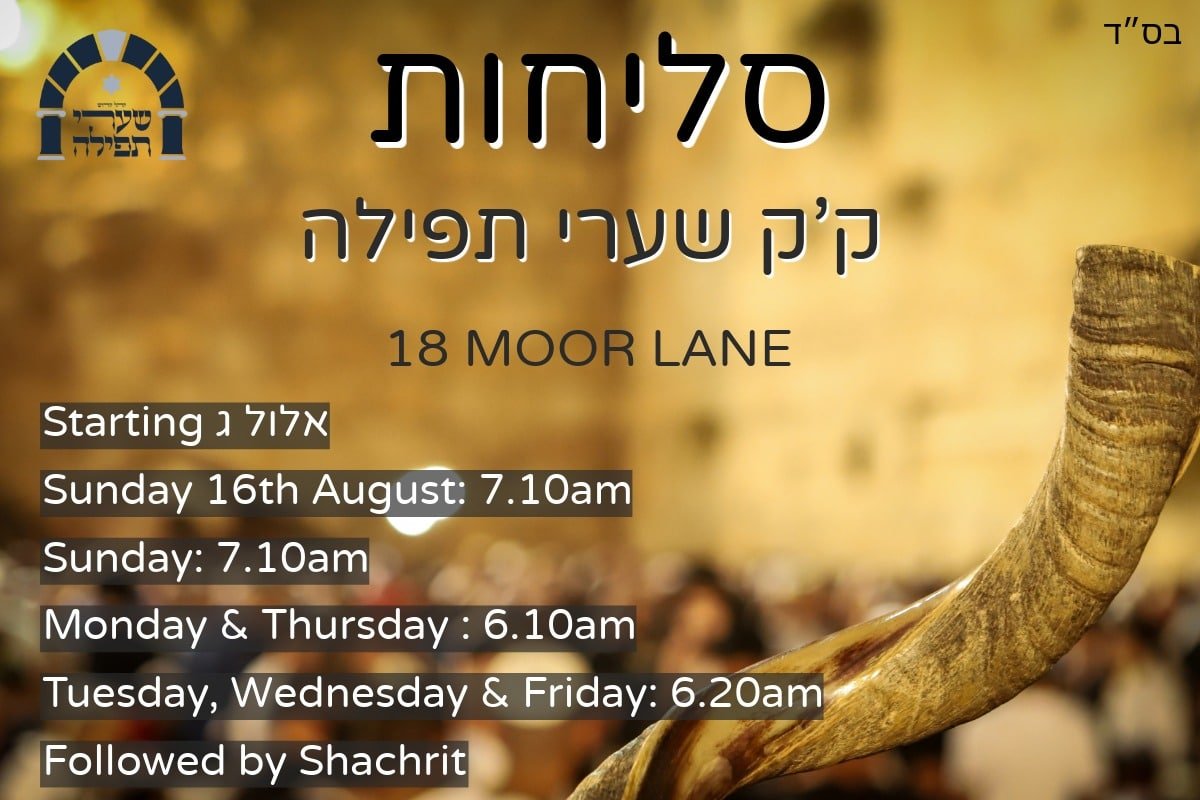
סליחות – Selichot
PHOTO-2026-08-01-23-38-48.jpg
*******
🕯️שבת🕯️

לוח זמני  תפילה לקיץ תשפ״ו

Summer Timetable 5786 – 2026

מוצאי שבת

ערבית

)מוצ”ש(

סוף זמן קריאת שמע

זמן שבת

מנחה וקבלת שבת

תאריך

שבת פרשת

Shabbat

Ends

Arbit

Shema to be read before

Candles to be
lit by

Minha & Kabbalat Shabbat

Date

Parasha

PM

PM

AM

PM

PM


9:16

9:12

9:35

8:09

7:30

21/22
Aug

כי תצא


For those not in the Bet Hakeneset, but
wishing to bring in Shabbat with the Kahal, candles should be lit about 30
minutes after the time listed for Minha and Kabbalat Shabbat. Unless the time
listed in the ‘latest candle lighting’ column is earlier, when candles should
be lit by that time, in all cases.

*****

🕯️SUMMER TIMES FOR SHABBAT 🕯️

שבת

מנחה וקבלת שבת

7:30 pm

קרבנות

9:00 am
הודו

9:15 am

מנחה של שבת

6:30 pm

********

image.png
Avot Ubanim Summer Season 
Every Shabbat Afternoon
@ 5:30 pm

******

📜
Parasha Overview

The Torah describes the only permissible way a woman captured in battle may be married. If a man marries two wives, and the less-favored wife bears a firstborn son, this son's right to inherit a double portion is protected against the father's desire to favor the child of the favored wife. The penalty for a rebellious son, who will inevitably degenerate into a monstrous criminal, is stoning. A body must not be left on the gallows overnight, because it had housed a holy soul. Lost property must be returned. Men are forbidden from wearing women's clothing and vice versa. A mother bird may not be taken together with her eggs. A fence must be built around the roof of a house. It is forbidden to plant a mixture of seeds, to plow with an ox and a donkey together, or to combine wool and linen in a garment. A four-cornered garment must have twisted threads tzitzit on its corners. Laws regarding illicit relationships are detailed. When Israel goes to war, the camp must be governed by rules of spiritual purity. An escaped slave must not be returned to his master. Taking interest for lending to a Jew is forbidden. Bnei Yisrael are not to make vows. A worker may eat of the fruit he is harvesting. Divorce and marriage are legislated. For the first year of marriage, a husband is exempt from the army and stays home to rejoice with his wife. Tools of labor may not be impounded, as this prevents the debtor from earning a living. The penalty for kidnapping for profit is death. Removal of the signs of the disease tzara'at is forbidden. Even for an overdue loan, the creditor must return the collateral daily if the debtor needs it. Workers' pay must not be delayed. The guilty may not be subjugated by punishing an innocent relative. Because of their vulnerability, converts and orphans have special rights of protection. The poor are to have a portion of the harvest. A court may impose lashes. An ox must not be muzzled while threshing. It is a mitzvah for a man to marry his brother's widow if the deceased left no offspring. Weights and measures must be accurate and used honestly. This Torah portion concludes with the mitzvah to erase the name of Amalek, for, in spite of knowing about the Exodus, they ambushed the Jewish People.

*******
image.png  

Halachot from Maran Rabbi Ovadia Yosef Ztz'l

ההכנות לימי הדין

בימים הסמוכים לימי לראש השנה, על כל אחד ואחד מעם ישראל, להתבונן על מעשיו, לעשות “חשבון נפש”, כדי לבחון במה יוכל לתקן את מעשיו ולשפרם, על מנת שלאחר מכן, יעמדו לו סניגורים טובים ליום הדין. 

משמעות השם “אלול” כתב מרן הרב עובדיה יוסף זצוק”ל, ש”אלול”, כלומר, משמעות השם של החודש “אלול”, היא מלשון “יאללון”  שהוא התרגום הארמי למה שנאמר אודות המרגלים “ויתורו” את ארץ כנען, “ויאללון” ית ארעא דכנען, כלומר, לשון ריגול וחיפוש אחר מעשיו. כי בחודש אלול, מנהג ישראל קדושים לתור אחר מעשיהם, ולבקר את עצמם, כי הם הימים המיוחדים והמסוגלים לתיקון העונות, לחזרה בתשובה שלימה, ולעלות מעלה מעלה בדרך העולה בית אל.

תפלות ימי חודש אלול

בלי ספק, ריבוי התפלה והתשובה מסייעים הרבה מאד לכל אדם, והם שיעמדו לו אחר כך בימי הדין, ראש השנה ויום הכפורים הבאים עלינו לשלום, כדי שיזכה להכתב ולהחתם לחיים טובים, לעושר ואושר ולמלוי כל משאלותיו.

ויש לאדם לעורר את עצמו ולהתנער מתרדמת השגרה הנופלת עליו במסע החיים האפלוליים, כי כמה השתדלויות כל אחד עושה כדי לשפר את מצבו החומרי, בקניית בית או רכב, ובהשקעת כוחותיו עבור מאכלות ערבים, טיולים ובילויים וכיוצא בזה, וכל מה שפועל ועושה, הכל כאין וכאפס לעומת מה שישפר את מצבו החומרי והרוחני כאחד, בעזרת התפלות לאל נורא עלילה בימים הנוראים הללו. וכמו שכתב הגאון החזון איש, שעל ידי התפלה, האדם פועל להטיב את מצבו יותר ממה שיוכל לפעול על ידי השתדלות טבעית שנראה לעין כל שהשתדלות זו מועילה.

תשובה ותפלה וצדקה

אמרו רבותינו בתלמוד ירושלמי (תענית פ”ב), אמר רבי אלעזר, שלשה דברים מבטלין את הגזרה, תפלה (קול), צדקה (ממון), ותשובה (צום). והביא ראיה לזה מן הפסוק. ולכן יש להרבות מאד בימים אלה בכל אלו השלשה, צום, קול, ממון, וכמו שאמר הפייטן “ותשובה ותפלה וצדקה מעבירין את רוע הגזירה”, ומקור הדברים בתלמוד הירושלמי כנזכר. וכתב מרן רבינו הגדול זצוק”ל, שאף על פי שבדורות הקודמים היו מרבים מאד בתעניות בימים אלה, בבחינת “תשובה”, מכל מקום בזמנינו שקשה לרוב בני האדם להתענות, יש להרבות עוד ועוד בצדקה יתרה, ומוטב להרבות בצדקה ומעשים טובים בזמנינו יותר מלהתענות, שעל ידי התענית הוא ממעט במלאכת שמים.

וכבר כתבנו כמה פעמים שיש להזהר להעביר את כספי הצדקה לאנשים אחראים, בכדי שיעבירו את המעות לעניים אמתיים, ואין לסמוך בזה על כל אדם, אפילו אם הוא מתהדר כביכול בהמלצות גדולי הדור.


Preparing for the Day of Judgment

During the days preceding Rosh Hashanah, every single member of the Jewish nation must contemplate his/her actions and perform some sort of self-introspection in order to ascertain how one can improve one’s actions and Mitzvah observance so as to guarantee one’s self powerful defenders on the Day of Judgment.

The Meaning of the Word “Elul”
Maran Rabbeinu Ovadia Yosef zt”l writes that the word “Elul” is similar to the Aramaic word “Ve’Alilu,” which is the Aramaic translation of the verse which is said regarding the spies sent to the Land of Israel, “And they spied the land.” This means that “Elul” connotes searching through and probing one’s actions. During the month of Elul, it is the custom of the holy Jewish nation to probe their deeds, for these days are auspicious for atonement of sin, attaining full repentance, and reaching loftier levels of spirituality and service of Hashem.

Prayer During the Month of Elul
Certainly, praying copiously and repenting for one’s sins are extremely beneficial for every individual and these things will defend an individual during the upcoming Days of Judgment of Rosh Hashanah and Yom Kippur. These will be one’s guarantors that one will be inscribed in the books of life, wealth, satisfaction, and the fulfillment of all of one’s requests.

One must awaken himself from the slumber which comes along with one’s daily routine throughout life; one should stop and think how much we invest on increasing the quality of our physical lives by purchasing new cars or homes, focusing on obtaining only the finest culinary delights, and going on all sorts of trips and vacations. All of this is nonsense compared to the Heavenly key to advancing one’s physical and spiritual status as one through deep and heartfelt prayer to Hashem during these Days of Awe. Similarly, Hagaon Chazon Ish writes that a person can improve his situation much more through prayer than through any other natural means that he believes may assist him.

Repentance, Prayer, and Charity
Our Sages teach us in the Talmud Yerushalmi (Ta’anit, Chapter 2), “Rabbi Elazar says, three things nullify harsh decrees: Prayer, charity, and repentance.” He continues to bring proofs to this idea from the scriptures. Thus, one should practice these three things, i.e. prayer, charity, and repentance, profusely during these days, as the hymnist writes, “Repentance, prayer, and charity shall annul the harshness of the decree.” The source for this is the aforementioned Talmud Yerushalmi. Maran zt”l writes that although in previous generations, people would fast many times during these days in the spirit of “repentance,” nevertheless, in our times when it is difficult for people to fast, one should increase one’s donation of charity instead. Indeed, it is better to give more charity in our times than to fast, for by fasting, one decreases his service of Heaven (for fasting weakens the body).

We have already mentioned several times that one should take care to pass along charity funds to responsible individuals so that they will in turn dispense these funds to truly needy people and one should not rely on every individual regarding such matters, even if one seemingly comes with the recommendation of the generation’s leading Torah leaders.

Newsletter Parashat Shofetim – Rosh Chodesh Elul HaMerutze

בס״ד
Moor Lane - Logo.JPG

image.png
ק׳ ק׳ שׁערי תפילה
Have a look at our website 
********
ראש חודש
image.png
Rosh Chodesh Elul HaMerutz
is 2 days
TONIGHT 
Wednesday night 12th Aug / Thursday 13th Aug
Friday 14th Aug
******
סליחות – Selichot
📖 Starting THIS SUNDAY 7:10 AM 📖
PHOTO-2026-08-01-23-38-48.jpg
******
Announcements on 
Moorlanenews Newsletter
Reminder
Anyone wishing to announce their Simcha on this email 
are kindly requested to send their invitation/announcement
before Wednesday midday.
Please be advised
even if we know about your simcha
we will NOT advertise it unless the 
Baal Simcha – those making the simcha,
specifically request the simcha to be advertised.
The same applies with Mazal Tov wishes. 
Exceptions will be made for late entries, 
we are even willing to delay sending the newsletter 
and will wait till you are ready with the advert/flyer
 but arrangements must be made 
directly to N Bitton before Wednesday.
May we share many and only have semachot on Moorlanenews
*****
🕯️שבת🕯️

לוח זמני  תפילה לקיץ תשפ״ו

Summer Timetable 5786 – 2026

מוצאי שבת

ערבית

)מוצ”ש(

סוף זמן קריאת שמע

זמן שבת

מנחה וקבלת שבת

תאריך

שבת פרשת

Shabbat

Ends

Arbit

Shema to be read before

Candles to be
lit by

Minha & Kabbalat Shabbat

Date

Parasha

PM

PM

AM

PM

PM


9:34

9:30

9:30

8:24

7:30

14/15
Aug

שופטים


*****

🕯️SUMMER TIMES FOR SHABBAT 🕯️

שבת

מנחה וקבלת שבת

7:30 pm

קרבנות

9:00 am
הודו

9:15 am

מנחה של שבת

6:30 pm

********

image.png
Avot Ubanim Summer Season 
Every Shabbat Afternoon
@ 5:30 pm

******

📜
Parasha Overview

Moshe tells Bnei Yisrael to appoint judges and officers in their cities. A bribe of even an insignificant sum is forbidden. Trees are not to be planted near Hashem's altar, as was the way of idolaters. Blemishes in animals designated for offerings and other points of disqualification are listed. The Great Sanhedrin is to make binding decisions on new situations, according to Torah criteria, to prevent the fragmentation of the Torah. A very learned scholar who refuses to accept the halachic decisions of the Sanhedrin incurs the death penalty. A Jewish king may have possessions and symbols of power only as commensurate with the honor of his office, but not for self-aggrandizement. He is to write for himself two Sifrei Torah — one to be kept with him wherever he goes, so that he doesn't become haughty. Neither the Kohanim nor the Levi'im are to inherit land in the Land of Israel. Rather, they are to be supported by the community, by a system of tithes.

All divination is prohibited. Hashem promises the Jewish People that He will send them prophets to guide them, and Moshe explains how a true prophet may be distinguished from a false one. Cities of refuge are to be provided for an accidental killer to escape the blood-avenger from the deceased's family. Someone who kills with malice, however, is to be handed over to the blood-avenger. Moshe cautions Bnei Yisrael not to move boundary markers to increase their property. Two witnesses who conspire to frame a third party are to be punished with the very same punishment that they conspired to bring upon the innocent party. 

A kohen is to be anointed specifically for when Israel goes to war, to instill the nation’s trust in Hashem. Among those disqualified from going to war is anyone who has built a new house but not lived in it yet, or anyone who is fearful or fainthearted. An enemy must be given the chance to make peace, but if they refuse, all males are to be killed. Fruit trees are to be preserved and not cut down during the siege. If a corpse is found between cities, the elders of the nearest city must take a heifer, slaughter it, and wash their hands over it, saying that they are not guilty of the death.

*******
image.png  

Halachot from Maran Rabbi Ovadia Yosef Ztz'l

ברכות קריאת שמע – אנשים ונשים

בהלכות הקודמות ביארנו, כי קריאת שמע של שחרית, אפשר לקוראה עד השעה השלישית מהיום. כלומר, לכל המאוחר, יש לחשב שלש שעות מזמן זריחת החמה, ועד אז חובה לקרוא קריאת שמע. וחיוב זה הוא מצוה מן התורה על האנשים דוקא, אבל הנשים פטורות מן הדין מקריאת שמע, שהרי היא בכלל “מצות עשה שהזמן גרמא”, שהרי יש זמן קצוב לקריאת שמע, וגם היא מצות עשה, ולכן הנשים פטורות ממנה.

כמו כן ביארנו שיש להזהר ולהתפלל שחרית לפני שתעבור השעה הרביעית מהיום. ובימים אלה סוף זמן תפלת שחרית בארץ ישראל יוצא בערך בשעה עשר ועשרים בבוקר. ומי שלא התפלל עד שעבר זמן זה, עליו להתפלל בכל זאת, עד שיגיע זמן חצות היום. וזמן חצות היום בימים אלה יוצא בערך כחמש עשרה דקות לפני השעה שתים עשרה לפני הצהרים.

ברכות קריאת שמע

בתפלת שחרית אנו קוראים שתי ברכות לפני קריאת שמע, ברכת “יוצר אור” וברכת “אהבת עולם” (ולמנהג האשכנזים “אהבה רבה”). וכן לאחר קריאת שמע מברכים ברכה אחת, היא ברכת “גאל ישראל”. והנשים, למנהג האשכנזים, מברכות גם הן את הברכות הללו. אבל למנהג הספרדים, שנשים אינן מברכות על מצוה שהן פטורות ממנה, אין הנשים מברכות את ברכות קריאת שמע כלל. ואם הן נשים צדקניות שאומרות את הברכות, עליהן להזהר בסיום הברכות, שלא להזכיר שם ומלכות, כלומר, לא תברכנה “ברוך אתה ה' יוצר המאורות”, אלא “ברוך יוצר המאורות” בלבד. וכן עליהן לנהוג בברכות “אוהב את עמו ישראל” ו”גאל ישראל”.

סוף זמן הברכות

כשם שיש זמן קצוב לקריאת שמע ולתפלה,  כמו כן יש זמן קצוב לברכות קריאת שמע.

ובמשנה במסכת ברכות (דף ט:) שנינו כי סוף זמן קריאת שמע הוא “עד שלוש שעות”. “והקורא מכאן ואילך לא הפסיד”. ובגמרא (בדף י:) אמרו: “הקורא מכאן ואילך לא הפסיד”, מהו מה ששנינו “לא הפסיד”? הרי בודאי הפסיד, שעבר זמן קריאת שמע! אלא ביארו בגמרא, “שלא הפסיד את ברכות קריאת שמע”.

ומכאן משמע שאף אם עבר זמן קריאת שמע, עדיין אפשר לברך את ברכות קריאת שמע. וכתב רבינו הרא”ש בשם רבינו האי גאון, שמה שאמרו בגמרא שאפשר לברך ברכות קריאת שמע גם לאחר סוף זמן קריאת שמע, פירוש הדבר, שאפשר לברך ברכות קריאת שמע עד סוף השעה הרביעית, שהוא סוף זמן תפלה. אבל אין הכוונה שבמשך כל היום יוכל לקרוא קריאת שמע עם ברכותיה. וכן כתבו עוד מגאוני קדם, רבינו יצחק אבן גיאת, ובעל האשכול ועוד. וכן פסק מרן השלחן ערוך (סימן נח סעיף ו).

נמצאנו למדים, כי סוף זמן ברכות קריאת שמע, הוא שווה לסוף זמן תפלה, כלומר, ארבע שעות זמניות לאחר הנץ החמה לכל המאוחר. וכפי שנדפס בלוחות השנה המהודרים.

ומכאן נלמד כמה גרוע מנהגם של אותם בתי כנסת ויחידים, שמתפללים בשעה מאוחרת מאד, ואם לא די בכך שהם מפסידים זמן קריאת שמע (אם לא קראו בשעה מוקדמת), ומפסידים זמן תפלה, הרי שעוד הם נכנסים באיסור ברכה לבטלה, שמברכים ברכות קריאת שמע לאחר סוף זמנן. וכן כתב מרן החיד”א בשו”ת חיים שאל (ח”ב סימן לא), בזו הלשון: “כמה צער בנפשי על רבים בערים אלה, שקוראים קריאת שמע בברכותיה אחרי ארבע שעות, ואינם קמים להתפלל עם הציבור, וכשהם קמים וקוראים קריאת שמע ביחיד, עברה שעה רביעית, ועם כל זה קוראים קריאת שמע בברכותיה, נגד דעת מרן שפסק שאם עברה שעה רביעית מהיום לא יברכו ברכות קריאת שמע”.

ולסיכום: מי שנכשל ומתפלל לאחר סוף זמן תפלה, כלומר לאחר ארבע שעות מזריחת החמה, אינו יכול לקרוא את ברכות קריאת שמע בשם ומלכות, אלא יברכם בלא שם ומלכות. וכפי שביארנו.


The Blessing of Keri’at Shema Regarding Men and Women

In the previous Halachot we have explained that one may recite Keri’at Shema until the end of the third seasonal hour of the day. This means that the latest time for Keri’at Shema should be calculated as no later than the end of the third hour of the day beginning from sunrise (although these hours should preferably be calculated beginning from dawn). The Mitzvah of reciting Keri’at Shema is a Torah obligation for men; women, however, are exempt from this Mitzvah since reciting Keri’at Shema is a positive time-bound Mitzvah, for there is an allotted time during which it must be recited (which is likewise a Torah obligation) and women are exempt from such positive, time-bound Mitzvot.

We have also explained that one must take care to pray the Shacharit prayer before the end of the fourth seasonal hour of the day. During this time of year in Israel, the end time for Shacharit is at approximately 9:55 AM and in New York it is at approximately 10:20 AM. If one did not pray Shacharit by this point, one must nevertheless still pray before halachic midday arrives. Halachic midday at this time of year is at approximately 11:35 AM in Israel and at approximately 11:55 AM in New York.

The Blessings of Keri’at Shema
Within the Shacharit prayer, there are two blessings recited before Keri’at Shema, i.e. the blessings of “Yotzer Ohr” and “Ahavat Olam” (“Ahava Rabba” according to the Ashkenazi tradition). Following Keri’at Shema, one blessing is recited, i.e. the “Ga’al Yisrael” blessing. According to the Ashkenazi custom, women may recite these blessings as well. Nevertheless, according to the Sephardic custom whereby women do not recite blessings upon Mitzvot they are exempt from performing, women do not recite these blessings at all. Righteous women who wish to recite these blessings must make sure not to mention Hashem’s name at the conclusion of the blessing, for instance, instead of “Baruch Ata Hashem Yotzer Ha’Me’orot” they should merely recite “Baruch Yotzer Ha’Me’orot”. The same procedure should be followed regarding the “Ohev Et Amo Yisrael” and “Ga’al Yisrael” blessings.

The Latest Time for These Blessings
Just as there is an allotted time for Keri’at Shema and the morning Amida prayer, there is likewise an allotted time for the blessings of Keri’at Shema.

The Mishnah (Berachot 9b) states that the latest time for the morning Keri’at Shema is “until three hours and one who recites it past this time has not lost out.” The Gemara (ibid. 10b) questions this statement that “one has not lost out.” What does this mean? One has certainly lost out since the proper time for Keri’at Shema has already passed! Rather, the Gemara explains that this means “one has not lost out the blessings of Keri’at Shema.”

It seems from here that even if the time for Keri’at Shema has passed, one may still recite the blessings of Keri’at Shema. The Rosh quoting Rav Hai Gaon writes that when the Gemara states that one may recite the blessings of Keri’at Shema even after the end time for Keri’at Shema has passed, this means that one may recite these blessings until the end of the fourth hour of the day which is the end time for the prayer. Thus does not mean, however, that one may recite Keri’at Shema and its blessings all day long. Many other great Rishonim, including Rabbeinu Yitzchak ibn Gi’at, the Sefer Ha’Eshkol, and others rule likewise as does Maran Ha’Shulchan Aruch (Chapter 58, Section 6).

Thus, the latest time for reciting the blessings of Keri’at Shema is equivalent to the latest time to pray Shacharit which is no later than the end of four seasonal hours past sunrise as is printed in many calendars quoting halachic times.

Based on this we can see that the custom that some synagogues (and even some individuals) have to pray at very late hours is quite terrible, for not only do they miss the proper time for Keri’at Shema (if they have not read it at an earlier hour) and the Shacharit prayer, they transgress the sin of reciting a blessing in vain by reciting the blessings of Keri’at Shema past the allotted time for doing so. Indeed, Maran Ha’Chida writes in his Responsa Chaim Sha’al (Volume 2, Chapter 31), as follows: “It causes my soul to suffer greatly when many people in these cities recite Keri’at Shema and its blessings after the fourth hour of the day and they do not arise to pray along with the congregation; when they eventually wake up and recite Keri’at Shema alone, the fourth hour has already passed and they nevertheless read Keri’at Shema with its blessings contrary to the ruling of Maran (Ha’Shulchan Aruch) who has written that the blessings of Keri’at Shema may not be recited past the fourth hour of the day.”

Summary: One who, for whatever reason, prays Shacharit after the allotted time for doing so, i.e. four seasonal hours past sunrise, may not recite the blessings of Keri’at Shema with Hashem’s name; rather, one should read these blessings while omitting Hashem’s name, as we have explained.