


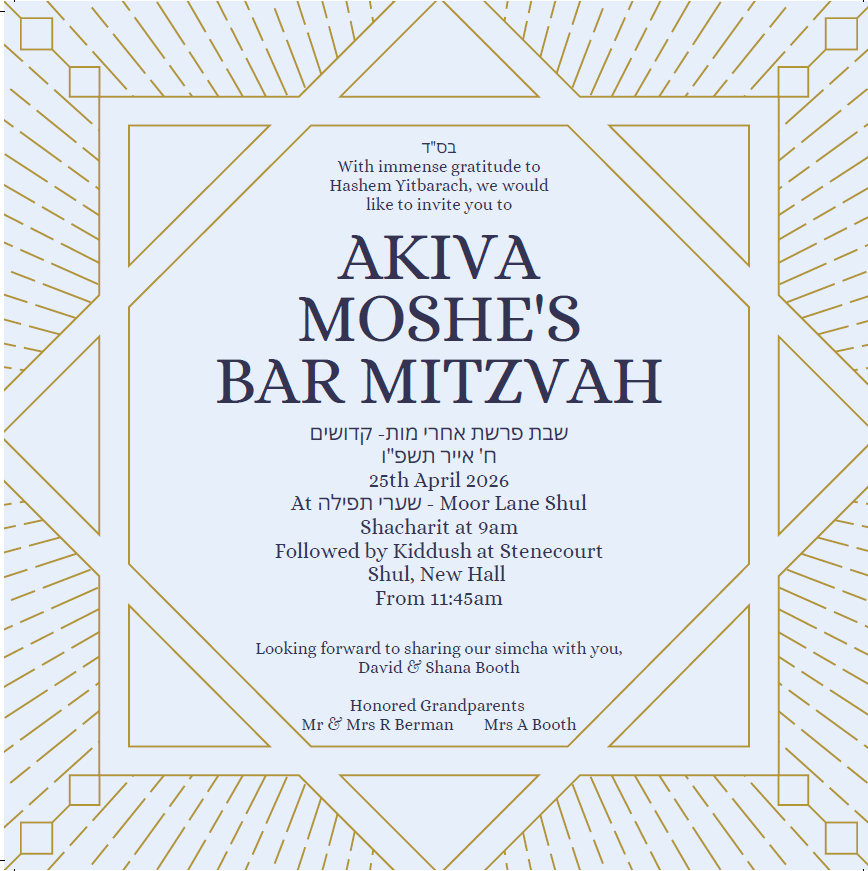
✡️Bar Mitzvah Invitation✡️
🎉🎉🎉🎉🎉🎉🎉🎉🎉🎉

********

The following nominees were elected unopposed
and have now formally assumed office:
- Yehuda Marshall – President
- Paul Delmonte – Vice President
- Loretta Hodari – Member of the Mahamad
- Mord Maman – Honorary Member of the Mahamad
We extend our sincere and heartfelt appreciation to Mordechai Maman, former President, and Benjamin Hassan, former Vice President, for their many years of dedicated service, care and commitment to Moor Lane and its community.
MEMBERS OF THE MAHAMAD 5786
a) Parnas Presidente: Yehuda Marshall
b) Parnas Vice Presidente: Paul Delmonte
c) Treasurer: Yehoshua Jacobs
d) Gabbai: Eli Shoshana
e) Hon. Secretary: Yehoshua Lewis
f) Ladies Committee Chair: Mrs. Elaine Marshall
g) Mahamad: David Bitan, Loretta Hodari, Rafi Marshall, Mordechai Maman (Honorary)
Delegate Jewish Rep Council: Fabian Borocin (MM)
Delegate Manchester Shechita Board: Fabian Borocin (MM)
******
*****
לוח זמני תפילה לקיץ תשפ״ו
Summer Timetable 5786 – 2026
מוצאי שבת | ערבית )מוצ”ש( | סוף זמן קריאת שמע | זמן שבת | מנחה וקבלת שבת | תאריך | שבת פרשת |
Shabbat Ends | Arbit | Shema to be read before | Candles to be | Minha & Kabbalat Shabbat | Date | Parasha |
PM | PM | AM | PM | PM |
|
|
9:24 | 9:20 | 9:27 | 8:11 | 7:30 | 24/25 | אחרי־קדושים |
For those not in the Bet Hakeneset, but wishing to bring in Shabbat with the Kahal, candles should be lit about 30 minutes after the time listed for Minha and Kabbalat Shabbat. Unless the time listed in the ‘latest candle lighting’ column is earlier, when candles should be lit by that time, in all cases.
*****
🕯️SUMMER TIMES FOR SHABBAT 🕯️
שבת
מנחה וקבלת שבת
7:30 pm
קרבנות
9:00 am
הודו
9:15 am
מנחה של שבת
6:30 pm
***********

*********
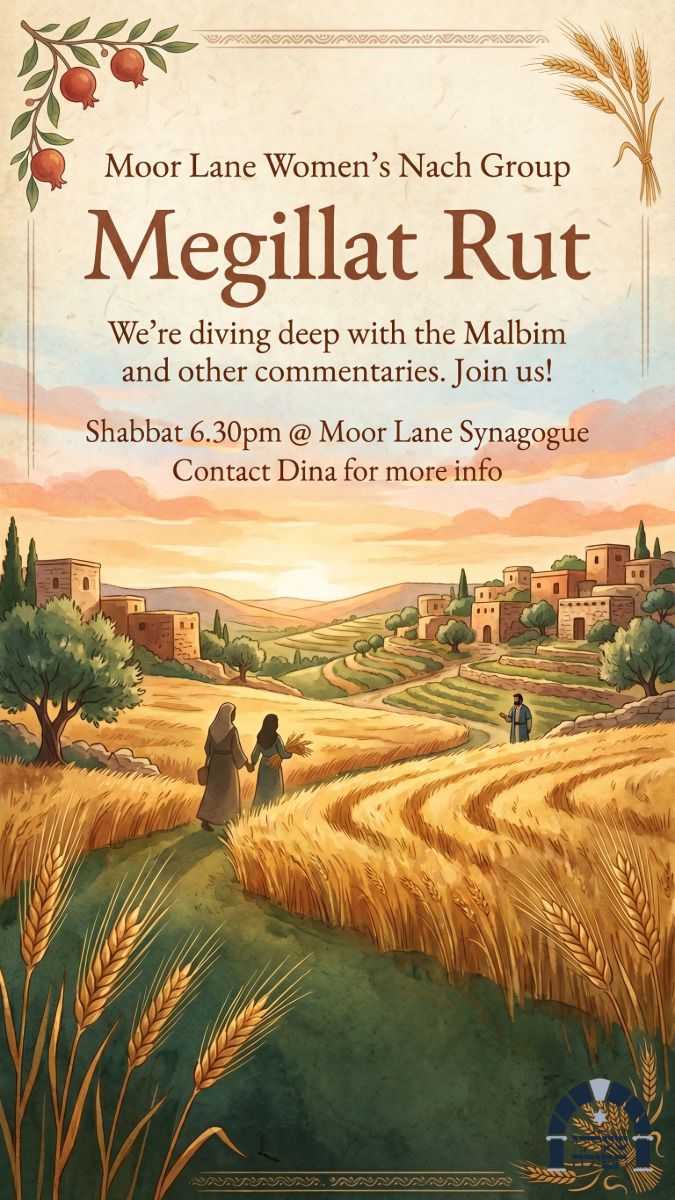
Moor Lane Women’s Nach Group
🪻🌷🌹🌺🌼🪷🌹🌷🪻
*******
Acharei Mot
G-d instructs the kohanim to exercise extreme care when they enter the Mishkan. On Yom Kippur, the Kohen Gadol is to approach the holiest part of the Mishkan after special preparations and wearing special clothing. He brings offerings unique to Yom Kippur, including two identical goats that are designated by lottery. One is “for G-d” and is offered in the Temple, while the other is “for Azazel” in the desert. The Torah states the individual's obligations on Yom Kippur: On the 10th day of the seventh month, one must “afflict” oneself. We are to abstain from eating and drinking, anointing, wearing leather footwear, washing and marital relations.
Consumption of blood is prohibited. The blood of slaughtered birds and undomesticated beasts must be covered. The people are warned against engaging in the wicked practices that were common in Egypt. Incest is defined and prohibited. Marital relations are forbidden during a woman's monthly cycle. Homosexuality, bestiality and child sacrifice are prohibited.
Kedoshim
The nation is enjoined to be holy. Many prohibitions and positive commandments are taught:
Prohibitions: Idolatry; eating offerings after their time-limit; theft and robbery; denial of theft; false oaths; retention of someone's property; delaying payment to an employee; hating or cursing a fellow Jew (especially one's parents); gossip; placing physical and spiritual stumbling blocks; perversion of justice; inaction when others are in danger; embarrassing; revenge; bearing a grudge; cross-breeding; wearing a garment of wool and linen; harvesting a tree during its first three years; gluttony and intoxication; witchcraft; shaving the beard and sideburns; tattooing.
Positive: Awe for parents and respect for the elderly; leaving part of the harvest for the poor; loving others (especially a convert); eating in Jerusalem the fruits from a tree's fourth year; awe for the Temple; respect for Torah scholars, the blind and the deaf.

עניית אמן על ברכת הגוי
והרמ”א הוסיף על דברי מרן, שמכל מקום, אם שומע מגוי ברכה שלימה, מתחילתה ועד סופה, ושמע שהוא באמת מברך את ה' אלוקינו מלך העולם, יש לענות אחר הברכה, אמן.
ולפי טעם זה, אם שמענו בפירוש את כל הברכה מפיו של הגוי, יש לענות אחריו אמן, שהרי בודאי לא הזכיר כאן שם עבודת כוכבים.
אולם רבינו הרמב”ם (פ”א מהל' ברכות הי”ג) כתב, שאין עונים אמן אחר ברכת הגוי כלל, ואפילו אם שמע מפיו את כל הברכה. וכן דעת עוד מרבותינו הראשונים. וכך משמעות דברי מרן השלחן ערוך. (עי' הליכות עולם ח”ג עמוד קכב), כי תמיד יש לחוש שהוא מתכוון בלבו לעבודה זרה שלו. אבל הרמ”א, כאמור, כתב כדברי הרא”ש, שאם שמענו את כל הברכה מפי הגוי, יש לענות אחריו אמן.
ולסיכום: למנהג הספרדים, אין לענות אמן אחר ברכתו של הגוי. ואם הוא מוסלמי, ושמענו את כל הברכה מפיו, יש לענות אמן. ולמנהג האשכנזים, כל ששמע את כל נוסח הברכה מפי הגוי, עונה אחריו אמן.
Answering Amen to the Blessing of a Non-Jew
Answering Amen
Maran Ha’Shulchan Aruch (Ch. 215, Sec. 2) rules: “If one hears a fellow Jew recite any blessing, one must answer Amen, even if one has not heard him recite the entire blessing from beginning to end. However, if the one reciting a blessing is a heretic or non-Jew, one should not answer Amen. The Rama adds, however, that if one heard the non-Jew recite the entire blessing, including the words “Hashem, Elokeinu Melech Ha’Olam,” one should, in fact, answer Amen.
The Reason
The reason why one cannot answer Amen to the blessing of a non-Jew is because we are concerned that he recited the blessing to foreign deities and idolatry, such as devout Christians who recite grace to their god before eating. This explanation is quoted by the Rosh (Berachot 8:5) and other Rishonim.
Based on this, if one hears a non-Jew recite the entire blessing, one should answer Amen, for we can be certain he did not mention the name of another deity.
On the other hand, the Rambam (Ch. 1 of Hilchot Berachot, Halacha 13) rules that one may never answer Amen to the blessing of a non-Jew, even if one heard the entire blessing, for we are concerned that he is thinking about his deity in his heart. This is echoed by many other Rishonim and seems to be the opinion of the Shulchan Aruch as well (see Halichot Olam, Vol. 3, p. 122). However, as we explained above, the Rama rules in accordance with the Rosh that as long as one hears the entire blessing recited by a non-Jew, one should answer Amen.
The Bottom Line
Halachically speaking, according to the Sephardic custom, one should never answer Amen to a blessing recited by a non-Jew, however, Ashkenazim may, if they hear an entire blessing being recited by a non-Jew.
The Law Regarding Muslims
Nevertheless, the Yalkut Yosef (Berachot, Ch. 215, p. 376) rules in the name of Rabbeinu Yaakov Castro that the law is different regarding Muslims. Since we know that they believe in one God and they do not appendage any other deities to Him, although they may believe in many other foreign theologies foreign to Judaism, we may accept the blessings they recite in our language as a satisfactory blessing, and one may answer Amen to their blessings.
Summary: According to the Sephardic custom, one may not answer Amen to blessings recited by non-Jews, with the exception of blessings recited by Muslims when one hears the entire blessing. According to the Ashkenazi custom, however, one may answer Amen to a blessing recited by any non-Jew as long as one hears the entire blessing being recited.