

Newsletter Parashat Tetzave – Shabbat Zachor

בס״ד
Moor Lane - Logo.JPG

image.png
ק׳ ק׳ שׁערי תפילה
Have a look at our website 
******

image.png

 *****

image.png

THIS SHABBAT

we take out 2 Sefarim

(1) Parashat Tetzave

(2) Parashat ZACHOR 

The haftara THIS week will be the 

Haftara of ZACHOR

********

מנהגים

 Liturgy (Piyutim)

On certain occasions piyutim are chanted during pesuqé dezimra:

On Shabat Shira and the Seventh Day of Pesah the piyut “Ashira keShirat Moshé” is sung before Shirat haYam (The Song on the Sea).

On Shabat Zakhor the piyut “Mi Khamokha” is chanted during Nishmat.

On Rosh haShana and Yom Kipur special piyutim are chanted after Shirat haYam, before Yishtabah, and between Yishtabah and the Qadish. 


The minhag of inserting piyutim into the prayers is actually quite ancient, dating back at least to the times of Ribi Yehuda haLevi (c. 1000-1100 CE) who penned the piyut “Mi Khamokha” for Shabat Zakhor and instituted its recital in the middle of Nishmat Kol Hai.

Several Rishonim, among them the Ri miGash (d. 1141), the Rashba (d. 1310), and the Radbaz (d. 1573), attest that this was the custom in their time, showing no sign of disapproval. 

Nevertheless, this custom was met with sharp, repeated critique by later halakhic authorities, all challenging the halakhic basis for this custom, as it constitutes a forbidden interruption (hefseq) in the prayers.

 Though Maran instructs in the Shulhan 'Arukh (O”H §68:1) that it is best to refrain from including liturgy in the Blessings of Qeriat Shema', he makes no mention of adding liturgy in Pesuqé deZimra. The determining factor for allowing liturgy in Pesuqé deZimra is whether or not there exists a prohibition to add praises or Tehilim to those instituted by the Sages as Pesuqé deZimra

The Hida in Tub 'Ayin (§18:35) cites the opinion of Ribi David Hayim Corinaldi in this matter, denouncing the practice of those who reserved the recital of liturgy intended for Pesuqé deZimra (e.g. Ribi Yehuda haLevi's Mi Khamokha) until after the repetition of the 'Amida; arguing that the Tur and Maran only took issue with adding liturgy to the Blessings of Qeriat Shema'. The simple logic behind Ribi Corinaldi's judgment seems to be that, since Pesuqé deZimra were instituted as praises to G-d, additional praises, such as the piyutim, should not be deemed an interruption therein. Still, the Hida rules that liturgy may not be added to Pesuqé deZimra, explaining that these praises were carefully arranged by the Sages in accordance with Qabala and are thus strictly unchangeable

Maghen Abot – e”H Ribi Mordekhai Lebhar s”t 


The Minhag in our Bet Hakeneset, which is the Spanish & Portuguese Minhag, is to say the Piyut Mi Chamoch in the middle of NISHMAT


****

SHABBAT ZACHOR

This Shabbat, (the Shabbat immediately before Purim) is called Shabbat Zachor. שבת זכור.
The Maftir, (additional reading), from Deut. / Devarim, Parshat Ki-Teitze, (25:17-19), deals with the commandment to “Remember what Amalek did to you on the way, upon your departure from Mitzrayim (Egypt)…. … how they perpetrated a cowardly and unprovoked attack… You shall erase the memory of Amalek from the heavens, you shall not forget.”
This commandment, to remember Amalek, is one of the 613 commandments. It is incumbent, therefore, upon every person to attend services on Shabbos Zachor in order to hear this special reading and remember its message. 
What is the connection between erasing the memory of Amalek and Purim? The wicked Haman, who intended to destroy all the Jews in one day and claim their spoils, was the descendant of Agag who was the king of Amalek in the time of King Shaul. Thus we know that Haman was from Amalek. This is why our sages ordained carrying out the commandment of remembering to erase the memory of Amalek before PurimZachor means remember – “Remember… do not forget!”

HAFTARA: (which is read after the ParshaSamuel 1 / Shmuel I 15:2-34

This week's Haftorah takes place 2,873 years ago. In the year 2883 – 878 b.c.e. Shmuel conveys to King Shaul Hashem's command to wage battle against Amalek, and to leave no survivors–neither human nor beast. Shaul mobilizes his military and attacks Amalek. They kill the entire population with the exception of the king, Agag, and they also spare the best of the cattle and sheep.

Hashem reveals Himself to Shmuel. “I regret that I have made Shaul king, for he has turned back from following Me, and he has not fulfilled My words.”

The next morning Shmuel travels to Shaul and confronts him. Shaul defends himself, saying that the cattle were spared to be used as sacrificial offerings for Hashem. Shmuel responds: “Does Hashem have as great a delight in burnt offerings and peace-offerings, as in obeying the voice of Hashem? Behold, to obey is better than a peace-offering; to listen, than the fat of rams. . . . Since you rejected the word of Hashem, He has rejected you from being a king.”

Shaul admits his wrongdoing and invites Shmuel to join him on his return home. Shmuel refuses his offer. “The Lord has torn the kingdom of Israel from you, today; and has given it to your fellow who is better than you.” Shmuel then kills the Amalek king.

The commentaries state that in the interim, Agag was able to marry a maidservant, from which the nation of Amalek would survive.

The connection to Purim is well documented. Haman is called, “the Agagi”. He was a direct descendant of Agag. In ascertaining Hashem's mercy and justice, we are forced to acknowledge our limited understanding. The notion of killing men woman and children is thankfully foreign and abhorrent to us. Nevertheless, Shaul was commanded to eradicate the entire nation.

The Haftorah identifies Shaul's sin in not fulfilling Hashem’s commandment as misplaced mercy. Had he known that, 521 years later, his merciful act would result in the potential extermination of the entire Jewish people, Shaul would not have had mercy on Agag and the cattle. It is the responsibility of a king to think beyond the immediate and do what has to be done to guarantee the future of his nation. Being that no single human can ever guarantee the future, he has no choice but to listen to Hashem's commandments and do as he is told. That ensures the future.

The message of Purim is the story of our Haftorah. Hashem works His miracles through the normal passage of time. Actions done today set in motion ripples in time that radiate far into the future.

*****

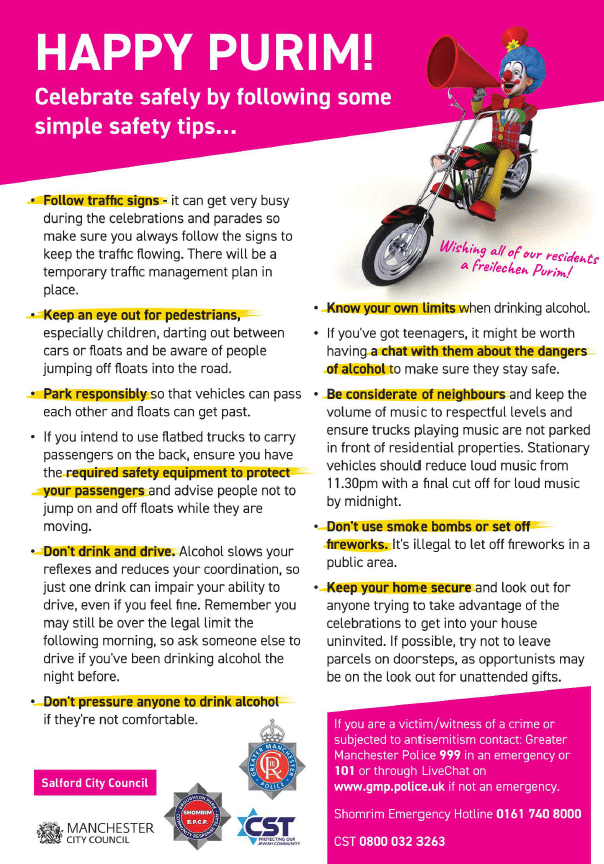
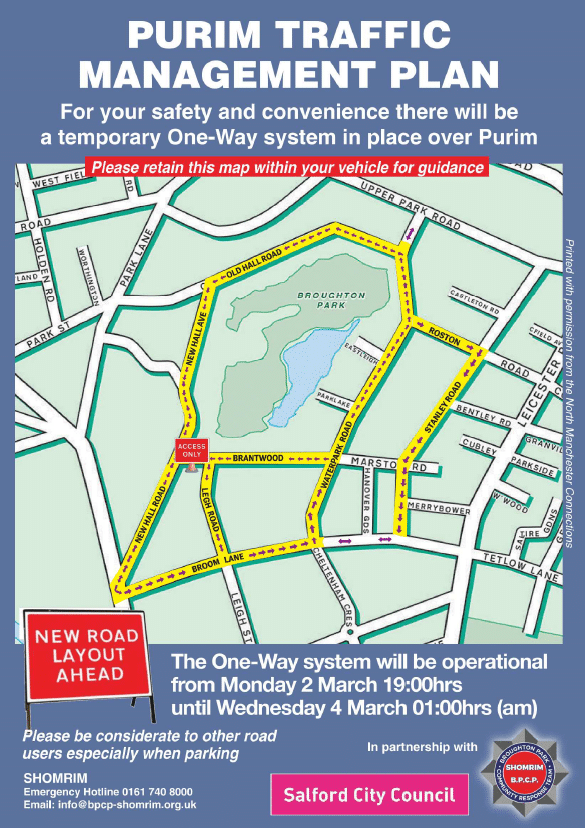
Important Taraffic Information for Purim
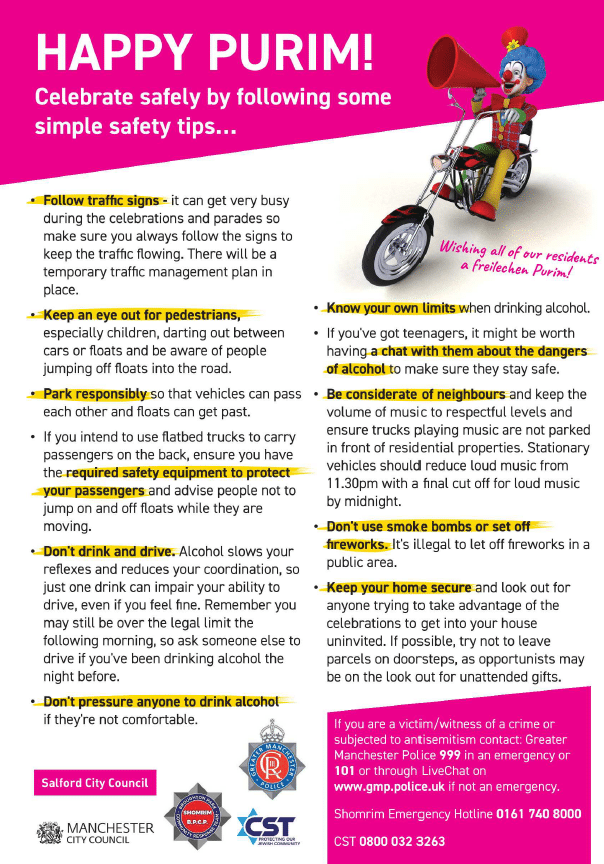
image.pngimage.png


*****

CST Security Co-ordinator.jpg

Dear Members,

CST is recruiting a full-time Security Co-ordinator to join the Manchester team.

The current security situation in Manchester has led to a significant increase in the need for CST’s work. The person appointed to this role will play an important part in supporting the safety and security of the Manchester Jewish community.

The role includes:

  • Assisting communal locations with ongoing security measures
  • Working closely with commercial guarding companies on the Home Office Protective Security Grant for the Jewish community
  • Ensuring best practice and emergency procedures are in place at schools and shuls
  • Delivering briefings and training across the Manchester Jewish community
  • Working with police and other key stakeholders, both within and outside the Jewish community

If you are interested in applying, please send your CV directly to CST or request the job pack at careers@cst.org.uk.

***** 

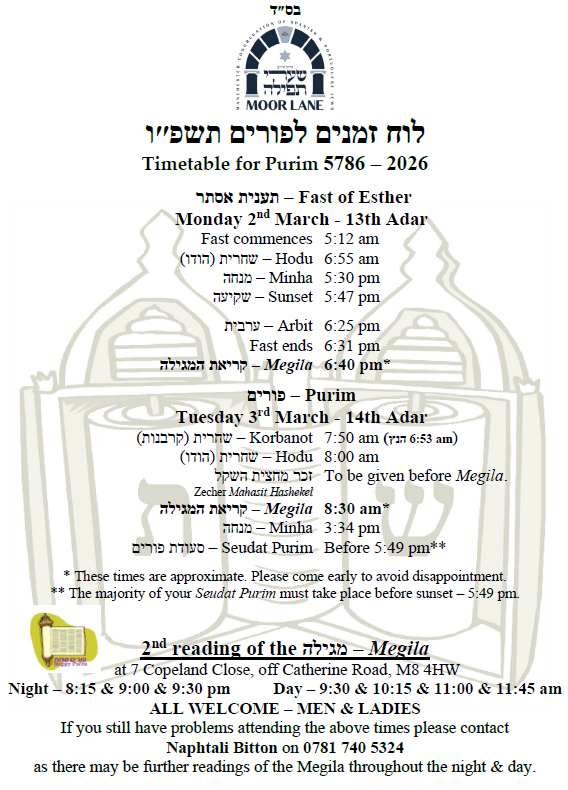
🎭🎺🪊🎷🎸🪘🪇🪈🪉Purim Timetable🪉🪈🪇🪘🎸🪊🎺🎭🎷

image.png

also attached to this email

*****

🕯️שבת🕯️

לוח זמני תפלה לחורף  תשפ״ו

Winter Timetable 5786 – 2025/26


מוצאי שבת

ערבית

(מוצ״ש)

שקיעה

מנחה שבת

סוף זמן קריאת שמע

הדלקת נרות

מנחה וקבלת שבת

תאריך

שבת פרשת

Shabbat

Ends

Arbit

Sunset

Minha

Shema before

Candle Lighting

Minha & Kabbalat Shabbat

Date

Parasha

PM

PM

PM

PM

AM

PM

PM


6:34

6:30

5:43

5:05

9:40

5:27

5:27

27/28 Feb

תצוה (זכור)

*****

🕯️WINTER TIMES FOR SHABBAT MORNING🕯️

שבת

קרבנות

8:45 am
הודו

9:00 am

*****

image.png
Avot Ubanim Winter Season 
has now concluded
Well done to all the participants
watch this space for the return
 of the Summer Season

*********

🪉Moor Lane Women’s Nach Group🪉

✴️👑✴️👑✴️👑✴️

PHOTO-2026-02-17-22-13-15.jpg

******
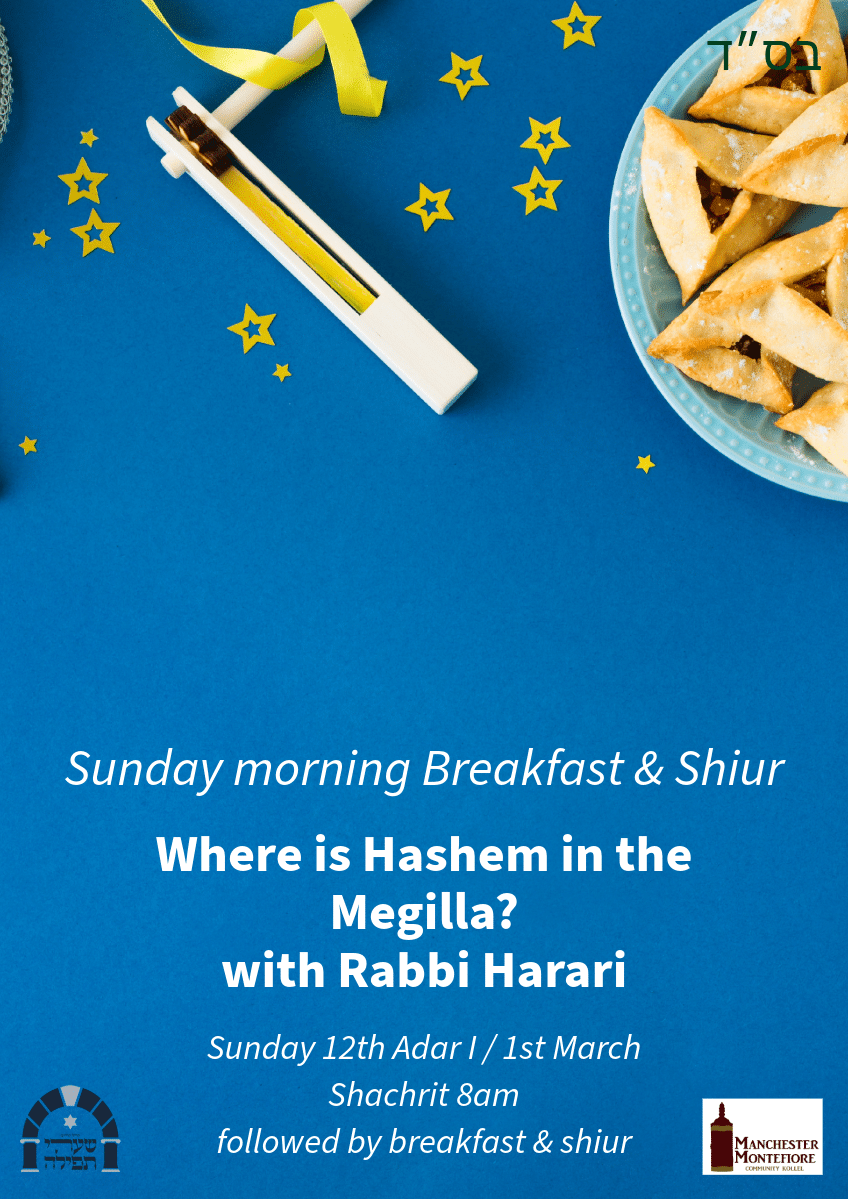
Sunday Morning
Adar 1 Breakfast.png
*******
📜
Parasha Overview

Hashem tells Moshe to command the Jewish People to supply pure olive oil for the Menorah in the Mishkan (Tent of Meeting). He also tells Moshe to organize the making of the Bigdei Kehuna (priestly garments): A breastplate, an ephod, a robe, a checkered tunic, a turban, a sash, a forehead-plate, and linen trousers. Upon their completion, Moshe is to perform a ceremony for seven days to consecrate Aharon and his sons. This includes offering sacrifices, dressing Aharon and his sons in their res ective garments, and anointing Aharon with oil.

Hashem commands that every morning and afternoon a sheep be offered on the Altar in the Mishkan. This offering should be accompanied by a meal-offering and libations of wine and oil. Hashem commands that another Altar for incense be built from acacia wood and covered with gold. Aharon and his descendants should burn incense on this Altar each day.

*******
image.png  

Halachot from Maran Rabbi Ovadia Yosef Ztz'l

נשים בקריאת המגילה – טעימה קודם המגילה

שאלה: מנהגינו שנשים שומעות קריאת המגילה בלילה, אבל לא ביום. האם מנהג זה נכון על פי ההלכה?

תשובה: אין חילוק בין האנשים לנשים לענין חיוב שמיעת קריאת המגילה, כי אף הנשים חייבות בקריאה זו כדין האנשים, שאף הן היו באותו נס ההצלה שבימי מרדכי ואסתר. וטעם מיוחד יש לחייב את הנשים בקריאת המגילה, שהרי הנס נעשה על יד אשה, היא אסתר. ובפרט בקריאת המגילה של היום, שהיא חמורה יותר מקריאת המגילה שבלילה.

ואמנם היו קצת מקומות, שהנשים נהגו שלא לשמוע קריאת המגילה בבוקר יום הפורים. ומרן רבינו עובדיה יוסף זצוק”ל בספרו טבעת המלך (תחילת הלכות מגילה), הביא את דברי שו”ת “מים חיים”, שכתב שמנהגם שלא קוראים מגילה עבור נשים ביום, והביא שרב אחר תמה על זה, ואחר כך מצא סמך להשען עליו בספר “מאורי אור”, שכתב שאין חובה כל כך בקריאת המגילה פעמיים, אלא זכר לנס שהיו צועקים ביום ובלילה בזמן צרתם, כמו שנאמר “אקרא יומם ולא תענה ולילה ולא דומיה לי”, ולכן לא רצו להחמיר כל כך על הנשים שהן טרודות בעניני הפורים שהם גם מצוה, והעוסק במצוה פטור מן המצוה. עד כאן דברי שו”ת “מים חיים” שבא להצדיק את המנהג שנשים לא קוראות מגילה ביום.

ומרן זצ”ל כתב על זה, שכל אלו דברי הבאי, ולא ניתנו להאמר, כי בודאי כל אשה יראת שמים יכולה למצוא זמן במשך היום לקיים מצות קריאת המגילה, שהיא עיקר מצות הפורים. וכמנהג כל נשות ישראל בכל מקומותיהן, ואין ספק שמנהג הנשים שזילזלו בקריאת המגילה ביום, אינו מנהג ותיק, אלא מנהג שעמי הארץ החלו בו, והוא מנהג נגד הגמרא שלנו, ונגד כל דברי הפוסקים. וברור שיש מצוה לבטל מנהג זה שלא יזכר עוד.

לכן למעשה, נשים חייבות במקרא מגילה, הן ביום והן בלילה, כדין האנשים ממש, ואסור לזלזל בזה.

אכילה לפני קריאת המגילה

אסור לאכול לפני קריאת המגילה, ולפיכך, נשים שאינן יכולות לבוא בזמן התפילה לבית הכנסת לשמוע קריאת המגילה, וממתינות עד שיחזרו האנשים מבית הכנסת, ורק אחר כך הן שומעות קריאת המגילה, צריכות להזהר שלא לאכול עד אשר תשמענה בעצמן את קריאת המגילה.

ומכל מקום מותר לשתות קפה או תה או לטעום פירות קודם קריאת המגילה. וכן מותר לאכול עוגה או פת פחות משיעור כביצה (שהוא שיעור חמישים וששה גרמים). והמחמירים שלא לטעום כלום קודם מקרא מגילה, תבוא עליהם הברכה. ואין חילוק בזה בין קריאת המגילה של הלילה לבין קריאת המגילה שביום, שאסור לאכול לפני מקרא מגילה.

ובליל פורים, במקומות שקוראים מגילה מיד בצאת תענית אסתר, והאשה ממתינה בביתה למקרא מגילה, הרי היא רשאית אפילו לכתחילה לאכול פירות או מעט עוגה וקפה או תה, ואינה צריכה להשאר בתענית עד אחר קריאת המגילה. (כן פסק הגאון הראש”ל שליט”א בילקוט יוסף הנד”מ עמוד תקנו).


The Obligation of Women in Hearing the Megillah-Eating Before Megillah Reading

Question: Our custom is that women hear Megillah reading on Purim night but not on Purim day. Is this custom correct according to Halacha?

Answer: There is no distinction between men and women regarding the obligation to hear Megillah reading and women are just as obligated as men in this Mitzvah since they too were included in the miraculous salvation in the days of Mordechai and Esther. There is an especially pertinent reason to obligate women to hear the Megillah being read since this miracle was brought about through a woman, namely Queen Esther. This is especially true regarding the Purim day Megillah reading which is more important than the Purim night Megillah reading.

Nevertheless, there were some places where the custom was for women not to hear the Megillah being read on the morning of Purim. Maran Rabbeinu Ovadia Yosef zt”l, in his Sefer Taba’at Ha’Melech (beginning of Hilchot Megillah), quotes the words of the Responsa Mayim Chaim who writes that their custom was that the Megillah would not be read for women on Purim day and he writes that a different Rav questioned this notion. However, he supported this custom based on the words of the Sefer Me’orei Ohr who writes that there is not such a firm obligation to read the Megillah twice and this is only done in commemoration of the fact that the Jewish nation would cry out day and night during their perilous situation, as the verse states, “I will call out during the day and you do not answer and by night and I have not respite.” Thus, they did not wish to burden women who are busy with the other Mitzvot of Purim and one who is involved with one Mitzvah is absolved from another. All of the above is the opinion of the Mayim Chaim who wished to uphold this custom of women not hearing Megillah being read on Purim day.

Maran zt”l writes that this opinion is completely baseless and should not even be said, for any G-d-fearing woman can certain find some time during Purim day to hear the Megillah being read since this is the primary Mitzvah of Purim. Needless to say, the custom of those women who treated Megillah reading on Purim day lightly is not an ancient custom and is merely a custom instituted by ignorant people and it contradicts the Gemara and all the Poskim. There is certainly a Mitzvah to eradicate this custom completely.

Thus, halachically speaking, women are obligated to hear Megillah reading, both on Purim night and then once again on Purim day, as is the law with regards to men, and this law may not be taken lightly.

Eating Before Megillah Reading
One may not eat before Megillah reading. Therefore, those women who do not come to hear Megillah at the time the congregation is praying in the synagogue and wait for their husbands to come home from synagogue and only then do they go to hear Megillah reading should be careful not to eat anything until they hear Megillah reading themselves.

However, they may drink tea or coffee or taste some fruit before hearing Megillah reading. Similarly, one may also partake of some cake or even less than a Kebeitza (an egg’s volume, approximately 54 grams) of bread. Those who act stringently and abstain from eating anything until the Megillah is read are especially praiseworthy. There is no distinction between the Purim night or Purim day Megillah reading, for one may not eat before Megillah reading in any case.

On Purim night in places where Megillah is read immediately following the Fast of Esther and a woman is waiting at home to hear Megillah reading later, she may eat some fruits or a some cake, tea, or coffee even preferably and she need not remain fasting until after she hears the Megillah. (The great Rishon Le’Zion Shlit”a rules likewise in his Yalkut Yosef-Purim, new edition, page 556.)

Newsletter Parashat Teruma – Rosh Chodesh Adar

בס״ד
Moor Lane - Logo.JPG

image.png
ק׳ ק׳ שׁערי תפילה
Have a look at our website 
******

image.png

 Chodesh Tov

to all our readers

משנכנס אדר מרבין בשמחה

בגמרא במסכת תענית (דף כט.) אמר רבי יהודה בנו של רב שמואל בן שילת משמו של רב, כשם שמשנכנס אב ממעטין בשמחה כך משנכנס אדר מרבים בשמחה. אמר רב פפא, הלכך כל אחד מישראל שיש לו דין (דהיינו משפט) עם נכרי (גוי), ישתמט ממנו בחודש אב, משום רוע מזלם של ישראל בחודש אב, וישתדל שיצא הדין בחודש אדר משום שאז מזלם של ישראל הוא טוב מאד.

ומקור הדברים, הוא כמו שנאמר במגילת אסתר, “והחודש אשר נהפך להם מיגון לשמחה”, ללמדנו, שמזל החודש גורם הצלה וטובה לישראל, שבחודש זה מזלם הוא טוב.

אולם הגאון החתם סופר (סימן קס) העיר, שמרן השלחן ערוך בהלכות תשעה באב (סימן תקנא) הביא את דברי חז”ל שמשנכנס אב ממעטין בשמחה, אבל את מאמר חז”ל שמשנכנס אדר מרבין בשמחה, לא הביא בשלחן ערוך. גם רבינו הרמב”ם לא הזכיר בכלל את דברי חז”ל הללו.

וכתב החתם סופר ליישב, שיתכן שהרמב”ם ומרן השמיטו את הדין שיש לשמוח בחודש אדר, משום שרב פפא, שאמר שיש להשתדל ולכוין את הדין (המשפט) עם הגוי דוקא בחודש אדר, זהו משום שהוא סובר שיש מזל לישראל, כלומר, שגם עם ישראל כפופים למזלות, ולכן בחודש אדר מזלם הוא טוב מאד ועליהם לשמוח. אבל אנחנו פוסקים כדעת האומרים (בסוף מסכת שבת) שאין מזל לישראל, כי ישראל אינם כפופים למזלות, ולכן הרמב”ם ומרן כלל לא הזכירו את הדין הזה לגבי חודש אדר.

אולם רבים מהפוסקים כתבו שיש לקיים את דברי רב פפא ש”משנכנס אדר מרבין בשמחה”, ויש מקומות שאף מציינים זאת בכתובת בולטת. וגם אם אנו סבורים ש”אין מזל לישראל”, עדיין יש לשמוח בימים הללו, משום שחודש זה כולו נהפך לשמחה בימי אבותינו, וכולו ראוי לשמחה. ומה שמרן השלחן ערוך לא הזכיר את הדברים, הוא משום שכבר כתב בפירוש (בסימן תרפח) שיש אומרים שאפשר לקרוא מגילה כבר מראש חודש. ואם כן בודאי מובן שכל ימי חודש אדר הם ימי שמחה. וכן הסביר בספר התעוררות תשובה (סימן תעג). ובשנים קודמות הסברנו את הדברים עוד על פי דברי הריטב”א ועוד, על פי מה שכתב בזה מרן רבינו זצ”ל.

ובטעם השמחה בחודש אדר, האריך הגאון הראשון לציון רבינו יצחק יוסף שליט”א בספרו ילקוט יוסף (עמוד קצב), וכתב שיש בשמחת חודש אדר משום הודאה לה' יתברך על הנסים שנעשו לישראל בימים אלה. וכן יש בזה משום ציון וסימן שהימים הללו מסוגלים לטובה ולברכה.

ועוד הוסיף, שכשם שבימי חודש אב, ממעטין בשמחה עוד ועוד עד לשיא האבלות ביום תשעה באב, כמו כן בחודש אדר, מרבין בשמחה כדי להתכונן לקראת השמחה הגדולה שיש ביום הפורים עצמו.

ועוד הביא בשם ספר שפת אמת (על מסכת תענית), שבימי חודש אדר מתעוררת שמחה גדולה בעולם, משום שבימים הללו היו רגילים עם ישראל להביא את תרומותיהם במחצית השקל לבית המקדש, ובאותם הימים היו עם ישראל נותנים את התרומה בשמחה גדולה כמו שמבואר בכמה מקומות, וכן היה גם בימי המקדש השני, שהיו מתנדבים בשמחה, ועדיין עד היום הזה השמחה נמצאת בחודש אדר והיא מתעוררת על ידי כך שקוראים בבית הכנסת בפרשת שקלים.

When Adar Begins, We Increase Our Joy”

The Gemara in Masechet Ta’anit (29a) tells us, “Rabbi Yehuda son of Rav Shmuel ben Shilat taught in the name of Rav: Just as when the month of Av begins we diminish our happiness, so too, when Adar begins we increase our happiness. Rav Papa says, therefore, if a Jew has a court case with a non-Jew pending, he should avoid having it during the month of Av when the Jewish nation’s fortune is bad and try to have it held during the month of Adar when the Jewish nation’s fortune is good.”The source for this is based on a verse in Megillat Esther which states, “And the month which was switched for them from tragedy to joy,” which teaches us that the good fortune of this month brings about salvation and goodness for Israel since their fortune is optimal during this month. Nevertheless, Hagaon Chatam Sofer (Chapter 160) points out the distinction in the words of Maran Ha’Shulchan Aruch in that whereas in the laws of Tisha Be’av (Chapter 551), Maran quotes the words of the Sages that when Av begins, we decrease our joy, Maran does not quote the corresponding teaching that when the month of Adar begins, we increase our joy. Furthermore, the Rambam does not quote this teaching of our Sages at all. The Chatam Sofer explain that it is possible that the reason why the Rambam and Shulchan Aruch omitted this law of rejoicing during Adar is because Rav Papa who maintained that one should try to schedule a court case with a non-Jew to be held specifically during the month of Adar is because he is of the opinion that the Jewish nation is subject to the influence of the constellation and during Adar when their fortune is good, this is cause for celebration. On the other hand, we maintain that the Jewish nation is not subject to the influence of the stars (based on the Gemara, end of Shabbat) and thus, the Rambam and Maran did not mention this law regarding the month of Adar at all. However, many Poskim defend the ruling of Rav Papa that when Adar begins, our joy increases; some actually post animated signs during the month of Adar to that effect. Although we maintain that the Jewish nation is not subject to the influence of the constellations, there is still room to rejoice during these days because this entire month has been switched from mourning to rejoicing in the times of our forefathers. The reason why Maran omits this law is because he had already written (in Chapter 688) that some rule that one may read the Megillah from the beginning of the month of Adar. Thus, the entire month of Adar is certainly a time for rejoicing. The Sefer Hitorerut Teshuva (Chapter 473) resolves this issue likewise. In previous years, we have explained this matter further based on the words of the Ritba and as discussed in the works of Maran zt”lThe great Rishon Le’Zion, Hagaon Rabbeinu Yitzchak Yosef Shlit”a, explains (in his Yalkut Yosef- Purim, page 192) that the reason for rejoicing during the month of Adar is out of thanksgiving to Hashem for all the miracles he performed for us during this period. It is also an indication that these days are auspicious for goodness and blessings. He adds that just as during the month of Av, we progressively decrease our joy until the epitome of mourning on the Ninth of Av, during the month of Adar, we progressively increase our joy in preparation for the most joyous day of the month, the day of Purim. He quotes the Sefer Sefat Emet (on Ta’anit ibid.) who explains that it is possible that since during the month of Adar during the eras of the Mishkan (Tabernacle) and the first and second Bet Hamikdash the Half-Shekel coins were collected in the Bet Hamikdash and the Jewish nation donated them joyously, there was a spirit of great joy in the world. Until this very day, from the time Parashat Shekalim is read in the synagogue (on the Shabbat of or preceding Rosh Chodesh Adar), a great joy is awakened in the world.

*****

Important Taraffic Information for Purim
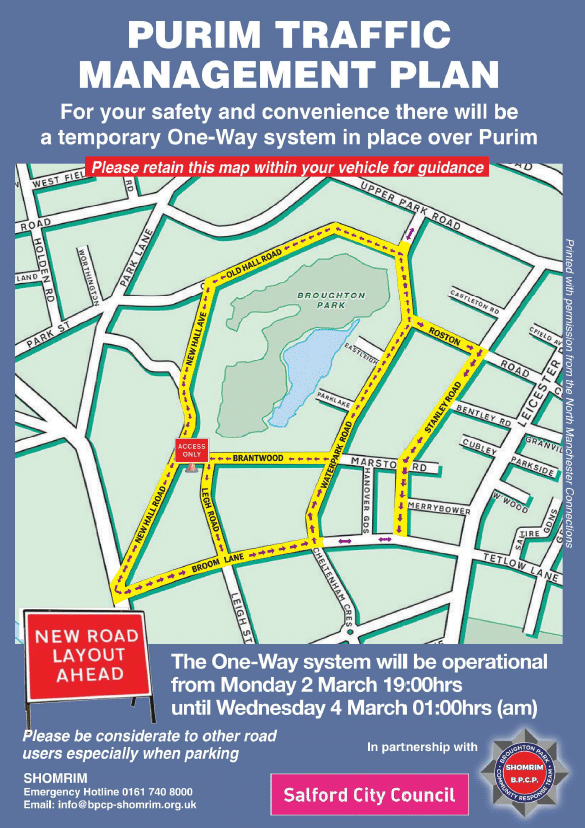
image.pngimage.png


****

🕯️שבת🕯️

לוח זמני תפלה לחורף  תשפ״ו

Winter Timetable 5786 – 2025/26

מוצאי שבת

ערבית

(מוצ״ש)

שקיעה

מנחה שבת

סוף זמן קריאת שמע

הדלקת נרות

מנחה וקבלת שבת

תאריך

שבת פרשת

Shabbat

Ends

Arbit

Sunset

Minha

Shema before

Candle Lighting

Minha & Kabbalat Shabbat

Date

Parasha

PM

PM

PM

PM

AM

PM

PM


6:21

6:17

5:30

4:55

9:48

5:14

5:14

20/21 Feb

תרומה

*****

🕯️WINTER TIMES FOR SHABBAT MORNING🕯️

שבת

קרבנות

8:45 am
הודו

9:00 am

*****

image.png
Avot Ubanim 
Winter Season 
1hr 15 min after 
Motzae Shabbat
THIS week @ 7:36 pm

*********

🪉Moor Lane Women’s Nach Group🪉

✴️👑✴️👑✴️👑✴️

PHOTO-2026-02-17-22-13-15.jpg

*******
📜
Parasha Overview

Hashem commands Moshe to build a Mishkan (Sanctuary) and supplies him with detailed instructions. The Jewish People are asked to contribute precious metals and stones, fabrics, skins, oil and spices. In the Mishkan's outer courtyard there is an Altar for the burnt offerings and a Laver for washing. The Tent of Meeting is divided by a curtain into two chambers. The outer chamber is accessible only to the Kohanim, the descendants of Aharon. This contains the Table of showbreads, the Menorah, and the Golden Altar for incense. Entrance to the innermost chamber, the Holy of Holies, was permitted only for the Kohen Gadol, and only once a year, on Yom Kippur. Here is the Ark that held the Ten Commandments inscribed on the two tablets of stone which Hashem gave to the Jewish nation on Mount Sinai. All of the utensils and vessels, as well as the instructions for the construction of the Mishkan, are described in great detail.

*******
image.png  

Halachot from Maran Rabbi Ovadia Yosef Ztz'l

אריזות כדורים בשבת

שאלה: האם מותר לפתוח בשבת אריזת גלולות?

תשובה: גלולות המצויות בזמנינו, רגילים בבתי החרושת לעוטפן בנייר פלסטיק מצדן האחד, ואילו מצדן השני הן סגורות באמצעות נייר אלומיניום שכתוב עליו שם התרופה. וכשרוצים להוציא את הגלולה, יש לקרוע את נייר האלומיניום העוטף אותה.

והנה אחת המלאכות האסורות בשבת (שנשנו במשנה במסכת שבת פרק שביעי), היא מלאכת “מוחק”. ומאחר ושם התרופה רשום על נייר האלומיניום, נמצא שמי שקורע את הנייר, גורם לכך שלא ניתן לקרוא את מה שהיה רשום עליו. ויש כאן חשש של איסור “מחיקה” בשבת. לכן עלינו לדון, האם מותר לקרוע בשבת את הנייר העוטף את הגלולה, או לא.

והנה באמת, איסור מחיקת כתב בשבת, הוא איסור מן התורה, אבל אין זה אלא כאשר המחיקה היא מחיקה על מנת לכתוב, כגון אדם המוחק כתב שבמחברת, שהמחיקה מאפשרת לכתוב שוב על הנייר, אבל כאשר אין המחיקה באה בכדי לכתוב, אין האיסור במחיקה זו אלא מדרבנן (מדברי רבותינו), שגזרו אף על מחיקה כזו שתהיה אסורה ביום השבת.

ומחיקת הכתב שמאחורי אריזת הגלולות, בודאי אינה נחשבת למחיקה על מנת לכתוב. ומעתה מבואר שאין הנדון בשאלתנו, אלא לגבי איסור מחיקה שהוא מדרבנן, אבל מצד איסור מחיקה ממש שהיא מן התורה, אין כאן חשש כלל.

ומעתה יש לנו לדון בזה מצד מה שכתב מרן רבינו זצ”ל בכמה מקומות בספריו, שכל איסור מלאכה (האסורה מדרבנן) שנעשית בשבת, כאשר אין האדם מתכוין לאותה המלאכה (ובלשון הפוסקים: “לא מתכוין”), וגם לא איכפת לו בתוצאה שיוצאת ממנה (“לא איכפת ליה”), אין איסור בעשיית אותה המלאכה.

ודוגמא לדבר, אדם שהולך על גבי שלג בשבת, אף על פי שהוא מרסק את השלג בהליכתו, מאחר ואין איסור בריסוק השלג (ברגליו) אלא מדרבנן, מותר ללכת עליו בשבת. שהרי ההליכה גורמת לאיסור דרבנן, “דלא ניחא ליה”, ו”דלא איכפת ליה”, והדבר מותר בשבת. (חזון עובדיה שבת חלק ד עמוד קעא).

וכן לענין קריעת אריזת הכדורים, מכיון שהאדם הקורע את אריזת הכדורים אינו מתכוין במלאכתו למחיקת האותיות, וגם לא איכפת לו ממחיקתם כלל וכלל, נראה שיש להקל בקריעת אריזת הכדורים בכדי שיוכל להשתמש בהן בשבת.

וכן פסק הגאון רבי שלמה זלמן אוירבך זצ”ל בספר שמירת שבת כהלכתה (עמ' תקיט), והוסיף, שאף לפי דברי האחרונים שהחמירו בנדון קרוב לנדון זה, מכל מקום במקום חולי, שהגלולות הן לרפואה, העיקר שיש להקל בזה.

ומכל מקום, המחמיר לקרוע את אריזת הכדורים מערב שבת ולהכין לו כמה כדורים שיצטרך לשבת, תבא עליו הברכה. ובפרט כאשר הכדורים אינם עשויים לצורך חולה, שאז יש מקום יותר להחמיר בזה.

ולסיכום: מותר מעיקר הדין לקרוע אריזת כדורים, אף על פי שעל ידי קריעת האריזה נמחק הכתב שעל גביה. והמחמיר לקרוע את האריזה מערב שבת, תבא עליו ברכה.


Opening Medication Packaging on Shabbat

Question: Is it permissible to open the packaging of medication tablets on Shabbat?

Answer: It is common nowadays that many pharmaceutical companies manufacture their medication tablets in a packaging of which one side is made of plastic and the other side is made of foil with the name of the company and medication imprinted on it. In order to remove the tablets, one must tear the foil in which the tablet is encased.

One of the thirty-nine forbidden works on Shabbat (listed in the Mishnah in the seventh chapter of Masechet Shabbat) is “erasing.” Since the name (and company) of the medication is printed on the foil, by tearing the foil, the words printed on it will no longer be legible which constitutes a concern of the forbidden work of “erasing” on Shabbat. We must therefore discuss whether or not it is permissible to tear the foil encasing around the tablets on Shabbat.

Although the act of erasing writing on Shabbat is certainly a Torah prohibition, this only applies when one erases in order to write, for instance, if one erases writing in a notebook which then allows him to once again write on the paper. However, if one is not erasing in order to write, this kind of erasing constitutes only a rabbinic prohibition.

If so, erasing the words on the back of a package of tablets is certainly not considered “erasing in order to write.” Thus, our discussion involves a form of erasing which is only a rabbinic prohibition and there is no concern for a Torah prohibition of erasing whatsoever.

We must now discuss what Maran Rabbeinu zt”l writes in several of his works that when any rabbinic prohibition is being performed on Shabbat, if one does not intend to perform this forbidden work and one does not care about that outcome that ensues as a result of it, there is not prohibition to perform such a work.

For example, if one walks on snow on Shabbat, although one is crushing the snow as he is walking, since crushing snow with one’s feet is only a rabbinic prohibition, one may walk on it on Shabbat, for this walking causes only a rabbinic prohibition the result of which (the crushed snow) one does not care about. This is therefore permissible (see Chazon Ovadia-Shabbat, Part 4, page 171).

The same would apply to tearing the packaging of the medication. Since the one tearing the packaging does not intend to perform the forbidden work of erasing letters and does not care about this outcome whatsoever, it seems that there is room for leniency to tear such packaging on Shabbat so that one may use the pills on Shabbat.

Indeed, the Sefer Shemirat Shabbat Ke’Hilchata (page 519) quotes Hagaon Harav Shlomo Zalman Auerbach zt”l as ruling leniently on this matter and adds that although some Acharonim rule stringently regarding a similar case, in our situation where the pills are meant to heal some sort of illness, there is certainly room to permit doing so.

Nevertheless, one who acts stringently and tears the packaging on Erev Shabbat and prepares the necessary amount of tablets for Shabbat before the onset of Shabbat shall certainly be blessed. This is especially true when the tablets are not meant for an ill individual in which case there is more room to act stringently.

Summary: According to the letter of the law, one may tear the packaging of medication tablets on Shabbat although by doing so, the letters on the back of the packaging are being torn. One who acts stringently and tears the packaging before the onset of Shabbat shall be blessed.

Newsletter Parashat Mishpatim – Shabbat Mevarechim – Shabbat Shekalim

בס״ד
Moor Lane - Logo.JPG

image.png
ק׳ ק׳ שׁערי תפילה
Have a look at our website 
********

image.png
שבת מברכים

THIS SHABBAT 

is  

שבת מברכים

Reminder
there will be NO derasha this week
instead we will have the 
kahal recitation of Sefer Tehilim
******
image.png

THIS SHABBAT

we take out 2 Sefarim

(1) Parashat Mishpatim (7 Aliyot)

(2) Parashat Shekalim (Maftir)

The haftara THIS week will be the 

Haftara of Shekalim

*********

🕯️שבת🕯️

לוח זמני תפלה לחורף  תשפ״ו

Winter Timetable 5786 – 2025/26

מוצאי שבת

ערבית

(מוצ״ש)

שקיעה

מנחה שבת

סוף זמן קריאת שמע

הדלקת נרות

מנחה וקבלת שבת

תאריך

שבת פרשת

Shabbat

Ends

Arbit

Sunset

Minha

Shema before

Candle Lighting

Minha & Kabbalat Shabbat

Date

Parasha

PM

PM

PM

PM

AM

PM

PM


6:08

6:04

5:16

4:40

9:56

5:00

5:00

13/14 Feb

משפטים (ש״מ) (שקלים)

*****

🕯️WINTER TIMES FOR SHABBAT MORNING🕯️

שבת

קרבנות

8:45 am
הודו

9:00 am

*****

image.png
Avot Ubanim 
Winter Season 
1hr 15 min after 
Motzae Shabbat
THIS week @ 7:25 pm

*********

🪉Moor Lane Women’s Nach Group🪉

PHOTO-2026-01-21-10-51-45.jpg

*******

📜
Parasha Overview

The Jewish People receive a series of laws concerning social justice. Topics include: Proper treatment of Jewish servants; a husband's obligations to his wife; penalties for hitting people and for cursing parents, judges, and leaders; financial responsibilities for damaging people or their property, either by oneself or by one's animate or inanimate property, or by pitfalls that one created; payments for theft; not returning an object that one accepted responsibility to guard; the right to self-defense of a person being robbed.

Other topics include: Prohibitions against seduction; witchcraft, bestiality and sacrifices to idols. The Torah warns us to treat the convert, widow and orphan with dignity, and to avoid lying. Usury is forbidden and the rights over collateral are limited. Payment of obligations to the Temple should not be delayed, and the Jewish People must be Holy, even concerning food. The Torah teaches the proper conduct for judges in court proceedings. The commandments of Shabbat and the Sabbatical year are outlined. Three times a year — for Pesach, Shavuot and Succot — we are to come to the Temple. The Torah concludes this listing of laws with a law of kashrut to not cook or mix meat and milk.

*******
image.png  

Halachot from Maran Rabbi Ovadia Yosef Ztz'l

לקיחת תרופות בשבת

דין נטילת תרופות בשבת

בדברי רבותינו במסכת שבת, מבואר שכל מיני רפואות, אסור לעשותן בשבת. ובכלל זה, לקיחת תרופה המרפא איזה חולי וכדומה. וטעם האיסור בזה, הוא מחמת גזירת חכמים, משום “שחיקת סממנים”. שראו רבותינו חכמי התלמוד, שהאדם מחמת הבהלה שיש לו במקום חולי שלו או של קרובו, עלול לבא לידי איסור תורה בהכנת התרופה לחולה, למשל על ידי שחיקת הסמננים לתרופה, (דהיינו טחינת העשבים לתרופות שהיו נוהגים בימים ההם), ועל כן אסרו להשתמש בשבת בכל סוג שהוא של תרופה. (אך לפי מה שיבואר, יש אופנים שמותר להתרפאות בשבת).

יש אומרים שבזמנינו שלא רגילים לייצר תרופות בבית, לא שייכת גזירה זו. ולדעת מרן רבינו עובדיה יוסף זצ”ל, יש לצרף דיעה זו להקל בכמה מקרים.

תרופה של הצלת נפשות

כתב מרן הבית יוסף (סימן שכח) בשם רבותינו הראשונים, כי ברור הדבר שלא אסרו רבותינו שום דבר, במקום פיקוח נפש ממש, כלומר, כאשר יש חשש שמחמת החולי יבא החולה לידי מיתה, שהרי אין לך דבר העומד בפני פיקוח נפש, ואפילו במקום ספק פיקוח נפש, חובה לחלל את השבת, ואפילו אם יש כמה ספקות לומר שאין מדובר בפיקוח נפש, לעולם מחללין את השבת עבור חולה כל שיש צד שיוכל לבא מתוך חוליו לידי סכנה. ואפילו במלאכות האסורות מן התורה, כגון נסיעה ברכב וכדומה, חייבים לעשותן עבור פיקוח נפש. ולא גזרו רבותינו על איסור נטילת תרופות בשבת, אלא לחולה שיש לו איזה מיחוש (כאב או חוסר נוחות), אבל הוא מתהלך כבריא, שאז אסור לו לקחת תרופה לחוליו.

למי מותר ליטול תרופות בשבת?

אדם הסובל מעט מחוסר נוחות בבטנו ביום השבת, אסור לו לקחת תרופה שמרפא את החולי ממנו הוא סובל. וכן אדם הסובל מצינון או משיעול בשבת, אסור לו לקחת תרופה לרפא את החולי ממנו הוא סובל. אבל אם גדול הסבל שלו עד כדי כך שהוא חולה בכל גופו או שהוא צריך כבר לשכב במיטה, אף על פי שלא נשקפת סכנה לחייו של החולה, מכל מקום מותר לו לקחת תרופה לרפא את חוליו, כי בחולה כזה לא גזרו רבותינו איסור משום שחיקת סממנים. וכל שכן במקום פיקוח נפש ממש, שאז מותר לעשות עבור החולה כל מה שיצטרכו עבורו לרפואתו.

דין ילד קטן

ילדים, עד גיל תשע שנים, לא שייכת בהם גזירת רבותינו בענין רפואות בשבת. ולכן מותר לתת להם תרופות, וכל כיוצא בזה בשבת. (חזון עובדיה שבת, חלק ג, עמוד שסא).

ולסיכום: אדם שאינו חולה ממש, רק הוא סובל מאיזה מיחוש, כגון שיעול או כאב בטן, והוא הולך כבריא, אסור לו ליטול בשבת תרופות המרפאות את החולי שלו. אבל אם חלה כל כך עד שכל גופו דואב בחוליו, או שהוא נאלץ לשכב במיטה, מותר לו ליטול תרופות לרפואתו. וילד עד גיל תשע, מותר לו ליטול תרופה בשבת.

ויש בזה עוד פרטי דינים מרובים, וכפי שיבואר בהלכה הבאה.


Taking Medicine on Shabbat

The Laws of Taking Medicine on Shabbat
Our Sages teach us in Masechet Shabbat that performing any sort of healing, including taking medication to heal any sort of illness, is forbidden on Shabbat. The reason for this prohibition is because the Sages of the Talmud understood that when one was in distress as a result of his own illness or a family member’s, one could possibly transgress Torah law by preparing the medicine, such as grinding herbs and other ingredients (which was common in those times) for the medicine. Our Sages therefore forbade making use of any type of medicine on Shabbat. (Nevertheless, there are situations where one may heal one’s self on Shabbat, as we shall soon discuss.)

Some say that this edict no longer applies nowadays when medicines are not usually home-made. Indeed, Maran Rabbeinu Ovadia Yosef zt”l utilizes this opinion in order to rule leniently in certain situations.

Life-Saving Medication
Maran Ha’Bet Yosef (Chapter 328) writes in the name of several Rishonim that it is clear that our Sages prohibited nothing in a life-threatening circumstance, i.e. when there is a concern that one’s illness may bring him to the verge of death. Shabbat must even be desecrated when there is even a doubtful life-threatening circumstance; even if there are several doubts pointing to the fact that the situation is non-life-threatening, Shabbat is nevertheless desecrated if there is even a slight chance that an individual’s illness can prove life-threatening. Even works forbidden by Torah law, such as driving a car and the like, must be performed in a life-threatening circumstance. Our Sages forbade taking medication on Shabbat only for an individual with pain or discomfort who continues to walk around like a healthy person.

Who May Take Medicine on Shabbat?

If one suffers from minor abdominal discomfort on Shabbat, one may not take medicine to alleviate this pain. Similarly, one who suffers from a cold or cough on Shabbat may not take medication to alleviate his symptoms. However, if one’s pain or discomfort is so great that one feels ill all over his body or if one must lay down in bed as a result of the pain, although the individual’s life is not in danger, one may take medicine to relieve his pain, for our Sages did not establish the edict regarding concern for grinding herbs in such a situation. This is certainly true regarding in a life-threatening situation in which case anything necessary to heal the ill individual may be done.

The Law Regarding Children
The edict of our Sages regarding healing on Shabbat does not apply to children under nine years of age. One may therefore give them medicine and the like on Shabbat (see Chazon Ovadia-Shabbat, Part 3, page 361).

Summary: If one is not actually ill and is merely suffering from some aches and pains, such as a stomach ache or a cough, and continues to walk around like a healthy person (as usual), one may not take medication to relieve his symptoms. However, if one becomes so ill that his entire body is in pain or if one must lie down in a bed, one may take medicine to relieve his pain and discomfort. A child under the age of nine may take medicine on Shabbat.

There are many other details pertaining to these laws, such as the law regarding taking antibiotics on Shabbat, as we shall discuss in the following Halacha.