
MoorLaneNews has the latest announcements and Divrei Torah and lots more. It is highly recommended. You can always find the latest edition here.
Newsletter Parashat Vayera

Announcements


***
New Opportunity for learning
The Avrechim of the Kollel are able to learn with the Kahal
from 6.50 pm till Arbit at 7.30 pm every evening
Need a partner?
contact Rabbi Stamler
***
Reminder THIS Motzae Shabbat
we change the clocks
1 hour backwards
***
SHABBAT
Shabbat Times
לוח זמני תפלה לחורף תשע"ט
Winter Timetable 5779 – 2018 / 19
מוצאי שבת | ערבית )מוצ"ש( | שקיעה | מנחה שבת | סוף זמן קריאת שמע | הדלקת נרות | מנחה וקבלת שבת | תאריך | שבת פרשת |
Shabbat Ends | Arbit | Sunset | Minha | Shema before | Candle Lighting | Minha & Kabbalat Shabbat | Date | Parasha |
PM | PM | PM | PM | AM | PM | PM |
|
|
6:37 | 6:30 | 5:45 | 5:10 | 10:25 | 5:33 | 5:30 | 26/27 Oct | וירא |
Shabbat Services
Children’s Tehilim straight after Musaf
Anyone wishing to donate a Kiddush Please email Moorlanenews
****
Q & A on Parashat Vayera
All references are to the verses and Rashi's commentary, unless otherwise stated.
- Why did G-d appear to Avraham after the brit mila?
18:1 – Avraham was sick, so G-d came to "visit" him. - Why was Avraham sitting at the entrance to his tent?
18:1 – He was looking for guests. - What were the missions of the three angels?
18:2 – To announce Yitzchak's birth, to heal Avraham and to destroy Sodom. - Why did Avraham enjoin the guests to wash the dust off their feet?
18:4 – He thought they were among those who worship the dust, and he didnt want any object of idolatry in his home. - Why did Avraham ask specifically Yishmael, and not someone else, to prepare food for the guests?
18:7 – To train him in the performance of mitzvot. - Why did the angels ask Avraham where Sarah was?
18:9 – To call attention to Sarahs modesty, so as to endear her to her husband. - When G-d related Sarahs thoughts to Avraham, He did not relate them precisely. Why?
18:13 – For the sake of peace. - What "cry" from Sodom came before G-d?
18:21 – The cry of a girl who was executed for giving food to the poor. - How many angels went to Sodom?
19:1 – Two; one to destroy the city and one to save Lot. - Why was Lot sitting at the gate of Sodom?
19:1 – He was a judge. - Lot served the angels matza. Why?
19:3 – It was Passover. - Why did Lot delay when he left Sodom?
19:16 – He wanted to save his property. - Why were Lot and his family not permitted to look back at Sodom?
19:17 – As they, too, deserved to be punished, it wasnt fitting for them to witness the destruction of Sodom. - Lots wife looked back and became a pillar of salt. Why was she punished in this particular way?
19:26 – She was stingy, not wanting to give the guests salt. - In what merit did G-d save Lot?
19:29 – Lot had protected Avraham by concealing from the Egyptians the fact that Sarah was his wife. - Why did Avraham relocate after the destruction of Sodom?
20:1 – Because travel in the region ceased and Avraham could no longer find guests. - Why did Avimelech give gifts to Avraham?
20:14 – So that Avraham would pray for him. - Why was Avraham told to listen to Sarah?
21:12 – Because she was greater in prophecy. - Why did G-d listen to the prayer of Yishmael and not to that of Hagar?
21:17 – Because the prayer of a sick person is more readily accepted than the prayer of others on his behalf. - Who accompanied Avraham and Yitzchak to the akeidah (binding)?
22:3 – Yishmael and Eliezer.
****
Halachot from Maran Rabbi Ovadia Yosef Ztz'l
דין דם הנמצא בביצים
דם הנמצא בביצים, אסור באכילה, משום שאותו דם הוא תחילת ריקום האפרוח, ואותו האפרוח, דין עוף יש לו, שדמו אסור באכילה מן התורה, ולכן גם דם הנמצא בביצים אסור באכילה מן התורה, וזו דעת רבינו הרא"ש והתוספות. אולם לדעת רבינו הרמב"ם, דם הנמצא בביצים אינו אסור באכילה אלא מדרבנן, משום שאף על פי שדם זה אמנם הוא תחילת ריקום האפרוח, מכל מקום מכיון שלא נגמרה יצירתו של האפרוח, אין לו דין עוף כלל, ואין דמו אסור מן התורה אלא מדרבנן, גזירה משום דם עוף.
ויש אופן שכל הביצה נאסרת אם נמצא בה דם, ויש אופנים שאין הביצה כולה נאסרת, רק צריך להסיר את הדם ממנה, והיא מותרת. וכדלהלן:
אם נמצא (אפילו מעט) דם בחלמון הביצה, כל הביצה אסורה, אבל אם נמצא דם בחלבון הביצה (היינו החלק הלבן) זורק את הדם ושאר הביצה כולה מותרת, וזהו לדעת מרן השלחן ערוך, אולם הרמ"א כתב שבכל מקום שיש דם בביצה אוסרים את כל הביצה באכילה. ומנהג הספרדים להקל בזה כדעת מרן שקבלנו הוראותיו.
אף על פי שדם הנמצא בביצים אסור באכילה, מכל מקום אין חיוב מן הדין לבדוק כל ביצה קודם אכילתה, משום שסומכים על כך שברוב הביצים אין דם, ומעיקר הדין אפשר לסמוך על הרוב, ורק אם מטגנים ביצים במחבת או שוברים ביצים לצורך אפייה וכדומה נוהגים לבדוק את הביצים (בכוס זכוכית או כלי אחר) אם יש בהם דם, מפני שבנקל אנו יכולים לבדוק את הביצים להנצל מאיסור דם, כל שבלאו הכי פותחים את הביצה, ולכן נוהגים לבדוק אותן אם יש בהן דם. אבל כאשר באים לבשל ביצים קשות במים, או שרוצים לשים ביצים בחמין וכדומה, אף על פי שאחר הבישול אי אפשר לדעת אם היה בהן דם, או אדם הבא לגמוע ביצה כמו שהיא רכה בלא לבדקה כלל, רשאי לעשות כן, מפני שהולכים אחר הרוב, ורוב ביצים אין בהן דם.
אולם בספר כנסת הגדולה כתב, שיש בני אדם המחמירים שלא לאכול ביצים אלא אם נבדקו תחילה, ואף כשרוצים לבשל ביצה, הם נוהגים לפתוח את קליפת הביצה ולהוריק מתוכה את תוכנה לתוך כלי, ואחר כך מחזירין את הביצה לתוך קליפתה וסותמין את הנקב ומבשלים או צולין אותה. ומכל מקום להלכה נראה דאין מקום לחומרא זו, שהרי כתב המהרח"ו (רבינו חיים ויטאל) שראה לרבו האר"י הקדוש, שהיה גומע ביצה כשהיא צלויה, בלי שישגיח לבדוק אם יש בתוכה דם, והביא ראיות מן התלמוד בכמה מקומות, שאין לחוש לסברת המחמירים בזה. והביא כל זה מרן החיד"א בספרו ברכי יוסף, וסיים, ובהגלות נגלות אמרי קדוש רבינו האר"י ז"ל אין לחוש לחומרת בני אדם הנזכרים
The Laws of Blood Found in Eggs
Blood found in eggs is forbidden for consumption, for this blood indicates the beginning of the embryotic development of the chick and this chick has the halachic status of "fowl" whose blood is forbidden for consumption by Torah law; thus, the opinion of the Rosh and Tosafot is that blood found in eggs is likewise forbidden to be eaten by Torah law. Nevertheless, according to the Rambam, blood found in eggs is only forbidden to be eaten by virtue of a rabbinic prohibition, for although this blood indicates the beginning of the chick's embryotic development, since the chick's development is not yet complete, it does not retain the status of "fowl" and its blood is not forbidden by Torah law; rather, there is merely a rabbinic decree banning it due to its similarity to blood of an actual bird.
There are instances where the entire egg becomes forbidden for consumption as a result of this blood and there instances where the entire egg does not become forbidden and one must only remove the blood and the rest of the egg is permissible, as follows:
If one finds blood (even a drop) in the yolk of the egg, the entire egg is forbidden. However, if the blood is found in the egg-white, one may remove the blood and the rest of the egg is permissible for consumption. This applies according to Maran Ha'Shulchan Aruch. However, according to the Rama, if blood is found in any part of the egg, the entire egg is forbidden for consumption. The Sephardic custom is to rule leniently on this matter in accordance with the ruling of Maran.
Although blood found in eggs is forbidden for consumption, there is no obligation to check every egg before eating it since we rely on the fact that most eggs do not contain blood and according to the letter of the law, one may rely on the majority. Only if one is frying eggs in a pan or breaking open eggs for baking and the like, it is customary to check the eggs for blood (in a glass or any other clear vessel), for in this case, it is quite easy to check the eggs for blood since they are being opened anyway. However, when one wishes to hard boil eggs in water or place eggs in a Chulent and the like, although after cooking them it will be impossible to tell if there was blood in them or not, it is indeed permissible to do so without checking them, for most eggs do not contain blood and we follow the majority. The same applies to one who wishes to swallow a whole egg, uncooked, that one need not check it first.
Nevertheless, the Kenesset Ha'Gedolah writes that there are some who are stringent not to eat eggs unless they have been checked for blood first; even if they wish to hard-boil the egg, they make a small hole in the shell, pour out the contents of the egg into a cup, and after ascertaining that the egg is clean of blood, pour the contents back into the shell, close up the hole, and then proceed to hard-boil it. However, halachically speaking, there is truly no room for this stringency, for Rabbeinu Chaim Vital writes that he has seen his rabbi, the saintly Ariz"l, eating a roasted egg without first checking if there was blood inside. He proceeds to bring sources from various places in the Talmud that there is no need to be concerned about the more stringent opinion on this matter. Maran Ha'Chida quotes all of this in his Birkei Yosef and concludes, "Now that the holy teachings of our rabbi, the Ari z"l, have been revealed, there is no need to be concerned with the aforementioned stringency some individuals follow."
דין דם הנמצא בביצים (המשך(
בהלכה הקודמת
ביארנו שאסור לאכול דם הנמצא בביצים, ושיש אופן שדם הנמצא בביצים אוסר את כל הביצה, משום שדם הנמצא בביצה הוא תחילת ריקום האפרוח שדמו אסור.
ולאור מה שנתבאר שאיסור הדם הוא מפני שזהו תחילת ריקום האפרוח, עולה השאלה לגבי רוב הביצים הנמכרות כיום (כגון ביצי "תנובה" בארץ ישראל) על ידי המשווקים הגדולים, האם יש בהם בכלל איסור דם, משום שכידוע כמעט כל התרנגולות המטילות את הביצים הללו, סגורות בלולים מבלי אפשרות לצאת ולבא כלל, ואין שם שום תרנגול זכר, ועל כל פנים, רוב ככל הביצים הם על דרך זה, ולכן יש לשאול אם יש איסור בביצים אלו אם נמצא בהם דם שהרי בודאי דם זה אינו תחילת ריקום האפרוח.
והגאון רבי משה פיינשטיין זצ"ל נשאל בזה כבר בשנת התשי"ז (1957), וכתב שאף על פי שמן הדין יש להקל בביצים אלו על ידי זריקת הדם עצמו, וכל הביצה תהיה מותרת, אך מכיוון שיש לולים שמגדלים תרנגולים עם תרנגולות ביחד לצורך גידול אפרוחים (לאכילה), ולפעמים כשיש להם הרבה ביצים יותר מכפי שצריכים לצורך אפרוחים, מוכרים גם את הביצים שנולדים מזכרים עם הביצים שנולדו בלא זכרים, (וכן אנו יודעים שהיא המציאות בארץ ישראל בשנים האחרונות), ראוי להחמיר לזרוק את כל הביצה אם נמצא בה דם (בחלמון לדעת מרן. ובכל מקום לדעת הרמ"א כפי שנתבאר
בהלכה הקודמת
.) אך מכל מקום מן הדין יש להקל בזה כיון שרוב מוחלט של הביצים אינם מופרות מזכרים ולמיעוט רחוק כל כך אין לחוש מן הדין, אף בזמנינו. אולם בשו"ת מנחת יצחק כתב להחמיר בזה אף מן הדין.
ומרן הרב עובדיה יוסף זצ"ל האריך בתשובה בדין זה, והעלה להקל בביצים הנמכרות בזמנינו, שדי לזרוק את הדם הנמצא בהן, אבל כל הביצה מותרת, משום שרובא דרובא של הביצים, אינם ביצים של זכר, והדם שבתוכם אינו יכול להיות תחילת ריקום של אפרוח. ולפיכך אין להאריך בהלכות דם הנמצא בביצים, לפי שבדרך כלל בזמנינו קונים ביצים בחנויות מידי המשווקים, ודי בהוצאת הדם עצמו וכל הביצה מותרת
The Laws of Blood Found in Eggs-Continued
In the previous Halacha we have discussed that it is forbidden to consume the blood sometimes found in eggs and that there are instances where the blood found in the egg can prohibit consumption of the entire egg since blood is an indication of the beginning of the chick’s embryotic development and the chick’s blood is indeed forbidden.
Based on what we have explained that the blood is forbidden because it indicates the beginning of the chick’s embryotic development, a question arises regarding most eggs sold today by large companies whether or not the blood found in them is forbidden for consumption, for as we know, almost all of the hens which lay these eggs are enclosed in a coop without the ability to move in and out and with no male chickens present at all. Indeed, at least most eggs are laid in this way. The question therefore is: Is blood found in such eggs likewise forbidden although it can certainly not indicate the beginning of a chick’s embryotic development?
This question has already been posed to Hagaon Harav Moshe Feinstein zt”l in the year 5717 (1957) to which he replied that according to the letter of the law, one may act leniently and merely remove the blood spot and the rest of the egg will be permissible for consumption. However, since there are farms which raise both male and female chickens for production of chicks (for eating) and there are times when they will have a surplus of eggs, more than are necessary for production of chicks, and these eggs laid from the fertilization of males will be sold along with eggs laid without males, it is correct to be stringent and dispose of the entire egg if blood is found inside (only if the blood is found in the yolk according to Maran Ha’Shulchan Aruch or anywhere in the egg according to the Rama, as we have explained in the previous Halacha). Nevertheless, as we have written, according to the letter of the law there is room for leniency in this matter since a vast majority of the eggs sold on the market today are without male contact and there is no halachic need to be concerned about such a small minority, even nowadays. On the other hand, the Minchat Yitzchak requires one to act stringently according to the law.
Maran Harav Ovadia Yosef zt’l deals with this matter lengthily in one of his responses and concludes that one may act leniently regarding the eggs sold nowadays and one may merely dispose of the blood found in the egg; however, the rest of the egg is permissible for consumption, for the vast majority of eggs nowadays are not from male contact and the blood found in them is certainly not the beginning of a chick’s embryotic development. It is thus unnecessary to discuss the laws of blood found in eggs lengthily, since nowadays, people usually purchase eggs marketed by large companies from the supermarket or grocery store and it is sufficient to remove the blood and the rest of the egg is permissible.
****
—
Shabbat Shalom
moorlanenews@gmail.com
Please feel free to ask us any questions or requests you may need through this e-mail. We will get back to you, bli neder, asap.
Please send us any announcement you would like to make through our e-mail before Wednesday morning, if possible, unless there is a Yom Tob. Exceptions will be made for late entries
Be advised that we will only announce your simcha when you give us permission to do so
If you no longer wish to receive further emails from moorlanenews please reply with the word "unsubscribe".
Thank you, Hatzlacha & all the best
Newsletter Parashat Lech Lecha
Announcements
***

1)
We welcome back the Kollel to a new Kolel zeman
&
would like to welcome all the new members of the kollel.
2)
Fresh New Opportunity for learning
The Avrechim of the Kollel are able to learn with the Kahal
from 6.50 pm till Arbit at 7.30pm every evening
Need a partner?
contact Rabbi Stamler
3)
***
SHABBAT
Shabbat Times
לוח זמני תפלה לחורף תשע"ט
Winter Timetable 5779 – 2018 / 19
מוצאי שבת | ערבית )מוצ"ש( | שקיעה | מנחה שבת | סוף זמן קריאת שמע | הדלקת נרות | מנחה וקבלת שבת | תאריך | שבת פרשת |
Shabbat Ends | Arbit | Sunset | Minha | Shema before | Candle Lighting | Minha & Kabbalat Shabbat | Date | Parasha |
PM | PM | PM | PM | AM | PM | PM |
|
|
6:51 | 6:45 | 6:00 | 5:25 | 10:19 | 5:48 | 5:45 | 19/20 Oct | לך לך |
Shabbat Services
Children’s Tehilim straight after Musaf
Anyone wishing to donate a Kiddush Please email Moorlanenews
****
Q & A on Parashat Lech Lecha
All references are to the verses and Rashi's commentary, unless otherwise stated.
- What benefits did G-d promise Avraham if he would leave his home?
12:1 – He would become a great nation, his excellence would become known to the world, and he would be blessed with wealth. - "And all the families of the earth will be blessed through you." What does this mean?
12:3 – A person will say to his child, "You should be like Avraham." - Who were the souls that Avraham and Sarah "made?"
12:5 – People they converted to the worship of G-d. - What were the Canaanites doing in the Land of Canaan when Avraham arrived?
12:6 – They were in the process of conquering the land from the descendants of Shem. - Why did Avraham build an altar at Ai?
12:8 – He foresaw the Jewish People's defeat there in the days of Yehoshua due to Achans sin. He built an altar to pray for them. - What two results did Avraham hope to achieve by saying that Sarah was his sister?
12:13 – That the Egyptians would not kill him, and would give him presents. - Why did Avraham's shepherds rebuke Lot's shepherds?
13:7 Lot's shepherds grazed their flocks in privately owned fields. - Who was Amrafel and why was he called that?
14:1 – Amrafel was Nimrod. He said (amar ) to Avraham to fall (fel ) into the fiery furnace. - Verse 14:7 states that the four kings "smote all the country of the Amalekites". How is this possible, since Amalek had not yet been born?
14:7 – The Torah uses the name that the place would bear in the future. - Why did the "palit " tell Avraham of Lot's capture?
14:13- He wanted Avraham to die trying to save Lot so that he himself could marry Sarah. - Who accompanied Avraham in battle against the four kings?
14:14 – His servant, Eliezer. - Why couldn't Avraham chase the four kings past Dan?
4:14 – He saw prophetically that his descendants would make a golden calf there, and as a result his strength failed. - Why did Avraham give "ma'aser " specifically to Malki-Tzedek?
14:20 – Because Malki-Tzedek was a kohen. - Why didn't Avraham accept any money from Sodom's king?
14:23 – G-d had promised Avraham wealth, and Avraham didn't want Sodom's King to say, "I made Avraham wealthy." - When did the decree of 400 years of exile begin?
15:13 – With the birth of Yitzchak. - What did G-d indicate with His promise that Avraham would "come to his ancestors in peace"?
15:15 – That his father, Terach, would repent and become righteous. - How did G-d fulfill His promise that Avraham would be buried in "a good old age"?
15:15 – Avraham lived to see his son Yishmael repent and become righteous, and he died before his grandson Esav became wicked. - Why did the Jewish People need to wait until the fourth generation until they returned to Eretz Canaan?
15:16 – They needed to wait until the Amorites had sinned sufficiently to deserve expulsion. - Who was Hagar's father?
16:1 – Pharaoh. - Why did Avraham fall on his face when G-d appeared to him?
17:3 – Because he was as yet uncircumcised.
****
Halachot from Maran Rabbi Ovadia Yosef Ztz'l
מאימתי מותר לשבת בחזרת התפילה?
בהלכה הקודמת ביארנו, שמעיקר הדין מותר לשבת בשעת חזרת התפילה שעל ידי השליח ציבור. כלומר, אחר תפילת העמידה שכל אחד ואחד מתפלל בעצמו, מותר לציבור לשבת, ואינם חייבים לעמוד במשך כל זמן החזרה.
אולם יש להבהיר, כי אין לשבת בחזרת התפלה, אלא לאחר שסיים השליח ציבור את ברכת "האל הקדוש". שכן כתב מרן השלחן ערוך (סימן קכג), שלאחר שמסיים כל אחד ואחד מן הציבור את תפילת הלחש, עליו לפסוע שלוש פסיעות לאחריו, ואז יעמוד במקומו ולא יזוז. ולא יחזור למקום שבו התפלל, אלא כאשר יגיע הציבור עם החזן לקדושה (נקדישך ונעריצך). שאז יחזור למקומו ויאמר את נוסח הקדושה כדין. ולאחר הקדושה ישאר במקומו, ויענה ברוך הוא וברוך שמו לברכת "האל הקדוש". ולאחר ברכה זו רשאי לשבת במקומו.
וכתב בספר תורת חיים, שיש לתמוה על מנהג ההמון שמיקלים בדבר זה, ומיד כשמסיימים תפילתם הם יושבים במקומותיהם, וכשמגיע שליח ציבור לקדושה הם עומדים. שמנהג זה עומד בניגוד למה שפסק מרן השלחן ערוך הנ"ל, שלכל הפחות חייבים לעמוד במקומם עד שיתחיל השליח ציבור את חזרת הש"ץ, שאז מותרים הם לחזור למקומם הראשון בשתיקה, ושם יענו לקדושה שבחזרת התפילה. ומן הראוי לעורר את לב העם לכך. עד כאן עיקר דבריו.
ומרן רבינו הקדוש רבי עובדיה יוסף זצ"ל (הכ"מ), גם בערוב ימיו, כשהיה חלש, ורגליו כואבות, היה עומד תמיד על מכונו, לאחר שסיים את התפלה, והיה ממתין לשליח ציבור עד אחר הקדושה. ורק אז היה מתיישב על מקומו.
ועוד יש להעיר, אודות מה שיש נוהגים, שבשעה שמגיע החזן לברכת "מודים", הם אינם עומדים במקומותיהם לעניית "מודים", אלא נשארים יושבים, ומסתפקים בקימה מועטת לעניית מודים. שמנהג זה אינו נכון, כי חובה עלינו לכרוע בשעת אמירת "מודים", וכאשר אדם יושב, הכריעה שהוא עושה אינה נחשבת כריעה מצד ההלכה, ולכן פסק מרן רבינו זצ"ל, שחייב כל אדם לעמוד בשעה שמגיע החזן לברכת מודים, כדי שיוכל לכרוע כדין וכפי מצות חכמים.
ואם הוא זקן או חולה שאינו יכול לעמוד אלא במאמץ גדול, יוכל להקל ולשבת מיד כשמסיים תפילתו, ועד עניית הקדושה, ולאחר מכן ישב עד אמירת מודים, ואז יענה מודים כשהוא יושב, ויכרע מעט כשהוא יושב. אבל אדם בריא, חייב לעמוד ממש, כדי שיוכל לכרוע כדין.
ולסיכום: כשמסיים אדם את תפילתו, עליו לפסוע שלוש פסיעות לאחריו. וישאר עומד במקומו עד שיגיע החזן לקדושה, שאז יחזור למקום בו עמד בתפילתו, ויענה לקדושה. וישאר עומד על מקומו עד סיום ברכת "האל הקדוש", ולאחר ברכת האל הקדוש רשאי מעיקר הדין לשבת במקומו, עד שיגיע החזן ל"מודים", ואז יעמוד ויכרע באמירת "מודים", ויוכל לחזור ולשבת בסיום אמירת "מודים".
At What Point During the Chazzan's Repetition of the Amida May One be Seated?
In the previous Halacha we have explained that, according to the letter of the law, one may sit during the Chazzan's repetition of the Amida. This means that after one has concluded one's personal, silent Amida, the congregation may be seated and need not remain standing for the entire duration of the Chazzan's repetition.
Nevertheless, we must point out that one may only be seated during the Chazzan's repetition once the Chazzan has concluded the "Ha'El Ha'Kadosh" blessing. Indeed, Maran Ha'Shulchan Aruch (Chapter 123) states that when one concludes one's silent Amida, one should take three steps back and then stand in that very same place and not move. One may only return to the original place one prayed (i.e. by taking three steps forward) when the Chazzan and congregation reach the Kedusha ("Nakdishach Ve'Na'aritzach") at which point one should return to one's original place and recite Kedusha along with the congregation. After the Kedusha is concluded, one should remain standing in place until one has answered "Baruch Hu U'Varuch Shemo" and Amen to the "Ha'El Ha'Kadosh" blessing. Only at the conclusion of this blessing may one be seated.
The Sefer Torat Chaim wonders about the common custom that many have to be seated immediately upon concluding their silent Amida and then rise when the Chazzan reaches the Kedusha, for this custom is contrary to the ruling of Maran Ha'Shulchan Aruch who writes that one must remain in place at least until the Chazzan begins the repetition of the Amida, at which point one is permitted to return to one's original place silently and recite the Kedusha along with the congregation. One should point this law out to as many people as possible.
Indeed, Maran Rabbeinu Ovadia Yosef zt"l would stand in place after having concluded his Amida prayer, even when he was advanced in age and his feet hurt, and he would only be seated once the Chazzan had concluded the Kedusha. Furthermore, another issue that must be addressed is that when the Chazzan reaches the "Modim" blessing, many individuals do not rise to recite "Modim"; rather, they do so while remaining seated and only having risen ever so slightly. This custom is incorrect, for one is obligated to bow while reciting "Modim" and any bowing exercised while seated has no halachic significance. It is for this reason that Maran zt"l that the entire congregation must rise when the Chazzan reaches the "Modim" blessing, in order to be able to bow in accordance with the edict of our Sages.
If one is elderly or infirm such that standing requires much strain and effort, one may be seated immediately upon concluding one's silent Amida prayer until Kedusha is recited (at which point one must rise) and one may then be seated again upon conclusion of the Kedusha. When the Chazzan reaches "Modim", such a person may recite "Modim" while remaining seated, albeit by bowing while raising one's body slightly. However, a healthy person must rise completely in order to be able to bow according to Halacha.
Summary: Upon concluding one's silent Amida prayer, one must take three steps back and remain standing in that very place until the Chazzan reaches Kedusha, at which point one should take three steps forward and return to the place one had originally prayed in order to recite Kedusha along with the congregation. One must remain in this position until the Chazzan concludes the "Ha'El Ha'Kadosh" blessing, at which point one may, according to the letter of the law, be seated until the "Modim" blessing. When the Chazzan reaches the "Modim" blessing, one must rise, bow, and recite "Modim" after which one may once again be seated.
****
—
Shabbat Shalom
moorlanenews@gmail.com
Please feel free to ask us any questions or requests you may need through this e-mail. We will get back to you, bli neder, asap.
Please send us any announcement you would like to make through our e-mail before Wednesday morning, if possible, unless there is a Yom Tob. Exceptions will be made for late entries
Be advised that we will only announce your simcha when you give us permission to do so
If you no longer wish to receive further emails from moorlanenews please reply with the word "unsubscribe".
Thank you, Hatzlacha & all the best
Newsletter ~ Parashat Noach
Announcements

Mazal Tov
to
Mr & Mrs M Calder
on the safe arrival
of their new baby grandson
Sheyizke Laberit bizmana
LaTorah lacgupa Ulemaasim tovim
***


This Friday
3 Mar Cheshvan
is the Nachala of
Maran Hagaon Rabbi Ovadia Yosef Ztz'l
***
Winter Timetable Attached
***
SHABBAT
Shabbat Times
לוח זמני תפלה לחורף תשע"ט
Winter Timetable 5779 – 2018 / 19
מוצאי שבת | ערבית )מוצ"ש( | שקיעה | מנחה שבת | סוף זמן קריאת שמע | הדלקת נרות | מנחה וקבלת שבת | תאריך | שבת פרשת |
Shabbat Ends | Arbit | Sunset | Minha | Shema before | Candle Lighting | Minha & Kabbalat Shabbat | Date | Parasha |
PM | PM | PM | PM | AM | PM | PM |
|
|
7:07 | 7:00 | 6:16 | 5:40 | 10:13 | 6:04 | 6:05 | 12/13 Oct | נח |
Shabbat Services
Children’s Service From 10am Every Shabbat morning
Children’s Tehilim straight after Musaf
Anyone wishing to donate a Kiddush Please email Moorlanenews
****
Q & A on Parashat Noach
All references are to the verses and Rashi's commentary, unless otherwise stated.
- Which particular sin sealed the fate of the flood generation?
6:13 – Robbery. - Why did Hashem tell Noach to build an ark, as opposed to saving him via some other method?
6:14 – So that people would see Noach building the ark and ask him what he was doing. When Noach would answer, "Hashem is bringing a flood," it might encourage some people to repent. - The ark had three levels. What function did each level serve?
6:16 – The top level housed the people, the middle level housed the animals, and the bottom level, the refuse. - What indication do we have that Noach was familiar with the Torah?
7:2 – Hashem told him to take into the ark seven of each kosher-type animal, and two of each non-kosher type. "Kosher" and "non-kosher" are Torah concepts. - Why did Hashem postpone bringing the flood for seven days?
7:4 – To allow seven days to mourn the death of Metushelach. - Why did the first water of the flood come down as light rain?
7:12 – To give the generation a chance to repent. - What did people say that threatened Noach, and what did Hashem do to protect him?
7:13,15 – People said, "If we see him going into the ark, we'll smash it!" Hashem surrounded it with bears and lions to kill any attackers. - What grouping of creatures escaped the punishment of the flood?
7:22 – The fish. - How deeply was the ark submerged in the water?
8:4 – Eleven amot. - What did the olive branch symbolize?
8:11 – Nothing. It was a leaf, not a branch. (The olive leaf symbolized that its better to eat food "bitter like an olive" but which comes directly from Hashem, rather than sweet food provided by humans.) - How long did the punishment of the flood last?
8:14 – A full solar year. - A solar year is how many days longer than a lunar year?
8:14 – Eleven days. - When did humans receive permission to eat meat?
9:3 – After the flood. - What prohibition was given along with the permission to eat meat?
9:4 – The prohibition of eating a limb cut from a living animal. - Why does the command to "be fruitful and multiply" directly follow the prohibition of murder?
9:7 – To equate one who purposely abstains from having children to one who commits murder. - Name two generations in which the rainbow never appeared.
9:12 – The generation of King Chizkiyahu and the generation of Shimon bar Yochai. - Why did Noach curse Canaan specifically? Give two reasons.
9:22,24 – Because Canaan is the one who revealed Noachs disgrace to Cham. And because Cham stopped Noach from fathering a fourth son. Thus, Noach cursed Cham's fourth son, Canaan. - Why does the Torah call Nimrod a mighty hunter?
10:9 – He used words to ensnare the minds of people, persuading them to rebel against Hashem. - The sin of the generation of the dispersion was greater than the sin of the generation of the flood. Why was the punishment of the former less severe?
11:9 – They lived together peacefully. - Why was Sarah also called Yiscah?
11:29 – The word "Yiscah" is related to the Hebrew word "to see." Sarah was called Yiscah because she could "see" the future via prophecy. Also, because of her beauty, everyone would gaze at her.
****
Halachot from Maran Rabbi Ovadia Yosef Ztz'l
דין הזכרת משיב הרוח
מתחילין לומר "משיב הרוח ומוריד הגשם" בתפילת מוסף של שמחת תורה, והזכרה זו אינה שאלה ובקשה על הגשם, אלא היא שבח להשם יתברך, ולכן הזכרה זו נקראת "גבורות גשמים", אבל שאלת טל ומטר שבברכת השנים, היא בקשה מהשם יתברך על הגשם, וישנם כמה הבדלים בהלכה בין הזכרת גבורות גשמים שבברכת "אתה גבור", לבין שאלת טל ומטר שבברכת השנים, והשינוי הראשון הוא, שמזכירין גבורות גשמים כבר מתפילת מוסף של שמחת תורה, ואילו שאלת גשמים אינה אלא מליל שבעה במרחשון כפי שיתבאר בהלכות הבאות.
ואמרו בגמרא (ברכות לג.) שמזכירין גבורות גשמים בברכת "אתה גבור" משום שהיא ברכה על תחיית המתים, ומתוך שירידת גשמים שקולה כנגד תחיית המתים לפיכך קבעוה בתחיית המתים. ושאלת גשמים קבעו בברכת השנים משום שברכת השנים היא ברכה על פרנסה, וירידת גשמים גם היא ענין פרנסה לעולם.
מנהג הספרדים וחלק מעדות האשכנזים, שבימות הקיץ אומרים בברכת "אתה גבור" "מוריד הטל", ולמנהג זה אם שכח לומר משיב הרוח ואמר מוריד הטל וכבר סיים ברכת מחיה המתים, אינו חוזר. אבל אם לא הזכיר משיב הרוח וגם לא הזכיר מוריד הטל (כמנהג חלק מעדות האשכנזים בימות הקיץ), אם לא התחיל עדיין ברכת "אתה קדוש" יאמר "משיב הרוח ומוריד הגשם" בין ברכת מחיה המתים לברכת האל הקדוש וימשיך תפילתו, ואם התחיל כבר ברכת "האל הקדוש" אין לו תקנה ויחזור לראש התפילה
The Laws of Mentioning “Mashiv Ha’Ruach”
We begin reciting “Mashiv Ha’Ruach U’Morid Ha’Geshem” in the Mussaf prayer of Simchat Torah (outside of Israel from Shemini Atzeret). This recitation does not constitute a request or plea for rain; rather, it is merely meant as praise to Hashem and is therefore dubbed, “Powers of Rain.” The actual request for dew and rain can be found in the ninth blessing of the Amidah prayer referred to as the “Blessing of the Years” (Barech Aleinu). There are several halachic differences between mentioning the “Powers of Rain” in the second blessing of the Amidah prayer entitled, “Ata Gibor,” and the actual request for dew and rain in the ninth blessing. Firstly, whereas we begin mentioning the “Powers of Rain” from Mussaf of Shemini Atzeret, we do not actually request dew and rain until the night of the Seventh of Marcheshvan (outside of Israel from the night of the Fifth of December), as we shall discuss in following Halachot.
The Gemara (Berachot 33a) states that we mention the “Powers of Rain” in the “Ata Gibor” blessing for this blessing deals with the Resurrection of the Dead and since rainfall is tantamount to The Resurrection, our Sages thus established this sentence to be mentioned in the blessing dealing with The Resurrection. Our Sages established the actual request for rain in the “Blessing of the Years,” for this is a blessing regarding one’s livelihood, and rainfall is a matter of sustenance for the entire world.
The Sephardic custom, which is followed by some Ashkenazi communities as well, is to recite “Morid Ha’Tal” in the “Ata Gibor” blessing during the summer months. Accordingly, if one forgets to recite “Mashiv Ha’Ruach” and instead recites “Morid Ha’Tal” and he has already concluded the “Mechayeh Ha’Metim” blessing, he would not go back. However, if one mentioned neither “Mashiv Ha’Ruach” or “Morid Ha’Tal” (which is indeed customary among several Ashkenazi communities during the summer months), if one has not yet begun the “Ata Kadosh” blessing, one should recite “Mashiv Ha’Ruach U’Morid Ha’Geshem” between the “Mechayeh Ha’Metim” and “Ata Kadosh” blessings and then just continue his prayer as usual. If, however, one has already begun the “Ata Kadosh” blessing and only then realizes his mistake, he must begin his Amidah prayer anew
****
—
Shabbat Shalom
moorlanenews@gmail.com
Please feel free to ask us any questions or requests you may need through this e-mail. We will get back to you, bli neder, asap.
Please send us any announcement you would like to make through our e-mail before Wednesday morning, if possible, unless there is a Yom Tob. Exceptions will be made for late entries
Be advised that we will only announce your simcha when you give us permission to do so
If you no longer wish to receive further emails from moorlanenews please reply with the word "unsubscribe".
Thank you, Hatzlacha & all the best
 2-Winter-Timetable-5779-2018-19.pdf
Newsletter Yom Kippur & Shabbat Haazinu
******
Tizku Leshanim Rabot
Neimot VeTovot
&
Well over the fast
****
Yom Kippur- How Much Should a Sick Person Eat on Yom Kippur?
Rabbi Eli Mansour
There are individuals who, due to specific health issues, may need to eat or drink on Yom Kippur. A person who is in an immediate situation of pikuach nefesh must eat or drink as much as he needs. However, often, a person is not currently in a life-threatening condition, i.e., pikuach nefesh, but must eat or drink to avoid reaching a life-threatening situation. In this case, who much may this person eat?
There are individuals who, due to specific health issues, may need to eat or drink on Yom Kippur. A person who is in an immediate situation of pikuach nefesh must eat or drink as much as he needs. However, often, a person is not currently in a life-threatening condition, i.e., pikuach nefesh, but must eat or drink to avoid reaching a life-threatening situation. In this case, who much may this person eat?
We must first determine the shiur of karet, i.e., the quantity of food which one must eat to become culpable (karet) on Yom Kippur. The Talmud (Yoma 73b) teaches that only one who eats the volumetric equivalent of a large date (kakotevet hagasa) is culpable on Yom Kippur. As it is difficult to determine this measurement, the rabbis say this is approximatly 2/3 of an egg (kebeisa). As a kebeisa is approximately 56 grams, the poskim say that a kakotevet hagasa is about 36 grams. Also, this amount must be eaten within a certain amount of time, called k’dei achilat peras, the amount of time it takes to eat half of a loaf of bread, which we assume is about 5-10 minutes. If a person ate a shiur of kakotevet hagasa within that amount of time, he is culpable on Yom Kippur.
It is preferable, when possible, for a person who must eat on Yom Kippur to avoid a hiyuv karet. Therefore, we generally instruct a person to eat about 30 grams, and to wait ten minutes, and then to eat another 30 grams, and then wait, and then eat another thirty grams, etc. This behavior is known as eating b’shiurim.
In this case, should he should say the hamosi blessing before eating. Furthermore, if he eats a kezayit, which is a bit less than 30 grams, then he should say birkat hamazon. What about netilat yadayim? If a person eats only 30 grams, then he washes his hands, i.e., netilat yadayim, without a blessing. If he eats the quantity of two olives, e.g, if he ate another thirty grams ten minutes later, then he should say the al netilat yadayim blessing. Hacham Ovadia Yosef rules that one who washes netilat yadayim on Yom Kippur may wash up to his wrists, as this washing is not for pleasure (letaanug).
In this case, should he should say the hamosi blessing before eating. Furthermore, if he eats a kezayit, which is a bit less than 30 grams, then he should say birkat hamazon. What about netilat yadayim? If a person eats only 30 grams, then he washes his hands, i.e., netilat yadayim, without a blessing. If he eats the quantity of two olives, e.g, if he ate another thirty grams ten minutes later, then he should say the al netilat yadayim blessing. Hacham Ovadia Yosef rules that one who washes netilat yadayim on Yom Kippur may wash up to his wrists, as this washing is not for pleasure (letaanug).
Summary: One who receives permission to eat on Yom Kippur should preferably eat b’shiurim, i.e., about 30 grams in ten-minute intervals. If he eats bread, he must say hamosi before eating, and birkat hamazon, if he ate a kezait, afterward. Regarding netilyat yadayim, he should only say the al netilat blessing if he plans to eat more than two k’zeitim; in this case, if he eats 30 grams of bread at least twice, he should wash with a blessing.
***
Some Halachot on Yom Kippur
Halachipedia.com
Eating on Yom Kippur
- It is absolutely forbidden to eat or drink any amount of food on Yom Kippur. [97]
- Everyone is obligated to fast on Yom Kippur including women who are pregnant or nursing (there is a serious medical concern one should consult one’s Rabbi). [98]
- It is permissible to swallow one’s saliva on Yom Kippur. [99]
- Someone for whom fasting Yom Kippur involves a serious health concern absolutely must ask a doctor and Rabbi whether he/she should eat on Yom Kippur. If the doctor (and Rabbi) ascertain that a person shouldn’t fast then that person should not fast even if he thinks he doesn’t need to eat. In such a case, one may not be strict upon oneself to fast as we are commanded to live by the Torah and not die by it (Chas VeShalom) and all the ways of the Torah are kind and pleasant. [100]
Those Who Must Eat
- In cases when one needs to eat on Yom Kippur (see above) one should eat less than a 2/3 of a KeBaytzah and then wait Kedi Achilat Pras (according to some this is 9 minutes) before eating again, and for drinks less than a Meloh Lugmav and wait Kedi Achilat Pras or at least Kedi Shtiyat Revi'it before drinking again. If the doctors assess that this is insufficient (after consultation with the doctor and Rabbi) one may eat as much as needed. [101]
- A person who is a Choleh SheEin Bo skana is permissible to take medicine on Yom Kippur if it doesn’t have a good taste. If one needs to have it with liquid one should have mouthwash. [102]
- Someone who needs to eat on Yom Kippur (see above) doesn’t need to make Kiddish. [103] If he says Birkat Hamazon he should say Yom Kippur in Yaaleh V'yavo.[104]
- Someone who is suffering from a bad headache may swallow an Aspirin capsule alone. [105]
- One who has a throat infection, a fever, or a headache may drink a quantity of water that is "less than the permitted amount" (2 ounces). [106]
- A person with diarrhea's condition theoretically may be such that he must drink on Yom Kippur. [107] A rabbi and doctor should be consulted.
- If there is no doctor available to determine the medical situation, one with hepatitis may drink "less than the permitted amount" on Yom Kippur. [108]
- Some cancer patients are prohibited to fast on Yom Kippur, while others, who are authorized by a doctor, are permitted to fast. [109]
- Some weak, elderly people are prohibited to fast on Yom Kippur. [110]
- A pregnant woman who is suffering from bleeding must drink on Yom Kippur. [111]
Mekorot – Sources
***
Youth Shabbat
We're excited to announce yet another
Youth Shabbat
on the
3rd November 2018
פרשת חיי שרה
In order to register your interest for your son to participate or for more info,
please contact Eli Hodari or Benjamin Hassan.
Boys of all ages are welcome & encouraged to participate
***
Q & A Parashat Haazinu
All references are to the verses and Rashi's commentary, unless otherwise stated
- Why were heaven and earth specifically chosen as witnesses?
32:1 – They endure forever. - How is the Torah like rain?
32:2 – The Torah gives life and promotes growth like rain. - How is G-d "faithful without injustice"?
32:4 – He is "faithful" by rewarding the righteous, and "without injustice" by rewarding even the wicked for any good deeds. - Why is G-d called "tzaddik"?
32:4 – All will agree that His judgments are righteous. - How many major floods did G-d bring upon the world?
32:7 – Two. One in the time of Adam's grandson Enosh and one in the time of Noach. - What group of people does the Torah call "fathers"? Cite an example.
32:7 – The Prophets. Elisha called the Prophet Eliyahu "My Father." (Melachim II 2:12). - Why did G-d separate the world's nations into exactly 70?
32:8 – To correspond to the 70 Bnei Yisrael who entered Egypt. - Why is the merit of the Jewish People's ancestry called a "rope"?
32:9 – Their merit is "woven from" the merits of the Avot. - How is G-d's behavior toward the Jewish People like an eagle's behavior toward its offspring?
32:12 – He mercifully wakes them gently, hovering over them, and carrying them on His "wings". - Regarding the Jewish People's punishment, G-d says, "I will spend my arrows on them." What is the positive aspect of this phrase?
32:23 – "The arrows will be spent" implies that the afflictions will cease but the Jewish People will not. - How does the idea of "chillul Hashem" prevent the nations from destroying the Jewish People?
32:27 – The nations would attribute their success to their might and the might of their gods. G-d would not let His name be desecrated like this. - What will happen to the nations that conquer the Jewish People?
32:35 – They will eventually be punished. - When G-d overturns a nation that persecutes the Jewish People, His attribute of Mercy is "replaced" by which attribute?
32:41 – His attribute of Justice. - When G-d punishes the heathen nations, for whose sins does He exact punishment?
32:42 – For their sins and the sins of their ancestors. - How will G-d's punishment change the way the nations view the Jewish People?
32:43 – They will view the Jewish People as praiseworthy for cleaving to G-d. - On what day was Ha'azinu taught to the Jewish People?
32:44 – The Shabbat upon which Moshe died. - Verse 32:44 calls Yehoshua "Hoshea." Why?
32:44 – To indicate that although he was the Jewish People's leader, he still maintained a humble bearing. - In verse 32:47, what does "it is not empty from you" mean?
32:47 – That you will receive reward for studying Torah and that there is nothing meaningless in the Torah. - Why did G-d tell Moshe that he would die a similar death to that of Aharon?
32:50 – Because Moshe wanted this. - If Moshe had spoken to the rock rather than striking it, what would the Jewish People have learned?
32:51 – The Jewish People would have reasoned as follows: If a rock, which receives neither reward nor punishment, obeys G-d's commands, all the more so should they.
—
Shabbat Shalom
moorlanenews@gmail.com
Please feel free to ask us any questions or requests you may need through this e-mail. We will get back to you, bli neder, asap.
Please send us any announcement you would like to make through our e-mail before Wednesday morning, if possible, unless there is a Yom Tob. Exceptions will be made for late entries
Be advised that we will only announce your simcha when you give us permission to do so
If you no longer wish to receive further emails from moorlanenews please reply with the word "unsubscribe".
Thank you, Hatzlacha & all the best
Newsletter Parashat Nitzavim – Rosh Hashana
Wishing members and friends of the
Bet Hakeneset a
כתיבה וחתימה טובה תזכו לשנים רבות
****
Security During The Yamim Noraim
Please ensure that all external doors (ie front door, back door, and both side doors) are kept closed and locked to people coming in from outside.
People coming in at the front can either use the code or knock to gain entry.
Doors should not be kept open with people coming in and out (especially if the weather is warm), as it significantly increases the level of risk to members of the kahal – this would apply to the front door and also to the side door which leads to the back of the Bet Hakeneset.
There will be a security guard outside on Erev Rosh Hashanah, both Rosh Hashanah mornings and throughout all Yom Kippur services (Kol Nidre to Neilah). Also, there will be a guard for the first two mornings of Succot. For other Yom Tov tefillot, there will be no guard.
If any member of the kahal feels willing and able to volunteer time outside with the guard, this will obviously be very welcome, the advantage being that members are familiar with who other members are.
***
SHABBAT
Shabbat Times
לוח זמני תפלה לקיץ תשע"ח
Summer Timetable 5778 – 2018
מוצאי שבת | ערבית )מוצ"ש( | סוף זמן קראת שמע | זמן שבת | פלג מנחה (לבוש) | מנחה וקבלת שבת | תאריך | שבת פרשת |
Shabbat Ends | Arbit | Shema to be read before | Candles to be | Earliest Candle lighting | Minha & Kabbalat Shabbat* | Date | Parasha |
PM | PM | AM | PM | PM | PM |
|
|
8:33 | 8:25 | 9:48 | 7:29 | 6:22 | 6:45 | 7/8 Sep | נצבים |
* For those not in synagogue, but wishing to bring in Shabbat with the community, candles should be lit about 30 minutes after the time listed for Minha and Kabbalat Shabbat. (Unless the time listed in the ‘latest candle lighting’ column is earlier, when candles should be lit by that time, in all cases.)
Mincha 6:00 pm followed by Shiur
Children’s Tehilim straight after Musaf
Anyone wishing to donate a Kiddush Please email Moorlanenews
*****
***

***
Q & A on Parashat Nitzavim
Nitzavim
- What is the connection between the verse "atem nitzavim" and the curses in the previous parsha?
29:12 – The Jewish People asked, "Who can survive such curses?" Moshe responded, "You've done a lot to anger G-d, and yet "atem nitzavim" you're still standing before Him." - Who were the wood-choppers and water-carriers?
29:10 – Canaanites who joined the Jewish People under false pretenses. - Why can G-d never "swap" the Jewish people for another nation?
29:12 – Because G-d swore to their ancestors that He would never do so. - One who ignores the Torah's warnings "adds drunkenness to thirst." What does this mean?
29:18 – He causes G-d to reckon his unintentional sins alongside his intentional ones, punishing him for all. - What two cities were destroyed along with Sedom and Amorah?
29:22 – Admah and Tsevoyim. - "The hidden things are for Hashem, our G-d, and the revealed things are for us…" What does this mean?
29:28 – There is collective culpability only for "open" sins, but not for "hidden" ones. - According to Rashi, how will the day of the ingathering of the exiles be "great and difficult?"
30: 3 – It will be as if G-d needs to take each individual by the hand and lead him out of exile. - Where is the Torah not to be found? Where is it to be found?
30:12-15 – The Torah is not found in heaven nor across the ocean. Rather, it is "very close to you, in your mouth and in your heart." - When and where did the Jewish People become culpable for each other's sins?
30:28 – When they crossed the Jordan and accepted the oath on Mt. Eval and Mt. Grizim. - How do the earth and sky remind us to keep the mitzvot?
30:19 – The earth and heavenly bodies, although receiving neither reward nor punishment, always obey G-d's will. How much more should we, who stand to receive reward or punishment, obey G-d.
****
Halachot from Maran Rabbi Ovadia Yosef Ztz'l
"אשרי העם יודעי תרועה"
מובא במדרש רבה (פר' אמור פר' כט אות ד), על הפסוק "אשר העם יודעי תרועה", אמר רבי יאשיה, וכי אין אומות העולם יודעים להריע? כמה קרנות יש להם, כמה חצוצרות יש להם? אלא, "העם יודעי תרועה", אלו ישראל, שהם יודעים ומכירים לרצות את בוראם בתרועה. והוא עומד מכסא דין ויושב על כסא רחמים, ומתמלא ברחמים על עמו ישראל. וזהו שנאמר "אשר העם יודעי תרועה", כלומר, מכירים ויודעים את סגולתה ומעלתה וישובו אל ה'.
וסיפר הגאון רבינו עזרא עטיה זצ"ל, ראש ישיבת פורת יוסף, כי הגאון רבי שלמה לניאדו, בעל שו"ת בית דינו של שלמה, שהיה רבה של חלב, היא ארם צובא, היה נוהג בראש השנה לעבור לפני התיבה כשליח צבור, כי ניחון בקול ערב, נעים זמירות ישראל, וגם היה תוקע בשופר. וכן היה נוהג מידי שנה בשנה. כשהגיע הרב לזקנה ושיבה, הודיע לפרנסי הקהל שבאו לביתו לבקרו בשבת שלפני ראש השנה, שנבצר ממנו השנה להיות שליח צבור ותוקע, מפני מצב בריאותו. נענו הפרנסים ואמרו, אולי יואיל רבינו לומר לבנו הגאון רבי אפרים (בעל שו"ת דגל מחנה אפרים) שהוא יעבור לפני התיבה ויתקע בשופר. כששמע כן בנו רבי אפרים, בא לפני מר אביו ואמר לו, אבא, אני מוכן למלא את מקומך השנה, נענה הגאון לדבריו ובירך אותו בהצלחה. וכן היה.
בראש השנה הלך רבי אפרים לבית הכנסת, ועבר לפני התיבה, וכשעמד לתקוע, נתבלבל קצת בתקיעות ותיכף ומיד תיקן כדת. ובבוא ראשי הקהל אל הרב בעל בית דינו של שלמה, לבקרו לנשק ידיו כנהוג, שאל אותם, איך היו התפילות, השיבו בשבח התפלות הנפלאות שהתפלל רבי אפרים כשליח צבור. ושאל, איך היו התקיעות, ועל זה השיבו בשפה רפה, והרגיש שלא היו תקינות כל כך. תיכף ומיד קרא לרבי אפרים, ושאלו על כך, השיבו רבי אפרים, כי היה קורא "יהי רצון" שלפני התקיעות, ואמר "ושלח מלאכיך הקדושים הממונים על התקיעות", והנה תיכף ראה שבא המלאך הממונה על ידו, ויעף אליו אחד מן השרפים והתייצב לימינו, לזאת היה חרד מפניו ונתבלבל. שחק בעל הבית דינו של שלמה, ואמר לו, הנה אתה הזמנת אותו ותירא מפניו. ועל כגון זה נאמר, אשר העם יודעי תרועה.
אכן לנו הדלים, לפחות נכוין לשוב בתשובה, וכמו שאמרו במדרש תהלים, "תקעו בחודש שופר", חדשו ושפרו מעשיכם על ידי השופר. כי השופר, רומז גם על השופר שבזמן מתן תורה, כמו שכתוב בו "ויהי קול השופר הולך וחזק מאד", ולכן אסור להשיח (לדבר) בשעת תקיעות השופר, כי על אותה שעה כתוב במדרש (פר' יתרו סוף פר' כט), שהיה כל העולם שקט, חמור לא נער, סוס לא צנף, צפור לא צפצף, מלאכים לא עפו, שרפים לא אמרו קדוש, וקול השופר נשמע מסוף העולם ועד סופו. ולכן אין להשיח או להשתעל ברצון, וצריך לשבת דומיה בעת התקיעות לקיים מצות עשה לשמוע קול שופר. קחו עמכם דברים ושובו אל ה', אשרי העם יודעי תרועה ומכירים בה לשוב בתשובה
“Fortunate is the Nation which knows the Shofar Blasts”
The Midrash Rabba (Parashat Emor Chapter 29, Section 4) states regarding the verse, “Fortunate is the nation which knows the Shofar blasts”: “Rabbi Yoshiya said: ‘Do the nations of the world not know how to blow? They have so many horns and so many trumpets! Rather, ‘The nation which knows the Shofar blasts,’ refers to the Jewish nation which knows how to appease their G-d with Shofar blasts. He (Hashem) then arises from the throne of judgment and sits on the throne of mercy and becomes filled with compassion for the Jewish nation.’” This is what is meant by the verse, “Fortunate is the nation which knows the Shofar blasts,” meaning the people who know the auspicious meaning and importance of the Shofar blasts and use them to return to Hashem.
Hagaon Harav Ezra Attiazt”l, late Rosh Yeshiva of Porat Yosef, recounts how Hagaon Harav Shlomo Laniado zt”l, author of the Responsa Bet Dino Shel Shlomo and Chief Rabbi of Aleppo, Syria, would serve as Chazzan on Rosh Hashanah since he was blessed with a pleasant and melodious voice in addition to serving as the Shofar blower. He would customarily do so every year. When the rabbi grew older though, he notified the respected community activists that came to visit his home on the Shabbat preceding Rosh Hashanah that due to the current status of his health, he would be unable to serve as Chazzan and Shofar blower during the coming Rosh Hashanah. The community activists replied by asking if the rabbi would request that his son, Hagaon Harav Efraim (author of Responsa Degel Machaneh Efraim), serve as the Chazzan and Shofar blower instead. When his son, Harav Efraim, heard of this, he came before his father and told him that he agreed to fill his father’s place this year. His father gave him his blessing and so it came to be.
On Rosh Hashanah, Harav Efraim went to the synagogue and served as Chazzan but when he began to blow the Shofar, he erred slightly in the order of blasts, but immediately corrected himself as prescribed by Halacha. Upon arriving at the home of his father, Harav Shlomo, in order to visit him and kiss his hand as was customary, the leaders of the community were asked how the prayer services went to which they replied that the services conducted by Harav Efraim were truly amazing. When asked how the Shofar blowing went, they replied half-heartedly and the rabbi understood that it did not go so well. He immediately summoned his son, Harav Efraim, and inquired about this matter. His son replied, “While reciting the ‘Yehi Ratzon’ text prior to the Shofar blowing, I said, ‘Send [me] your holy angels who are appointed over the Shofar blasts.’ I immediately saw one of the fiery angels fly towards me and stand on my right side! I became frightened and this caused me to become confused.” His father then chuckled and told him, “You invited him and then you were afraid of him?!” About such an incident does the verse state, “Fortunate is the nation which knows the Shofar blasts!”
However, regarding us ordinary people, we should, at the very least, have in mind to repent, as the Midrash Tehillim states regarding the verse, “Blow the Shofar on the [new] month”: “Renew and better your deeds through the Shofar.” The Shofar represents the Shofar that was blown during the giving of the Torah, as the verse states, “And the sound of the Shofar became [progressively] much stronger.” Thus, one may not converse during the blowing of the Shofar, for regarding this time, the Midrash (Parashat Yitro, end of Chapter 29) states, “The entire world was silent; no horses neighed, no donkeys brayed, no birds chirped, no angles flew, no fiery angels recited ‘Kadosh,’ and the sound of the Shofar could be heard from one end of the world to the other.” Therefore, one should not speak or cough willingly; one should sit silently during the Shofar blowing and have in mind to fulfill the positive Torah commandment to hear the sound of the Shofar. Take these words with you and use them to return to Hashem while utilizing the sound of the Shofar for this purpose
תקיעת שופר
מצות עשה מן התורה לשמוע תרועת השופר ביום ראש השנה, שנאמר "יום תרועה יהיה לכם". ואסור לדבר בין התקיעות, וכל שכן בזמן התקיעות עצמם, ונחלקו הפוסקים אם יש לומר וידוי בין התקיעות, (כפי שמודפס בהרבה מחזורים.) או שאסור לומר וידוי בין התקיעות, ודעת מרן הרב עובדיה יוסף שליט"א, שאסור לומר וידוי בין התקיעות, ושאף מי שנהג כן, צריך לבטל מנהגו, שנכנס לחשש ברכה לבטלה, ולספק אם חייב לחזור שוב ולברך על התקיעות, ומכל מקום, אם רוצה להרהר הוידוי בליבו בלבד, רשאי לעשות כן בין התקיעות, אבל בשעת התקיעות עצמם ידום ויקשיב היטב לקול השופר.
נשים פטורות ממצות שופר, שהרי היא מצות עשה שהזמן גרמא, וכל מצוות עשה שהזמן גרמן נשים פטורות, כמו שביארנו בכמה הזדמנויות. ומכל מקום נהגו הנשים להחמיר על עצמן ולבוא לבית הכנסת לשמוע תקיעת שופר, ואשה שלא היה באפשרותה לבוא לבית הכנסת, יכולה לשמוע תקיעת שופר בבית, (או בבית הכנסת בשעות הצהריים כפי שמקובל בכמה מקומות). ואין לברך על תקיעת שופר כשתוקע עבור נשים, משום שנשים אינם מברכות על מצות עשה שהזמן גרמא. ויש נשים מעדות אשכנז שנוהגות לברך לעצמן על תקיעת שופר, ויש להן על מה שיסמוכו. ומכל מקום אין לתוקע עצמו לברך עבור נשים גם למנהג זה.
כל היום כשר למצות שופר, מהנץ החמה ועד לשקיעתה, ולכן הבא לתקוע לנשים, רשאי לתקוע כל היום כולו עד שקיעת החמה.
כלל גדול בידינו, כי מצות צריכות כוונה, וכפי שביארנו בהלכה מיוחדת. ועל כן, השומע קול שופר בראש השנה, צריך שישים לבו, לכוין שבשמיעת קול השופר הוא מקיים את מצות השופר
Blowing the Shofar on Rosh Hashanah
It is a positive Torah commandment to hear the Shofar blasts on the day of Rosh Hashanah, as the verse states, “It shall be a day of [Shofar] blasts for you.” One may not speak between the various sets of Shofar blasts and certainly not during the blasts themselves. The Poskim disagree regarding whether or not it is permissible to recite the order of confession (which is printed in most Rosh Hashanah prayer books). Maran Harav Ovadia Yosef Shlit”a rules that one may not recite this confessional between the sets of the Shofar blasts, for this causes one to enter the realm of a blessing in vain and it is doubtful whether or not one must recite the blessing on the Shofar blasts again; even if one has customarily recited this confessional prayer in the past, one must discontinue this custom at once. Nevertheless, if one would like to read this confessional prayer with his eyes only and ponder it in his heart, this is indeed permissible between the sets of blasts; however, during the time the Shofar blasts are actually being sounded, one must sit silently and listen to the Shofar blasts carefully.
Women are exempt from hearing the Shofar blasts since this is positive, time-bound Mitzvah and women are exempt from such Mitzvot as we have discussed on several occasions. Nevertheless, it is customary that women act stringently and come to the synagogue to hear the Shofar blasts. If a woman did not have the opportunity to come to the synagogue may indeed hear the Shofar blasts at home (or later on in the synagogue during the afternoon hours of Rosh Hashanah, as has become the prevalent custom in many synagogues). When one blows the Shofar for women, one may not recite the “Lishmo’a Kol Shofar” blessing since women are exempt from such positive, time-bound Mitzvot. There are some Ashkenazi women who customarily recite the blessing on the Shofar for themselves and they indeed have on whom to rely. Nonetheless, the one blowing the Shofar should not recite a blessing when blowing for women, even according to this view.
The Mitzvah of hearing Shofar blasts may be fulfilled the entire day of Rosh Hashanah, from sunrise until sunset. Therefore, if one would like to blow the Shofar for women, he may do so all day, until sunset.
We have a great rule that “Mitzvot require intention”, as we have discussed in a special Halacha. Thus, before hearing the Shofar blasts on Rosh Hashanah, one must pay attention and have in mind to fulfill the positive Torah commandment of hearing the Shofar blasts when hearing the Shofar
****
—
Shabbat Shalom
moorlanenews@gmail.com
Please feel free to ask us any questions or requests you may need through this e-mail. We will get back to you, bli neder, asap.
Please send us any announcement you would like to make through our e-mail before Wednesday morning, if possible, unless there is a Yom Tob. Exceptions will be made for late entries
Be advised that we will only announce your simcha when you give us permission to do so
If you no longer wish to receive further emails from moorlanenews please reply with the word "unsubscribe".
Thank you, Hatzlacha & all the best
Newsletter Parashat Ki Tavo
Announcements
***

Dear Members and friends of the Bet Hakeneset
with a lot of help from Hashem we have managed to have a minyan for selichot
from the beginning of Elul until now.
We are grateful to members of our Bet Hakeneset for their extra efforts in this achievement
however, we are also grateful to members of other shuls for helping our minyan every day
Next week the other minyanim in town will have their own minyanim and as a result, we will lose their support.
As we approach the last full week before Rosh Hashana
we ask everyone to please help us continue the Selichot minyan till Yom Kippur.
Tizke lemitzvot
****
Ladies’ Seating Plan for the Yamim Noraim – High Holy Days
Dear Ladies,
As we know tefila, prayer, is our strongest tool in connecting directly to Hashem and especially during the upcoming awe-inspiring days of Rosh Hashanah and Yom Kippur, now only a few days away. It is vitally important that we use our tefilot to ask Hashem to inscribe each and every one of us in the Book of Life and that all may merit a year of health and happiness.
The Shulchan Aruch expresses the importance of makom kabua, makon kodesh – that a person’s regular and fixed place where he or she prays has a direct relationship to the power of the tefila, to the extent that the place a person prays is called kodesh – holy.
Therefore, in order to avoid disappointment on such special days we are willing to reserve a seat for lady members of our community.
We will attempt, to the best of our ability, to allocate the seats according to where the ladies sit throughout the year, but we cannot guarantee how the seats will be allocated. We will also consider accommodating places for unmarried girls over Bat Mitzva to sit next to or close to their mothers.
Please tick for which day(s):
1) ONLY Rosh Hashana (2 days) _______
2) ONLY Yom Kippur _______
3) BOTH (Rosh Hashana and Yom Kippur) _______
Please let us know below who the seat is for:
1) Name ______________________________
2) Name ______________________________
3) Name ______________________________
Please note, we will gladly reserve and allocate you a seat, however, if for example, you are allocated a seat for Yom Kippur but can only come for Ne’ilah please understand that your seat cannot be kept vacant all day, when others could use the seat until you arrive.
Therefore, we endeavour to do the following:
· A clear sign will be posted asking ladies to respect the allocated seating plan by not sitting in someone’s allocated place and to vacate the seat as soon as the lady comes.
· If someone is sitting in your allocated seat when you arrive, you have the right to politely ask that person to move.
· We request that you ask the lady to move in the most polite, discreet and nicest way possible so as not to cause embarrassment, offence or any discomfort whatsoever.
Thanking you in advance.
Tizku leshanim rabot
The Gabbaim
Deadline for reserving a seat will be on
Wednesday 5th September
25th Elul
4:00 pm
PS – Whilst there is no charge for allocating you a seat, any donations made will be gratefully appreciated.
***

Silver cleaning this Sunday at 1:30 pm in the Bet Hakeneset
May Hashem bless all those who are involved in the mitzva of
Ze Keli Veanvehu – to beautify the mitzvot
****
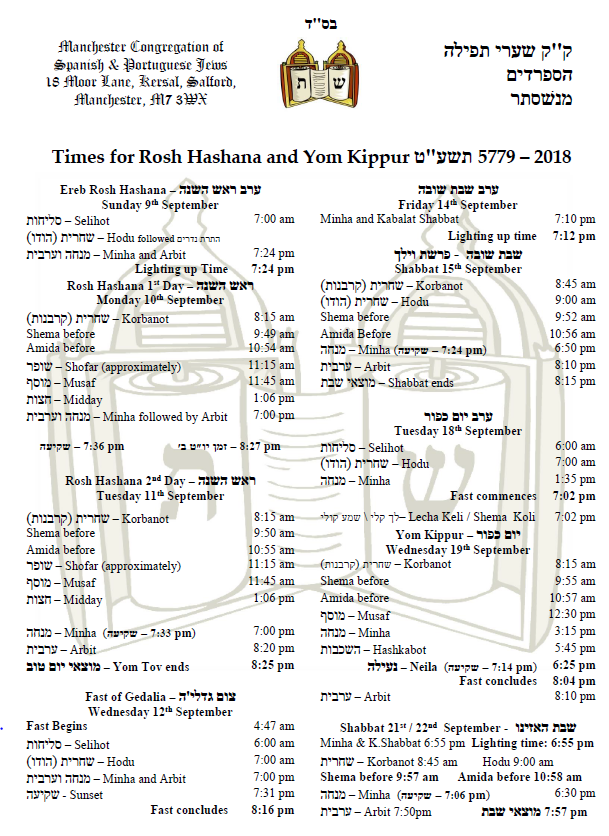
Yamim Noraim Time table
(also attached on this email)


***
SHABBAT
Shabbat Times
לוח זמני תפלה לחורף תשע"ח
Winter Timetable 5778 – 2017 / 18
מוצאי שבת | ערבית )מוצ"ש( | סוף זמן קראת שמע | זמן שבת | פלג מנחה (לבוש) | מנחה וקבלת שבת | תאריך | שבת פרשת |
Shabbat Ends | Arbit | Shema to be read before | Candles to be | Earliest Candle lighting | Minha & Kabbalat Shabbat* | Date | Parasha |
8:51 | 8:45 | 9:43 | 7:46 | 6:36 | 6:45 | 31 Aug / 1 Sep | כי תבא |
Shabbat Services
Children’s Tehilim straight after Musaf
Anyone wishing to donate a Kiddush Please email Moorlanenews
****
Q & A on Parashat Ki Tavo
All references are to the verses and Rashi's commentary, unless otherwise stated
- When did the obligation to bring bikkurim begin?
26:1 – After the Land was conquered and divided. - Bikkurim are from which crops?
26:2 – The seven species for which Eretz Yisrael is praised. - How does one designate bikkurim?
26:2 – When he sees the first fruit ripen on a tree, he binds a piece of straw around it to mark it as bikkurim. - Who shakes the basket containing the bikkurim?
26:4 – The kohen places his hands under the hands of the one bringing it, and they wave the basket together. - What does "v'anita v'amarta" mean?
26:5 – Speak loudly. - Which Arami "tried to destroy my father?"
26:5 – Lavan. - When during the year may bikkurim be brought? Until when are the special verses recited?
26:11 – Bikkurim are brought from Shavuot until Channuka. The verses are recited only until Succot. - Someone declaring that he separated terumah and ma'aser
says: "And I didn't forget." What didn't he forget?
26:13 – To bless Hashem. - What were the Jewish People to do with the 12 stones on Mt. Eval?
10. 27:2 – Build an altar. - Six tribes stood on Mt. Eval and six on Mt. Gerizim. Who and what were in the middle?
27:12 – Kohanim, levi'im and the Holy Ark. - Who "causes the blind to go astray?"
27:18 – Any person who intentionally gives bad advice. - How does one "strike another secretly?"
27:24 – By slandering him. - Eleven curses were spoken on Mt. Eval. What is the significance of this number?
27:24 – Each curse corresponds to one of the tribes, except for the tribe of Shimon. Since Moshe didn't intend to bless the tribe of Shimon before his death, he did not want to curse them either. - Why are sheep called "ashterot"?
28:4 – Because they "enrich" (m'ashirot) their owners. - How is the manner of expressing the curses in Parshat Bechukotai more severe than in this week's parsha?
28:23 – In Bechukotai the Torah speaks in the plural, whereas in this week's Parsha the curses are mentioned in the singular.
****
Halachot from Maran Rabbi Ovadia Yosef Ztz'l
מדברי מרן זצ"ל לחודש אלול – ראש השנה האחרון של מרן זצ"ל
מידי שנה בשנה בימי חודש אלול, היה מרן רבינו הקדוש רבי עובדיה יוסף זצ"ל הכ"מ, עובר מעיר לעיר וממקום למקום בכל רחבי הארץ, לחזק את התורה, ואפילו בימי הזקנה, היה מטריח עצמו ללכת לשלושה וארבעה מקומות מידי ערב.
וזכור לנו, לפני כשנתיים, בערב יום הכפורים, תוכננה עצרת תשובה בהשתתפות מרן זצ"ל באיצטדיון "יד אליהו" שבתל אביב, ובסמוך למועד העצרת, היא בוטלה.
ביום ההוא, לאחר תפלת מנחה, קרא לנו מרן זצ"ל לחדרו, ואמר לנו בדאגה, כי מאחר ובוטלה העצרת, הלא עתה הוא מפסיד זמן יקר, כי הימים הם ימי התשובה, ויש בכחו להשפיע בדברי התעוררות על הקהל. לכן הוא מבקש שימצאו לו מקום חילופי שיוכל להרצות שם את דבריו. (ובהשתדלות עוזרו הרב צבי חקק שליט"א, הלך מרן זצ"ל בלילה ההוא ל"מרכז הרב", והשמיע שם דברי תורה ומוסר. ובענין זה כתבנו בהרחבה נפלאות ממעשיו, בספר אביר הרועים חלק שני שיצא לאור בס"ד בימים אלה).
ראו כמה יקרים הם ימים אלו, שהלב פתוח לדברי תשובה, ועל כל אחד ואחד, להשתדל בכל כחו, שלא להתרשל חס ושלום במלאכת שמים, ולחזק ולהתחזק, וה' יתברך שומע תפלה, ורוצה בתשובה, יקבל את תפלתינו, ויענה לעתירתינו, ויוליך אותנו באורח מישור, בטוב ובחסד, ויחדש עלינו שנה טובה ומבורכת, תכלה שנה וקללותיה, תחל שנה וברכותיה.
אחד הנושאים המרכזיים עליהם היה מרן זצ"ל מדבר בעצרות התשובה בערים המרוחקות, היה ענין חינוך הילדים, ונעתיק כאן מדבריו בענין זה:
מורי ורבותי! חוב קדוש מוטל עלינו לחנך את בנינו בתלמודי תורה ובישיבות, כמו שכתוב "ושננתם לבניך", ואז יתקיים בנו הפסוק "וכל בניך למודי ה' ורב שלום בניך".
בואו וראו מה שאמרו חכמינו זכרונם לברכה על דוד המלך עליו השלום: אמר רבי אבין, אין אנו יכולים לעמוד על אופיו של דוד המלך, לפעמים הוא קורא לעצמו "עני ואביון", כמו שנאמר, "הטה ה' אזנך ענני כי עני ואביון אני", ולפעמים הוא קורא לעצמו "מלך", כמו שנאמר, ה' בעזך ישמח "מלך" ובישועתך מה יגל מאד. הא כיצד? אלא שבשעה שהיה דוד המלך צופה ברוח הקודש והיה רואה שמלכים צדיקים יוצאים מחלציו, כגון אסא ויהושפט, חזקיה ויאשיהו, היה שמח וקורא עצמו מלך. ובשעה שהיה צופה ברוח הקודש ורואה שיוצאים ממנו מלכים רשעים, כגון אחז, מנשה, אמון ויהויקים, היה קורא עצמו עני ואביו. ללמדך, שאין אדם מאושר ושמח, כמו זה שיש לו מזרעו בנים תלמידי חכמים וצדיקים. אין לך אדם עני ואביון, כאדם שבניו סטו מדרכי האבות, ומן התורה והמצוות, מחללי שבת וימים טובים, וכל דבר תועבה אשר שנא ה'.
הערובה לזכות לבנים צדיקים, היא חינוכם במוסדות שמלאים יראת שמים. כי "חנוך לנער על פי דרכו גם כי יזקין לא יסור ממנה".
והנה מרן רבינו הקדוש זצ"ל, היה נאה דורש ונאה מקיים. ובראש השנה בשנה שעברה, שהיה ראש השנה האחרון בחיי מרן זצ"ל, הוא יום ראש השנה שבו נגזר עלינו שמרן זצ"ל יסתלק מאיתנו. היה מרן זצ"ל מאושפז בבית החולים, והוא חלש מאד ומלא מכאובים, והיה נראה כי על פי דרך הטבע ימיו ספורים. ובכל זאת, כאשר נכנסו לבקרו ניניו, שהם עוסקים בתורה, בא לדבר איתו אחד הרבנים בענין ציבורי, נשען מרן זצ"ל על כסאו, ואמר, "כל מה שאתה מדבר, אין זה חשוב כעת, תראו כמה מאושר אני! כמה שמח אני! שיש לי נין שעוסק בתורה! כמה שמחה הוא מסב לי!"
וכך תמיד, לא היה לו אושר בחייו, זולת בלימוד התורה, ובראותו את בניו ונכדיו אחריו עוסקים בתורה. זכותו תגן עלינו, וממרום יעמוד בתפלה עלינו, שהשם יתברך יחיש לגאלנו גאולת עולמים, ונזכה לראות בתחיית המתים, ומלאה הארץ דעה את ה' כמים לים מכסים. אמן. (וראה עוד במאור ישראל דרשות, עמוד כ).
The Words of Maran zt”l During the Month of Elul-Maran’s Final Rosh Hashanah
Every year during the month of Elul, Maran Rabbeinu Ovadia Yosef zt”l would travel from city to city across Israel in order to strengthen the ideas of Torah learning and fear of G-d among the nation. Even in his advanced age, Maran zt”l would trouble himself to go to three or four places nightly.
Approximately two years ago, a mass Teshuva gathering was planned to take place in the “Yad Eliyahu” stadium in Ramat Gan on Erev Yom Kippur. For whatever reason, shortly before the gathering was to be held, the event was cancelled.
That day after Mincha services, Maran zt”l called over his devoted grandson, Rabbi Yaakov Sasson Shlit”a, author and coordinator of the Hebrew Halacha Yomit, and told him worriedly that since the event was cancelled, he would be missing a prime opportunity, for they were in the midst of the Ten Days of Repentance and he would be able to influence and uplift countless people. Maran therefore requested that he be found an alternate venue to speak at. (Thanks to the intervention of Maran’s trusted aid, Rabbi Tzvi Hakak Shlit”a, Maran zt”l spoke words of Torah, Mussar, and inspiration in Yeshivat Merkaz Harav.)
If only we would pay attention to how much one’s heart is open to repentance during these days. Every individual must exert the maximum amount of effort in order to strengthen one’s self and others during this time and not, G-d-forbid, to become lax in one’s service of Heaven. Hashem who listens to all prayers and desires repentance shall surely accept our prayers and guide us along a path filled with goodness and kindness as well as granting us a sweet new year.
One of the main topics Maran zt”l would discuss during Teshuva events in far-out cities was the issue of educating one’s children. Let us quote some of his precious teachings:
“Ladies and gentlemen! It is a great and holy obligation for us to educate our children specifically in Yeshivot, as the verse states, “And you shall teach them to your son” and only after this shall we merit fulfillment of the verse, “And all your children shall be taught of Hashem and great shall be the peace of your children.”
Just look at what our Sages tell us about King David: Rav Avin said: We cannot be certain of King David’s character, for sometimes he refers to himself as ‘poor and downtrodden,’ as the verse states, ‘Turn your ear, Hashem, and answer me, for I am poor and downtrodden’ while other times he refers to himself as a king, as the verse states, ‘Hashem, through your might shall a king be glad and through your salvation shall he be exceedingly glad.’ How can this be? Rather, when King David saw through divine revelation that righteous kings would descend from him, such as Assa, Yehoshafat, Chizkiyahu, and Yoshiyahu, he was joyful and would refer to himself as a king. However, when he would see through divine revelation that wicked kings would emerge from him, such as Achaz, Menashe, Amon, and Yehoyakim, he would refer to himself as ‘poor and downtrodden.’” This comes to teach us that there is no happier man on earth than one whose children are righteous Torah scholars and, on the other hand, there is no one poorer and more pitiful than one whose children have strayed from the path of our forefathers and from the holy Torah and Mitzvot by desecrating Shabbat, holidays, and doing any other things Hashem despises.
The guarantee for righteous children is educating them in institutions filled with fear of Heaven, as the verse states, ‘Educate the lad according to his own way; even when he grows old he shall not stray from it.’”
Maran zt”l was certainly true to his own word. Last Rosh Hashanah was the last Rosh Hashanah of Maran’s life and the day it was decreed that he would be taken from us. Maran zt”l lay weak and infirm in a hospital bed and it seemed that he only had several days remaining. Nevertheless, when his great-grandchildren, who toil in Torah and fear of Heaven, came in to visit him, another rabbi came in to discuss a public matter with Maran. Maran leaned against his chair and exclaimed, “Whatever you are telling me is not that important at the moment. Look how happy I am to have a great-grandchild who studies and delves in Torah! He causes me such joy!”
As always, nothing brought Maran zt”l more joy in the entire world than Torah study and seeing his children and grandchildren following the Torah’s path. May Maran’s merit serve to protect us and may he pray for us on high that Hashem speedily redeem us for eternity. May we soon merit being reunited with our great leader, Maran zt”l with the Resurrection of the Dead and may the world be filled with the knowledge of Hashem like the waters that cover the seas, Amen (see Ma’or Yisrael-Derashot, page 20).
****
—
Shabbat Shalom
moorlanenews@gmail.com
Please feel free to ask us any questions or requests you may need through this e-mail. We will get back to you, bli neder, asap.
Please send us any announcement you would like to make through our e-mail before Wednesday morning, if possible, unless there is a Yom Tob. Exceptions will be made for late entries
Be advised that we will only announce your simcha when you give us permission to do so
If you no longer wish to receive further emails from moorlanenews please reply with the word "unsubscribe".
Thank you, Hatzlacha & all the best
Newsletter Parashat Ki Tetze
Announcements

Your attendance will enhance our daily minyan
****
SHABBAT
Shabbat Times
לוח זמני תפלה לקיץ תשע"ח
Summer Timetable 5778 – 2018
מוצאי שבת | ערבית )מוצ"ש( | סוף זמן קראת שמע | זמן שבת | פלג מנחה (לבוש) | מנחה וקבלת שבת | תאריך | שבת פרשת |
Shabbat Ends | Arbit | Shema to be read before | Candles to be | Earliest Candle lighting | Minha & Kabbalat Shabbat* | Date | Parasha |
PM | PM | AM | PM | PM | PM |
|
|
9:09 | 9:00 | 9:38 | 8:02 | 6:49 | 6:45 | 24/25 Aug | כי תצא |
* For those not in synagogue, but wishing to bring in Shabbat with the community, candles should be lit about 30 minutes after the time listed for Minha and Kabbalat Shabbat. (Unless the time listed in the ‘latest candle lighting’ column is earlier, when candles should be lit by that time, in all cases.)
Mincha 6:00 pm
Followed by Shiur
Children’s Tehilim straight after Musaf
Anyone wishing to donate a Kiddush Please email Moorlanenews
****
Q & A on Parashat Ki Tetze
All references are to the verses and Rashi's commentary, unless otherwise stated
- Why must a captured woman mourn her family for a month in her captor's house?
21:13 – So her captor will find her unattractive. - What fraction of the inheritance does a first-born receive if he has a) one brother? b) two brothers?
21:17 – a) 2/3 b) 1/2 - What will become of a ben sorer u'moreh if his parents don't bring him to court?
21:22 – He will eventually rob and kill to support his physical indulgences. - Why is it a degradation to G-d to hang a criminal's body on the gallows overnight?
21:23 – Because humans are made in G-d's image; and because the Jewish People are G-d's children. - What do you do if you find a lost object that costs money to maintain?
22:2 – Sell it and save the money for the owner. - Why does the Torah forbid wearing the clothing of the opposite gender?
22:5 – It leads to immorality. - Why does the Torah link the mitzvah of sending away the mother-bird with the mitzvah of making a railing on the roof of your house?
22:8 – To teach that one mitzvah leads to another, and to prosperity. - When is it permitted to wear wool and linen?
22:12 – Wool tzitzit on a linen garment. - What three things happen to a man who falsely slanders his bride?
22:18 – He receives lashes, pays a fine of 100 silver selah, and may never divorce her against her will. - Although the Egyptians enslaved the Jewish People, the Torah allows marriage with their third-generation converts. Why?
23:8 – Because they hosted Yaakov and his family during the famine. - Why is causing someone to sin worse than killing him?
23:9 – Murder takes away life in this world, while causing someone to sin takes away his life in the World to Come. - If one charges interest to his fellow Jew, how many commandments has he transgressed?
23:21 – Three; two negative commandments and a positive commandment. - What is the groom's special obligation to his bride during their first year together?
24:5 – To gladden her. - When is a groom required to fight in a non-obligatory war?
24:5 – When he remarries his ex-wife. - What type of object may one not take as collateral?
24:6 – Utensils used to prepare food.
****
Halachot from Maran Rabbi Ovadia Yosef Ztz'l
חודש הרחמים והסליחות
כבר הזכרנו באחת ההלכות הקודמות, מאיזה טעם אנו נוהגים להרבות בסליחות ותחנונים בכל ימי חודש אלול, שהוא מסוגל לסליחה וכפרה.
וידוע שבימים אלה אנו קרובים יותר לה' יתברך, והוא ממהר לשמוע תפילות. כמו שדרשו "אני לדודי ודודי לי", ראשי תיבות אלול. וכן בפסוק "ובא לציון גואל ולשבי פשע ביעקב", רמוז חודש "אלול". וכתב רבינו יונה בספר היראה בזו הלשון, "משנכנס אלול עד מוצאי יום הכפורים יהיה ירא וחרד מאימת יום הדין". ובזכות התשובה בימים אלה, אנו עתידים להגאל, כמו שנרמז בפסוקים שאמר דוד המלך, "לדוד ה' אורי וישעי", אורי, בראש השנה, וישעי, ביום הכפורים. ומסיים דוד המלך, "לולא האמנתי לראות בטוב ה'", ופירשו רבותינו (בברכות ד.), שהיה דוד המלך מתיירא (מפחד) שמא יגרום החטא ולא תבא הישועה, ולכן יש ניקוד (נקודות) מעל המילה "לולא" האמנתי לראות בטוב ה', שרצונו לרמוז בזה על חודש "אלול" (אותיות לולא), שבזכות תשובתינו בימים אלה נוושע ביום הדין.
וכתב הגאון רבי דוד עמר ז"ל, בספר תפלה לדוד (סי' ריב), שבחודש אלול ובעשרת ימי תשובה, נכון מאד לכוין בברכת "השיבנו אבינו לתורתך" שבתפלת שמונה עשרה, ולהזכיר כמה משמותיהם של אלה שנטו מדרכי ה' ותורתו, ויצאו לתרבות רעה, וביחוד אם הם קרוביו. והביא כל זה מרן רבינו הגדול זצ"ל הכ"מ בספרו חזון עובדיה (עמוד כה). וכמו כן בודאי שראוי לאדם להתפלל גם על עצמו, שיזכה לשוב בתשובה, ולעלות מעלה מעלה בתורה וביראת ה'. וגם כל בקשותיו האחרות, יהיו לשם שמים, שאם תהיה לו פרנסה טובה ובריאות טובה, יוכל להתחזק עוד ועוד בעבודת ה'.
ובאמת שאם נתבונן, הלא נראה כל איש ואשה, כמה אנו מאריכים בתפלה על קרובינו שחלילה אינם בקו הבריאות, או מעוכבי זיווג וכדומה. והלא הדברים קל וחומר, כי הכאב על מי שאינו הולך בדרך ה' הוא גדול פי כמה וכמה, שמאבד עצמו מחיי העולם הבא, ואינו מזכה את עצמו בזכויות רבות לחיי עולם הנצח, אשר כל קורות האדם בזה העולם הם כאין וכאפס לעומת חיי העולם הבא.
וזכור לנו, שאחר פטירת רעייתו של מרן רבינו זצ"ל, היה מרבה בתפלות ובלימוד תורה לעלוי נשמתה, והיה מזכיר מה שכתבו המקובלים, שיראה אדם את קרובו הנפטר כאילו הוא עומד ומתחנן לפניו שיצילו מאש אוכלה. כי צורך האדם בעולם הבא לזכויות ומעשים טובים בכדי לזכות בחיי העולם הבא, הוא גדול לאין שיעור מכל צרכיו בזה העולם השפל והחולף.
והגאון רבי דוד עמר הנזכר, הביא בספרו את הנוסח הנכון למי שרוצה להוסיף שמות קרובים בברכת "השיבינו", שיאמר בתוך הברכה, אחרי אמירת "השיבנו אבינו לתורתך וקרבנו מלכינו לעבודתך והחזירינו בתשובה שלימה לפניך": יהי רצון מלפניך ה' אלהינו ואלהי אבותינו, שתחתור חתירה מתחת כסא כבודך להחזיר בתשובה שלימה כל פושעי ישראל, ובכללם תחזיר בתשובה שלימה את (יאמר את שם הקרוב ואת שם אמו, כגון דוד בן אסתר), כי ימינך פשוטה לקבל שבים, ברוך אתה ה' הרוצה בתשובה.
(ונכון שבסיום הברכה כשמזכיר את שם ה', יכוין שניקוד שם ה' בכתיבתו בברכה זו, הוא בסגול, כפי שמודפס בסידורים המדויקים).
ויהי רצון שהשם יתברך יחזיר את כל פושעי ישראל בתשובה שלימה וידעו תועי רוח בינה, ומלאה הארץ דעה את ה' כמים לים מכסים
The Month of Mercy and Forgiveness
We have already discussed in a previous Halacha the reason why we customarily recite Selichot prayers throughout the entire month of Elul which is an auspicious time for forgiveness and atonement.
It is well-known that during these days we are closer to Hashem and he hears our prayers more quickly than usual, as our Sages have expounded the verse, “Ani Le’Dodi Ve’Dodi Li” (“I am to my beloved and my beloved is to me”) which is an acronym for the word “Elul.” Similarly, the month of Elul is also hinted in the verse, “Uva Le’Zion Go’El Ul’shaveh Fesha Be’Yaakov.” Furthermore, Rabbeinu Yonah writes in his Sefer Ha’Yir’ah: “From the beginning of Elul until the conclusion of Yom Kippur, one should be filled with fear and trepidation over the Day of Judgment.” In the merit of the repentance during these days, we shall one day be redeemed, as is hinted in the verses composed by King David, “A Psalm by David, Hashem is my light and salvation”: “My light” on Rosh Hashanah “and salvation” on Yom Kippur. King David ends this Psalm by saying, “Were it not that I believe that I should see the goodness of Hashem,” and our Sages explain (Berachot 4b) that King David feared that sins might impede the salvation and thus, the word “Luleh” (“Were it not,” also the same Hebrew letters as “Elul”) is dotted in the scripture in order to allude to the fact that in the merit of our repentance during the month of Elul, we shall be saved on the Day of Judgment.
Hagaon Harav David Amar zt”l writes in his Sefer Tefillah Le’David (Chapter 212) that during the month of Elul and the Ten Days of Repentance (the ten days between Rosh Hashanah and Yom Kippur), it is especially worthy to recite the blessing of “Hashivenu Avinu Le’Toratecha” (fifth blessing of the Amidah prayer which deals with repentance) with proper concentration and to mention the names of some individuals who have strayed from the proper path of Hashem and His Torah, especially if they are one’s relatives. Maran Rabbeinu Ovadia Yosef zt”l quotes this in his Chazon Ovadia-Yamim Nora’im (page 25). One should certainly pray that one merit repenting fully on his own and continue to ascend higher and higher in spirituality.
Indeed, if we stop and think for a moment, do we not all pray lengthily for our relatives who, G-d-forbid, are not in the best of health or have yet to find their marriage partners and the like? Certainly the pain one feels for an individual who does not follow the path of Hashem is much greater, for such an individual loses his share in the World to Come and misses out on countless merits in the Eternal World; anything a person can experience in this world pales greatly in comparison to life in the World to Come.
We remember that when Maran zt”l’s wife passed away, he would learn and pray a substantial amount in order to elevate her soul. He would mention what the Mekubalim say that one should imagine his deceased relative as though he is standing before him and begging him to save him from a raging inferno. One’s need for merits and good deeds in order to merit entry in the World to Come is infinitely greater than any physical need one may have in this lowly, fleeting world.
The aforementioned Hagaon Harav David Amar quotes in his work the correct text for one who wishes to insert names of relatives in the blessing of “Hashivenu.” After reciting “Hashivenu Avinu Le’Toratecha Ve’Karevenu Malkeinu La’Avodatecha Ve’Hachazirenu Bitshuva Shelema Lefanecha,” one inserts: “May it be Your will, Hashem our G-d and the G-d of our fathers, that You dig a tunnel under Your Holy Throne to accept the repentance of all of the sinners of Israel, and similarly may You cause so-and-so (insert name) son/daughter of so-and-so (insert mother’s name) to repent fully, for Your right hand is outstretched to accept those who are repentant,” then conclude the blessing, “Baruch Ata Hashem Ha’Rotzeh Bitshuva.” Here is the actual Hebrew text one should recite in the Amida:
יהי רצון מלפניך ה' אלקינו ואלקי אבותינו שתחתור חתירה מתחת כסא כבודך להחזיר בתשובה שלימה לכל פושעי ישראל, וכן תחזיר בתשובה שלימה את פלוני בן פלונית, כי ימינך פשוטה לקבל שבים.
It is correct that when one concludes this blessing upon reciting the name of Hashem one should have in mind that this name of Hashem is punctuated with the “Segol” mark, as is printed in precise Siddurim; one should concentrate on this but not utter it.
May Hashem return all sinners of Israel to Him through complete repentance and may the land be filled with the knowledge of the Hashem like the waters that fill the sea.
****
—
Shabbat Shalom
moorlanenews@gmail.com
Please feel free to ask us any questions or requests you may need through this e-mail. We will get back to you, bli neder, asap.
Please send us any announcement you would like to make through our e-mail before Wednesday morning, if possible, unless there is a Yom Tob. Exceptions will be made for late entries
Be advised that we will only announce your simcha when you give us permission to do so
If you no longer wish to receive further emails from moorlanenews please reply with the word "unsubscribe".
Thank you, Hatzlacha & all the best
Newsletter Parashat Shofetim
Announcements

***

Live Selichot
from
Yeshivat Ohr Hachaim
at around 10:35 pm British Time
or through this link
(https://orhachaim.co.il/%D7%
***
SHABBAT
Shabbat Times
לוח זמני תפלה לקיץ תשע"ח
Summer Timetable 5778 – 2018
מוצאי שבת | ערבית )מוצ"ש( | סוף זמן קראת שמע | זמן שבת | פלג מנחה (לבוש) | מנחה וקבלת שבת | תאריך | שבת פרשת |
Shabbat Ends | Arbit | Shema to be read before | Candles to be | Earliest Candle lighting | Minha & Kabbalat Shabbat* | Date | Parasha |
PM | PM | AM | PM | PM | PM |
|
|
9:27 | 9:20 | 9:32 | 8:18 | 7:02 | 6:45 | 17/18 Aug | שופטים |
* For those not in synagogue, but wishing to bring in Shabbat with the community, candles should be lit about 30 minutes after the time listed for Minha and Kabbalat Shabbat. (Unless the time listed in the ‘latest candle lighting’ column is earlier, when candles should be lit by that time, in all cases.)
Mincha 6:00 pm
Children’s Service From 10am Every Shabbat morning
Children’s Tehilim straight after Musaf
Anyone wishing to donate a Kiddush Please email Moorlanenews
****
Q & A on Parashat Shofetim
1. What is the role of shoftim? What is the role of shotrim?
2. What qualifications should one look for when appointing a judge?
3. May a judge accept a bribe if only for the purpose of judging fairly?
4. What is the source for the concept "seek out a good beit din"?
5. Although the avot built matzevot, the Torah later forbade doing so. Why?
6. "You will come to…the judge who will be in those days." It's impossible to visit a judge living at a different time, so why must the Torah add these apparently extra words?
7. What does Hashem promise a king who doesn't amass much gold, doesn't raise many horses and doesn't marry many wives?
8. How many Torah scrolls must the king have?
9. How was King Shaul punished for disobeying a minor command of the Prophet Shmuel?
10. Certain kosher animals are not included in the law of "chazeh, shok, and keiva." Which ones?
11. Families of kohanim served in the Beit Hamikdash on a rotational basis. When was this rotation system implemented?
12. Which three categories of false prophets are executed?
13. What does it mean to "prepare the way" to the cities of refuge?
14. How many witnesses are meant when the Torah writes the word eid (witness)?
15. "Through the mouth of two witnesses…." What types of testimony does this verse invalidate?
16. If witnesses in a capital case are proven to be zomemim (false-conspirators
17. Why does the section about going to war follow the laws governing witnesses?
18. The Jewish army is warned of four "scare-tactics" the enemy might employ. What are they?
19. When a murder victim is found in a field, who determines which city is closest?
20. What happens if the murderer is found after the calf's neck was broken?
1. 16:18 – Shoftim are judges who pronounce judgment. Shotrim are officers who enforce it.
2. 16:18 – That he is expert in the law and that he is righteous.
3. 16:19 – No, because it will sway his judgment.
4. 16:20 – "Tzedek tzedek tirdof…."
5. 16:22 – Because the Canaanites used them for idolatry.
6. 17:9 – To teach that although a judge may not be as eminent as judges of previous generations, we must obey him nevertheless.
7. 17:18 – That his kingdom will endure.
8. 17:18 – Two. One stays in his treasury and one he keeps with him.
9. 17:20 – He lost his kingship.
10. 18:3 – Chayot (non-domestic-type animals).
11. 18:8 – During the time of David and Shmuel.
12. 18:20 – One who prophesies something he didn't hear, something told to another prophet, or prophecies in the name of an idol.
13. 19:3 – To post direction signs saying "refuge" at the crossroads.
14. 19:15 – Two, unless otherwise specified.
15. 19:15 – Written testimony and testimony translated from a language which the judges don't understand.
16. 19:19 – They are put to death.
17. 20:1 – To teach that if the Jewish People execute fair judgment they will be victorious in war.
18. 20:3 –
(a)Clanging their shields
(b)Making their horses stomp and whinny
(c)Shouting
(d)Blowing horns.
19. 21:2 – The Sanhedrin.
20. 21:9- He is tried and, if guilty, executed.
***
Halachot from Maran Rabbi Ovadia Yosef Ztz'l
חודש אלול – מעשה במרן זצ"ל בענין שמיעת מוזיקה
כתב מרן רבינו עובדיה יוסף זצ"ל: חסד גדול עשה ה' יתברך עם עמו ישראל, כאשר גילה להם, כי יום המשפט הוא יום א' בתשרי. (כי באמת, גם אומות העולם נדונים ביום זה, אבל אין להם ידיעה על כך, ולכן אינם מתכוננים כראוי ליום זה, ומפסידים טובה הרבה). וכמו שנאמר בתהלים, "תִּקְעוּ בַחֹדֶשׁ שׁוֹפָר בַּכֵּסֶה לְיוֹם חַגֵּנוּ, כִּי חֹק לְיִשְׂרָאֵל הוּא מִשְׁפָּט לֵאלֹהֵי יַעֲקֹב". כי בנוהג שבעולם, מי שעבר על החוק, ונתפס אצל שוטר והלה יקחהו באופן מיידי לפני שופט, להשפט בצורה מהירה, הלא קרוב לודאי שלא יוכל להתמודד מול האשמות שהוא מואשם בהן. מה שאין כן אילו תנתן לו האפשרות לדעת את מועד המשפט, ויוכל להתמודד ולהתיעץ עם עורך דין טוב, בכדי שידע מה לטעון במשפט ומי יסנגר עליו, שאז בודאי יש תקוה שיוכל לצאת זכאי במשפטו.
כמו כן אנו, מיום ראש חודש אלול, מריעים בשופר וקמים לסליחות ומתכוננים ליום הדין שאומרים בו הרת עולם היום יעמיד במשפט כל יצורי עולם, ואז מתחילים גם כן לומר בתפילה, המלך הקדוש, המלך המשפט, ובאלול אנו מתכוננים כראוי להכין פרקליטים גדולים לפני הקדוש ברוך הוא, ואלו הם פרקליטיו של אדם, תורה ומצוות ומעשים טובים (שבת לב.), ובתוספתא אמרו, צדקה וגמילות חסדים, פרקליטים גדולים הם בין ישראל לאביהם שבשמים. וכן שנינו באבות, כל העושה לו מצוה אחת, קונה לו פרקליט אחד. ואם הפרקליט הוא גיבור ואיש מלחמה, כגון שהוא נוצר מפי תלמיד חכם העוסק בתורה, בודאי שאז אותם המקטרגים לא יהיו אלא כשועלים קטנים מחבלים כרמים, שגערה אחת מאת סנגור כזה תשתק את כולם. וכמו שאנו אומרים בסליחות, חתום פה שטן ואל ישטין עלינו, ויעמוד מלאך ומליץ טוב בעדינו, הוא יגיד יושרנו. הרי פתח רחב להוציא אותנו זכאים לפני ה' יתברך, וכמו שאמרו במסכת ראש השנה, על הפסוק, כי מי גוי גדול אשר לו אלקים קרובים אליו, כה' אלקינו בכל קראנו אליו.
רבינו האר"י ז"ל כתב בשער הפסוקים, על הפסוק העוסק בבריחת הרוצח לעיר מקלט, ששם לא יאונה לו כל רע, וכפי שנאמר "אנה לידו ושמתי לך" (מקום אשר ינוס שמה). ראשי תיבות "אלול", לרמוז כי חודש אלול ניתן לתשובה, ושב ורפא לו. והכל צריכים לחזור בתשובה, וכן אמרו על הפסוק: ומל ה' אלהיך "את לבבך ואת לבב" זרעך, ראשי תיבות אלול, לרמוז על הבא ליטהר, מסייעין אותו. ובפרט בענין התשובה שהקדוש ברוך הוא אמר לישראל, פתחו לי פתח כחודו של מחט, ואני אפתח לכם פתח כפתחו של אולם. וזוהי הסיעתא דשמיא לחזור בתשובה.
ועוד נרמז חודש אלול בפסוק, ומשלוח מנות "איש לרעהו ומתנות לאביונים", ראשי תיבות אלול. כי זהו הזמן הראוי ביותר למצות הצדקה, שמכפרת עוון. וכמו שאמרו במדרש, הקרבנות אין מכפרים אלא על השוגג, והצדקה מכפרת בין על השוגג ובין על המזיד.
בימי חודש אלול, על האדם להתבונן ולעשות חשבון נפש עם עצמו, להתחזק בעבודת ה'. ואפילו מי שזכה לעבוד את ה' כראוי, עליו להתחזק ביתר שאת בימים אלה, ברצינות גדולה ובריכוז, כדי שלא יאבד ימים יקרים אלה.
ומעשה היה, לפני כשש שנים, שנסע מרן זצוק"ל ברכבו לאיזה שיעור תורני, ובשעת הנסיעה רצה הנהג שלו להסב לו קורת רוח, לכן הפעיל "דיסק" עם מוזיקה ייחודית שמרן זצ"ל היה אוהב לשמוע. פנה אליו מרן זצ"ל בנעימות וביקש ממנו שיכבה את המוזיקה, מהרי ימים אלה הם ימי חודש אלול!!! ישמע חכם ויוסף לקח!
The Month of Elul
Maran Rabbeinu Ovadia Yosef zt”l writes that Hashem bestowed a great kindness upon his Jewish nation by revealing to them that the Day of Judgment is on the First of Tishrei (for in truth, the other nations of the world are also judged on this day, but since they do not know about this, they do not prepare themselves accordingly and they miss out on a substantial benefit), as the verse states, “Blow the Shofar on the [new] month, on the designated day of our festival. For it is a statute for Israel, a [day of] judgment for the G-d of Yaakov.” Usually, if one breaks the law and is caught by a police officer, if the officer takes him immediately in front of a judge to be judged in a swift manner, it is almost certain that the defendant will not be able to cope with the charges being leveled against him. If, however, he is made known of the court-date and given the chance to meet with and seek adequate legal counsel and know who will represent him in court, he surely has hope to be found innocent in his case.
Similarly, from the day of Rosh Chodesh Elul, we begin blowing the Shofar and waking up early in the morning to recite Selichot (prayer service for atonement) in preparation for the Day of Judgment when we will proclaim, “Today is the world’s birthday; today He shall make [everyone] stand for judgment, all creations of the world,” and is likewise the day we begin to recite “Ha’Melech Ha’Kadosh” and “Ha’Melech Ha’Mishpat” in our prayers. During Elul, we prepare great “attorneys” before Hashem; one’s “attorneys” are Torah, Mitzvot, and worthy deeds (Shabbat 32a). The Tosefta states, “Charity and acts of kindness are great defenders between Israel and their Father in Heaven.” We have also learned in Pirkei Avot, “One who performs one Mitzvah acquires for himself one defending attorney.” If the defender is strong and mighty, such as one formed by a Torah scholar who delves in Torah, certainly the other prosecuting angels will only be like small foxes in comparison and one roar from the defending angel shall be sufficient to silence them all. As we say in Selichot, “Seal the mouth of Satan so that he may not prosecute us; may a good-speaking advisor stand up for us and speak of our righteousness.” This is a tremendous opportunity to allow us be found innocent in the eyes of Hashem, as the Gemara in Rosh Hashanah expounds the verse, “For who is a great nation that has a God who is close to him, like Hashem our G-d [who is close to us] whenever we call him.”
Rabbeinu HaAri z”l writes in his Sha’ar Ha’Pesukim regarding the verse which deals with the fleeing of a murderer to a City of Refuge where no harm will befall him, as the verse states (in Hebrew), “Eenah Le’Yado VeSamti Lecha,” which is the acronym of “Elul.” This hints to us that Elul is the month of repentance and if one returns, he shall be healed. All must repent, as the verse states, “U’mal Hashem Elokecha Et Levavecha Ve’et Levav Zar’echa,” which is likewise an acronym of “Elul,” to hint that if one comes to purify himself, he is aided from Above. This is especially so regarding repentance about which Hashem tells the Jewish nation, “Open for me like the opening of a needle and I shall open for you like the opening of a hall.” This refers to the Heavenly assistance offered to repent.
The word “Elul” is also hinted in the verse, “U’mishloach Manot Ish Le’Re’ehu U’Matanot La’Evyonim,” to teach us that this is the most opportune time to fulfill the Mitzvah of charity, which atones for sins. As the Midrash tells us, “Offerings atone only for sins performed unknowingly, but charity atones for sins performed knowingly or unknowingly.”
During the month of Elul, one must carry out self-introspection and strengthen one’s self in the service of Hashem. Even one who serves Hashem properly must strengthen himself even more during these days amid much seriousness and focus so as not to lose out on these precious days.
An incident once occurred approximately six years ago when Maran zt”l was on his way to deliver a Torah class. His personal driver wanted Maran to relax and enjoy himself a little so he turned on a CD of special music that Maran enjoyed. Maran zt”l turned to the driver and pleasantly requested that he turn off the music, for we are in the midst of the month of Elul!
****
—
Shabbat Shalom
moorlanenews@gmail.com
Please feel free to ask us any questions or requests you may need through this e-mail. We will get back to you, bli neder, asap.
Please send us any announcement you would like to make through our e-mail before Wednesday morning, if possible, unless there is a Yom Tob. Exceptions will be made for late entries
Be advised that we will only announce your simcha when you give us permission to do so
If you no longer wish to receive further emails from moorlanenews please reply with the word "unsubscribe".
Thank you, Hatzlacha & all the best
Newsletter Parashat Vaetchanan – Shabbat Nachamu
Announcements
Wishing all our members and friends
an enjoyable summer break
Moorlanenews
will be taking a break
and back in time for
SELICHOT
on
Monday 2nd Elul
13 August @ 6 am
For updates on the Daily & Shabbat Minyan
during the summer holidays
please check on the
Moorlane Minyan Whatsapp Group
or check with a member of the Mahamad
****
SHABBAT
Shabbat Times
לוח זמני תפלה לקיץ תשע"ח
Summer Timetable 5778 – 2018
מוצאי שבת | ערבית )מוצ"ש( | סוף זמן קראת שמע | זמן שבת | פלג מנחה (לבוש) | מנחה וקבלת שבת | תאריך | שבת פרשת |
Shabbat Ends | Arbit | Shema to be read before | Candles to be | Earliest Candle lighting | Minha & Kabbalat Shabbat* | Date | Parasha |
10:16 | 10:10 | 9:16 | 8:58 | 7:35 | 7:10 | 27/28 July | ואתחנן (שבת נחמו) |
10:01 | 9:55 | 9:21 | 8:46 | 7:25 | 7:10 | 3/4 Aug | עקב (ש''מ) |
9:44 | 9:35 | 9:27 | 8:32 | 7:14 | 7:00 | 10/11 Aug | ראה ) ראש חודש( |
9:27 | 9:20 | 9:32 | 8:18 | 7:02 | 6:45 | 17/18 Aug | שופטים |
* For those not in synagogue, but wishing to bring in Shabbat with the community, candles should be lit about 30 minutes after the time listed for Minha and Kabbalat Shabbat. (Unless the time listed in the ‘latest candle lighting’ column is earlier, when candles should be lit by that time, in all cases.)
Mincha 6:00 pm
Followed by Shiur
Children’s Tehilim straight after Musaf
Anyone wishing to donate a Kiddush Please email Moorlanenews
****
Q & A on Parashat
- "And I prayed to Hashem at that time." Why "at that time"?
3:23 – Defeating Sichon and Og, whose lands were part of Eretz Canaan, Moshe thought perhaps Hashem had annulled the vow against his entering the Land. - What characteristic trait is represented by Hashem's "strong hand"?
3:24 – His willingness to forgive. - What is ha'levanon?
3:25 – Ha'levanon means the Beit Hamikdash, which makes "white" (lavan), i.e., atones for, the Jewish People. - What did Hashem tell Yehoshua after the battle of Ai?
3:28 – Yehoshua must lead the army into battle. - What will happen if the Jewish People fail to keep the mitzvot properly?
4:9 – The non-Jewish world will regard them as foolish. - How did the decree that Moshe not enter the Land affect him even in death?
4:22 – Even his remains weren't buried in the Land. - What is hinted by the word v'noshantem?
4:25 – The gematria of v'noshantem, 852, hints at the number of years until the first exile. - Why were the Jewish People exiled two years earlier than indicated by Moshe's prophecy?
4:25 – So that the rest of the prophecy "that you shall utterly perish" would not be fulfilled. - "You'll serve man-made gods." Is this literal?
4:28 – No. It means you'll serve others who serve idols. - Why is east called mizrach?
4:41 – It's the direction from which the sun shines (mizrach means shining). - "Keep the Shabbat day as I have commanded you." When had Hashem previously commanded us to keep Shabbat?
5:13 – Before Matan Torah, at Marah. (Shmot 15:25) - Where did the Jewish People first receive the command to honor parents?
5:16 – At Marah. (Shmot 15:25). - What is meant by "Hashem, our G-d, Hashem is One"?
6:4 – Hashem, who is now our G-d, but not [accepted as] G-d of the other nations, will eventually be [accepted as] the one and only G-d. - What are two meanings of loving Hashem "with all your might"?
6:5 – 1) With everything you own. 2) Whether Hashem treats you with kindness or harshness. - How well-versed must one be in Torah?
6:7 – If asked a Torah question, one should be able to reply quickly and clearly. - Where does the word totafot come from?
6:8 – Tot means two in Caspi. Fot means two in Afriki. Together they allude to the four sections of tefillin. - Who is fit to swear in Hashem's name?
6:13 – One who serves Hashem and reveres His name. - What does it mean that the Jews are the "smallest nation"?
7:7 – B'nei Yisrael are the humblest nation. - When someone serves Hashem with love, how many generations receive reward?
7:9 – 2,000. - Why are evil-doers rewarded in this world?
7:10 – So that they get no reward in the next world.
****
Halachot from Maran Rabbi Ovadia Yosef Ztz'l
ט"ו באב
בעוד יומיים, יום ששי, הוא יום ט"ו באב, וכידוע יש ליום זה משמעות מיוחדת, ולכן בהלכה זו ובהלכה שאחריה, נדבר בענינים אלה.
במשנה במסכת תענית (דף כ"ו:) אמר רבן שמעון בן גמליאל, לא היו ימים טובים לישראל כחמישה עשר באב וכיום הכפורים, שבהן בנות ירושלים יוצאות בכלי (בבגדי) לבן שאולין (שכולן שואלות זו מזו אפילו עשירות כדי שלא לבייש את מי שאין לה) ויוצאות וחולות בכרמים.
ובגמרא (דף ל"א:) נזכרו עוד כמה טעמים שיום ט"ו באב היה יום טוב לישראל, ולכן נפסק להלכה שביום זה אין אומרים תחנון, וידוי ונפילת אפיים.
ונזכר בגמרא, יפיפיות שבהן מה היו אומרות? תנו עינכם ליופי וכו', מכוערות שבהן מה היו אומרות? קחו מקחכם לשם שמים ובלבד שתעטרונו בזהובים. ומרן הרב עובדיה יוסף שליט"א, כתב לפרש הכוונה עפ"י דברי הגמרא (נדרים כא.) מעשה באחד שנדר שלא ישא את בת אחותו, משום שהייתה נראית לו כעורה, והכניסוה לבית, רבי ישמעאל וייפוה, אמר לו רבי ישמעאל, בני, מזו נדרת? והתירה לו רבי ישמעאל. באותה שעה בכה רבי ישמעאל, ואמר, בנות ישראל נאות הן, אלא שהעניות מנוולתן. וכשמת רבי ישמעאל היו בנות ישראל נושאות עיניהן עליו, ואומרות, בנות ישראל, על רבי ישמעאל בכינה. ואף כאן מה שהיו אומרות המכוערות ובלבד שתעטרונו בזהובים, כוונתן לומר שיעטרו אותן בתכשיטין וכדומה, ואז יראו נכוחה שהן נאות וראויות להם.
והביא מרן שליט"א, מדברי ספר אורחות חיים שכתב, ואין לתמוה על זה, שאיך היה מנהג זה טוב בעיני החכמים, שדומה חס וחלילה כאילו בנות ישראל הפקר, אין זה תימה, כי בודאי שכל מי שהייתה ידו משגת להשיא את בתו למי שהגון לה, לא היה שולח את בתו לשם, אלא המנהג היה בשביל הבנות שאין יד אביהן משגת להשיאן, ואלמלא היו נוהגים כן היו יושבות עד שילבין שיער ראשן. (ומכאן תוכחת מגולה על הנוהגין כאילו בנות ישראל הפקר בחינם בדור יתום זה.)
והנה נאמר בספר משלי "דבר בעתו מה טוב", ובודאי סגולת יום זה של ט"ו באב, שבו יש הארה יותר בענין הזיווגים. ולכם ראוי לכל אדם להעתיר בתפילה ביום זה יותר ממה שרגיל תמיד, שיזמן לו ה' יתברך את זיווגו הטוב לו, וכן יתפלל אדם על יוצאי חלציו שיזכו לחופה בשעה טובה, ונשמע ונתבשר בשורות טובות
Tu Be’av
Tu Be’av (the Fifteenth of Av) will fall out this coming Friday. It is known that this day has great significance. Therefore, let us discuss this matter in today’s Halacha and in the following Halacha as well.
The Mishnah in Masechet Ta’anit (26b) states: “Rabban Shimon ben Gamilel said: There were no better days for the Jewish nation than the Fifteenth of Av and Yom Kippur, for on the Fifteenth of Av the young women of Jerusalem would go out wearing borrowed white garments (they would all borrow from one another, even the wealthy girls, so as not to embarrass those who did not have) and dance in the vineyards.”
The Gemara (ibid. 31b) cites several other reasons why Tu Be’av was a joyous day for the Jewish nation. It was therefore established that Tachanun and Viduy (supplication prayers) are not recited on this day.
The Gemara continues to recount: “What would the pretty women say? Pay attention to my beauty etc. What would the ugly women say? Take your purchase for the sake of Heaven as long as you adorn us with golden jewelry.” Maran Harav Ovadia Yosef Shlit”a explains this based on the Gemara (Nedarim 21a) that once, a man vowed not to marry his niece for she appeared ugly to him. This woman was taken to the home of Rabbi Yishmael and beautified. Rabbi Yishmael asked this man, “My son, did you intend to make a vow about such a woman?” Rabbi Yishmael then proceeded to annul the man’s vow and allowed him to marry this woman. At that point, Rabbi Yishmael cried and exclaimed, “The daughters of Israel are beautiful but poverty makes them unappealing.” When rabbi Yishmael passed away, the Jewish women exclaimed, “Daughters of Israel, cry for Rabbi Yishmael!” Similarly, when the ugly women stipulated that the man must adorn them with golden jewelry, they meant that after they would be adorned with jewelry and the like, it would become apparent that they were indeed as beautiful and worthy as anyone else.
Maran Shlit”a quotes the Orchot Chaim who writes that one should not wonder how the Sages found this custom to be proper as it would appear that, G-d-forbid, Jewish women are cheap and lowly, for clearly whoever had the means to marry off his daughter to a worthy individual did so and did not send his daughter to these places. This custom was instituted only for those who were unable to marry off their daughters and if they would not do this, the women would stay unmarried for the rest of their lives.
The verse in Mishlei states, “A matter in its proper time is quite good.” Thus, in the spirit of the day, it is an especially auspicious day for finding a partner for marriage. It is therefore especially prudent that one pray more than usual on this day that Hashem prepare him a good and worthy match. One should likewise pray for his children to find their proper matches on the day of Tu Be’av
תוספת בלימוד התורה מיום ט"ו באב
בהלכה הקודמת ביארנו שיום ט"ו לחודש אב, יום גדול הוא לישראל, ולכן אין אומרים בו תחנון ונפילת אפים.
בגמרא במסכת תענית (דף לא) תניא, רבי אליעזר הגדול אומר, מחמשה עשר באב והלאה, תשש כוחה של חמה, כלומר, מתחיל היום להתקצר ונעשים הלילות ארוכים, ולא היו כורתין עצים למערכה (לעבודה בבית המקדש) מפני שאינם יבשים, ויש לחוש שמא מחמת לחלוחית שבהם יש בהם תולעים, ועץ שהתליע פסול למערכה. אמר רב מנשיא, מכאן ואילך (כלומר מיום ט"ו באב) דמוסיף (מי שמוסיף בלימוד התורה) יוסיף, כלומר יוסיף לו ה' יתברך חיים על חייו, כמו שנאמר "כי בי ירבו ימיך ויוסיפו לך שנות חיים". ומאן דלא יוסיף (ומי שלא יוסיף בתלמודו) יסיף, כלומר ימות ח"ו בקיצור ימים ושנים.
ועל כן כתב מרן הרב שליט"א, שיש להזהר להוסיף בלימוד התורה בלילה מיום ט"ו באב, וכמו שאמרו בגמרא במסכת עירובין (דף סה) לא נברא הלילה אלא לגירסא, כלומר ללימוד תורה, וכמו שאמרו במדרש רבה, אמר רבי יוחנן, אין רינה של תורה אלא בלילה, שנאמר "קומי רוני בלילה". וכן פסק הרמב"ם (בפ"ג מהל' ת"ת הי"ג) "אין אדם למד רוב חכמתו אלא בלילה, לפיכך הרוצה לזכות לכתרה של תורה, יזהר בכל לילותיו, ולא יאבד אף אחד מהם באכילה ושתיה ושיחה וכיוצא בזה, אלא בתלמוד תורה וחכמה, וכמו שאמרו חכמים אין רינה של תורה אלא בלילה."
וזכור לנו, כשהיה מרן הרב שליט"א מכתת רגליו בלילות חודש אלול מעיר לעיר להרבות תורה ויראה בישראל, והיה חוזר לביתו בשעות הלילה המאוחרות, לא היה מבטל מתלמודו, והיה משלים על חשבון שעות השינה שלו את כל הזמן שנדרש לו לסדרי הלימוד הרגילים שלו, וכל זאת מפני מה שהזכרנו. ומעט מגודל קדושתו והתמדתו בתורה לילות שלמים כל ימי חייו (לאוי"ט), כתבנו בספר אביר הרועים, כפי שעיני המעיין תחזינה משרים.
ועל כן חובה קדושה על כל אדם, לראות איך לקבוע לעצמו זמן יותר ללימוד התורה בלילות החורף, שלא יפול חלילה בקללת רבותינו. ואף על הנשים חובה קדושה, להפציר בבעליהן בדרכי נועם ובשפה רכה, שירבו בתורה ויראת ה', ורב שכרן מאד מאד, כמו שביארנו במקום אחר. ואף הן יראו ללמוד בעצמן דינים השייכים להן, אשר חובה עליהן ללומדם, כפי שביארנו גם כן.
ובדרך אגב נזכיר כאן ממה שכתב מרן הרב שליט"א בהקדמת ספרו "טהרת הבית" על הלכות נדה, אשר נתחבר במסירות נפש בימים שהיה מוטל על הרב עול הציבור הרבה מאד, וכה כתב שם: אזכרה ימים מקדם, עם לבבי אשיחה ועלה במחשבה לפני למעט בהופעותי ברבים כדי להתמסר יותר לעריכת כל חיבורי אשר עמי בכתובים, כי מתי אעשה גם אנכי לביתי, ואם אין אני לי מי לי? ורעיוני על משכבי סליקו (כלומר נרדם מתוך מחשבה זו), והנה בחלומי בלילה ההוא, ראיתי את הגאון רבי יוסף חיים מבבל זצ"ל (מחבר "בן איש חי") אשר בא לבקרני בביתי, ופניו מאירות כזוהר החמה. נכנס לחדר הספריה, והתישב על יד השלחן, ראה לפניו את אחד מחיבורי, והתחיל לעיין בו אחת הנה ואחת הנה, וכשסיים אמר, טוב מאד. ושאל אותי, האם אני ממשיך להופיע ולדרוש ברבים בדברי תורה ומוסר, כאשר היתה באמנה איתי, עניתי ואמרתי, כי עדיין אני ממשיך בימים אלה להופיע ברבים בדרשות כאשר חנני ה', ובדרך כלל אני מופיע ביחד עם עמיתי הרב הגדול רבי יהודה צדקה שליט"א (זצ"ל, שהוא קרובו של רבי יוסף חיים). אך התאוננתי לפניו שדבר זה מפריע לי בהמשך הכנת חיבורי להוציאם לאור, שמוני נוטרה (שומר) את הכרמים, כרמי שלי לא נטרתי. ענה דודי ואמר לי, בסבר פנים יפות, טוב אשר תאחוז מזה וגם מזה אל תנח ידיך,(כלומר המשך לעסוק בחיבוריך אך אל תפסיק את הופעותיך בציבור), כי יש נחת רוח מאד לפני ה' יתברך בזיכוי הרבים ששומעים דברי תורה ומוסר וחוזרים בתשובה. וכל אחד שחוזר בתשובה הוא עולם מלא. ואיקץ והנה חלום
Increasing one’s Torah Learning from the Day of Tu Be’av and On
In the previous Halacha we have explained that Tu Be’av (the Fifteenth of Av) is a great day for the Jewish nation and for this reason we do not recite Viduy and Tachanun (supplication prayers) on this day.
The Gemara in Masechet Ta’anit (31) tells us that Rabbi Eliezer the Great said that from the Fifteenth of Av and on, the power of the sun diminishes (i.e. by the daytime hours becoming shorter and the nighttime hours becoming longer) and tree branches were no longer cut down for the pyre of the alter from this point on for they were not as dry and there was concern that due to its moisture it might have been infested with worms and such branches are invalid for use on the pyre. The Gemara continues: “Rav Menashia said: From Tu Be’av and on, one who increases his Torah study shall have his life lengthened, as the verse states, ‘Through Me shall your days be multiplied and they shall add for you years of life.’ However, if one does not increase his Torah study, he shall, G-d-forbid, have his life shortened.”
Maran Harav Shlit”a therefore writes that one should take care to increase his Torah study at night from Tu Be’av on, as the Gemara in Masechet Eruvin (65) states that night was only created for Torah study. Similarly, the Midrash Rabba writes that Rabbi Yochanan said that the joy of Torah study is only experienced at night, as the verse states, “Awaken and rejoice at night.” Indeed, the Rambam writes (Chapter 3 of Hilchot Talmud Torah, Halacha 13), “The majority of one’s knowledge is acquired at night. Thus, if one wishes to merit acquiring the crown of Torah one should us all of his nights to the maximum and not waste even one of them eating, drinking, and the like; rather, one should use them for studying Torah and knowledge, as our Sages tell us that the joy of Torah is only experienced at night.”
We remember that even during the period of time when Maran Shlit”a would spend his nights during the month of Elul travelling all over Israel to many different cities disseminating Torah and fear of Heaven among the Jewish nation, when he would return home late at night he would not neglect his learning; instead, he would complete the hours of his daily learning routines on the account of his hours of sleep all because of what we have discussed. Only a small glimpse of his diligence and holiness in Torah for entire nights all throughout his life is recorded in the biography on Maran Shlit”a entitled “Abir Ha’Ro’im” (Hebrew edition, to be followed by an English edition) coming soon to a fine Judaica store near you.
One is therefore obligated to set aside more time for Torah study during the winter nights so as not to, G-d-forbid, be included in the curse of our Sages. It is also quite important for women to encourage their husbands in a pleasant manner to increase their Torah study and fear of Heaven and by doing so their reward will be very great. They should also make sure to learn the laws of the Torah that apply to them which they are indeed obligated to learn as we have explained elsewhere.
Let us now quote the words of Maran Harav Shlit”a related to this matter which are printed in the introduction to his “Taharat Ha’Bayit,” his magnificent work on the laws of Niddah (family purity), which he wrote with tremendous dedication while being heavily involved with his rabbinical and communal responsibilities: “I remember that quite long ago I had contemplated minimizing my public appearances so that I would be able to spend more time learning, writing, and publishing my works, for if not now than when? I had indeed fallen asleep pondering this thought. That night I dreamt that Hagaon Rabbeinu Yosef Haim of Baghdad (the saintly Ben Ish Hai) had come to visit my home and his face shined like the sun. He entered the library and had a seat by the table. Before him on the table lay one of the books I had authored and he began to randomly skim through it. When he had concluded, he looked at me and told me, “Very good.” He then asked me if I continue to appear in public lecturing about words of Torah and Mussar as I had been doing until now. I replied that indeed, I continue to appear in public and give Torah speeches and the like and that I usually do so alongside my dear friend Hagaon Harav Yehuda Tzadka (zt”l, a relative of Rabbeinu Yosef Haim). However, I complained to him that this hinders me from preparing my works for publishing and the like. He replied to me with a soft and pleasant demeanor that I should continue writing and publishing my works but I should not halt my public appearances either, for Hashem is pleased when one brings merit to the public by infusing them with words of Torah and Mussar and causing them to repent fully. Indeed, every person that repents is an entire world. I then awoke and behold, it was all a dream
****
—
Shabbat Shalom
moorlanenews@gmail.com
Please feel free to ask us any questions or requests you may need through this e-mail. We will get back to you, bli neder, asap.
Please send us any announcement you would like to make through our e-mail before Wednesday morning, if possible, unless there is a Yom Tob. Exceptions will be made for late entries
Be advised that we will only announce your simcha when you give us permission to do so
If you no longer wish to receive further emails from moorlanenews please reply with the word "unsubscribe".
Thank you, Hatzlacha & all the best