



*****

THIS SHABBAT
we take out 2 Sefarim
(1) Parashat Tetzave
(2) Parashat ZACHOR
The haftara THIS week will be the
Haftara of ZACHOR
********
מנהגים
Liturgy (Piyutim)
On certain occasions piyutim are chanted during pesuqé dezimra:
On Shabat Shira and the Seventh Day of Pesah the piyut “Ashira keShirat Moshé” is sung before Shirat haYam (The Song on the Sea).
On Shabat Zakhor the piyut “Mi Khamokha” is chanted during Nishmat.
On Rosh haShana and Yom Kipur special piyutim are chanted after Shirat haYam, before Yishtabah, and between Yishtabah and the Qadish.
The minhag of inserting piyutim into the prayers is actually quite ancient, dating back at least to the times of Ribi Yehuda haLevi (c. 1000-1100 CE) who penned the piyut “Mi Khamokha” for Shabat Zakhor and instituted its recital in the middle of Nishmat Kol Hai.
Several Rishonim, among them the Ri miGash (d. 1141), the Rashba (d. 1310), and the Radbaz (d. 1573), attest that this was the custom in their time, showing no sign of disapproval.
Nevertheless, this custom was met with sharp, repeated critique by later halakhic authorities, all challenging the halakhic basis for this custom, as it constitutes a forbidden interruption (hefseq) in the prayers.
Though Maran instructs in the Shulhan 'Arukh (O”H §68:1) that it is best to refrain from including liturgy in the Blessings of Qeriat Shema', he makes no mention of adding liturgy in Pesuqé deZimra. The determining factor for allowing liturgy in Pesuqé deZimra is whether or not there exists a prohibition to add praises or Tehilim to those instituted by the Sages as Pesuqé deZimra.
The Hida in Tub 'Ayin (§18:35) cites the opinion of Ribi David Hayim Corinaldi in this matter, denouncing the practice of those who reserved the recital of liturgy intended for Pesuqé deZimra (e.g. Ribi Yehuda haLevi's Mi Khamokha) until after the repetition of the 'Amida; arguing that the Tur and Maran only took issue with adding liturgy to the Blessings of Qeriat Shema'. The simple logic behind Ribi Corinaldi's judgment seems to be that, since Pesuqé deZimra were instituted as praises to G-d, additional praises, such as the piyutim, should not be deemed an interruption therein. Still, the Hida rules that liturgy may not be added to Pesuqé deZimra, explaining that these praises were carefully arranged by the Sages in accordance with Qabala and are thus strictly unchangeable
Maghen Abot – e”H Ribi Mordekhai Lebhar s”t
The Minhag in our Bet Hakeneset, which is the Spanish & Portuguese Minhag, is to say the Piyut Mi Chamoch in the middle of NISHMAT
****
SHABBAT ZACHOR
HAFTARA: (which is read after the Parsha) Samuel 1 / Shmuel I 15:2-34
This week's Haftorah takes place 2,873 years ago. In the year 2883 – 878 b.c.e. Shmuel conveys to King Shaul Hashem's command to wage battle against Amalek, and to leave no survivors–neither human nor beast. Shaul mobilizes his military and attacks Amalek. They kill the entire population with the exception of the king, Agag, and they also spare the best of the cattle and sheep.
Hashem reveals Himself to Shmuel. “I regret that I have made Shaul king, for he has turned back from following Me, and he has not fulfilled My words.”
The next morning Shmuel travels to Shaul and confronts him. Shaul defends himself, saying that the cattle were spared to be used as sacrificial offerings for Hashem. Shmuel responds: “Does Hashem have as great a delight in burnt offerings and peace-offerings, as in obeying the voice of Hashem? Behold, to obey is better than a peace-offering; to listen, than the fat of rams. . . . Since you rejected the word of Hashem, He has rejected you from being a king.”
Shaul admits his wrongdoing and invites Shmuel to join him on his return home. Shmuel refuses his offer. “The Lord has torn the kingdom of Israel from you, today; and has given it to your fellow who is better than you.” Shmuel then kills the Amalek king.
The commentaries state that in the interim, Agag was able to marry a maidservant, from which the nation of Amalek would survive.
The connection to Purim is well documented. Haman is called, “the Agagi”. He was a direct descendant of Agag. In ascertaining Hashem's mercy and justice, we are forced to acknowledge our limited understanding. The notion of killing men woman and children is thankfully foreign and abhorrent to us. Nevertheless, Shaul was commanded to eradicate the entire nation.
The Haftorah identifies Shaul's sin in not fulfilling Hashem’s commandment as misplaced mercy. Had he known that, 521 years later, his merciful act would result in the potential extermination of the entire Jewish people, Shaul would not have had mercy on Agag and the cattle. It is the responsibility of a king to think beyond the immediate and do what has to be done to guarantee the future of his nation. Being that no single human can ever guarantee the future, he has no choice but to listen to Hashem's commandments and do as he is told. That ensures the future.
The message of Purim is the story of our Haftorah. Hashem works His miracles through the normal passage of time. Actions done today set in motion ripples in time that radiate far into the future.
*****
Important Taraffic Information for Purim


*****

Dear Members,
CST is recruiting a full-time Security Co-ordinator to join the Manchester team.
The current security situation in Manchester has led to a significant increase in the need for CST’s work. The person appointed to this role will play an important part in supporting the safety and security of the Manchester Jewish community.
The role includes:
- Assisting communal locations with ongoing security measures
- Working closely with commercial guarding companies on the Home Office Protective Security Grant for the Jewish community
- Ensuring best practice and emergency procedures are in place at schools and shuls
- Delivering briefings and training across the Manchester Jewish community
- Working with police and other key stakeholders, both within and outside the Jewish community
If you are interested in applying, please send your CV directly to CST or request the job pack at careers@cst.org.uk.
*****
🎭🎺🎷🎸🪘🪇🪈Purim Timetable🪈🪇🪘🎸🎺🎭🎷
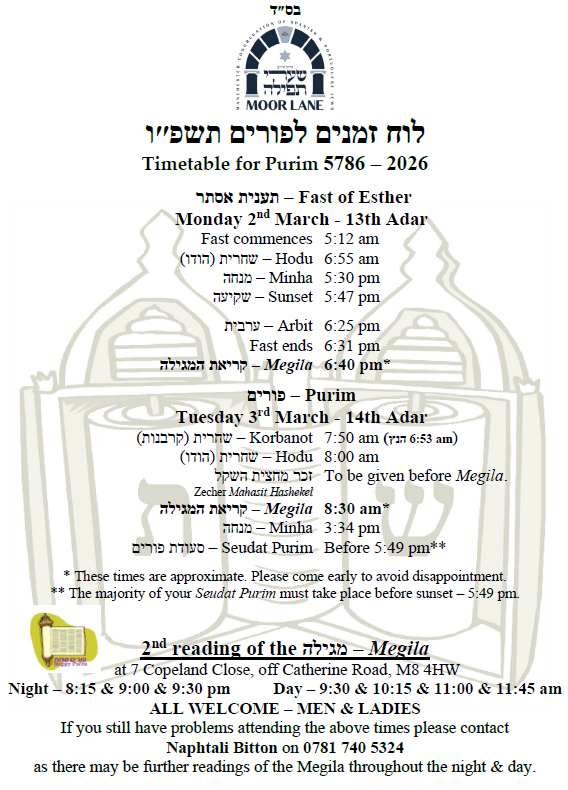
also attached to this email
*****
לוח זמני תפלה לחורף תשפ״ו
Winter Timetable 5786 – 2025/26
מוצאי שבת | ערבית (מוצ״ש) | שקיעה | מנחה שבת | סוף זמן קריאת שמע | הדלקת נרות | מנחה וקבלת שבת | תאריך | שבת פרשת |
Shabbat Ends | Arbit | Sunset | Minha | Shema before | Candle Lighting | Minha & Kabbalat Shabbat | Date | Parasha |
PM | PM | PM | PM | AM | PM | PM |
|
|
6:34 | 6:30 | 5:43 | 5:05 | 9:40 | 5:27 | 5:27 | 27/28 Feb | תצוה (זכור) |
*****
🕯️WINTER TIMES FOR SHABBAT MORNING🕯️
שבת
קרבנות
8:45 am
הודו
9:00 am
*****

*********
Moor Lane Women’s Nach Group
✴️👑✴️👑✴️👑✴️

Hashem tells Moshe to command the Jewish People to supply pure olive oil for the Menorah in the Mishkan (Tent of Meeting). He also tells Moshe to organize the making of the Bigdei Kehuna (priestly garments): A breastplate, an ephod, a robe, a checkered tunic, a turban, a sash, a forehead-plate, and linen trousers. Upon their completion, Moshe is to perform a ceremony for seven days to consecrate Aharon and his sons. This includes offering sacrifices, dressing Aharon and his sons in their res ective garments, and anointing Aharon with oil.
Hashem commands that every morning and afternoon a sheep be offered on the Altar in the Mishkan. This offering should be accompanied by a meal-offering and libations of wine and oil. Hashem commands that another Altar for incense be built from acacia wood and covered with gold. Aharon and his descendants should burn incense on this Altar each day.

נשים בקריאת המגילה – טעימה קודם המגילה
שאלה: מנהגינו שנשים שומעות קריאת המגילה בלילה, אבל לא ביום. האם מנהג זה נכון על פי ההלכה?
תשובה: אין חילוק בין האנשים לנשים לענין חיוב שמיעת קריאת המגילה, כי אף הנשים חייבות בקריאה זו כדין האנשים, שאף הן היו באותו נס ההצלה שבימי מרדכי ואסתר. וטעם מיוחד יש לחייב את הנשים בקריאת המגילה, שהרי הנס נעשה על יד אשה, היא אסתר. ובפרט בקריאת המגילה של היום, שהיא חמורה יותר מקריאת המגילה שבלילה.
ואמנם היו קצת מקומות, שהנשים נהגו שלא לשמוע קריאת המגילה בבוקר יום הפורים. ומרן רבינו עובדיה יוסף זצוק”ל בספרו טבעת המלך (תחילת הלכות מגילה), הביא את דברי שו”ת “מים חיים”, שכתב שמנהגם שלא קוראים מגילה עבור נשים ביום, והביא שרב אחר תמה על זה, ואחר כך מצא סמך להשען עליו בספר “מאורי אור”, שכתב שאין חובה כל כך בקריאת המגילה פעמיים, אלא זכר לנס שהיו צועקים ביום ובלילה בזמן צרתם, כמו שנאמר “אקרא יומם ולא תענה ולילה ולא דומיה לי”, ולכן לא רצו להחמיר כל כך על הנשים שהן טרודות בעניני הפורים שהם גם מצוה, והעוסק במצוה פטור מן המצוה. עד כאן דברי שו”ת “מים חיים” שבא להצדיק את המנהג שנשים לא קוראות מגילה ביום.
ומרן זצ”ל כתב על זה, שכל אלו דברי הבאי, ולא ניתנו להאמר, כי בודאי כל אשה יראת שמים יכולה למצוא זמן במשך היום לקיים מצות קריאת המגילה, שהיא עיקר מצות הפורים. וכמנהג כל נשות ישראל בכל מקומותיהן, ואין ספק שמנהג הנשים שזילזלו בקריאת המגילה ביום, אינו מנהג ותיק, אלא מנהג שעמי הארץ החלו בו, והוא מנהג נגד הגמרא שלנו, ונגד כל דברי הפוסקים. וברור שיש מצוה לבטל מנהג זה שלא יזכר עוד.
לכן למעשה, נשים חייבות במקרא מגילה, הן ביום והן בלילה, כדין האנשים ממש, ואסור לזלזל בזה.
ומכל מקום מותר לשתות קפה או תה או לטעום פירות קודם קריאת המגילה. וכן מותר לאכול עוגה או פת פחות משיעור כביצה (שהוא שיעור חמישים וששה גרמים). והמחמירים שלא לטעום כלום קודם מקרא מגילה, תבוא עליהם הברכה. ואין חילוק בזה בין קריאת המגילה של הלילה לבין קריאת המגילה שביום, שאסור לאכול לפני מקרא מגילה.
ובליל פורים, במקומות שקוראים מגילה מיד בצאת תענית אסתר, והאשה ממתינה בביתה למקרא מגילה, הרי היא רשאית אפילו לכתחילה לאכול פירות או מעט עוגה וקפה או תה, ואינה צריכה להשאר בתענית עד אחר קריאת המגילה. (כן פסק הגאון הראש”ל שליט”א בילקוט יוסף הנד”מ עמוד תקנו).
The Obligation of Women in Hearing the Megillah-Eating Before Megillah Reading
Question: Our custom is that women hear Megillah reading on Purim night but not on Purim day. Is this custom correct according to Halacha?
Answer: There is no distinction between men and women regarding the obligation to hear Megillah reading and women are just as obligated as men in this Mitzvah since they too were included in the miraculous salvation in the days of Mordechai and Esther. There is an especially pertinent reason to obligate women to hear the Megillah being read since this miracle was brought about through a woman, namely Queen Esther. This is especially true regarding the Purim day Megillah reading which is more important than the Purim night Megillah reading.
Nevertheless, there were some places where the custom was for women not to hear the Megillah being read on the morning of Purim. Maran Rabbeinu Ovadia Yosef zt”l, in his Sefer Taba’at Ha’Melech (beginning of Hilchot Megillah), quotes the words of the Responsa Mayim Chaim who writes that their custom was that the Megillah would not be read for women on Purim day and he writes that a different Rav questioned this notion. However, he supported this custom based on the words of the Sefer Me’orei Ohr who writes that there is not such a firm obligation to read the Megillah twice and this is only done in commemoration of the fact that the Jewish nation would cry out day and night during their perilous situation, as the verse states, “I will call out during the day and you do not answer and by night and I have not respite.” Thus, they did not wish to burden women who are busy with the other Mitzvot of Purim and one who is involved with one Mitzvah is absolved from another. All of the above is the opinion of the Mayim Chaim who wished to uphold this custom of women not hearing Megillah being read on Purim day.
Maran zt”l writes that this opinion is completely baseless and should not even be said, for any G-d-fearing woman can certain find some time during Purim day to hear the Megillah being read since this is the primary Mitzvah of Purim. Needless to say, the custom of those women who treated Megillah reading on Purim day lightly is not an ancient custom and is merely a custom instituted by ignorant people and it contradicts the Gemara and all the Poskim. There is certainly a Mitzvah to eradicate this custom completely.
Thus, halachically speaking, women are obligated to hear Megillah reading, both on Purim night and then once again on Purim day, as is the law with regards to men, and this law may not be taken lightly.
Eating Before Megillah Reading
One may not eat before Megillah reading. Therefore, those women who do not come to hear Megillah at the time the congregation is praying in the synagogue and wait for their husbands to come home from synagogue and only then do they go to hear Megillah reading should be careful not to eat anything until they hear Megillah reading themselves.
However, they may drink tea or coffee or taste some fruit before hearing Megillah reading. Similarly, one may also partake of some cake or even less than a Kebeitza (an egg’s volume, approximately 54 grams) of bread. Those who act stringently and abstain from eating anything until the Megillah is read are especially praiseworthy. There is no distinction between the Purim night or Purim day Megillah reading, for one may not eat before Megillah reading in any case.
On Purim night in places where Megillah is read immediately following the Fast of Esther and a woman is waiting at home to hear Megillah reading later, she may eat some fruits or a some cake, tea, or coffee even preferably and she need not remain fasting until after she hears the Megillah. (The great Rishon Le’Zion Shlit”a rules likewise in his Yalkut Yosef-Purim, new edition, page 556.)
 3-Purim-5786.pdf