Shabbat Hagadol
The Shabbat before Pesach is called “Shabbat Hagadol,” or “the Great Shabbat,” a term that is generally understood as a reference to the miracle that occurred in Egypt on the Shabbat before Benei Yisrael's departure from Egypt. It was on that Shabbat, which fell on the tenth of Nissan, that Benei Yisrael designated sheep for the Korban Pesach (paschal offering) and tied them to their bedposts. The Egyptians inquired as to the purpose behind this designation of sheep, which the Egyptians worshipped as a pagan deity, and Benei Yisrael explained that they prepared the sheep for a sacrificial offering to God. Despite this grave insult to their deity, the Egyptians were powerless to oppose Benei Yisrael. They were miraculously struck by a disease that required them to regularly visit the restroom, thus impairing their ability to cause any harm to Benei Yisrael.
In commemoration of this great miracle that occurred on the Shabbat before Pesach on the year when Benei Yisrael left Egypt, we observe this Shabbat as a special occasion and refer to it as “Shabbat Hagadol.”
Some have raised the question as to why we commemorate this miracle specifically on the Shabbat before Pesach, rather than on the calendar date when this miracle occurred – the tenth of Nissan. Why don't we observe a commemoration on this date regardless of the day of week on which it falls?
One answer suggests that it was specifically due to Benei Yisrael's observance of Shabbat that the greatness of this miracle was felt. When they told the Egyptians on that day of their plans to slaughter the sheep as a sacrifice, the Egyptians believed them despite the fact that they did not slaughter the sheep that day, because they understood that Benei Yisrael would not kill animals on Shabbat. On the subsequent days, however, when the Egyptians saw that Benei Yisrael were not yet slaughtering the sheep, they began to suspect that they were bluffing all along. It was thus specifically on Shabbat when the Egyptians sought to foil Benei Yisrael's plans but were miraculously prevented from doing so, and for this reason we commemorate this miracle specifically on the Shabbat before Pesach.
Others explain that the tenth of Nissan marks yet another great miracle in Jewish history – the splitting of the Jordan River when Benei Yisrael entered the Land of Israel, as recorded in the Book of Yehoshua (chapter 3). In order to make it clear that we commemorate the miracle in Egypt, and not the splitting of the Jordan, we observe our commemoration on the Shabbat before Pesach, rather than on the calendar date of the tenth of Nissan.
The Chid”a (Rabbi Chayim Yosef David Azulai, 1724-1806) writes that on this Shabbat people should extend to one another the greeting, “Shabbat Hagadol Shalom” and then respond, “Shabbat Hagadol Shalom U'mevorach.”
There is a widespread custom for the Grand Rabbi of the congregation to deliver on this Shabbat a special Derasha (lecture) devoted to the laws of Pesach and discussions of the Haggada in preparation for the holiday. This is another reason for calling this Shabbat “Shabbat Hagadol,” which perhaps means, “the Shabbat of the great person,” referring to the Grand Rabbi. Additionally, the Derasha delivered on Shabbat Hagadol is typically lengthier than the Rabbi's usual lecture. (The late Chief Rabbi of the Sephardic Community in Brooklyn, Chacham Yaakov Kassin A”H, would deliver his Derasha on Shabbat Hagadol in Congregation Shaare Zion for several hours before Mincha.) The term “Shabbat Hagadol” may thus refer to the “great,” or long, lecture that the Rabbi delivers on this Shabbat.
Some Ashkenazim have the practice of reciting the Maggid section of the Haggada on Shabbat Hagadol, in order to familiarize themselves with the Haggada in preparation for the Seder. The Gaon of Vilna (Rabbi Eliyahu of Vilna, 1720-1797) opposed this practice, in light of the emphasis made in the Haggada itself that the obligation to tell the story of the Exodus applies only on the night of Pesach (“Lo Amarti Ela Be'sha'a She'yeish Matza U'marror Munachim Lefanecha”). In any event, even for those of us who do not actually recite the Haggada on Shabbat Hagadol, this Shabbat is an appropriate time to begin reviewing the Haggada and prepare material for the Seder
The Significance of Shabbat Hagadol
Maran, in Shulhan Aruch, discusses the special Shabbatot that precede Pesah and the various Halachot that apply on those days. On Shabbat Shekalim, we take out an extra Sefer Torah and read the section of Shekalim, just as on Shabbat Zachor, the Shabbat before Purim, we read the section of Zachor, and we read special portions from the Torah on Shabbat Para and Shabbat Ha’hodesh. Interestingly, however, Maran also makes mention of the Shabbat immediately preceding Pesah, which is called Shabbat Hagadol (“The Great Shabbat”) because of the miracle that occurred on this Shabbat. Maran makes mention of this Shabbat, even though there are no specific Halachot associated with this Shabbat. There is no special reading from the Sefer Torah on this Shabbat, and there are no special prayers, and yet Maran made a point of mentioning in his Halachic code that this Shabbat is special and is called Shabbat Hagadol.
It is true that there are several customs observed by some communities on this Shabbat. For example, many synagogues read a special Haftara on this Shabbat, but this is not required according to the strict Halacha. Some Ashkenazim read portions of the Haggadah on Shabbat Hagadol, but this, too, is just a custom, and in fact the Vilna Gaon (Rabbi Eliyahu of Vilna, 1720-1797) was opposed to the practice.
The Hida (Rav Haim Yosef David Azulai, 1724-1807) suggested that perhaps the Halachic implications of the status of Shabbat Hagadol relates to greetings extended to one another on this Shabbat. Instead of greeting one another with the usual greeting of “Shabbat Shalom,” the Hida suggested that perhaps one should instead extend the greeting, “Shabbat Hagadol Shalom,” and the other should then respond, “Shabbat Hagadol Shalom U’meborach.” Still, it remains unclear why Maran would make a point of mentioning Shabbat Hagadol if there are no actual Halachot that apply on this Shabbat.
Former Chief Rabbi Eliyahu Bakshi-Doron, in his work Binyan Ab, suggested that the practical significance of Shabbat Hagadol lies in the perspective it gives us on the preparations for Pesah. On the Shabbat before the Exodus, which was the 10th of Nissan, Beneh Yisrael were instructed to prepare a sheep for the Korban Pesah (paschal sacrifice) which was slaughtered four days later, on the 14th of Nissan. In full view of the Egyptians, who worshipped sheep as an Aboda Zara, Beneh Yisrael took a lamb and tied it to their bedpost, and they even explained to the Egyptians what they were doing, that this animal would be sacrificed to G-d. The Egyptians wanted to kill the people for desecrating their deity, but G-d performed a miracle and made them powerless to cause Beneh Yisrael any harm.
Rav Bakshi-Doron noted that this miracle differed fundamentally from the ten plagues. The ten plagues were brought directly by G-d, whereas the miracle of Shabbat Hagadol came about through the people’s courage. It was through their preparations for the Misva that a miracle happened. And the fact that G-d performed a miracle during the preparation for the Misva, four days before the actual performance of the Misva, is very significant. It demonstrates that even the preparatory stages have great value; that even the work we do in preparation for a Misva is laden with significance. And thus Maran made mention of Shabbat Hagadol in Shulhan Aruch, to teach us the importance of preparing for Pesah, by learning and teaching the Halachot and putting ourselves in the proper frame of mind for the holiday. The miracle of Shabbat Hagadol teaches us that it is not only the Misva itself that has value, but also the work we invest beforehand preparing ourselves for the performance of the Misva.

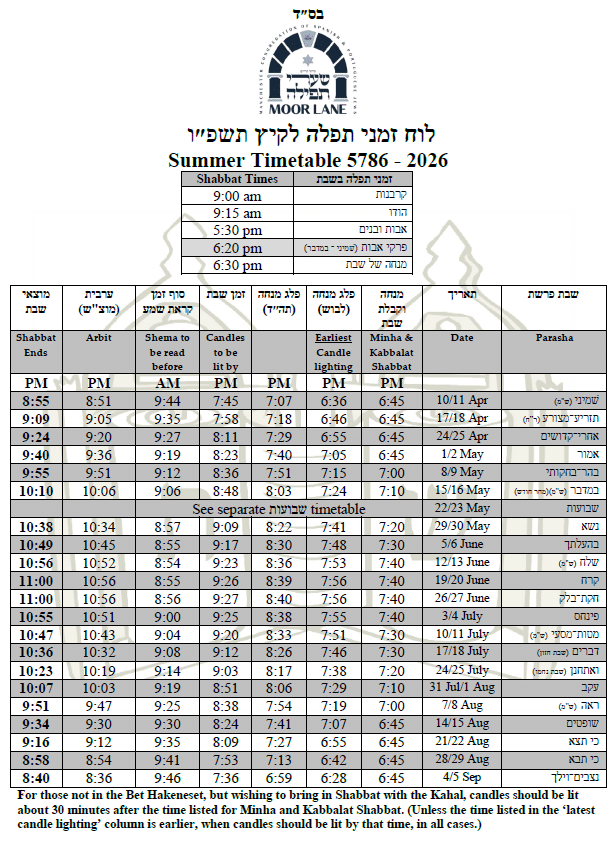
🕯️SUMMER TIMES FOR SHABBAT MORNING🕯️
שבת
קרבנות
9:00 am
הודו
*********
***
Moor Lane Women’s Nach Group

*******
לוח זמני תפלה לחורף תשפ״ו
Winter Timetable 5786 – 2025/26
מוצאי שבת | ערבית (מוצ״ש) | שקיעה | מנחה שבת | סוף זמן קריאת שמע | הדלקת נרות | מנחה וקבלת שבת | תאריך | שבת פרשת |
Shabbat Ends | Arbit | Sunset | Minha | Shema before | Candle Lighting | Minha & Kabbalat Shabbat | Date | Parasha |
PM | PM | PM | PM | AM | PM | PM |
|
|
7:27 | 7:23 | 6:36 | 6:00 | 9:03 | 6:20 | 6:20 | 27/28 Mar | צו (שבת הגדול) |
*****
🕯️WINTER TIMES FOR SHABBAT MORNING🕯️
שבת
קרבנות
8:45 am
הודו
9:00 am
********
The Torah addresses Aharon and his sons to teach them additional laws relating to their service. The ashes of the korban olah — the offering burned on the Altar throughout the night — are to be removed from the area by the kohen after he changes his special linen clothing. The olah is brought by someone who forgot to perform a positive commandment of the Torah. The kohen retains the skin. The fire on the Altar must be kept constantly ablaze. The korban mincha is a meal-offering of flour, oil and spices. A handful is burned on the Altar and a kohen eats the remainder before it becomes leaven. The Torah portion describes the special korbanot to be offered by the Kohen Gadol each day and by Aharon’s sons and future descendants on the day of their inauguration. The chatat, the korban brought after certain accidental transgressions, is described, as are the laws of slaughtering and sprinkling the blood of the asham guilt-korban. The details of shelamim, various peace korbanot, are described, including the prohibition against leaving uneaten until morning the remains of the todah, the thanksgiving-korban. All sacrifices must be burned after they may no longer be eaten. No sacrifice may be eaten if it was slaughtered with the intention of eating it too late. Once they have become ritually impure, korbanot may not be eaten and should be burned. One may not eat a korban when he is ritually impure. Blood and chelev (certain animal fats) are prohibited to be eaten. Aharon and his sons are granted the breast and shank of every korban shelamim. The inauguration ceremony for Aharon, his sons, the Mishkan and all of its vessels is detailed.
הכשר הכיורים והמטבח
כבר ביארנו, שכשם שיש לייחד כלים נפרדים למאכלי בשר ולמאכלי חלב, כמו כן בחג הפסח, אסור להשתמש בכלים של כל השנה, אלא יש לייחד כלים כשרים לפסח.
ואמנם יש אופנים בהם ניתן להכשיר כלי שהשתמשו בו בחמץ, ולעשותו כשר לפסח.
כלי פלסטיק, יש להם הכשר לפסח כדרך תשמישן, דהיינו שאם השתמשו בהם בצונן, די להם בשטיפה יסודית, ואם השתמשו בהם בכלי שני, דהיינו שיצקו לתוכם מאכלים חמים מסיר אחר, יש להם הכשר על ידי עירוי מים רותחים מכלי ראשון, וכפי שכבר הסברנו, שניתן לעשות זאת על ידי יציקת מים רותחים מהקומקום החשמלי ישירות על גבי כלי הפלסטיק.
ולפיכך “שעוונית” (שהיא מפה מחומר פלסטי) שהייתה פרושה על גבי השולחן במשך כל השנה, ויש לחוש שנשפכו על גביה מאכלי חמץ רותחים במשך השנה. אפשר להכשירה על ידי ניקיון יסודי, ועירוי מים רותחים מכלי ראשון על גבי השעוונית, וכן ניתן להכשיר את השעוונית, על ידי כיבוס במים רותחים.
ואם אכלו על השלחן בלא הפסק מפה נוהגים להכשירו על ידי ניקיון יסודי ועירוי במים רותחים כנ”ל. ואם אין רוצים לערות מים רותחים על גבי השלחן כדי שלא יתקלקל או מאיזה סיבה שתהיה, מותר לאכול על גביו בחג הפסח על ידי שיפרוש עליו מפה או שעוונית.
דין השיש שבמטבח הרי הוא כדין השלחן, ואפשר להכשירו לפסח על ידי שיערו עליו מים רותחים מכלי ראשון אחרי ניקוי יסודי. וכמו כן יש להכשיר את הכיורים בבית (אף אם הם עשויים חרסינה) על ידי עירוי מים רותחים מכלי ראשון, ודי בזה. ויש המחמירים לצפות את השיש והכיור בנייר אלומיניום. ונכון לעשות כן על ידי נייר חזק ועבה, כדי שלא יקרע בקלות.
כתב רבינו יהודה החסיד, שבהיות ודיני הגעלה מרובים מאד בפרטיהם ובפרטי פרטים, ראוי למנות בעל תורה להשגיח על הגעלת כלים. וכן בכל מקרה שמתעוררת שאלה בדיני פסח, צריך כל אדם לפנות לתלמיד חכם אמיתי שיורה לו הדרך אשר ילך בה ואת המעשה אשר יעשון.
ובזמנינו ברוך ה', לרוב בני האדם יש כלים מיוחדים לימות הפסח, ובזה יוצאים מכל חשש
Koshering Sinks and Kitchen Countertops
We have previously discussed that just as one should designate vessels for milk and meat respectively, likewise, regarding the holiday of Pesach, one should not use one’s regular Chametz vessels that were used all year round; rather, one should designate special kosher for Pesach vessels.
Nevertheless, there are ways to make vessels that were used for Chametz kosher for Pesach use.
Plastic utensils are able to be koshered according to their use, meaning that if they were used with cold items, a thorough washing is sufficient, and if they were used as a “Keli Sheni”, meaning that hot foods were dished into them from a pot boiled on a flame, they may be koshered by pouring boiling water from a “Keli Rishon” (a pot where the water was boiled) onto them. As we have explained in a previous Halacha, this may be performed by pouring boiling water directly from an electric kettle onto the plastic utensil.
Therefore, if a plastic tablecloth (non-disposable) was draped over the table during the course of the year which hot Chametz quite possibly may have spilled onto, it may be koshered with a thorough cleaning followed by pouring boiling water from a “Keli Rishon” onto it. Similarly, it may be koshered through laundering it in boiling water.
If a table was eaten on during the course of the year without the use of a tablecloth, the table may be koshered with a thorough cleaning followed by pouring boiling water from a “Keli Rishon” onto it, as above. If one does not wish to pour boiling water onto the table so as not to ruin it or for any other reason, one may eat on this table during the holiday of Pesach by using a new regular or plastic tablecloth.
Kitchen countertops have the same halachic status as the table and may be koshered through pouring boiling water from a “Keli Rishon” onto them after being thoroughly cleaned. Similarly, kitchen sinks (even if they are made of ceramic) may be koshered through pouring boiling water from a “Keli Rishon” onto them, and this is sufficient. Some act more stringently and cover the countertops and sinks with aluminum foil.
Rabbeinu Yehuda Ha’Chassid writes that since the laws of Hag’ala are tedious and detailed, it is proper to appoint a prominent Torah scholar to oversee the process of Hag’ala of utensils. Similarly, if one encounters a question regarding any Pesach-related issue, one should consult a leading halachic authority to guide him on the true Torah path.
Nowadays, most people are able to afford a separate set of dishes and silverware fore Pesach and in this way, one avoids all doubt.
 4-Pesach-Timetable-5786-2026.pdf