


Chodesh Tov
to all our readers
משנכנס אדר מרבין בשמחה
בגמרא במסכת תענית (דף כט.) אמר רבי יהודה בנו של רב שמואל בן שילת משמו של רב, כשם שמשנכנס אב ממעטין בשמחה כך משנכנס אדר מרבים בשמחה. אמר רב פפא, הלכך כל אחד מישראל שיש לו דין (דהיינו משפט) עם נכרי (גוי), ישתמט ממנו בחודש אב, משום רוע מזלם של ישראל בחודש אב, וישתדל שיצא הדין בחודש אדר משום שאז מזלם של ישראל הוא טוב מאד.
ומקור הדברים, הוא כמו שנאמר במגילת אסתר, “והחודש אשר נהפך להם מיגון לשמחה”, ללמדנו, שמזל החודש גורם הצלה וטובה לישראל, שבחודש זה מזלם הוא טוב.
אולם הגאון החתם סופר (סימן קס) העיר, שמרן השלחן ערוך בהלכות תשעה באב (סימן תקנא) הביא את דברי חז”ל שמשנכנס אב ממעטין בשמחה, אבל את מאמר חז”ל שמשנכנס אדר מרבין בשמחה, לא הביא בשלחן ערוך. גם רבינו הרמב”ם לא הזכיר בכלל את דברי חז”ל הללו.
וכתב החתם סופר ליישב, שיתכן שהרמב”ם ומרן השמיטו את הדין שיש לשמוח בחודש אדר, משום שרב פפא, שאמר שיש להשתדל ולכוין את הדין (המשפט) עם הגוי דוקא בחודש אדר, זהו משום שהוא סובר שיש מזל לישראל, כלומר, שגם עם ישראל כפופים למזלות, ולכן בחודש אדר מזלם הוא טוב מאד ועליהם לשמוח. אבל אנחנו פוסקים כדעת האומרים (בסוף מסכת שבת) שאין מזל לישראל, כי ישראל אינם כפופים למזלות, ולכן הרמב”ם ומרן כלל לא הזכירו את הדין הזה לגבי חודש אדר.
אולם רבים מהפוסקים כתבו שיש לקיים את דברי רב פפא ש”משנכנס אדר מרבין בשמחה”, ויש מקומות שאף מציינים זאת בכתובת בולטת. וגם אם אנו סבורים ש”אין מזל לישראל”, עדיין יש לשמוח בימים הללו, משום שחודש זה כולו נהפך לשמחה בימי אבותינו, וכולו ראוי לשמחה. ומה שמרן השלחן ערוך לא הזכיר את הדברים, הוא משום שכבר כתב בפירוש (בסימן תרפח) שיש אומרים שאפשר לקרוא מגילה כבר מראש חודש. ואם כן בודאי מובן שכל ימי חודש אדר הם ימי שמחה. וכן הסביר בספר התעוררות תשובה (סימן תעג). ובשנים קודמות הסברנו את הדברים עוד על פי דברי הריטב”א ועוד, על פי מה שכתב בזה מרן רבינו זצ”ל.
ובטעם השמחה בחודש אדר, האריך הגאון הראשון לציון רבינו יצחק יוסף שליט”א בספרו ילקוט יוסף (עמוד קצב), וכתב שיש בשמחת חודש אדר משום הודאה לה' יתברך על הנסים שנעשו לישראל בימים אלה. וכן יש בזה משום ציון וסימן שהימים הללו מסוגלים לטובה ולברכה.
ועוד הוסיף, שכשם שבימי חודש אב, ממעטין בשמחה עוד ועוד עד לשיא האבלות ביום תשעה באב, כמו כן בחודש אדר, מרבין בשמחה כדי להתכונן לקראת השמחה הגדולה שיש ביום הפורים עצמו.
ועוד הביא בשם ספר שפת אמת (על מסכת תענית), שבימי חודש אדר מתעוררת שמחה גדולה בעולם, משום שבימים הללו היו רגילים עם ישראל להביא את תרומותיהם במחצית השקל לבית המקדש, ובאותם הימים היו עם ישראל נותנים את התרומה בשמחה גדולה כמו שמבואר בכמה מקומות, וכן היה גם בימי המקדש השני, שהיו מתנדבים בשמחה, ועדיין עד היום הזה השמחה נמצאת בחודש אדר והיא מתעוררת על ידי כך שקוראים בבית הכנסת בפרשת שקלים.
“When Adar Begins, We Increase Our Joy”
The Gemara in Masechet Ta’anit (29a) tells us, “Rabbi Yehuda son of Rav Shmuel ben Shilat taught in the name of Rav: Just as when the month of Av begins we diminish our happiness, so too, when Adar begins we increase our happiness. Rav Papa says, therefore, if a Jew has a court case with a non-Jew pending, he should avoid having it during the month of Av when the Jewish nation’s fortune is bad and try to have it held during the month of Adar when the Jewish nation’s fortune is good.”The source for this is based on a verse in Megillat Esther which states, “And the month which was switched for them from tragedy to joy,” which teaches us that the good fortune of this month brings about salvation and goodness for Israel since their fortune is optimal during this month. Nevertheless, Hagaon Chatam Sofer (Chapter 160) points out the distinction in the words of Maran Ha’Shulchan Aruch in that whereas in the laws of Tisha Be’av (Chapter 551), Maran quotes the words of the Sages that when Av begins, we decrease our joy, Maran does not quote the corresponding teaching that when the month of Adar begins, we increase our joy. Furthermore, the Rambam does not quote this teaching of our Sages at all. The Chatam Sofer explain that it is possible that the reason why the Rambam and Shulchan Aruch omitted this law of rejoicing during Adar is because Rav Papa who maintained that one should try to schedule a court case with a non-Jew to be held specifically during the month of Adar is because he is of the opinion that the Jewish nation is subject to the influence of the constellation and during Adar when their fortune is good, this is cause for celebration. On the other hand, we maintain that the Jewish nation is not subject to the influence of the stars (based on the Gemara, end of Shabbat) and thus, the Rambam and Maran did not mention this law regarding the month of Adar at all. However, many Poskim defend the ruling of Rav Papa that when Adar begins, our joy increases; some actually post animated signs during the month of Adar to that effect. Although we maintain that the Jewish nation is not subject to the influence of the constellations, there is still room to rejoice during these days because this entire month has been switched from mourning to rejoicing in the times of our forefathers. The reason why Maran omits this law is because he had already written (in Chapter 688) that some rule that one may read the Megillah from the beginning of the month of Adar. Thus, the entire month of Adar is certainly a time for rejoicing. The Sefer Hitorerut Teshuva (Chapter 473) resolves this issue likewise. In previous years, we have explained this matter further based on the words of the Ritba and as discussed in the works of Maran zt”l. The great Rishon Le’Zion, Hagaon Rabbeinu Yitzchak Yosef Shlit”a, explains (in his Yalkut Yosef- Purim, page 192) that the reason for rejoicing during the month of Adar is out of thanksgiving to Hashem for all the miracles he performed for us during this period. It is also an indication that these days are auspicious for goodness and blessings. He adds that just as during the month of Av, we progressively decrease our joy until the epitome of mourning on the Ninth of Av, during the month of Adar, we progressively increase our joy in preparation for the most joyous day of the month, the day of Purim. He quotes the Sefer Sefat Emet (on Ta’anit ibid.) who explains that it is possible that since during the month of Adar during the eras of the Mishkan (Tabernacle) and the first and second Bet Hamikdash the Half-Shekel coins were collected in the Bet Hamikdash and the Jewish nation donated them joyously, there was a spirit of great joy in the world. Until this very day, from the time Parashat Shekalim is read in the synagogue (on the Shabbat of or preceding Rosh Chodesh Adar), a great joy is awakened in the world.
*****
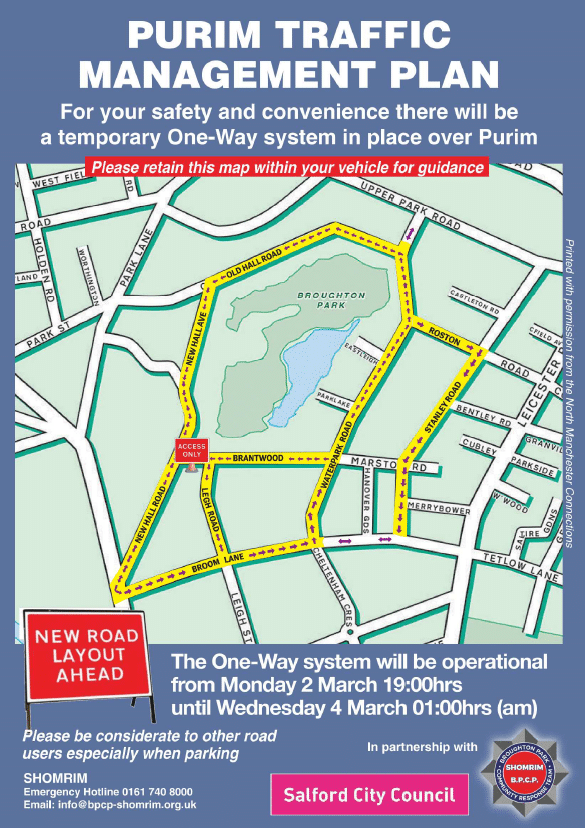
Important Taraffic Information for Purim

****
לוח זמני תפלה לחורף תשפ״ו
Winter Timetable 5786 – 2025/26
מוצאי שבת | ערבית (מוצ״ש) | שקיעה | מנחה שבת | סוף זמן קריאת שמע | הדלקת נרות | מנחה וקבלת שבת | תאריך | שבת פרשת |
Shabbat Ends | Arbit | Sunset | Minha | Shema before | Candle Lighting | Minha & Kabbalat Shabbat | Date | Parasha |
PM | PM | PM | PM | AM | PM | PM |
|
|
6:21 | 6:17 | 5:30 | 4:55 | 9:48 | 5:14 | 5:14 | 20/21 Feb | תרומה |
*****
🕯️WINTER TIMES FOR SHABBAT MORNING🕯️
שבת
קרבנות
8:45 am
הודו
9:00 am
*****

*********
Moor Lane Women’s Nach Group
✴️👑✴️👑✴️👑✴️

Hashem commands Moshe to build a Mishkan (Sanctuary) and supplies him with detailed instructions. The Jewish People are asked to contribute precious metals and stones, fabrics, skins, oil and spices. In the Mishkan's outer courtyard there is an Altar for the burnt offerings and a Laver for washing. The Tent of Meeting is divided by a curtain into two chambers. The outer chamber is accessible only to the Kohanim, the descendants of Aharon. This contains the Table of showbreads, the Menorah, and the Golden Altar for incense. Entrance to the innermost chamber, the Holy of Holies, was permitted only for the Kohen Gadol, and only once a year, on Yom Kippur. Here is the Ark that held the Ten Commandments inscribed on the two tablets of stone which Hashem gave to the Jewish nation on Mount Sinai. All of the utensils and vessels, as well as the instructions for the construction of the Mishkan, are described in great detail.

אריזות כדורים בשבת
שאלה: האם מותר לפתוח בשבת אריזת גלולות?
תשובה: גלולות המצויות בזמנינו, רגילים בבתי החרושת לעוטפן בנייר פלסטיק מצדן האחד, ואילו מצדן השני הן סגורות באמצעות נייר אלומיניום שכתוב עליו שם התרופה. וכשרוצים להוציא את הגלולה, יש לקרוע את נייר האלומיניום העוטף אותה.
והנה אחת המלאכות האסורות בשבת (שנשנו במשנה במסכת שבת פרק שביעי), היא מלאכת “מוחק”. ומאחר ושם התרופה רשום על נייר האלומיניום, נמצא שמי שקורע את הנייר, גורם לכך שלא ניתן לקרוא את מה שהיה רשום עליו. ויש כאן חשש של איסור “מחיקה” בשבת. לכן עלינו לדון, האם מותר לקרוע בשבת את הנייר העוטף את הגלולה, או לא.
והנה באמת, איסור מחיקת כתב בשבת, הוא איסור מן התורה, אבל אין זה אלא כאשר המחיקה היא מחיקה על מנת לכתוב, כגון אדם המוחק כתב שבמחברת, שהמחיקה מאפשרת לכתוב שוב על הנייר, אבל כאשר אין המחיקה באה בכדי לכתוב, אין האיסור במחיקה זו אלא מדרבנן (מדברי רבותינו), שגזרו אף על מחיקה כזו שתהיה אסורה ביום השבת.
ומחיקת הכתב שמאחורי אריזת הגלולות, בודאי אינה נחשבת למחיקה על מנת לכתוב. ומעתה מבואר שאין הנדון בשאלתנו, אלא לגבי איסור מחיקה שהוא מדרבנן, אבל מצד איסור מחיקה ממש שהיא מן התורה, אין כאן חשש כלל.
ומעתה יש לנו לדון בזה מצד מה שכתב מרן רבינו זצ”ל בכמה מקומות בספריו, שכל איסור מלאכה (האסורה מדרבנן) שנעשית בשבת, כאשר אין האדם מתכוין לאותה המלאכה (ובלשון הפוסקים: “לא מתכוין”), וגם לא איכפת לו בתוצאה שיוצאת ממנה (“לא איכפת ליה”), אין איסור בעשיית אותה המלאכה.
ודוגמא לדבר, אדם שהולך על גבי שלג בשבת, אף על פי שהוא מרסק את השלג בהליכתו, מאחר ואין איסור בריסוק השלג (ברגליו) אלא מדרבנן, מותר ללכת עליו בשבת. שהרי ההליכה גורמת לאיסור דרבנן, “דלא ניחא ליה”, ו”דלא איכפת ליה”, והדבר מותר בשבת. (חזון עובדיה שבת חלק ד עמוד קעא).
וכן לענין קריעת אריזת הכדורים, מכיון שהאדם הקורע את אריזת הכדורים אינו מתכוין במלאכתו למחיקת האותיות, וגם לא איכפת לו ממחיקתם כלל וכלל, נראה שיש להקל בקריעת אריזת הכדורים בכדי שיוכל להשתמש בהן בשבת.
וכן פסק הגאון רבי שלמה זלמן אוירבך זצ”ל בספר שמירת שבת כהלכתה (עמ' תקיט), והוסיף, שאף לפי דברי האחרונים שהחמירו בנדון קרוב לנדון זה, מכל מקום במקום חולי, שהגלולות הן לרפואה, העיקר שיש להקל בזה.
ומכל מקום, המחמיר לקרוע את אריזת הכדורים מערב שבת ולהכין לו כמה כדורים שיצטרך לשבת, תבא עליו הברכה. ובפרט כאשר הכדורים אינם עשויים לצורך חולה, שאז יש מקום יותר להחמיר בזה.
ולסיכום: מותר מעיקר הדין לקרוע אריזת כדורים, אף על פי שעל ידי קריעת האריזה נמחק הכתב שעל גביה. והמחמיר לקרוע את האריזה מערב שבת, תבא עליו ברכה.
Opening Medication Packaging on Shabbat
Question: Is it permissible to open the packaging of medication tablets on Shabbat?
Answer: It is common nowadays that many pharmaceutical companies manufacture their medication tablets in a packaging of which one side is made of plastic and the other side is made of foil with the name of the company and medication imprinted on it. In order to remove the tablets, one must tear the foil in which the tablet is encased.
One of the thirty-nine forbidden works on Shabbat (listed in the Mishnah in the seventh chapter of Masechet Shabbat) is “erasing.” Since the name (and company) of the medication is printed on the foil, by tearing the foil, the words printed on it will no longer be legible which constitutes a concern of the forbidden work of “erasing” on Shabbat. We must therefore discuss whether or not it is permissible to tear the foil encasing around the tablets on Shabbat.
Although the act of erasing writing on Shabbat is certainly a Torah prohibition, this only applies when one erases in order to write, for instance, if one erases writing in a notebook which then allows him to once again write on the paper. However, if one is not erasing in order to write, this kind of erasing constitutes only a rabbinic prohibition.
If so, erasing the words on the back of a package of tablets is certainly not considered “erasing in order to write.” Thus, our discussion involves a form of erasing which is only a rabbinic prohibition and there is no concern for a Torah prohibition of erasing whatsoever.
We must now discuss what Maran Rabbeinu zt”l writes in several of his works that when any rabbinic prohibition is being performed on Shabbat, if one does not intend to perform this forbidden work and one does not care about that outcome that ensues as a result of it, there is not prohibition to perform such a work.
For example, if one walks on snow on Shabbat, although one is crushing the snow as he is walking, since crushing snow with one’s feet is only a rabbinic prohibition, one may walk on it on Shabbat, for this walking causes only a rabbinic prohibition the result of which (the crushed snow) one does not care about. This is therefore permissible (see Chazon Ovadia-Shabbat, Part 4, page 171).
The same would apply to tearing the packaging of the medication. Since the one tearing the packaging does not intend to perform the forbidden work of erasing letters and does not care about this outcome whatsoever, it seems that there is room for leniency to tear such packaging on Shabbat so that one may use the pills on Shabbat.
Indeed, the Sefer Shemirat Shabbat Ke’Hilchata (page 519) quotes Hagaon Harav Shlomo Zalman Auerbach zt”l as ruling leniently on this matter and adds that although some Acharonim rule stringently regarding a similar case, in our situation where the pills are meant to heal some sort of illness, there is certainly room to permit doing so.
Nevertheless, one who acts stringently and tears the packaging on Erev Shabbat and prepares the necessary amount of tablets for Shabbat before the onset of Shabbat shall certainly be blessed. This is especially true when the tablets are not meant for an ill individual in which case there is more room to act stringently.
Summary: According to the letter of the law, one may tear the packaging of medication tablets on Shabbat although by doing so, the letters on the back of the packaging are being torn. One who acts stringently and tears the packaging before the onset of Shabbat shall be blessed.