



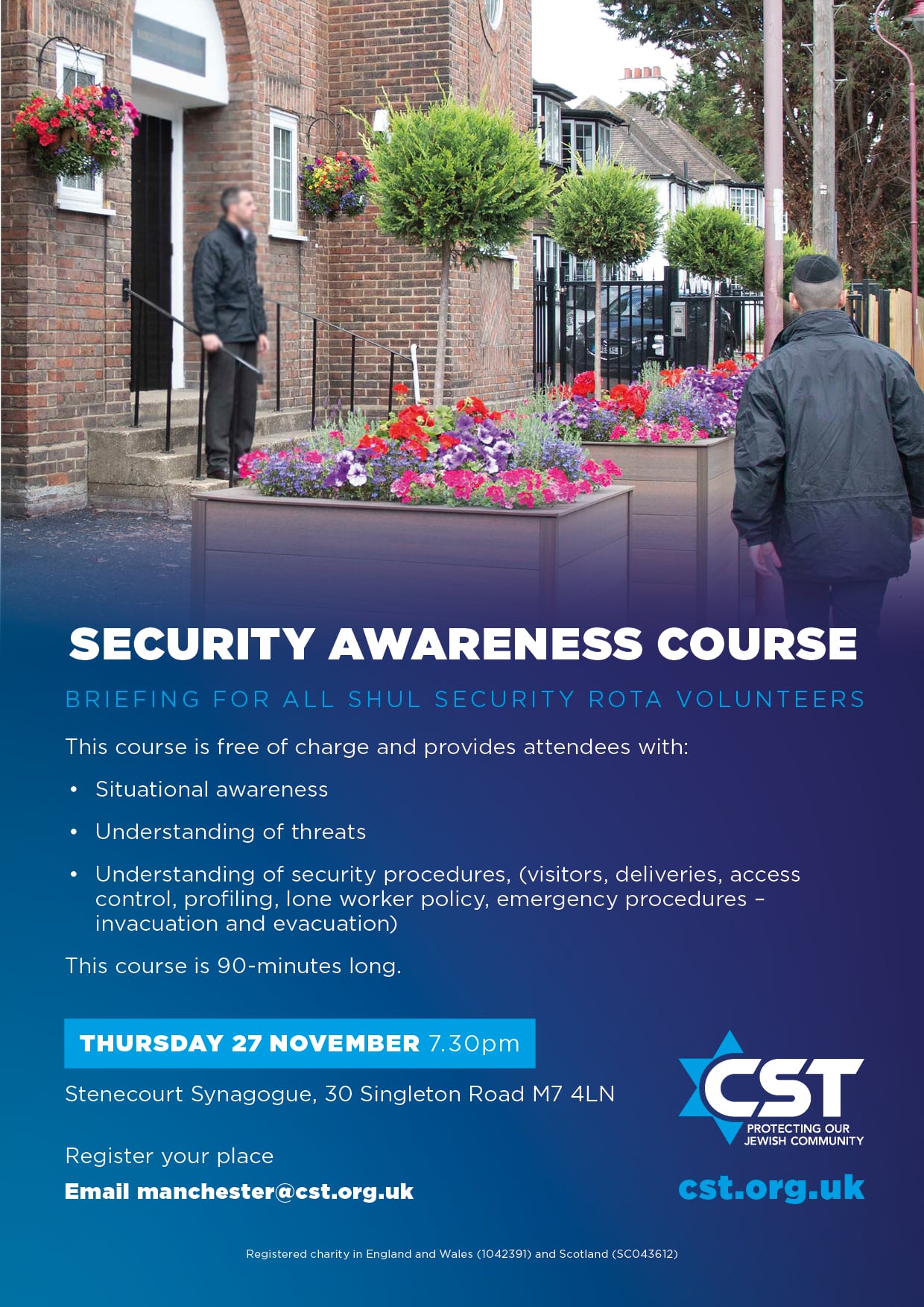
After the tragic events of 2nd October, CST felt it is important to provide a security awareness session
to all communal shul rota security volunteers, shul executive members and Rabbonim.
Attending regular security briefings and training is critical to providing the best security possible to our community
and ensuring our shul security rotas teams are fully briefed on up-to-date methods and procedures.
This training session will take place at Stenecourt Synagogue, on
TOMORROW
Thursday 27th November 2025,
doors open at 07.30 pm.
All attendees must register,
this can be done directly via an email to
*******

לוח זמני תפלה לחורף תשפ״ו
Winter Timetable 5786 – 2025/26
מוצאי שבת | ערבית (מוצ״ש) | שקיעה | מנחה שבת | סוף זמן קריאת שמע | הדלקת נרות | מנחה וקבלת שבת | תאריך | שבת פרשת |
Shabbat Ends | Arbit | Sunset | Minha | Shema before | Candle Lighting | Minha & Kabbalat Shabbat | Date | Parasha |
PM | PM | PM | PM | AM | PM | PM |
|
|
4:52 | 4:48 | 3:54 | 3:20 | 9:58 | 3:41 | 3:41 | 28/29 Nov | ויצא |
*********
🕯️WINTER TIMES FOR SHABBAT MORNING🕯️
שבת
קרבנות
8:45 am
הודו
9:00 am
*****
*****
Moor Lane Women’s Nach Group

**********
Fleeing from Esav, Yaakov leaves Be’er Sheva and sets out for Charan, the home of his mother's family. After a 14-year stint in the Torah Academy of Shem and Ever, he resumes his journey and comes to Mount Moriah, the place where his father Yitzchak was brought as an offering, and the future site of the Beit Hamikdash. He sleeps there and dreams of angels going up and down a ladder between Heaven and Earth. G-d promises him the Land of Israel, that he will found a great nation and that he will enjoy Divine protection. Yaakov wakes and vows to build an altar there and tithe all that he will receive.
Then he travels to Charan and meets his cousin Rachel at the well. He arranges with her father, Lavan, to work seven years for her hand in marriage, but Lavan fools Yaakov, substituting Rachel’s older sister, Leah. Yaakov commits himself to work another seven years in order to also marry Rachel. Leah bears four sons: Reuven, Shimon, Levi and
Yehuda, the first Tribes of Israel. Rachel is barren, and in an attempt to give Yaakov children, she gives her handmaiden Bilhah to Yaakov as a wife. Bilhah bears Dan and Naftali. Leah also gives Yaakov her handmaiden Zilpah, who bears Gad and Asher. Leah then bears Yissaschar, Zevulun, and a daughter, Dina. Hashem finally blesses Rachel with a son, Yosef.
Yaakov decides to leave Lavan, but Lavan, aware of the wealth Yaakov has made for him, is reluctant to let him go, and concludes a contract of employment with him. Lavan tries to swindle Yaakov, but Yaakov becomes extremely wealthy. Six years later, Yaakov, aware that Lavan has become dangerously resentful of his wealth, flees with his family. Lavan pursues them but is warned by G-d not to harm them. Yaakov and Lavan agree to a covenant and Lavan returns home. Yaakov continues on his way to face his brother Esav.
Ohr Somayach Institutions www.ohr.edu

מי ששכח לומר “אתה חוננתנו”
כתב רבינו הרמב”ם (בפכ”ט מהלכות תפלה), מצות עשה מן התורה לקדש את יום השבת בדברים (בדיבורים), שנאמר: “זכור את יום השבת לקדשו”. כלומר, תזכור אותו בדברי שבח בכניסתו וביציאתו. בכניסתו, בקידוש היום, וביציאתו בהבדלה.
וההבדלה שאנו עושים במוצאי שבת, עושים אותה גם בתפלת ערבית, וגם בהבדלה שעושים עם כוס יין. בתפלת ערבית, וכשברכים “אתה חונן לאדם דעת”, מוסיפים “אתה חוננתנו” כפי שמודפס בכל הסידורים.
ובמסכת ברכות (דף לג.) מבואר, שמי שטעה ושכח ולא אמר “אתה חוננתנו” בתפלת ערבית, לא הצריכו אותו רבותינו לחזור ולהתפלל, משום שלאחר מכן יעשה הבדלה על הכוס (עם כוס יין). ואמר רב ששת, שמי שטעה בזו ובזו, כלומר, גם שכח לומר אתה חוננתנו, וגם טעה ואכל לפני ההבדלה, עליו לחזור ולהתפלל שוב תפלת ערבית (והכוונה היא לתפלת העמידה של ערבית). ואז יתקן ויאמר “אתה חוננתנו”.
וכן פסק מרן בשלחן ערוך (סימן רצד), שמי ששכח להזכיר “אתה חוננתנו” בתפלה, אינו חוזר להתפלל. אבל אם טעה ואכל לפני ההבדלה, עליו לחזור ולהתפלל.
אולם מרן השלחן ערוך ב”בית יוסף”, כאשר הביא את הדין הזה בשורשו, עם דברי הראשונים שפסקו להלכה שמי שטעה ואכל לאחר ששכח לומר את חוננתנו, עליו לחזור ולהתפלל, תמה על כך שרבינו הרמב”ם לא הזכיר כלל את הדין הזה. ומכל מקום בשלחן ערוך פסק כן למעשה, אחר שכתבו כן כמה מרבותינו הראשונים בפירוש.
ומרן רבינו עובדיה יוסף זצ”ל דן בענין זה (חזון עובדיה שבת, ח”ב עמוד שעט), והביא שבכמה מספרי הראשונים שנדפסו לאחר זמן מרן הבית יוסף, פסקו בפירוש שאפילו אם טעה ואכל, אינו חוזר להתפלל. והסבירו שמה שאמר רב ששת בגמרא “טעה בזו ובזו חוזר”, הכוונה היא, שאדם טעה ולא אמר אתה חוננתנו, ולאחר מכן ראה שגם כוס יין אין לו, הרי הוא חייב לחזור ולהתפלל כדי לומר לכל הפחות את ההבדלה בתפלה. וכתב מרן זצ”ל, שיתכן שזו גם דעת הרמב”ם שהשמיט את הדין הזה, משום שלדעתו אינו צריך לחזור ולהתפלל אפילו אם טעה ואכל.
ולמעשה פסק מרן זצ”ל, שיש להורות כדברי מרן השלחן ערוך, שמי שטעה ולא אמר אתה חוננתנו, ולאחר מכן טעה ואכל לפני ההבדלה, עליו לחזור ולהתפלל. אולם נכון לעשות “תנאי” ולומר בפירוש לפני שחוזר להתפלל, ש”אם איני חייב לחזור ולהתפלל, תהיה תפלה זו תפלת נדבה”.
One Who Forgets to Recite “Ata Chonantanu”
The Rambam (Chapter 29 of Hilchot Shabbat) writes: “There is a positive Torah commandment to sanctify the Shabbat with words, as the verse states, ‘Remember the day of Shabbat to make it holy,’ meaning remember it through words of praise and sanctification when it begins and when it ends. When it begins through Kiddush and when it ends through Havdala.”
The Havdala that we perform on Motza’ei Shabbat is comprised of two parts: The Havdala we recite within the Amida prayer of Arvit (which is the addition of the “Ata Chonantanu” text within the “Ata Chonen” blessing, as printed in all Siddurim) and the Havdala recited on a cup of wine.
The Gemara (Berachot 33a) states that one who erred and did not recite “Ata Chonantanu” within the Arvit prayer is not required to repeat one’s prayer since one will be reciting Havdala on a cup of wine afterwards. Nevertheless, Rav Sheshat says that if one forgets to recite “Ata Chonantanu” in Arvit and also eats before reciting Havdala on a cup of wine, one must then repeat the Amida prayer while making sure to recite “Ata Chonantanu” this time. Maran Ha’Shulchan Aruch (Chapter 294) rules likewise.
Nevertheless, in his commentary Bet Yosef, when discussing the source of the law that one who eats before reciting Havdala on a cup of wine from the Gemara and Poskim, Maran wonders why the Rambam did not mention this law at all. Nonetheless, in his Shulchan Aruch, Maran rules that halachically, one must repeat the Arvit Amida if one ate before reciting Havdala on a cup of wine since several Rishonim rule likewise explicitly.
Maran Rabbeinu Ovadia Yosef zt”l discusses this matter in his Chazon Ovadia-Shabbat (Volume 2, page 379) and quotes several works of Rishonim printed after the time of Maran Ha’Bet Yosef who rule explicitly that even if one mistakenly eats before reciting Havdala on a cup of wine, one would not repeat the Arvit Amida prayer. These Rishonim explain the above statement of Rav Sheshat to mean that if one mistakenly forgets to recite “Ata Chonantanu” in the Arvit prayer and later realizes that he has no wine to recite Havdala on either, one must then repeat the Amida prayer so that one may at least recite Havdala in the prayer. Maran zt”l writes that this may indeed be the opinion of the Rambam and why he omitted this law because he may maintain that one need not repeat the Amida prayer even if one mistakenly eats before reciting Havdala on a cup of wine.
Halachically speaking, Maran zt”l writes that the correct ruling on this matter follows the opinion of Maran Ha’Shulchan Aruch who rules that one who mistakenly eats before reciting Havdala on a cup of wine must repeat the Arvit Amida. Nevertheless, it is preferable to stipulate before repeating the Amida that “if I am not obligated to repeat this Amida prayer, this prayer is hereby a voluntary, donated prayer.”