
Manchester Congregation of Spanish and Portuguese Jews
Moor Lane Governance Studio
Proofread scans page by page, or switch to the laws-only view for a concise reading of the separated Ascamot laws and proposed modern wording.
Articles of Association — scan page 1 Printed page 1
Human proofread complete

Main page text
CHARITY COMMISSION
FOR ENGLAND AND WALES

Charitable Companies:
Model Articles of Association

A19
09/12/2020
COMPANIES HOUSE
#150

AUGUST 2014
New format January 2017
Units on this page
These are the law/article records that make cross-document comparison possible. The page transcript is the raw proofread text; the unit record is where each law/article is separated, annotated and linked.
No units are currently assigned to this page.
Articles of Association — scan page 2 Printed page 2
Human proofread complete
Main page text
Model Memorandum and Model Articles of Association for a Charitable Company

A charity may need to take the form of a company when there is a risk that it might incur large financial liabilities because, for example, it is expected to:
- control substantial assets; or
- employ staff; and/or
- engage in charitable purposes involving commercial risks.

Guidance to consider before you begin

You may find it helpful to begin by reading the following guidance on our website:

- The comprehensive information under Start up a charity

- Registering as a Charity (CC21). Its checklist of questions will help you to decide how best to set up the charity. Annex A summaries the nature of the responsibilities of those who run the charity, both as charity trustees and as company directors (in this document we use the term ‘directors’).

- Choosing and Preparing a Governing Document (CC22). This gives advice on the practicalities of completing the charity's governing document and on the different provisions which may be needed.

- Our guidance The Essential Trustee - What you need to know (CC3), which sets out the basics that all charity trustees need to know.

Next steps

1. Completing the articles of association

Once you have decided to apply to register a charitable company, please read the articles of association and its accompanying guidance notes carefully.

Some articles contain blank spaces that you will need to fill in.

The model is intended to be sufficiently flexible to deal with most eventualities. If you want to include special or complex provisions which are not contained in it you should consider asking a solicitor to help you.

Please make clear any changes you make and why they are necessary. This will help us to consider your application as quickly as possible. We cannot guarantee to accept every organisation which uses the model articles of association as charitable. We must consider each case separately.

When you have completed this document please check that you have filled in all the gaps and deleted any articles which are not appropriate.
Units on this page
These are the law/article records that make cross-document comparison possible. The page transcript is the raw proofread text; the unit record is where each law/article is separated, annotated and linked.
No units are currently assigned to this page.
Articles of Association — scan page 3 Printed page 3
Human proofread complete
Main page text
2. Applying to register as a company

You will need to apply to Companies House to incorporate your organisation. Companies House will then issue you a certificate of incorporation. For details please visit the Companies House website.

3. Applying to register as a charity

To register a new charity, apply online. (The online application material includes Application for registration - guidance notes.)
Please attach the following documents to your application:
- signed memorandum of association;
- the articles of association;
- signed Trustee Declaration;
- a copy of your certificate of incorporation (issued by Companies House).

If you cannot attach these documents to your application please proceed to apply online and we will email you instructions about how to send them to us. (Please do not send us your original certificate of incorporation.)

If you cannot apply online, please contact our First Contact Division. The best way to contact us is by email (using the Contact us link from our website homepage). If you need to speak to someone over the phone you can call our contact centre on 0845 300 0218.
4. How long will it take?

We can normally make a decision in 15 working days if an organisation:
- uses our model wording for its objects (as set out in the Example charitable objects on our website);
- shows that its activities are or will be consistent with the objects;
- shows that any private benefit is incidental and is properly managed; and
- uses our model governing document.

Other applications will need closer consideration and so will take longer (especially where the purposes are novel and/or at the boundaries of what
is charitable).
Please note that if you want to include any special or complex provisions
which are not contained in the model articles of association you should consider asking a solicitor to help you. We may require more time to consider any such specialist changes. It is important to make clear what
changes you make.

The Commission cannot guarantee that a proposed organisation which uses a model as its governing document will be accepted as charitable. Every case has to be considered separately.
Units on this page
These are the law/article records that make cross-document comparison possible. The page transcript is the raw proofread text; the unit record is where each law/article is separated, annotated and linked.
No units are currently assigned to this page.
Articles of Association — scan page 4 Printed page 4
OCR draft
Main page text
COMPANY NOT HAVING A SHARE CAPITAL
Articles of Association for a Charitable Company
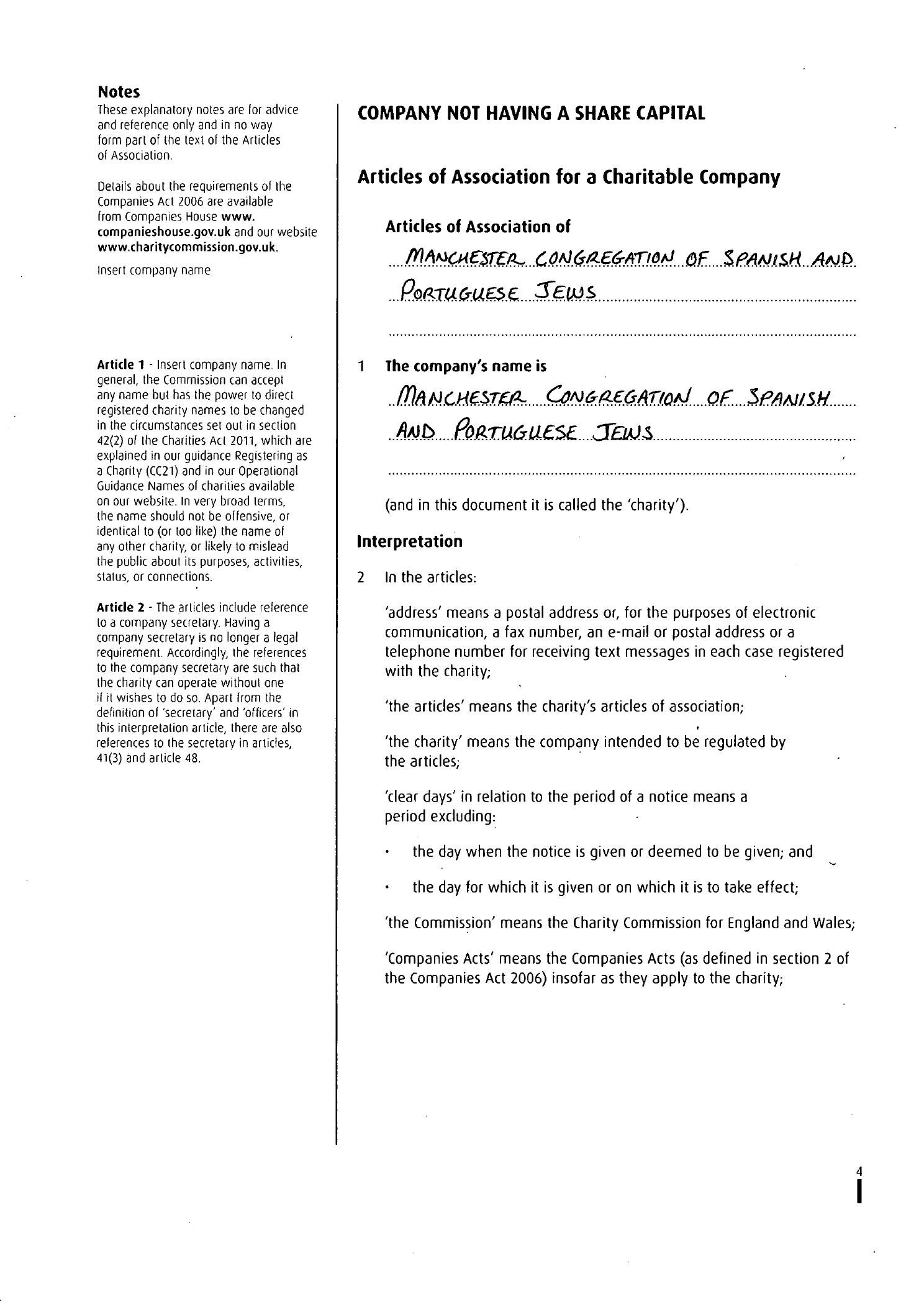
Articles of Association of
. LNASCHESTER.. CONGREGATION OF. SPANISH. AND.
PORTUGUESE... SEWS ..cccssrtsninnntinnininirnnnnnnner
1 The company’s name is .
MANCHESTER... CONGREGATION ..OF... SPAMISH......
| AND... PORTUGUESE. TEWS. octet
(and in this document it is called the ‘charity’).
Interpretation
2 In the articles:
‘address’ means a postal address or, for the purposes of electronic
communication, a fax number, an e-mail or postal address or a
telephone number for receiving text messages in each case registered
with the charity; ;
‘the articles’ means the charity's articles of association;
‘the charity’ means the company intended to be regulated by
the articles; ;
‘clear days’ in relation to the period of a notice means a
period excluding:
+ — the day when the notice is given or deemed to be given; and -
* the day for which it is given or on which it is to take effect;
‘the Commission’ means the Charity Commission for England and Wales;
‘Companies Acts’ means the Companies Acts (as defined in section 2 of
the Companies Act 2006) insofar as they apply to the charity;
|
Units on this page
These are the law/article records that make cross-document comparison possible. The page transcript is the raw proofread text; the unit record is where each law/article is separated, annotated and linked.
Article 1 — Name
Linked Articles / Laws
- No links yet.
Article 2 — Interpretation
Linked Articles / Laws
- No links yet.
Articles of Association — scan page 5 Printed page 5
OCR draft
Main page text
‘the directors’ means the directors of the charity. The directors are

charity trustees as defined by section 177 of the Charities Act 2011;
‘document’ includes, unless otherwise specified, any document sent or

supplied in electronic form;

‘electronic form’ has the meaning given in section 1168 of the

Companies Act 2006;

‘the memorandum’ means the charity's memorandum of association;

‘officers’ includes the directors and the secretary (if any);

‘the seal’ means the common seal of the charity if it has one;

‘secretary’ means any person appointed to perform the duties of the

secretary of the charity;

‘the United Kingdom’ means Great Britain and Northern ireland; and

words importing one gender shall include all genders, and the singular

includes the plural and vice versa.

Unless the context otherwise requires words or expressions contained

in the articles have the same meaning as in the Companies Acts but

excluding any statutory modification not in force when this constitution

becomes binding on the charity.

Apart from the exception mentioned in the previous paragraph a

reference to an Act of Parliament includes any statutory modification or

re-enactment of it for the time being in force.

Liability of members :

3 The liability of the members is limited to a sum not exceeding £10,
being the amount that each member undertakes to contribute to the
assets of the charity in the event of its being wound up while he, she
or it is a member or within one year after he, she or it ceases to be a
member, for:

(1) payment of the charity’s debts and liabilities incurred before he,
she or it ceases to be a member;

(2) payment of the costs, charges and expenses of winding up; and

(3) adjustment of the rights of the contributories among themselves.
Units on this page
These are the law/article records that make cross-document comparison possible. The page transcript is the raw proofread text; the unit record is where each law/article is separated, annotated and linked.
Article 3 — Liability of members
Linked Articles / Laws
- No links yet.
Articles of Association — scan page 6 Printed page 6
OCR draft
Main page text
Objects
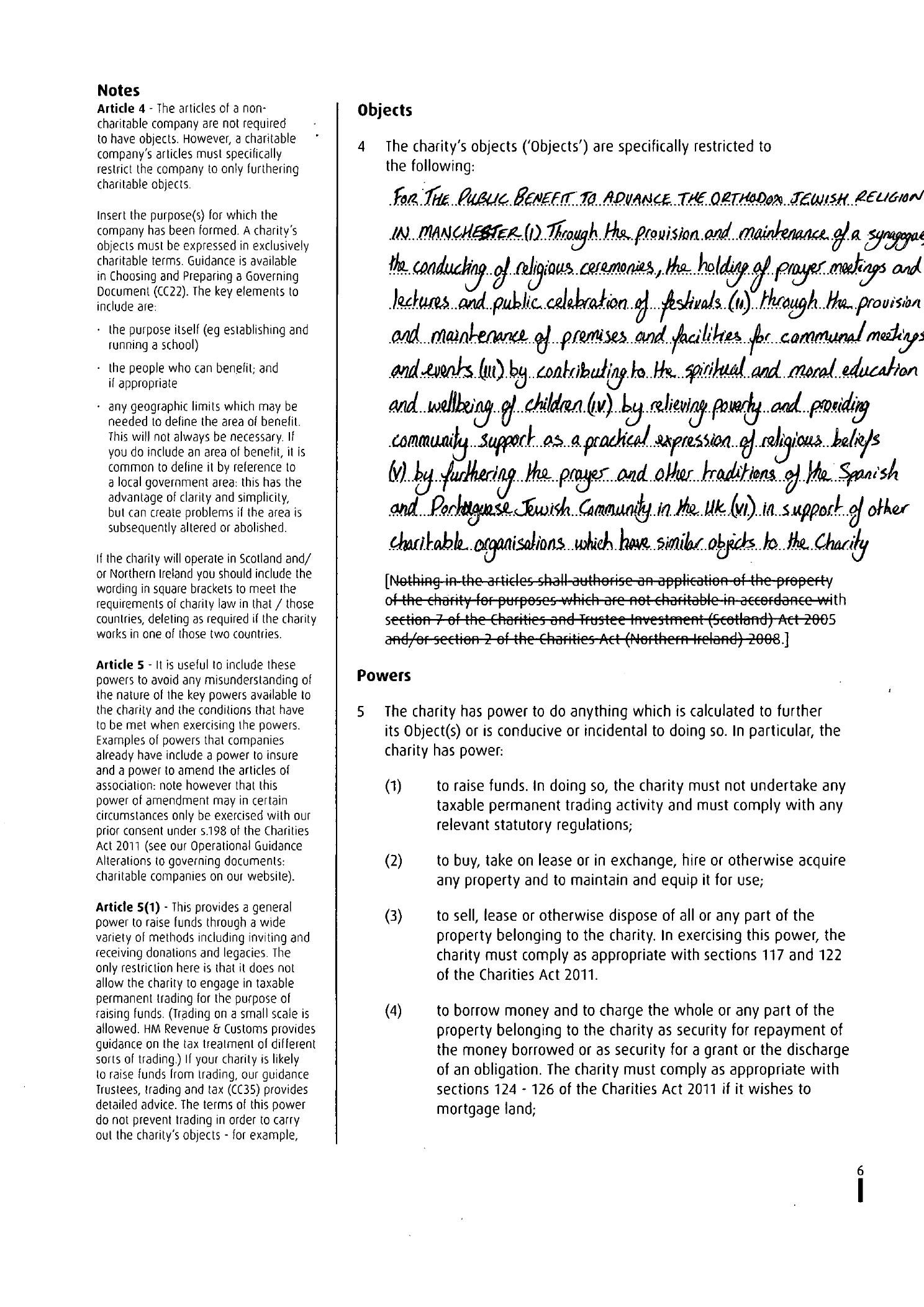
4 The charity’s objects (‘Objects’) are specifically restricted to

the following:

Fon Tie Cullte. BENEEM. 1a. ROUASCE. THE ORTHADeN. TéuusH PE

IN. PANCHEBTER. (1) Through. Fhs. Provision and..Onainkenaace. ofa ;

Me. coaduchip. of Celigaus. ceremonies, He..oldig of pPraspes evel

Keeluses. and. public. calebradion. of. Asliuals.(u). Haugh. Hep

and. oamnkenane. oe]. premises and. jrcililies. foe. communal f

and unas (ut) by. concbading ko. He..spinhead and. crorad ede

and..welleing. of children.) by celienay. pow. .and..proeiditg
commuaily..supeock.0.a prackiced. sapression. of religious. heli

(by. fuchering Hea. ptayer..and. older. kradtions. of He. Sore

and. Feckikqwse. Rwish. Caaauady. ia the. Uk. kv). ta. support. of

Chucitable..otoanisalions. which, have. simibe. obs. ko. He. Chacity
| _ i saaaaiain ; tt SES ri 5 ni arene are mn
y section 7—eHthe-Charittes-and trustee tavestaent-Sseettand) Act 2665
LU b the Chariti ert land ]
: Powers
5 The charity has power to do anything which is calculated to further

its Object(s) or is conducive or incidental to doing so. In particular, the

charity has power:

(1) to raise funds. in doing so, the charity must not undertake any
taxable permanent trading activity and must comply with any
relevant statutory regulations;

(2) to buy, take on lease or in exchange, hire or otherwise acquire
any property and to maintain and equip it for use;

(3) to sell, lease or otherwise dispose of all or any part of the
property belonging to the charity. In exercising this power, the
charity must comply as appropriate with sections 117 and 122
of the Charities Act 2011.

(4) to borrow money and to charge the whole or any part of the

5 property belonging to the charity as security for repayment of

the money borrowed or as security for a grant or the discharge
of an obligation. The charity must comply as appropriate with
sections 124 - 126 of the Charities Act 2011 if it wishes to
mortgage land;
Units on this page
These are the law/article records that make cross-document comparison possible. The page transcript is the raw proofread text; the unit record is where each law/article is separated, annotated and linked.
Article 4 — Objects
Linked Articles / Laws
- No links yet.
Article 5 — Powers
Linked Articles / Laws
- No links yet.
Articles of Association — scan page 7 Printed page 7
OCR draft
Main page text
yf (5) to co-operate with other charities, voluntary bodies and
statutory authorities and to exchange information and advice
with them;
(6) to establish or support any charitable trusts, associations or
institutions formed for any of the charitable purposes included
in the Objects;
(7) to acquire, merge with or to enter into any partnership or joint
s venture arrangement with any other charity;
(8) to set aside income as a reserve against future expenditure but
only in accordance with a written policy about reserves;
(9) to employ and remunerate such staff as are necessary for
carrying out the work of the charity. The charity may employ
or remunerate a director only to the extent it is permitted to do
so by article 7 and provided it complies with the conditions in
that article;
(10) to:
S (a) deposit or invest funds;
, (b) employ a professional fund-manager; and
(c) arrange for the investments or other property of the
charity to be held in the name of a nominee;
in the same manner and subject to the same conditions as the
| trustees of a trust are permitted to do by the Trustee Act 2000;
(11) to provide indemnity insurance for the directors in accordance
with, and subject to the conditions in, section 189 of the
Charities Act 2011;
| (12) to pay out of the funds of the charity the costs of forming and
registering the charity both as a company and as a charity.
$
Application of income and property
6 (1) The income and property of the charity shall be applied solely
towards the promotion of the Objects.
(2) (a) A director is entitled to be reimbursed from the property
- of the charity or may pay out of such property reasonable
expenses properly incurred by him or her when acting on
behalf of the charity.
r (b) A director may benefit from trustee indemnity insurance —
nl cover purchased at the charity’s expense in accordance
with, and subject to the conditions in, section 189 of the
Charities Act 2011.
(c) A director may receive an indemnity from the charity in
the circumstances specified in article 57.
Units on this page
These are the law/article records that make cross-document comparison possible. The page transcript is the raw proofread text; the unit record is where each law/article is separated, annotated and linked.
Article 6 — Application of income and property
Linked Articles / Laws
- No links yet.
Articles of Association — scan page 8 Printed page 8
OCR draft
Main page text
(d) Adirector may not receive any other benefit or payment
| unless it is authorised by article 7.

(3) Subject to article 7, none of the income or property of the
charity may be paid or transferred directly or indirectly by way
of dividend bonus or otherwise by way of profit to any member
of the charity. This does not prevent a member who is not also a
director receiving:

(a) a benefit from the charity in the capacity of a beneficiary
of the charity;

(b) reasonable and proper remuneration for any goods or
services supplied to the charity.

Benefits and payments to charity directors and connected persons
7 @ General provisions
y .

No director or connected person may:

(a) buy any goods or services from the charity on terms

, preferential to those applicable to members of the public;

(b) sell goods, services, or any interest in land to the charity;

(c) be employed by, or receive any remuneration from,

) the charity;
(d) receive any other financial benefit from the charity;
unless the payment is permitted by sub-clause (2) of this article,
or authorised by the court or the prior written consent of the
; Charity Commission has been obtained. -
| In this article a ‘financial benefit’ means a benefit, direct or indirect,
which is either money or has a monetary value.
Scope and powers permitting directors’ or connected persons’ benefits
(2) (a) Adirector or connected person may receive a benefit from
the charity in the capacity of a beneficiary of the charity
provided that a majority of the directors do not benefit in
this way.

(b) A director or connected person may enter into a contract
for the supply of services, or of goods that are supplied in
connection with the provision of services, to the charity
where that is permitted in accordance with, and subject
to the conditions in, sections 185 and 186 of the Charities

; Act 2011.
(c) Subject to sub-clause (3) of this article a director or
s connected person may provide the charity with goods
that are not supplied in connection with services provided
to the charity by the director or connected person.
l
Units on this page
These are the law/article records that make cross-document comparison possible. The page transcript is the raw proofread text; the unit record is where each law/article is separated, annotated and linked.
Article 7 — Benefits and payments
Linked Articles / Laws
- No links yet.
Articles of Association — scan page 9 Printed page 9
OCR draft
Main page text
(d) Adirector of connected person may receive interest on

money ient to the charity at a reasonable and proper rate
4 which must be not more than the Bank of England bank
rate (also known as the base rate).

(e)  Adirector or connected person may receive rent for

| premises let by the director or connected person to the
charity. The amount of the rent and the other terms of
s the lease must be reasonable and proper. The director
concerned must withdraw from any meeting at which
such 2 proposal or the rent or other terms of the lease are
under discussion.

(f) Adirector or connected person may take part in the
normal trading and fundraising activities of the charity on
the same terms as members of the public.

it
. Payment for supply of goods only - controls
(3) The charity and its directors may only rely upon the authority
>f provided by sub-clause (2)(c) of this article if each of the
following conditions is satisfied:

(a) |The amount or maximum amount of the payment for
the goods is set out in an agreement in writing between
the charity or its directors (as the case may be) and the
director or connected person supplying the goods (‘the
supplier’) under which the supplier is to supply the goods

> in question to or on behalf of the charity.
y

(b) The amount or maximum amount of the payment for
the goods does not exceed what is reasonable in the
circumstances for the supply of the goods in question.

(c) The other directors are satisfied that it is in the best
interests of the charity to contract with the supplier rather

than with someone who is not a director or connected
person. In reaching that decision the directors must
balance the advantage of contracting with a director or
connected person against the disadvantages of doing so.

(d) The supplier is absent from the part of any meeting at
which there is discussion of the proposal to enter into a
contract or arrangement with him or her or it with regard
to the supply of goods to the charity.

(e) The supplier does not vote on any such matter and is not
to be counted when calculating whether a quorum of
directors is present at the meeting.

(f) | The reason for their decision is recorded by the directors
in the minute book.

(g) A majority of the directors then in office are not in receipt
of remuneration or payments authorised by article 7.
Units on this page
These are the law/article records that make cross-document comparison possible. The page transcript is the raw proofread text; the unit record is where each law/article is separated, annotated and linked.
No units are currently assigned to this page.
Articles of Association — scan page 10 Printed page 10
OCR draft
Main page text
(4) In sub-clauses (2) and (3) of this article:
(a) ‘charity’ includes any company in which the charity:
(i) holds more than 50% of the shares; or
(ii) controls more than 50% of the voting rights
attached to the shares; or
(iii) has the right to appoint one or more directors to the
board of the company.
(b) ‘connected person’ includes any person within the
definition in article 61 ‘Interpretation’.
; | Declaration of.directors’ interests
8 Adirector must declare the nature and extent of any interest, direct or
A indirect, which he or she has in a proposed transaction or arrangement
with the charity or in any transaction or arrangement entered into by
the charity which has not previously been declared. A director must
absent himself or herself from any discussions of the charity directors

in which it is possible that a conflict will arise between his or her duty

to act solely in the interests of the charity and any personal interest

(including but not limited to any personal financial interest).

Conflicts of interests and conflicts of loyalties
9 (1) If a conflict of interests arises for a director because of a duty of
loyalty owed to another organisation or person and the conflict
is not authorised by virtue of any other provision in the articles,
the unconflicted directors may authorise such a conflict of
interests where the following conditions apply:
(a) the conflicted director is absent from the part of the
meeting at which there is discussion of any arrangement
or transaction affecting that other organisation or person;
(b) the conflicted director does not vote on any such matter
and is not to be counted when considering whether a
quorum of directors is present at the meeting; and
(c). the unconflicted directors consider it is in the interests
of the charity to authorise the conflict of interests in the

| circumstances applying.

(2) In this article a conflict of interests arising because of a duty of
loyalty owed to another organisation or person only refers to
such a conflict which does not involve a direct or indirect benefit

f of any nature to a director or to a connected person.
1
Units on this page
These are the law/article records that make cross-document comparison possible. The page transcript is the raw proofread text; the unit record is where each law/article is separated, annotated and linked.
Article 8 — Declaration of interests
Linked Articles / Laws
- No links yet.
Article 9 — Conflicts of interests and loyalties
Linked Articles / Laws
- No links yet.
Articles of Association — scan page 11 Printed page 11
OCR draft
Main page text
Members
10 (1) The subscribers to the memorandum are the first members of
the charity.
(2) Membership is open to other individuals or organisations who:

(a) apply to the charity in the form required by the
directors; and

(b) are approved by the directors.

(3) (a) The directors may only refuse an application for
. membership if, acting reasonably and properly, they
consider it to be in the best interests of the charity to
refuse the application.

(b) The directors must inform the applicant in writing of
the reasons for the refusal within twenty-one days of
the decision.

(c} The directors must consider any written representations
the applicant may make about the decision. The directors’
decision following any written representations must be
notified to the applicant in writing but shall be final.

(4) Membership is not transferable.
(5) The directors must keep a register of names and addresses of
| the members.
Classes of membership
11 (1) The directors may establish classes of membership with
different rights and obligations and shall record the rights and
5 obligations in the register of members.
(2) The directors may not directly or indirectly alter the rights or
obligations attached to a class of membership.
(3) The rights attached to a class of membership may only be
varied if:

(a) three-quarters of the members of that class consent in
writing to the variation; or

(b) a special resolution is passed at a separate general meeting
of the members of that class agreeing to the variation.

(4) The provisions in the articles about general meetings shall apply
to any meeting relating to the variation of the rights of any class
of members.
Units on this page
These are the law/article records that make cross-document comparison possible. The page transcript is the raw proofread text; the unit record is where each law/article is separated, annotated and linked.
Article 10 — Members
Linked Articles / Laws
- No links yet.
Article 11 — Classes of membership
Linked Articles / Laws
- No links yet.
Articles of Association — scan page 12 Printed page 12
OCR draft
Main page text
Termination of membership
12 Membership is terminated if:

(1) the member dies or, if it is an organisation, ceases to exist;

(2} the member resigns by written notice to the charity unless, after
the resignation, there would be less than two members;

(3) any sum due from the member to the charity is not paid in full
within six months of it falling due;

(4) the member is removed from membership by a resolution of
the directors that it is in the best interests of the charity that his
or her or its membership is terminated. A resolution to remove a
member from membership may only be passed if:

. (a) | the member has been given at least twenty-one days’
notice in writing of the meeting of the directors at which
the resolution will be proposed and the reasons why it is
to be proposed;

(b) the member or, at the option of the member, the
member's representative (who need not be a member of
the charity) has been allowed to make representations to
the meeting.

General meetings .
13 (1) The charity must hold its first annual general meeting within
eighteen months after the date of its incorporation.

(2) An annual general meeting must be held in each subsequent
year and not more than fifteen months may elapse between
successive annual general meetings.

14 The directors may call a general meeting at any time.

Notice of general meetings

15 (1) The minimum periods of notice required to hold a general
meeting of the charity are:

(a) twenty-one clear days for an annual general meeting
or a general meeting called for the passing of a
special resolution;

, (b) fourteen clear days for all other general meetings.

(2) A general meeting may be called by shorter notice if it is so
agreed by a majority in number of members having a right to
attend and vote at the meeting, being a majority who together
hold not less than 90 percent of the total voting rights.

1
Units on this page
These are the law/article records that make cross-document comparison possible. The page transcript is the raw proofread text; the unit record is where each law/article is separated, annotated and linked.
Article 12 — Termination of membership
Linked Articles / Laws
- No links yet.
Article 13 — General meetings
Linked Articles / Laws
- No links yet.
Article 14 — Directors may call general meeting
Linked Articles / Laws
- No links yet.
Article 15 — Notice of general meetings
Linked Articles / Laws
- No links yet.
Articles of Association — scan page 13 Printed page 13
OCR draft
Main page text
(3) The notice must specify the date time and place of the meeting
and the general nature of the business to be transacted. If the
meeting is to be an annual general meeting, the notice must
say so. The notice must also contain a statement setting out the
right of members to appoint a proxy under section 324 of the
Companies Act 2006 and article 22.

(4) The notice must be given to all the members and to the
directors and auditors.

16 The proceedings at a meeting shall not be invalidated because a person
who was entitled to receive notice of the meeting did not receive it
because of an accidental omission by the charity.

Proceedings at general meetings

17 (1) No business shall be transacted at any general meeting unless a

quorum is present.

(2) A quorum is:

(a) [3] members present in person or by proxy and entitled to
vote upon the business to be conducted at the meeting; or

(b) one tenth of the total membership at the time

whichever is the greater.

(3) The authorised representative of a member organisation shall
be counted in the quorum.

18 (1) If:

(a) a quorum is not present within half an hour from the time
appointed for the meeting; or

(b) during a meeting a quorum ceases to be present;

the meeting shall be adjourned to such time and place as the

directors shall determine.

(2) The directors must reconvene the meeting and must give at
least seven clear days’ notice of the reconvened meeting stating
the date, time and place of the meeting.

(3) If no quorum is present at the reconvened meeting within
fifteen minutes of the time specified for the start of the meeting
the members present in person or by proxy at that time shall
constitute the quorum for that meeting.

19 (1) General meetings shall be chaired by the person who has been

appointed to chair meetings of the directors.

(2) If there is no such person or he or she is not present within
fifteen minutes of the time appointed for the meeting a director
nominated by the directors shall chair the meeting.
Units on this page
These are the law/article records that make cross-document comparison possible. The page transcript is the raw proofread text; the unit record is where each law/article is separated, annotated and linked.
Article 16 — Defective notice
Linked Articles / Laws
- No links yet.
Article 17 — Proceedings at general meetings
Linked Articles / Laws
- No links yet.
Article 18 — Quorum
Linked Articles / Laws
- No links yet.
Article 19 — Chairing general meetings
Linked Articles / Laws
- No links yet.
Articles of Association — scan page 14 Printed page 14
OCR draft
Main page text
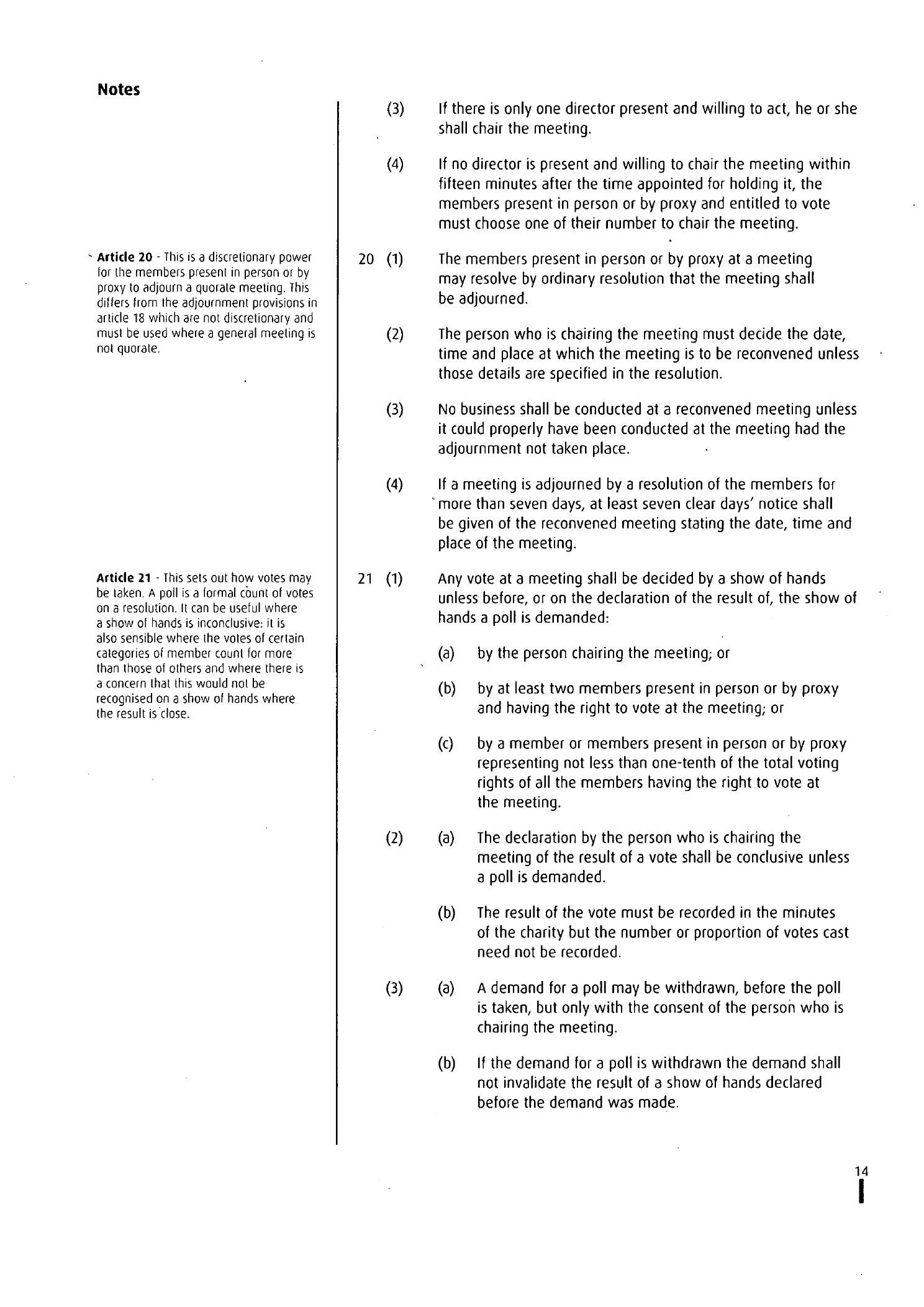
[OCR did not produce readable main text. Please transcribe this page from the scan.]
Units on this page
These are the law/article records that make cross-document comparison possible. The page transcript is the raw proofread text; the unit record is where each law/article is separated, annotated and linked.
Article 20 — No quorum
Linked Articles / Laws
- No links yet.
Article 21 — Voting at general meetings
Linked Articles / Laws
- No links yet.
Articles of Association — scan page 15 Printed page 15
OCR draft
Main page text
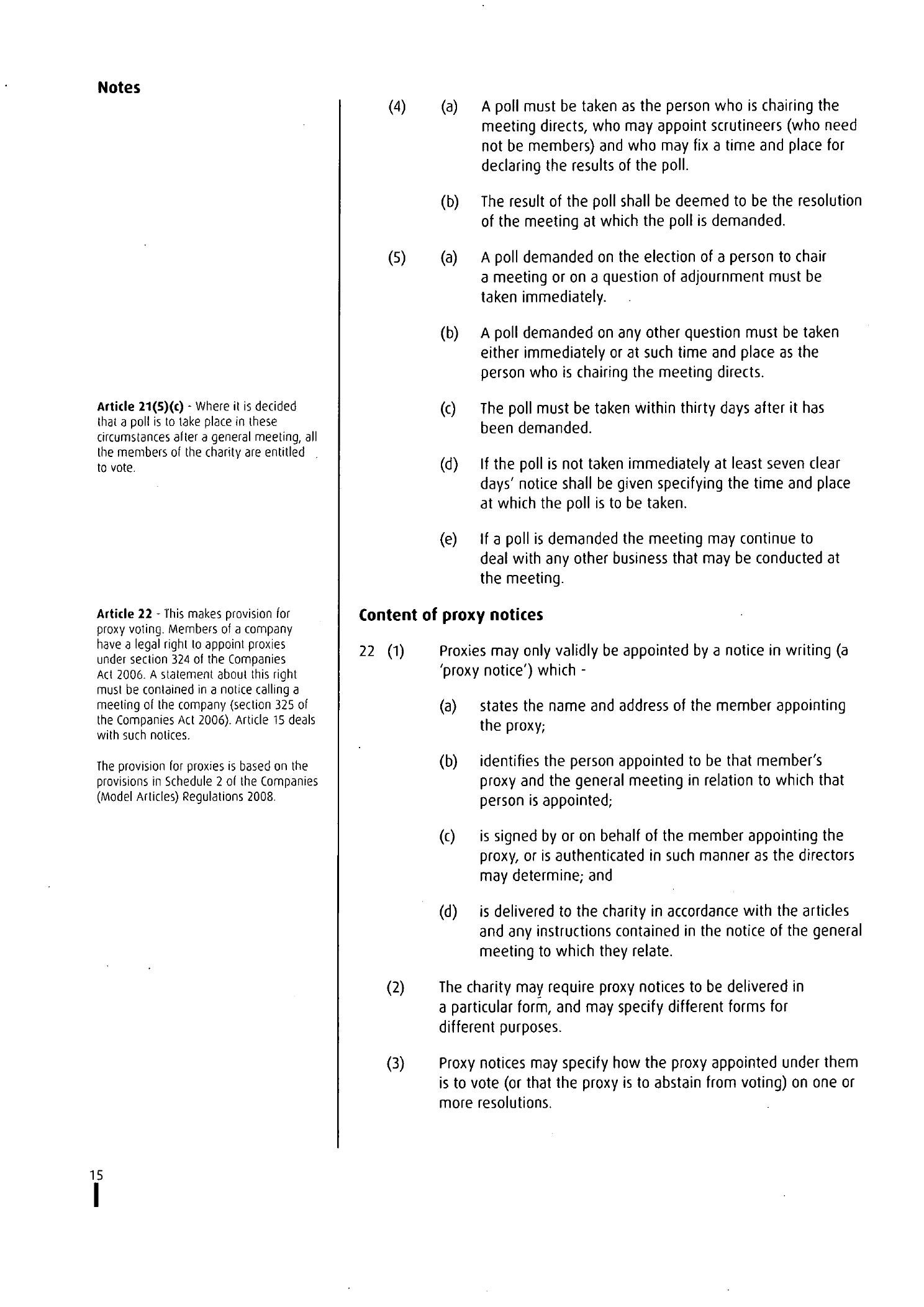
(4) (a) Apoll must be taken as the person who is chairing the
meeting directs, who may appoint scrutineers (who need
not be members) and who may fix a time and place for
declaring the results of the poll.

(b) The result of the poll shall be deemed to be the resolution
of the meeting at which the poll is demanded.

(5) (a) Apoll demanded on the election of a person to chair
a meeting or on a question of adjournment must be
taken immediately.

(b) A poll demanded on any other question must be taken
either immediately or at such time and place as the
person who is chairing the meeting directs.

() The poll must be taken within thirty days after it has

; been demanded.

(d) If the poll is not taken immediately at least seven clear
days’ notice shall be given specifying the time and place
at which the poll is to be taken.

{e) if a poll is demanded the meeting may continue to
deat with any other business that may be conducted at
the meeting.

Content of proxy notices
22 (1) Proxies may only validly be appointed by a notice in writing (a

‘proxy notice’) which -

| (a) states the name and address of the member appointing

, the proxy;

(b) identifies the person appointed to be that member's

5 proxy and the general meeting in relation to which that
person is appointed;

(©) _ is signed by or on behalf of the member appointing the
proxy, or is authenticated in such manner as the directors
may determine; and

~ (d) is delivered to the charity in accordance with the articles
and any instructions contained in the notice of the general
meeting to which they relate.

(2) The charity may require proxy notices to be delivered in

a particular form, and may specify different forms for

different purposes.

(3) Proxy notices may specify haw the proxy appointed under them

is to vote (or that the proxy is to abstain from voting) on one or

more resolutions. .Units on this page
These are the law/article records that make cross-document comparison possible. The page transcript is the raw proofread text; the unit record is where each law/article is separated, annotated and linked.
Article 22 — Proxy notices
Linked Articles / Laws
- No links yet.
Articles of Association — scan page 16 Printed page 16
OCR draft
Main page text
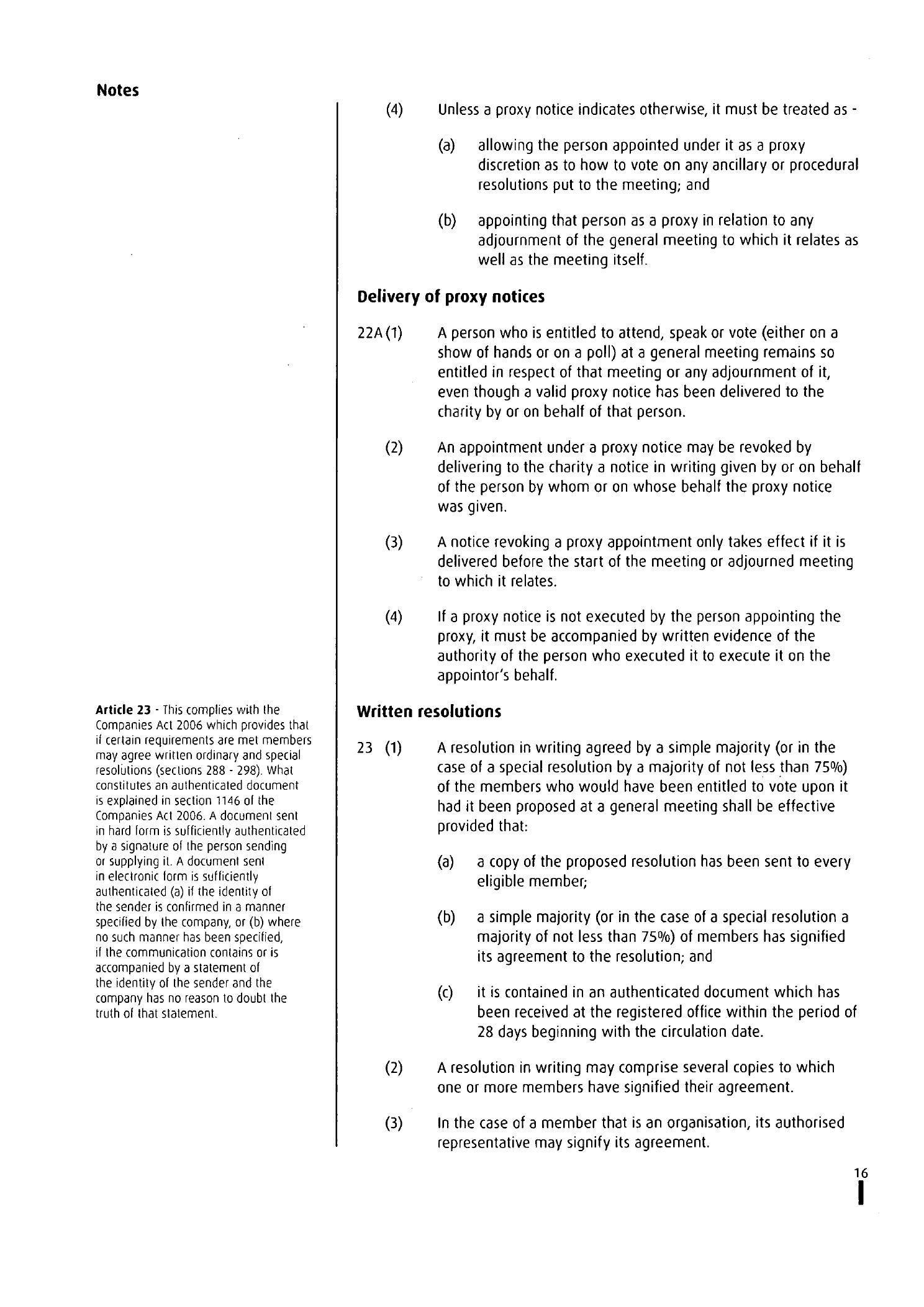
(4) Unless a proxy notice indicates otherwise, it must be treated as -

(2) allowing the person appointed under it as a proxy
discretion as to how to vote on any ancillary or procedural
resolutions put to the meeting; and

(b) appointing that person as a proxy in relation to any
adjournment of the general meeting to which it relates as
well as the meeting itself.

Delivery of proxy notices
22A (1) A person who is entitled to attend, speak or vote (either on a
show of hands or on a poll) at a general meeting remains so
entitled in respect of that meeting or any adjournment of it,
even though a valid proxy notice has been delivered to the
charity by or on behalf of that person.

(2) An appointment under a proxy notice may be revoked by
delivering to the charity a notice in writing given by or on behalt
of the person by whom or on whose behalf the proxy notice
was given.

(3) A notice revoking a proxy appointment only takes effect if it is
delivered before the start of the meeting or adjourned meeting
to which it relates.

(4) If a proxy notice is not executed by the person appointing the
proxy, it must be accompanied by written evidence of the
authority of the person who executed it to execute it on the
appointor’s behalf.

Written resolutions
23 (1) A resolution in writing agreed by a simple majority (or in the

case of a special resolution by a majority of not less than 75%)

of the members who would have been entitled to vote upon it

had it been proposed at a general meeting shall be effective
provided that:

{a) a copy of the proposed resolution has been sent to every
eligible member;

(b) a simple majority (or in the case of a special resolution a
majority of not less than 75%) of members has signified
its agreement to the resolution; and

(Q _ it is contained in an authenticated document which has
been received at the registered office within the period of
28 days beginning with the circulation date.

(2) A resolution in writing may comprise several copies to which
one or more members have signified their agreement.

(3) In the case of a member that is an organisation, its authorised
representative may signify its agreement.

16Units on this page
These are the law/article records that make cross-document comparison possible. The page transcript is the raw proofread text; the unit record is where each law/article is separated, annotated and linked.
Article 22A — Delivery of proxy notices
Linked Articles / Laws
- No links yet.
Article 23 — Written resolutions
Linked Articles / Laws
- No links yet.
Articles of Association — scan page 17 Printed page 17
OCR draft
Main page text
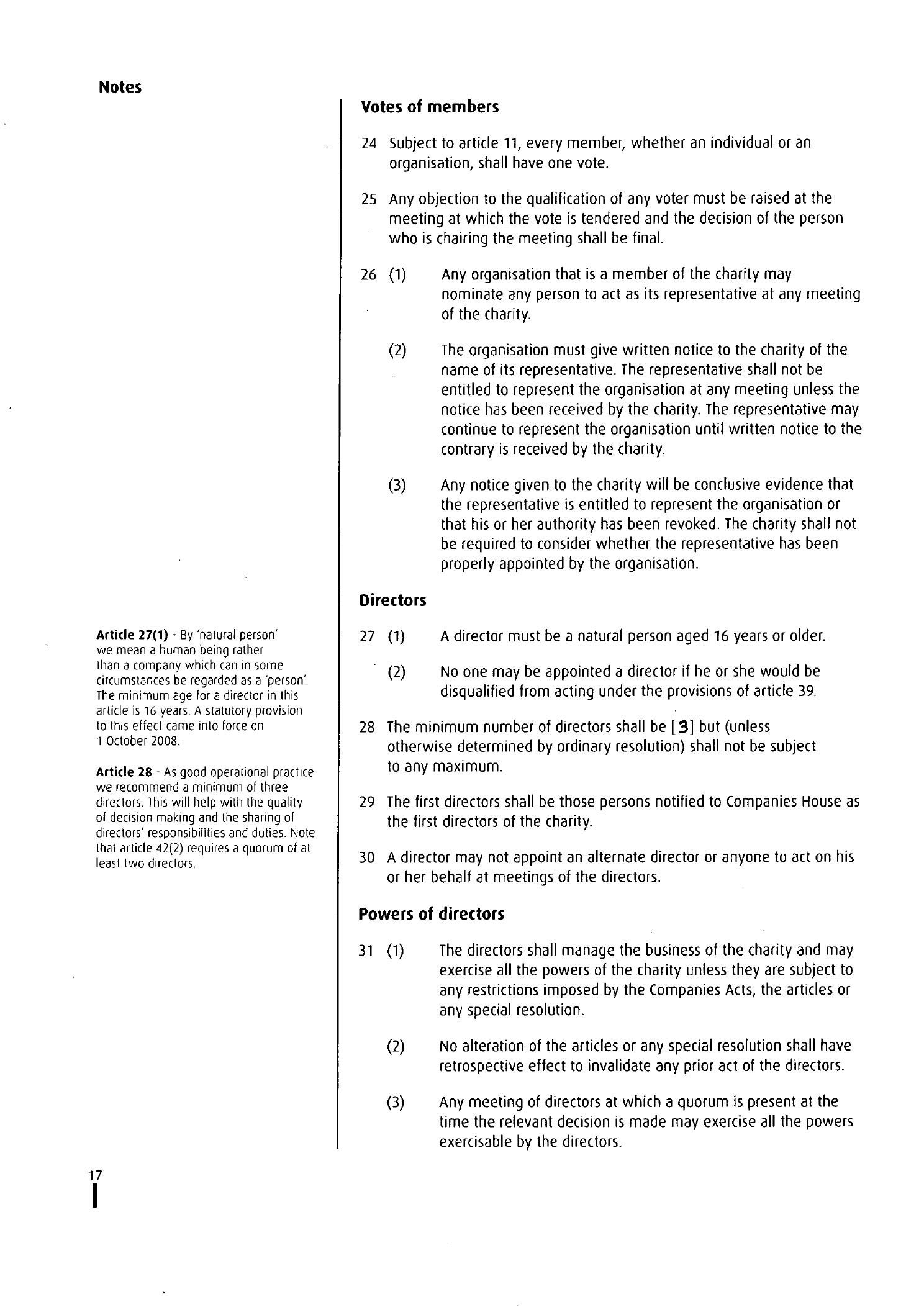
Votes of members
. 24 Subject to article 11, every member, whether an individual or an
organisation, shall have one vote.

25 Any objection to the qualification of any voter must be raised at the
meeting at which the vote is tendered and the decision of the person
who is chairing the meeting shall be final.

26 (1) Any organisation that is a member of the charity may

nominate any person to act as its representative at any meeting

, of the charity.

(2) The organisation must give written notice to the charity of the
name of its representative. The representative shall not be
entitled to represent the organisation at any meeting unless the
notice has been received by the charity. The representative may
continue ta represent the organisation until written notice to the
contrary is received by the charity.

(3) Any notice given to the charity will be conclusive evidence that
the representative is entitled to represent the organisation or
that his or her authority has been revoked. The charity shall not
be required to consider whether the representative has been
properly appointed by the organisation.

Directors

27 (1) A director must be a natural person aged 16 years or older.

~ (2) No one may be appointed a director if he or she would be
disqualified from acting under the provisions of article 39.

28 The minimum number of directors shall be [3] but (unless
otherwise determined by ordinary resolution) shall not be subject
to any maximum.

29 The first directors shall be those persons notified to Companies House as

| the first directors of the charity.

30 A director may not appoint an alternate director or anyone to act on his
or her behalf at meetings of the directors.

Powers of directors

31 (1) The directors shall manage the business of the charity and may

exercise all the powers of the charity unless they are subject to
any restrictions imposed by the Companies Acts, the articles or
any special resolution.

(2) No alteration of the articles or any special resolution shall have
retrospective effect to invalidate any prior act of the directors.

(3) Any meeting of directors at which a quorum is present at the
time the relevant decision is made may exercise all the powers
exercisable by the directors.
Units on this page
These are the law/article records that make cross-document comparison possible. The page transcript is the raw proofread text; the unit record is where each law/article is separated, annotated and linked.
Article 24 — Votes of members
Linked Articles / Laws
- No links yet.
Article 25 — Objections to voting qualifications
Linked Articles / Laws
- No links yet.
Article 26 — Members appointing representatives
Linked Articles / Laws
- No links yet.
Article 27 — Directors must be natural persons
Linked Articles / Laws
- No links yet.
Article 28 — Minimum number of directors
Linked Articles / Laws
- No links yet.
Article 29 — First directors
Linked Articles / Laws
- No links yet.
Article 30 — Alternate directors
Linked Articles / Laws
- No links yet.
Article 31 — Powers of directors
Linked Articles / Laws
- No links yet.
Articles of Association — scan page 18 Printed page 18
OCR draft
Main page text
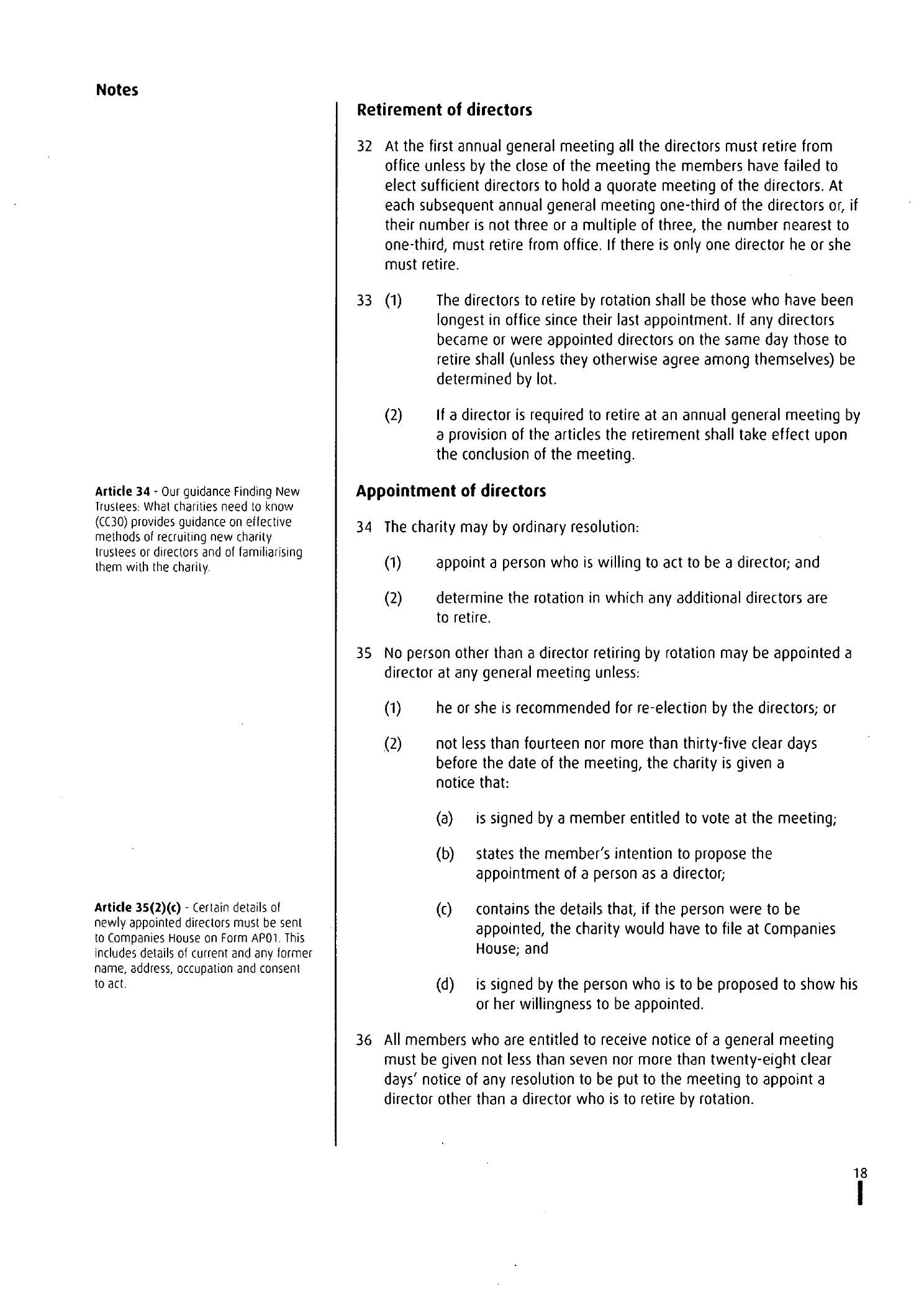
Retirement of directors

32 At the first annual general meeting all the directors must retire from
office unless by the close of the meeting the members have failed to
elect sufficient directors to hold a quorate meeting of the directors. At
each subsequent annual general meeting one-third of the directors or, if
their number is not three or a multiple of three, the number nearest to
one-third, must retire from office. If there ts only one director he or she
must retire.

33 (1) The directors to retire by rotation shall be those who have been
longest in office since their last appointment. If any directors
became or were appointed directors on the same day those to
retire shall (unless they otherwise agree among themselves) be
determined by lot.

(2) If a director is required to retire at an annual general meeting by
a provision of the articles the retirement shall take effect upon
the conclusion of the meeting.

Appointment of directors

34 The charity may by ordinary resolution:

(1) appoint a person who is willing to act to be a director; and
(2) determine the rotation in which any additional directors are
to retire.

35 No person other than a director retiring by rotation may be appointed a
director at any general meeting unless:

(1) he or she is recommended for re-election by the directors; or
(2) not less than fourteen nor more than thirty-five clear days :
before the date of the meeting, the charity is given a
notice that:
(a) _ is signed by a member entitled to vote at the meeting;
(b) states the member's intention to propose the
appointment of a person as a director;
(©) contains the details that, if the person were to be
appointed, the charity would have to file at Companies
House; and
(d) is signed by the person who is to be proposed to show his
or her willingness to be appointed.

36 All members who are entitled to receive notice of a general meeting
must be given not less than seven nor more than twenty-eight clear
days’ notice of any resolution to be put to the meeting to appoint a
director other than a director who is to retire by rotation.

1
Units on this page
These are the law/article records that make cross-document comparison possible. The page transcript is the raw proofread text; the unit record is where each law/article is separated, annotated and linked.
Article 32 — Retirement of directors
Linked Articles / Laws
- No links yet.
Article 33 — Rotation rule
Linked Articles / Laws
- No links yet.
Article 34 — Appointment by ordinary resolution
Linked Articles / Laws
- No links yet.
Article 35 — Nomination of directors
Linked Articles / Laws
- No links yet.
Article 36 — Appointment resolutions
Linked Articles / Laws
- No links yet.
Articles of Association — scan page 19 Printed page 19
OCR draft
Main page text
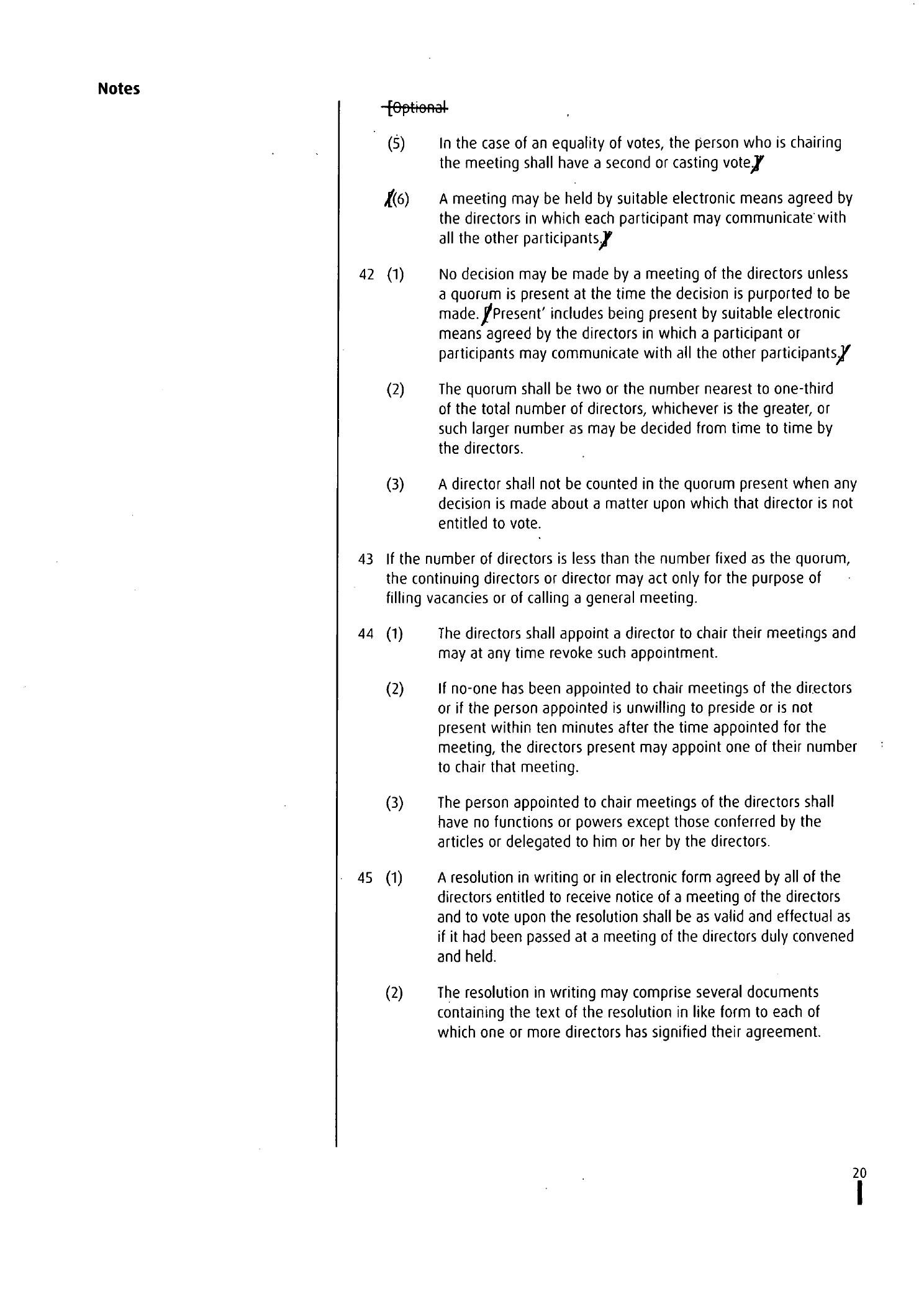
“foptenat ;
~ (8) In the case of an equality of votes, the person who is chairing
the meeting shall have a second or casting vote

ié) — Ameeting may be held by suitable electronic means agreed by
the directors in which each participant may communicate with
all the other participants ¥

42 (1) No decision may be made by a meeting of the directors unless

a quorum is present at the time the decision is purported to be
made. Present’ includes being present by suitable electronic
means agreed by the directors in which a participant or

; participants may communicate with all the other participants ¥

(2) The quorum shall be two of the number nearest to one-third
of the total number of directors, whichever is the greater, or
such larger number as may be decided from time to time by
the directors. ;

(3) A director shail not be counted in the quorum present when any
decision is made about a matter upon which that director is not
entitled to vote.

43 If the number of directors is less than the number fixed as the quorum,
the continuing directors or director may act only for the purpose of —-
filling vacancies or of calling a general meeting.

44 (1) The directors shall appoint a director to chair their meetings and

may at any time revoke such appointment.

(2) If no-one has been appointed to chair meetings of the directors
or if the person appointed is unwilling to preside or is not
present within ten minutes after the time appointed for the
meeting, the directors present may appoint one of their number
to chair that meeting.

Q) The person appointed to chair meetings of the directors shall
have no functions or powers except those conferred by the
articles or delegated to him or her by the directors.

- 45 (1) A resolution in writing or in electronic form agreed by all of the
directors entitled to receive notice of a meeting of the directors
and to vote upon the resolution shall be as valid and effectual as
if it had been passed at a meeting of the directors duly convened
and held.

(2) The resolution in writing may comprise several documents
containing the text of the resolution in like form to each of
which one or more directors has signified their agreement.
Units on this page
These are the law/article records that make cross-document comparison possible. The page transcript is the raw proofread text; the unit record is where each law/article is separated, annotated and linked.
Article 42 — Directors’ meetings quorum
Linked Articles / Laws
- No links yet.
Article 43 — Continuing directors
Linked Articles / Laws
- No links yet.
Article 44 — Appointment of chair
Linked Articles / Laws
- No links yet.
Article 45 — Written directors’ decisions
Linked Articles / Laws
- No links yet.
Articles of Association — scan page 20 Printed page 20
OCR draft
Main page text
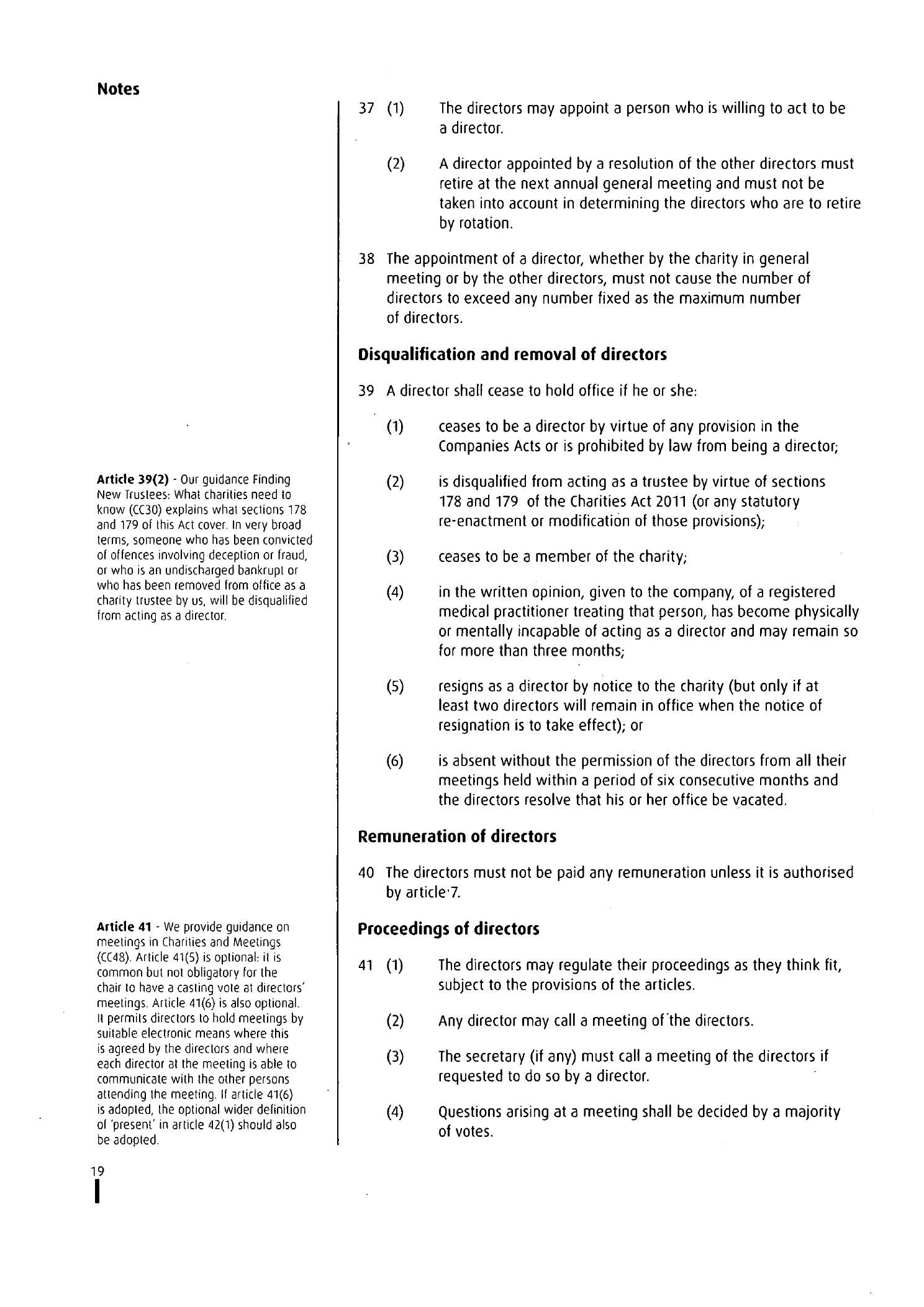
37 (1) The directors may appoint a person who is willing to act to be
a director.

(2) A director appointed by a resolution of the ather directors must
retire at the next annual general meeting and must not be
taken into account in determining the directors who are to retire
by rotation.

38 The appointment of a director, whether by the charity in general
meeting or by the other directors, must not cause the number of
directors to exceed any number fixed as the maximum number
of directors.

Disqualification and removal of directors

39 Adirector shall cease to hold office if he or she:

, (3) ceases to be a director by virtue of any provision in the
. Companies Acts of is prohibited by law from being a director;

(2) is disqualitied from acting as a trustee by virtue of sections
178 and 179 of the Charities Act 2011 (or any statutory
re-enactment or modification of those provisions);

GB) ceases to be a member of the charity;

(4) in the written opinion, given to the company, of a registered
medical practitioner treating that person, has become physically
or mentally incapable of acting as a director and may remain so
for more than three months;

(5) resigns as a director by notice to the charity (but only if at
least two directors will remain in office when the notice of
resignation is to take effect); or

(6) is absent without the permission of the directors from all their
meetings held within a period of six consecutive months and
the directors resolve that his or her office be vacated.

Remuneration of directors

40 The directors must not be paid any remuneration unless it is authorised
by article'7.

Proceedings of directors

41 (1) The directors may requlate their proceedings as they think fit,

subject to the provisions of the articles.

(2) Any director may call a meeting of the directors.

(3) The secretary (if any) must call a meeting of the directors if
requested to do so by a director. .

(4) Questions arising at a meeting shall be decided by a majority
of votes.
Units on this page
These are the law/article records that make cross-document comparison possible. The page transcript is the raw proofread text; the unit record is where each law/article is separated, annotated and linked.
Article 37 — Appointment by directors
Linked Articles / Laws
- No links yet.
Article 38 — Maximum number of directors
Linked Articles / Laws
- No links yet.
Article 39 — Disqualification and removal of directors
Linked Articles / Laws
- No links yet.
Article 40 — Remuneration of directors
Linked Articles / Laws
- No links yet.
Article 41 — Proceedings of directors
Linked Articles / Laws
- No links yet.
Articles of Association — scan page 21 Printed page 21
OCR draft
Main page text
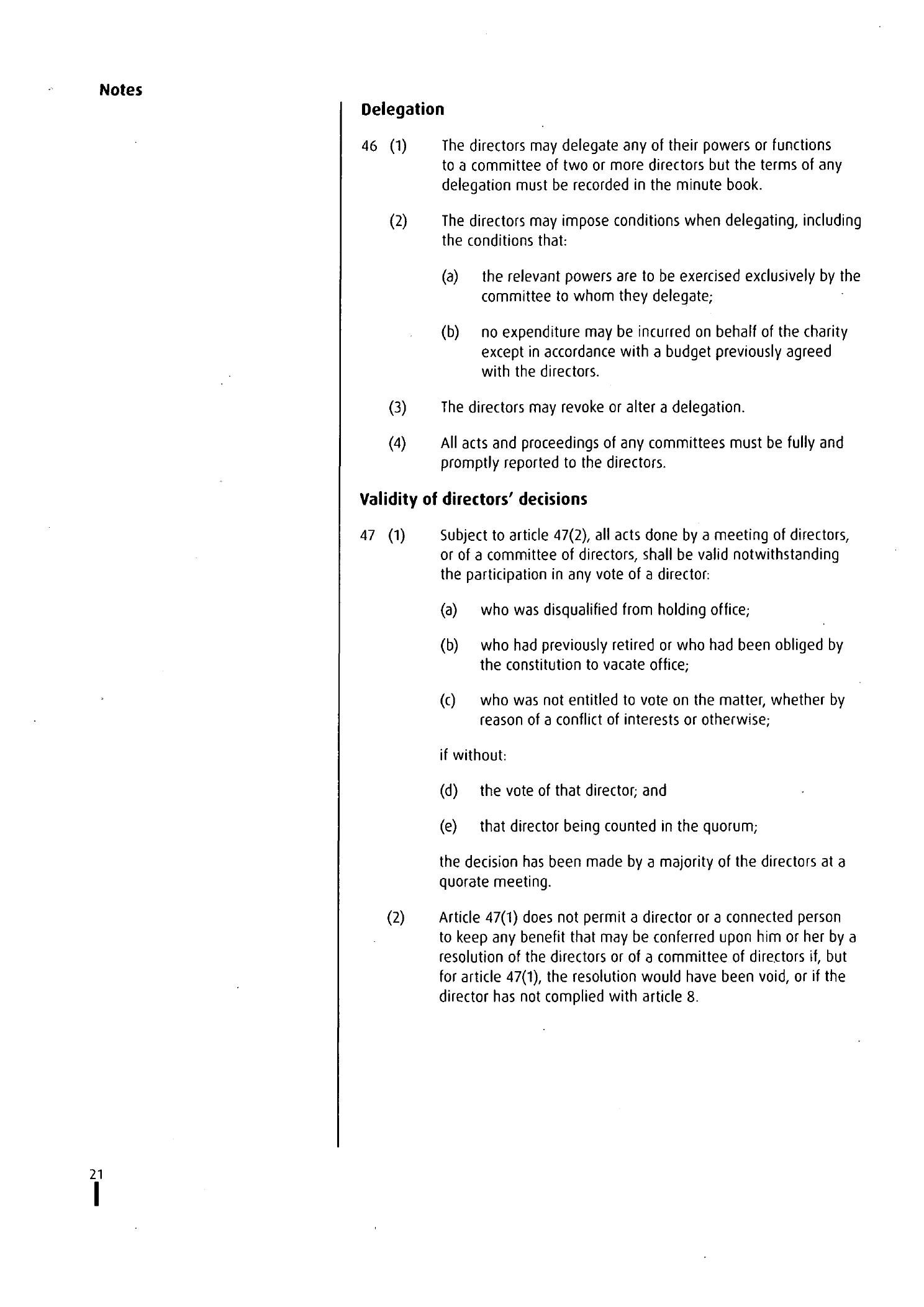
Delegation
46 (1) The directors may delegate any of their powers or functions
to a committee of two or more directors but the terms of any
delegation must be recorded in the minute book.
(2) The directors may impose conditions when delegating, including
the conditions that:
(a) the relevant powers are to be exercised exclusively by the
committee to whom they delegate; :
.  {b) no expenditure may be incurred on behalf of the charity
except in accordance with a budget previously agreed
with the directors.
(3) The directors may revoke or alter a delegation.
(4) All acts and proceedings of any committees must be fully and
promptly reported to the directors.
Validity of directors’ decisions
47 (1) Subject to article 47(2), all acts dane by a meeting of directors,
or of a committee of directors, shall be valid notwithstanding
the participation in any vote of a director:
(a) who was disqualified from holding office;
(b) who had previously retired or who had been obliged by
the constitution to vacate office;
() who was not entitled to vote on the matter, whether by
reason of a conflict of interests or otherwise;
if without:
(d} the vote of that director; and :
(e) _ that director being counted in the quorum;
the decision has been made by a majority of the directors at 3
quorate meeting.
(2) Article 47(1) does not permit a director or a connected person
to keep any benefit that may be conferred upon him or her by a
resolution of the directors or of a committee of directors if, but
for article 47(1), the resolution would have been void, or if the
director has not complied with article 8.Units on this page
These are the law/article records that make cross-document comparison possible. The page transcript is the raw proofread text; the unit record is where each law/article is separated, annotated and linked.
Article 46 — Delegation
Linked Articles / Laws
- No links yet.
Article 47 — Validity of directors’ decisions
Linked Articles / Laws
- No links yet.
Articles of Association — scan page 22 Printed page 22
OCR draft
Main page text
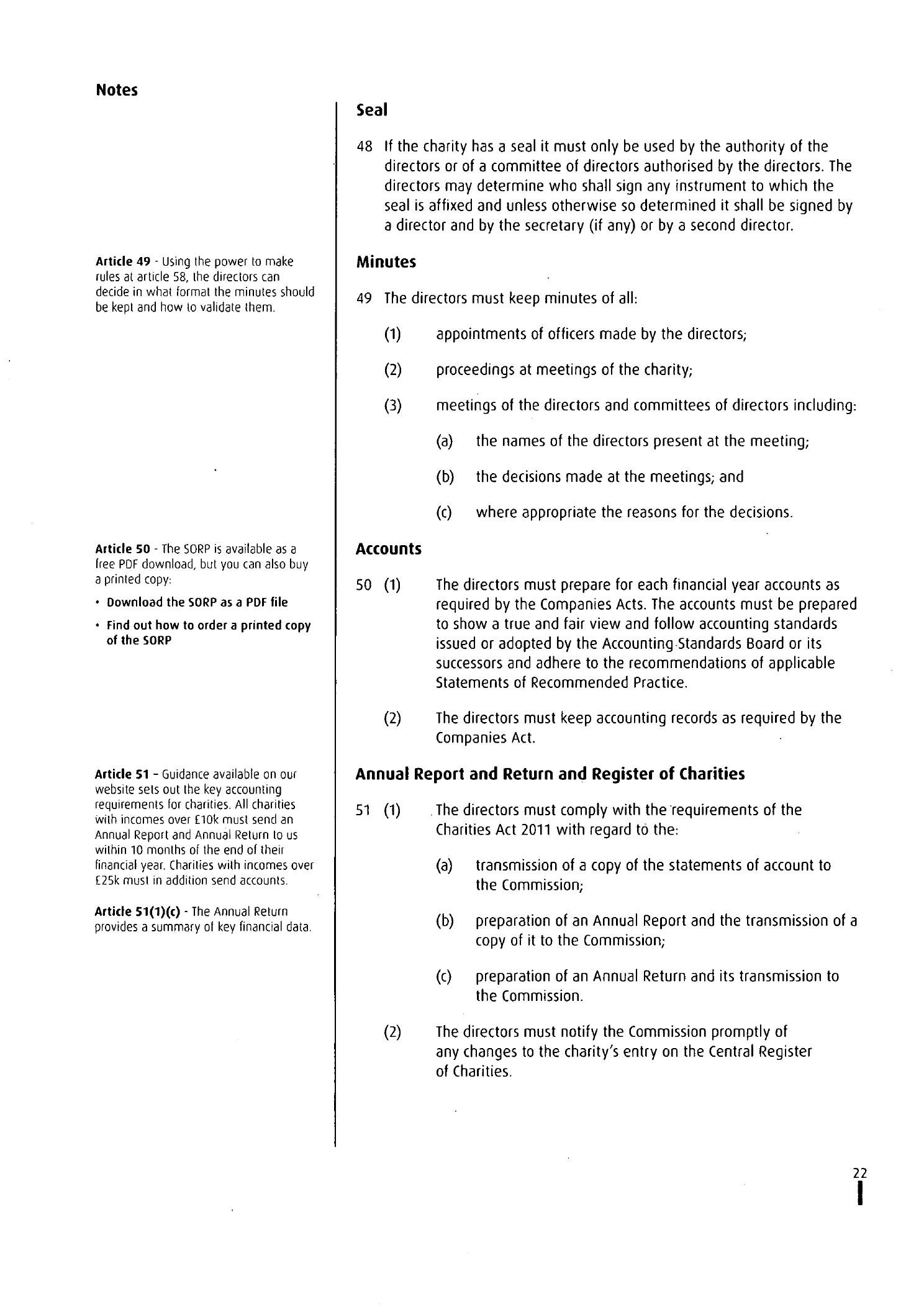
Seal
48 tf the charity has a seal it must only be used by the authority of the
directors or of a committee of directors authorised by the directors. The
ditectors may determine who shall sign any instrument to which the
seal is affixed and unless otherwise so determined it shall be signed by
a director and by the secretary (if any) or by a second director.
Minutes
| 49 The directors must keep minutes of all:
(1) appointments of officers made by the directors;
(2) proceedings at meetings of the charity;
(3) meetings of the directors and committees of directors including:
(a) the names of the directors present at the meeting;
(b} the decisions made at the meetings; and
(c) | where appropriate the reasons for the decisions.
Accounts
50 (1) The directors must prepare for each financial year accounts as
required by the Companies Acts. The accounts must be prepared
to show a true and fair view and follow accounting standards
issued or adopted by the Accounting-Standards Board or its
successors and adhere to the recommendations of applicable
Statements of Recommended Practice.
(2) The directors must keep accounting records as required by the
Companies Act. :
Annual Report and Return and Register of Charities
51 (1) —_ The directors must comply with the requirements of the
Charities Act 2011 with regard to the: ;
(a) transmission of a copy of the statements of account to
the Commission;
(b) preparation of an Annual Repart and the transmission of a
copy of it to the Commission;
(c} — preparation of an Annual Return and its transmission to
the Commission.
(2) The directors must notify the Commission promptly of
any changes to the charity’s entry on the Central Register
of Charities.
1
Units on this page
These are the law/article records that make cross-document comparison possible. The page transcript is the raw proofread text; the unit record is where each law/article is separated, annotated and linked.
Article 48 — Seal
Linked Articles / Laws
- No links yet.
Article 49 — Minutes
Linked Articles / Laws
- No links yet.
Article 50 — Accounts
Linked Articles / Laws
- No links yet.
Article 51 — Annual report and return
Linked Articles / Laws
- No links yet.
Articles of Association — scan page 23 Printed page 23
OCR draft
Main page text
[OCR did not produce readable main text. Please transcribe this page from the scan.]
Units on this page
These are the law/article records that make cross-document comparison possible. The page transcript is the raw proofread text; the unit record is where each law/article is separated, annotated and linked.
Article 52 — Means of communication
Linked Articles / Laws
- No links yet.
Article 53 — Form of notices
Linked Articles / Laws
- No links yet.
Article 54 — Notice to members
Linked Articles / Laws
- No links yet.
Article 55 — Deemed receipt at meeting
Linked Articles / Laws
- No links yet.
Article 56 — Proof of posting
Linked Articles / Laws
- No links yet.
Articles of Association — scan page 24 Printed page 24
OCR draft
Main page text
(3) In accordance with section 1147 of the Companies Act 2006
notice shall be deemed to be given:
(2) 48 hours after the envelope containing it was posted; or
(b) _ in the case of an electronic form of communication, 48
hours after it was sent.
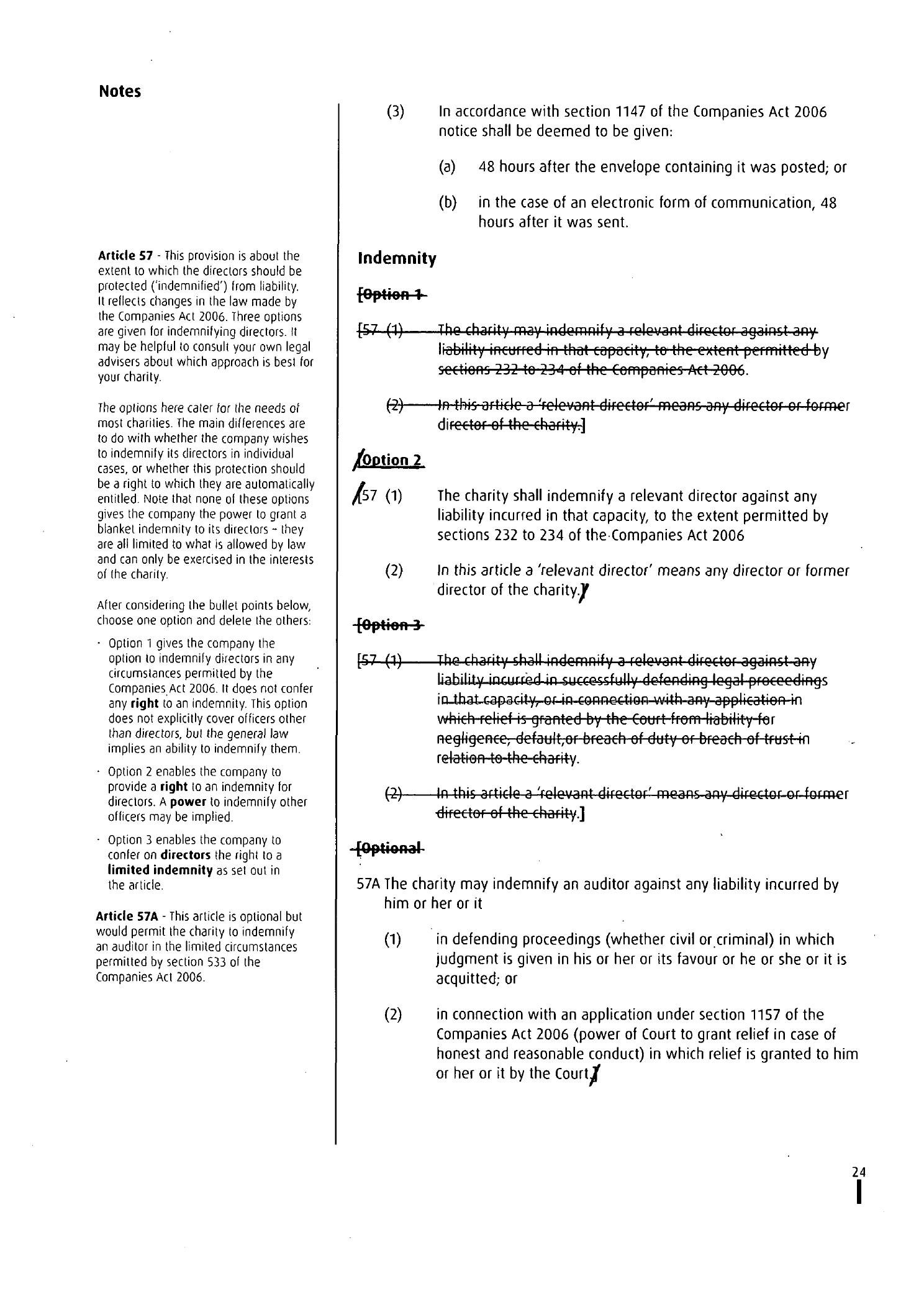
Indemnity
{option
57 (4 The-chari indarait ‘i .
liabilieed Liat! ty Htted-by
director-oHthecharty]
{Option 2
| Asz (1) The charity shall indemnify a relevant director against any
liability incurred in that capacity, to the extent permitted by
sections 232 to 234 of the-Companies Act 2006
(2) In this article a ‘relevant director’ means any director or former
director of the charity, Y
+4eptier3-
| Bie ebay sha ndernnity 2 ielvank director against 2
inthat capacity-o+-in-connection-with-any-application-in
hi te batt fsore-tabitity-fer
{Optional
57A The charity may indemnify an auditor against any liability incurred by
him or her or it
(1) ‘in defending proceedings (whether civil or criminal) in which
judgment is given in his of her or its favour or he or she or it is
acquitted; or
(2) in connection with an application under section 1157 of the
Companies Act 2006 (power of Court to grant relief in case of
honest and reasonable conduct) in which relief is granted to him
or hes or it by the court
]Units on this page
These are the law/article records that make cross-document comparison possible. The page transcript is the raw proofread text; the unit record is where each law/article is separated, annotated and linked.
Article 57 — Indemnity
Linked Articles / Laws
- No links yet.
Article 57A — Indemnity for auditors
Linked Articles / Laws
- No links yet.
Articles of Association — scan page 25 Printed page 25
OCR draft
Main page text
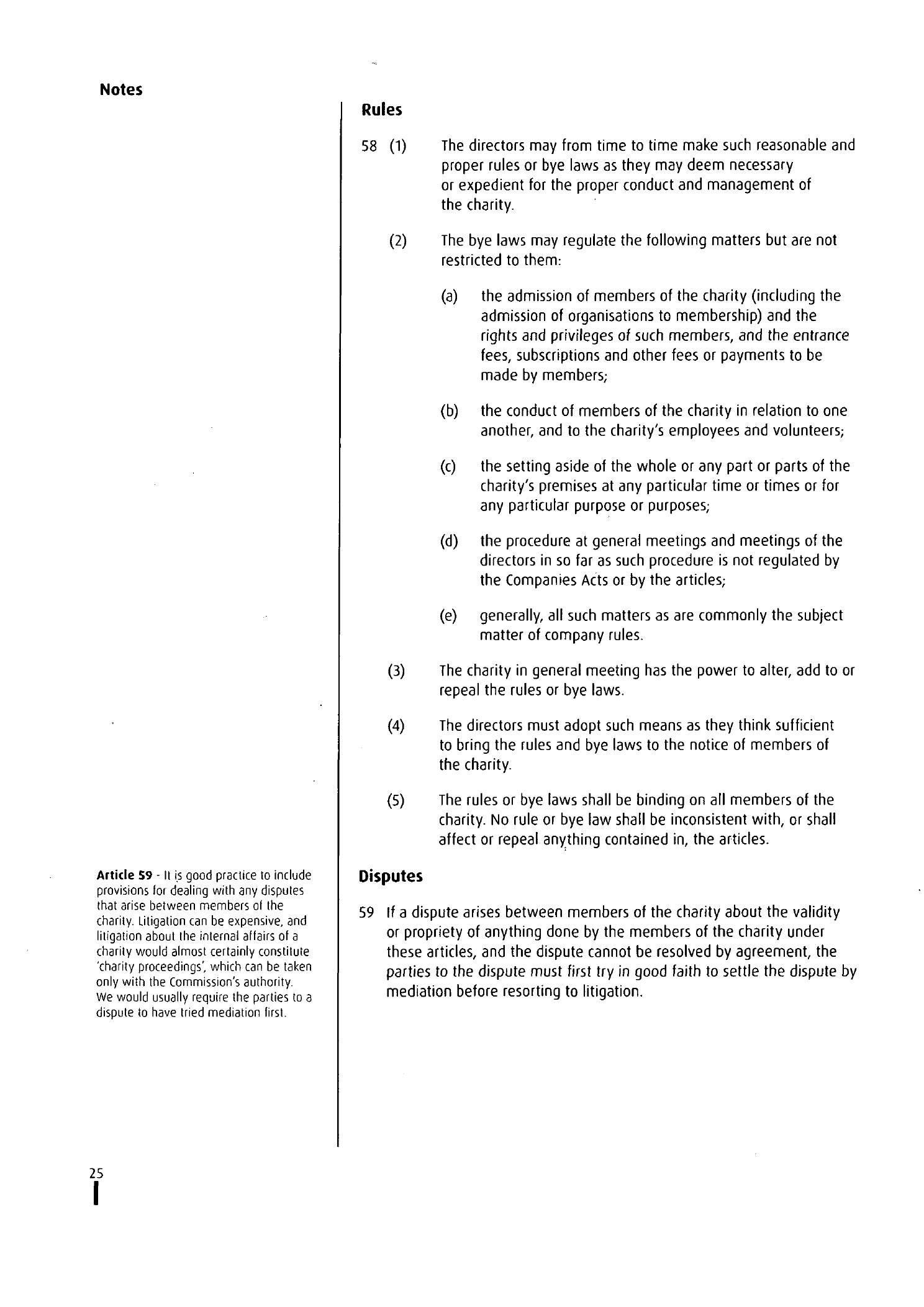
Rules
58 (1) The directors may from time to time make such reasonable and
proper rules or bye laws as they may deem necessary

or expedient for the proper conduct and management of

the charity.

(2) The bye laws may regulate the following matters but are not
restricted to them:

(a) the admission of members of the charity (including the
admission of organisations to membership) and the
tights and privileges of such members, and the entrance
fees, subscriptions and other fees or payments to be
made by members;

(b) the conduct of members of the charity in relation to one
another, and to the charity’s employees and volunteers;

(c) _ the setting aside of the whole or any part or parts of the
charity’s premises at any particular time or times or for
any particular purpose or purposes;

(d) the procedure at general meetings and meetings of the
directors in so far as such procedure is not regulated by
the Companies Acts or by the articles;

(e) generally, alf such matters as are commanly the subject
matter of company rules.

(3) The charity in general meeting has the power to alter, add to or
repeal the rules or bye laws.

(4) The directors must adopt such means as they think sufficient
to bring the rules and bye laws to the notice of members of
the charity.

(5) The rules or bye faws shall be binding on all members of the
charity. No rule or bye faw shall be inconsistent with, or shall
affect or repeal anything contained in, the articles.

Disputes

59 If a dispute arises between members of the charity about the validity
or propriety of anything done by the members of the charity under
these articles, and the dispute cannot be resolved by agreement, the
parties to the dispute must first try in good faith to settle the dispute by
mediation before resorting to litigation.
Units on this page
These are the law/article records that make cross-document comparison possible. The page transcript is the raw proofread text; the unit record is where each law/article is separated, annotated and linked.
Article 58 — Rules
Linked Articles / Laws
- No links yet.
Article 59 — Disputes
Linked Articles / Laws
- No links yet.
Articles of Association — scan page 26 Printed page 26
OCR draft
Main page text
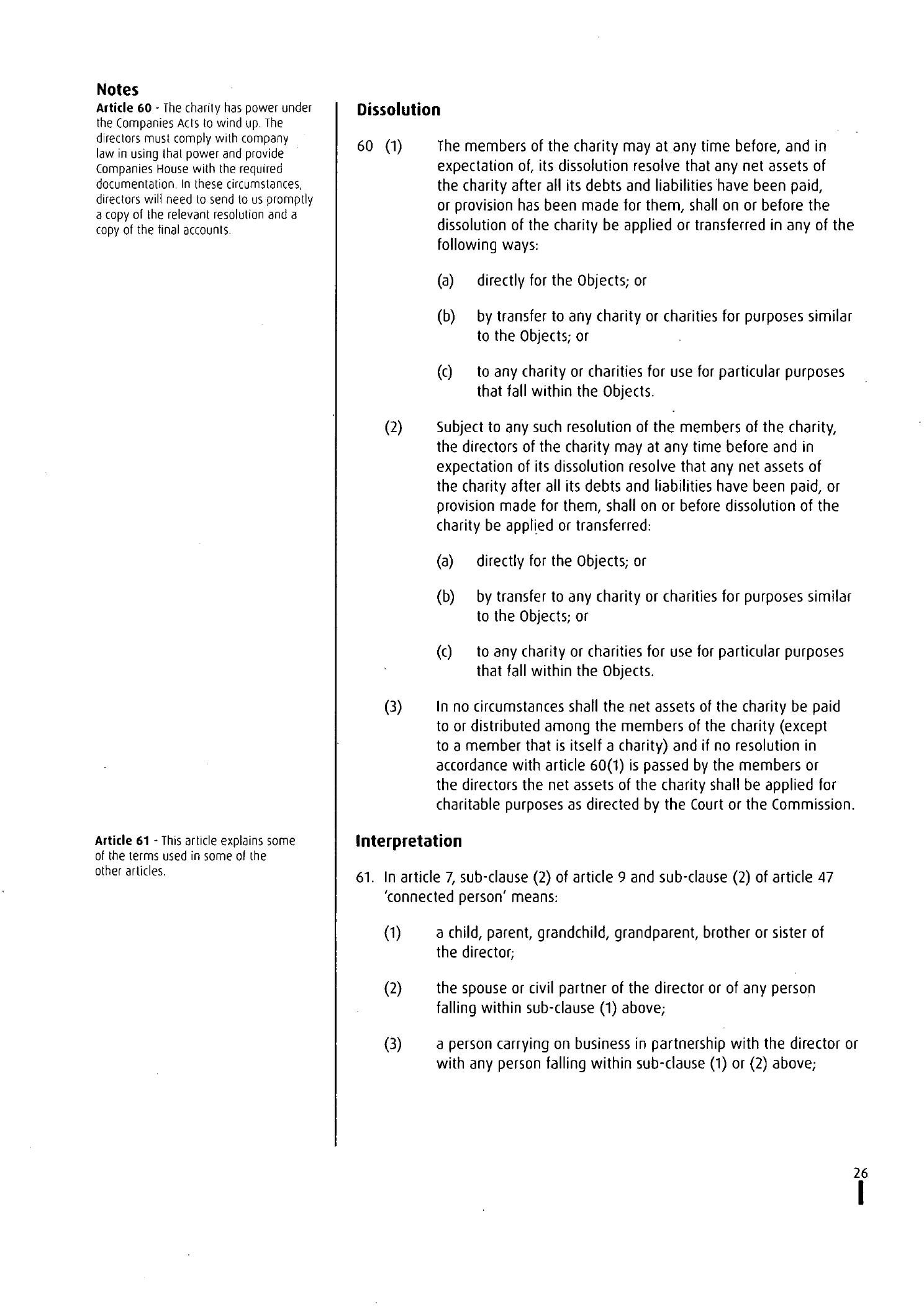
Dissolution
60 (1) The members of the charity may at any time before, and in
expectation of, its dissolution resolve that any net assets of
the charity after all its debts and liabilities have been paid,
of provision has been made for them, shail on or before the
dissolution of the charity be applied or transferred in any of the
following ways:
(a) directly for the Objects; or
(b) by transfer to any charity or charities for purposes similar
to the Objects; or ;
() _ to any charity or charities for use for particular purposes
that fall within the Objects.

(2) Subject to any such resolution of the members of the charity,
the directors of the charity may at any time before and in
expectation of its dissolution resolve that any net assets of
the charity after all its debts and liabilities have been paid, or
provision made for them, shall on or before dissolution of the
charity be applied or transferred:

(a) directly for the Objects; or
(b) by transfer to any charity or charities for purposes similar
to the Objects; or
(c) to any charity or charities for use for particular purposes
that fall within the Objects.
(3) In no circumstances shall the net assets of the charity be paid
to or distributed among the members of the charity (except

to a member that is itself a charity) and if no resolution in
accordance with article 60(1) is passed by the members or
the directors the net assets of the charity shall be applied for
charitable purposes as directed by the Court or the Commission.

Interpretation
61. In article 7, sub-clause (2) of article 9 and sub-clause (2) of article 47
‘connected person’ means:
(1) a child, parent, grandchild, grandparent, brother or sister of
the director;
(2) the spouse or civil partner of the director or of any person
. falling within sub-clause (1) above;
(3) a person carrying on business in partnership with the director or
with any person falling within sub-clause (1) or (2) above;
1
Units on this page
These are the law/article records that make cross-document comparison possible. The page transcript is the raw proofread text; the unit record is where each law/article is separated, annotated and linked.
Article 60 — Dissolution
Linked Articles / Laws
- No links yet.
Article 61 — Interpretation
Linked Articles / Laws
- No links yet.
Articles of Association — scan page 27 Printed page 27
OCR draft

Main page text
(4) an institution which is controlled -
(a) _ by the director or any connected person falling within
sub-clause (1), (2), or (3) above; or
(b) by two or more persons falling within sub-clause 4(a),
when taken together
(5) a body corporate in which ~ .
(a) the director of any connected person falling within sub-
clauses (1) to (3) has a substantial interest; or
(b) two or more persons falling within sub-clause (5)(a) who,
when taken together, have a substantial interest.
(CQ) Sections 350 - 352 of the Charities Act 2011 apply for the
purposes of interpreting the terms used in this article.
Units on this page
These are the law/article records that make cross-document comparison possible. The page transcript is the raw proofread text; the unit record is where each law/article is separated, annotated and linked.
No units are currently assigned to this page.